Investing Basics
Index Funds Explained: A Complete Beginner’s Guide
Index funds explained in plain English: how they work, why they beat most pros, what fees really cost, and a simple plan to start investing this week.
Picture someone like Jordan, a 31-year-old HVAC technician. He’s finally got a little breathing room. His credit card is paid off. He has a few months of expenses tucked away. And there’s an extra $300 a month that keeps sitting in checking, doing nothing.
He knows he should invest it. But every time he opens an app, he freezes. Which stock? What if he picks wrong? A coworker swears by one company. A video online says another is about to crash. So the money just sits there, another month, then another year.
If that sounds familiar, you’re far from alone. And here’s the good news: one of the simplest tools in investing also happens to be one of the most effective. It’s called an index fund. It lets you skip the guessing game entirely. Many experts, including one of the most famous investors alive, have recommended it to regular people for decades.
This guide walks you through all of it, in plain English. By the end, you’ll know exactly what to look for and how to make your first purchase this week.
What you’ll learn in this guide:
- What an index fund is and why it’s different from picking stocks
- Why most professional fund managers fail to beat a simple index fund over time
- How a fee that sounds tiny can cost you tens of thousands of dollars
- The difference between index mutual funds and ETFs, and which might suit you
- The real risks, including how bad a down year can get
- How to pick a good fund and build a simple portfolio with just one to three funds
- A step-by-step plan to get started, plus the mistakes to avoid
Jump to a section:
- What an index fund is, in plain English
- How index funds work behind the scenes
- Why index funds are so hard to beat
- The fee advantage: small numbers, big money
- Types of index funds, and mutual funds vs. ETFs
- The real risks of index funds
- How to pick a good index fund
- How to build a simple index fund portfolio
- Where to hold your index funds
- Your step-by-step action plan
- Common mistakes to avoid
- Myths vs. facts
- Key takeaways
- Frequently asked questions
- Sources
What an index fund is, in plain English
Let’s start with two words you’ll see a lot.
A fund is a big pot of money from lots of investors. A professional company uses that pot to buy many investments at once. When you buy a share of the fund, you own a small slice of everything in the pot.
An index is simply a list of investments that someone uses to measure a part of the market. The most famous one is the S&P 500. It’s a list of about 500 of the largest U.S. companies. (According to Kiplinger, it actually holds 503 stocks.) When the news says “the market was up today,” they usually mean an index like this one.
Put those together and you get an index fund: a fund that buys the investments on an index’s list so it can match that index’s results. The SEC’s investor education site, Investor.gov, explains that you can’t invest in an index directly. An index fund is the way to get the same returns indirectly.
So instead of trying to guess which handful of companies will win, you just buy the whole list. If the S&P 500 goes up 10% in a year, an S&P 500 index fund goes up close to 10%, minus a small fee. If it falls, your fund falls too.


Active vs. passive: the key difference
Most funds fall into one of two camps.
- Actively managed funds pay a manager and a research team to pick investments. Their goal is to beat the market. They buy and sell often, and they charge more to cover all that work.
- Passively managed funds (index funds) just follow the list. Their goal is to match the market, not beat it. They trade much less, so they can charge much less.
Vanguard puts it simply: an index fund is built to keep pace with its benchmark rather than try to outrun it. A benchmark is just the index a fund is measured against.
That might sound like settling for average. As you’ll see in a minute, “average” turns out to beat most of the pros.
A quick bit of history
Index funds aren’t new or trendy. Vanguard says it launched the first retail index fund in 1976. Fifty years later, you can buy index funds through a regular brokerage account, an IRA, and often through your workplace 401(k), as CNBC Select notes.
Ownership of stocks, whether directly or through funds and retirement accounts, is common too. The Federal Reserve’s latest Survey of Consumer Finances found that 56% of U.S. families owned stocks in 2025, either directly or indirectly, down slightly from 58% in 2022. Only 19% owned stocks directly. In other words, most families who own stocks do it through funds and retirement accounts, not by picking individual companies.
How index funds work behind the scenes
You don’t need to understand every gear to use an index fund well. But knowing a few basics will help you read a fund’s description and avoid surprises.
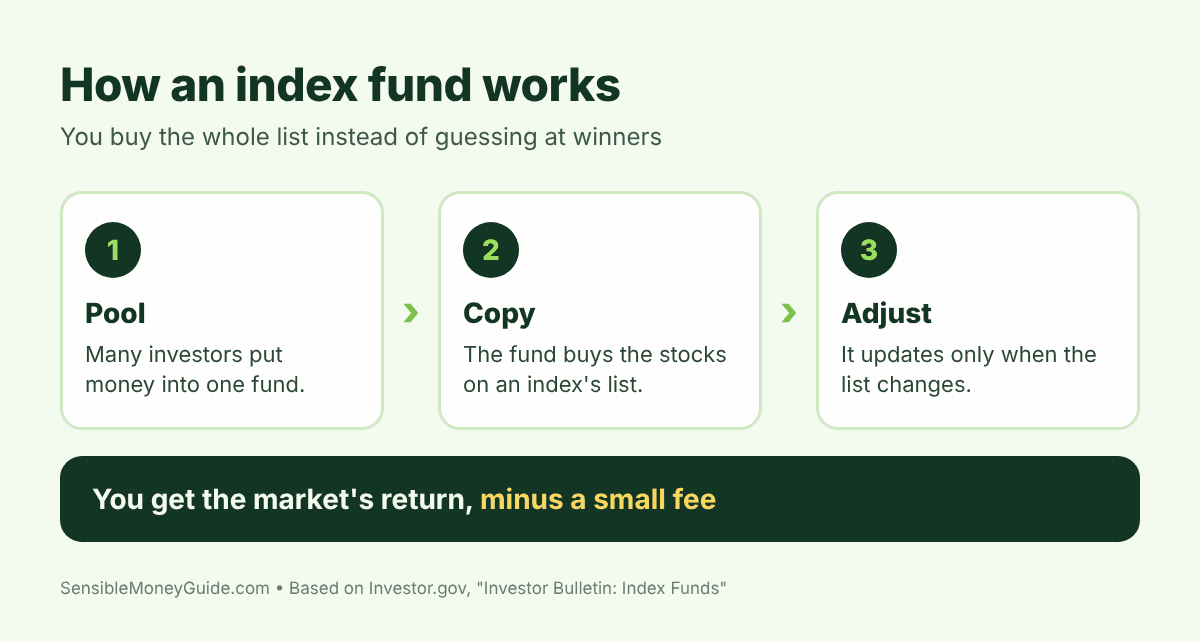
Step 1: Someone builds the index
Companies like S&P Dow Jones Indices, MSCI, FTSE Russell and Bloomberg create indexes. Each one has rules about what gets in. For example, Fidelity notes that the Russell 2000 tracks over 2,000 small U.S. companies, while the Bloomberg US Aggregate Bond Index covers U.S. bonds of all types.
Step 2: The index decides how much of each company to hold
Most indexes are market-cap weighted. Market cap (short for market capitalization) is a company’s total stock value. Bigger companies get a bigger slice of the fund. So a giant tech company might make up several percent of an S&P 500 fund, while a smaller company makes up a tiny sliver.
A few indexes work differently. Investor.gov points out that the Dow Jones Industrial Average is price weighted, meaning companies with higher share prices count more, no matter how big the company is.
Step 3: The fund copies the list
The fund company then buys the securities on the list in the right amounts. Some funds buy every single one. Others buy a representative sample that behaves like the full index. This is common with huge bond indexes that hold thousands of bonds.
Step 4: The fund adjusts when the index changes
Indexes change a few times a year as companies grow, shrink, merge or get dropped. When the list changes, the fund buys and sells to match. That’s about it. There’s no star manager making bold bets.
Step 5: You get the result, minus costs
Your return is the index’s return, minus the fund’s fees and a little bit of tracking error. Tracking error is the small gap between what the index did and what the fund did. It comes from fees, trading costs and the timing of trades. In a well-run index fund, it’s tiny.

Why index funds are so hard to beat
Here’s the part that surprises most people. If you buy an index fund, you’re accepting the market’s return. You’ll never beat it. Yet over long periods, that “average” result beats the large majority of professional fund managers.
We don’t have to guess about this. S&P Dow Jones Indices has tracked it for more than 20 years in a report called the SPIVA U.S. Scorecard. It compares actively managed funds with the index they’re trying to beat.
The year-end 2025 results are hard to argue with. In 2025 alone, 79% of active large-company U.S. stock funds trailed the S&P 500. Stretch the time frame out and it gets worse. Over 20 years, nearly 93% of them fell short.

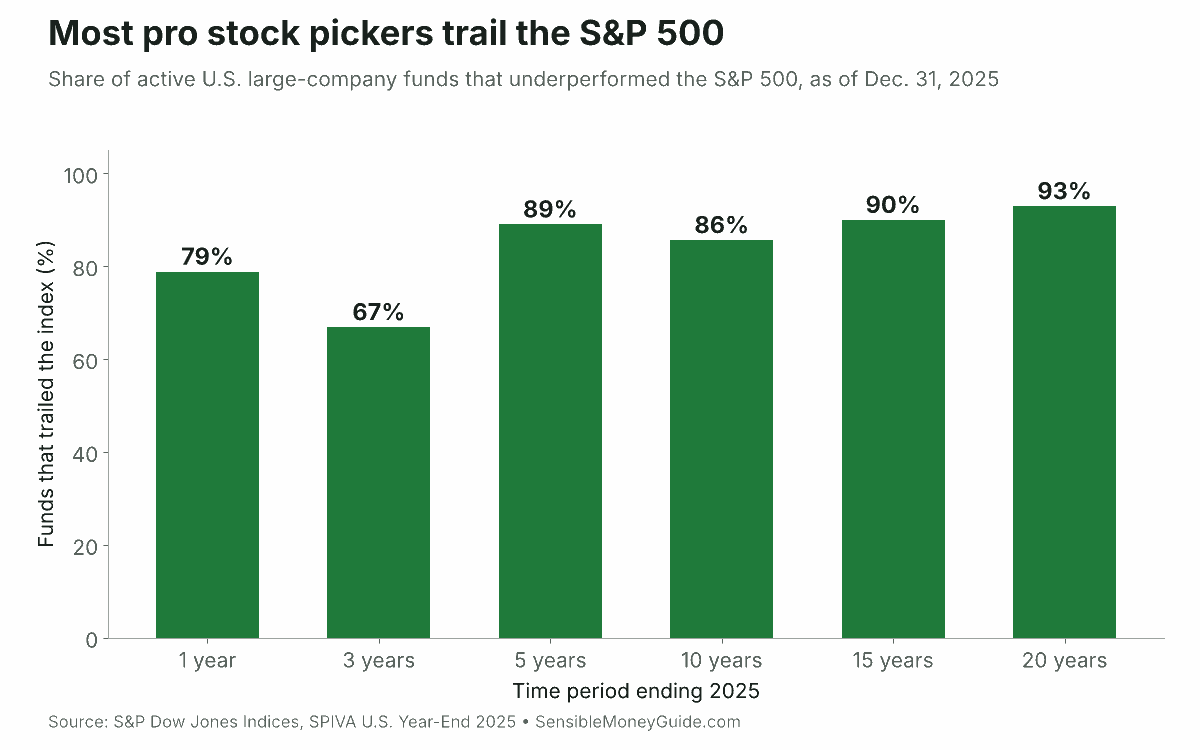
Look closely at that chart and you’ll notice one odd bar. Over three years, “only” about 67% of active funds lost to the index. Short stretches can look better or worse depending on what happened in the market. But the longer the time frame, the clearer the pattern gets. Fewer and fewer active funds keep up.
Why do the pros lose?
It’s not because fund managers aren’t smart. Most are very smart. The problem is math and cost.
- The market is everyone’s average. All investors together own the whole market. So before costs, the average dollar invested earns the market’s return. For one manager to beat it, another has to trail it.
- Costs come off the top. Once you subtract higher fees and trading costs, the average active fund ends up below the market. An index fund’s tiny costs keep it just a hair under the market.
- Winning streaks rarely last. A fund that beats the market for a few years often falls back. It’s very hard to know in advance which managers will be the winners.
Warren Buffett, who built Berkshire Hathaway by picking companies, has given regular investors surprisingly simple advice. In his 2013 letter to shareholders, he described his instructions for money he’d leave to his wife. Put 10% in short-term government bonds and 90% in a “very low-cost S&P 500 index fund.” He wrote that a non-professional’s goal shouldn’t be to pick winners, but to own a cross-section of businesses.
That’s his view, and it fits his situation. Plenty of advisors suggest more bonds and international stocks than his 90/10 split, especially for people nearing retirement. We’ll come back to how to choose your own mix.
Pro tip: You don’t have to choose between “index funds” and “picking stocks” forever. Some people keep most of their money in index funds and a small “fun money” slice, say 5%, for individual stocks they like. That way a bad pick can’t sink your future.
The fee advantage: small numbers, big money
If there’s one idea that makes index funds work, it’s low cost. And fees are the part of investing you can actually control.
What an expense ratio is
Every fund charges a yearly fee called an expense ratio. It’s shown as a percentage of what you have invested. You never get a bill. The fee is quietly taken out of the fund’s value a little at a time.
Here’s what different expense ratios cost each year on $10,000:
| Expense ratio | Yearly cost on $10,000 | Example of who charges this |
|---|---|---|
| 0.015% | $1.50 | Some large S&P 500 index funds |
| 0.04% | $4 | Some large S&P 500 index funds |
| 0.14% | $14 | Average index stock ETF (asset-weighted, 2025) |
| 0.40% | $40 | Average stock mutual fund (asset-weighted, 2025) |
| 1.00% | $100 | Many higher-cost active funds |
The fund examples come from real numbers. NerdWallet, citing Morningstar data as of September 2026, lists S&P 500 index funds from Fidelity, Schwab and Vanguard with expense ratios of 0.015%, 0.02% and 0.04%. Fidelity notes that an actively managed fund might charge 1% or more. The averages come from the Investment Company Institute, the fund industry’s research group.
According to the ICI’s 2025 fee report, the average index stock mutual fund charged just 0.05% in 2025, weighted by how much money is in each fund. The average stock mutual fund of any kind charged 0.40%. Back in 1996, the average stock mutual fund charged 1.04%.
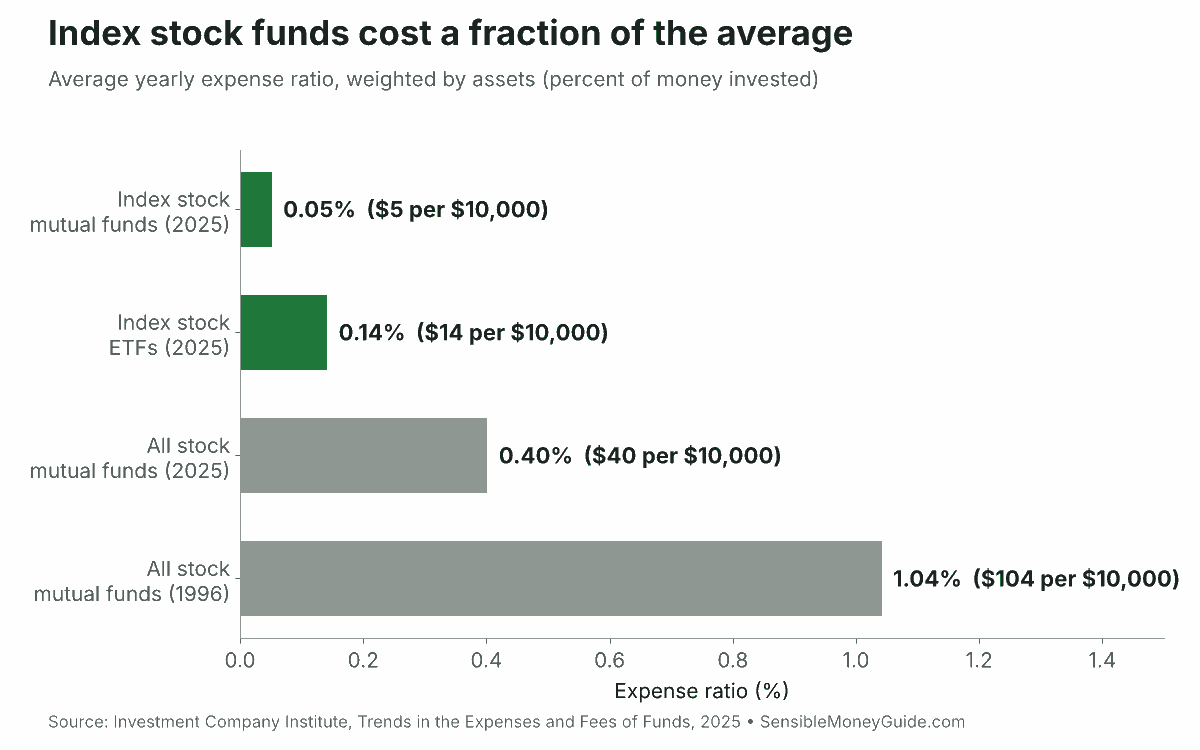
Fees have fallen across the whole industry, too. Morningstar’s yearly fee study found the average fee investors paid across all U.S. funds dropped to 0.32% in 2025, down from 0.80% in 2006. The same study notes that fees on many well-known index funds are near a floor, with many charging less than 0.05%.
Worked example 1: what fees cost over 30 years
A gap of 0.95% a year doesn’t sound like much. Let’s see what it does over a working lifetime.
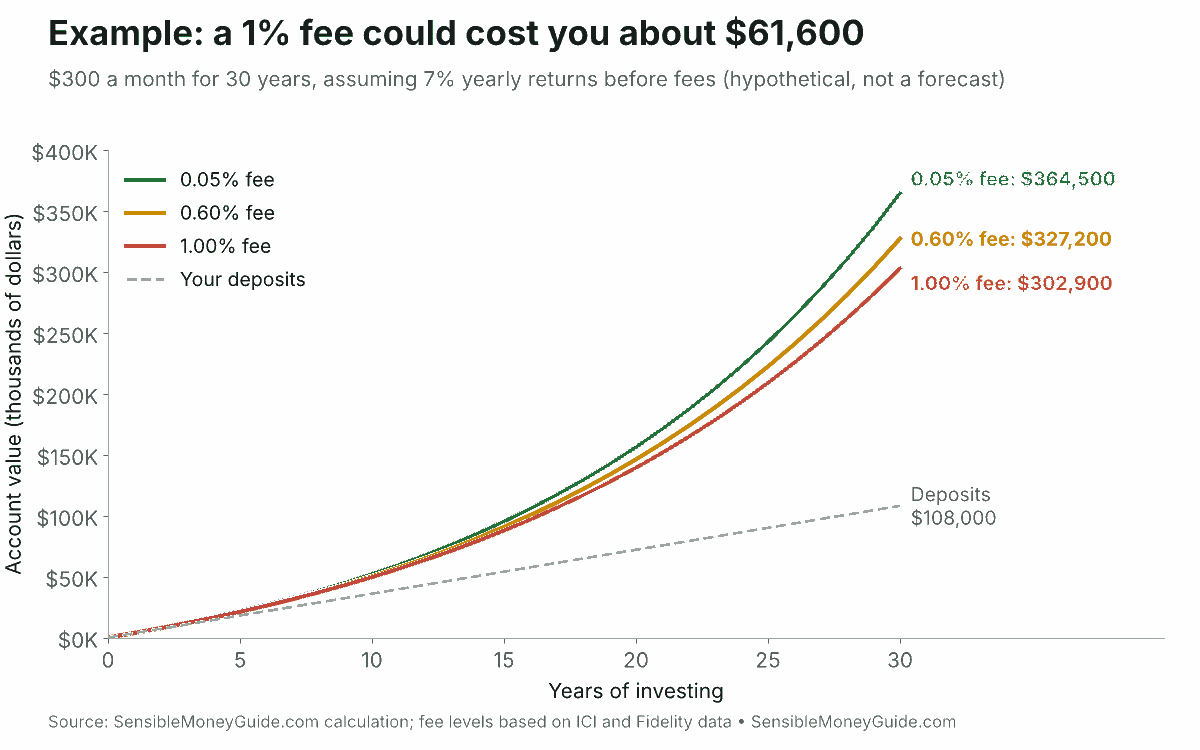
Say you invest $300 a month for 30 years. That’s $108,000 of your own money. We’ll assume the investments earn 7% a year before fees. That’s just an example, not a promise, since real returns bounce around a lot.
- With a 0.05% fee, you’d end up with about $364,500.
- With a 0.60% fee, you’d end up with about $327,200.
- With a 1.00% fee, you’d end up with about $302,900.
That 1% fund costs you about $61,600 compared with the low-cost index fund. Same deposits. Same market. The only difference is the fee.
The SEC makes the same point with its own example. In its bulletin on fees, a $100,000 portfolio grows 4% a year for 20 years. With a 0.25% fee, it ends at about $208,000. With a 1% fee, it ends at only about $179,000. As the SEC puts it, “Over time, even small ongoing fees have a big impact on your investment portfolio.”
Watch out: Low cost isn’t automatic. Investor.gov warns that “not all index funds have lower costs than actively managed funds.” The pricier ones often carry sales charges or are sold through commission-based advisors, so check the fee table and expense ratio before you buy.
Other costs to know about
- Sales loads. A load is a sales commission, sometimes charged when you buy or sell a fund. Most low-cost index funds don’t have one. If you see one, look elsewhere.
- Trading commissions. Many big brokerages now charge $0 to buy and sell ETFs and their own mutual funds online. Some charge a fee to buy another company’s mutual funds, so check first.
- Account fees. A few providers charge yearly account or advisory fees. A robo-advisor, for example, adds its own fee on top of the funds’ expense ratios.
Want to compare the true cost of two funds side by side? FINRA’s free Fund Analyzer lets you pick up to three funds and enter how much you’ll invest and for how long. It then shows how fees and expenses affect what you’d end up with.
Types of index funds, and mutual funds vs. ETFs
There’s an index fund for almost any slice of the market. Most people only need a few of the broad ones. Here are the main types.
The main kinds of index funds
- S&P 500 funds. About 500 of the biggest U.S. companies. Simple and popular.
- Total U.S. stock market funds. Thousands of U.S. companies of every size, big, medium and small. A bit more spread out than the S&P 500.
- International stock funds. Companies based outside the U.S., in places like Europe, Japan and emerging markets.
- Bond index funds. Thousands of bonds, which are loans to governments and companies that pay interest. Bonds usually swing less than stocks and help smooth out the ride.
- Target-date index funds. An all-in-one fund that holds stock and bond index funds and slowly gets more conservative as a target year, usually your retirement year, gets closer.
- Sector and specialty funds. Narrow funds that track one industry, like technology or health care, or a theme. These are riskier and usually not where beginners should start.


S&P 500 or total market?
This is one of the most common beginner questions, and the honest answer is that it doesn’t matter much. Because both are weighted by company size, the biggest companies drive most of the results in either fund. A total market fund adds thousands of smaller companies, which gives you a bit more variety. An S&P 500 fund is a little simpler and very easy to find, often including in 401(k) plans. Either one is a fine core holding. Just don’t buy both and think you’ve doubled your diversification.
Index mutual funds vs. index ETFs
An index fund comes in two “wrappers.” Both can track the same index. The difference is mostly in how you buy and sell them.
An ETF, or exchange-traded fund, trades on a stock exchange like a stock. A mutual fund is bought and sold directly through the fund company, once a day. Here’s how they compare, based on Charles Schwab’s guide and the others cited in this article.
| Feature | Index mutual fund | Index ETF |
|---|---|---|
| When it trades | Once a day, after the market closes. Everyone gets the same price. | All day long, at prices that change minute to minute. |
| Minimum to start | Can be $0 or up to a few thousand dollars, depending on the fund. | The price of one share, or as little as $1 where fractional shares are offered. |
| Buying in dollar amounts | Yes. Easy to invest exactly $300 each month. | Only if your brokerage offers fractional shares. |
| Regular monthly deposits | A natural fit, since you can invest the same dollar amount each time. | Works well where fractional shares are offered. |
| Taxes in a regular account | Can pass along capital gains more often. | Often pass along fewer capital gains. |
| Typical costs | Very low for big index funds. | Very low for big index ETFs. |
So which is better? It honestly depends on how you’ll use it.
- If you want to set up a fixed dollar amount every month and never think about it, an index mutual fund is hard to beat. Schwab notes that mutual funds let you invest the same dollar amount each time.
- If you’re investing in a regular taxable account, or you want no minimum and the freedom to move between brokerages, an ETF is often the better fit. Vanguard says you can buy its ETFs for as little as $1.
Inside a 401(k) or IRA, the tax difference mostly doesn’t matter. Pick whatever is cheapest and easiest for you.
Watch out: A few zero-fee index funds can only be held at the company that runs them. NerdWallet points out that you can’t take those funds with you if you switch brokerages. In a regular account, that could mean selling them and owing taxes on any gains.
The real risks of index funds
Index funds are simple, but they’re not safe in the way a savings account is safe. You need to know the downsides before you put in a dollar.
Risk 1: You get all of the market’s drops
An index fund follows its index down as well as up. There’s no manager who will step in and move to cash when things look scary. Fidelity lists this plainly as a drawback: there’s no downside protection.
How bad can it get? Here are the S&P 500’s yearly total returns, including dividends, from 2000 through 2025, using data compiled by NYU finance professor Aswath Damodaran.
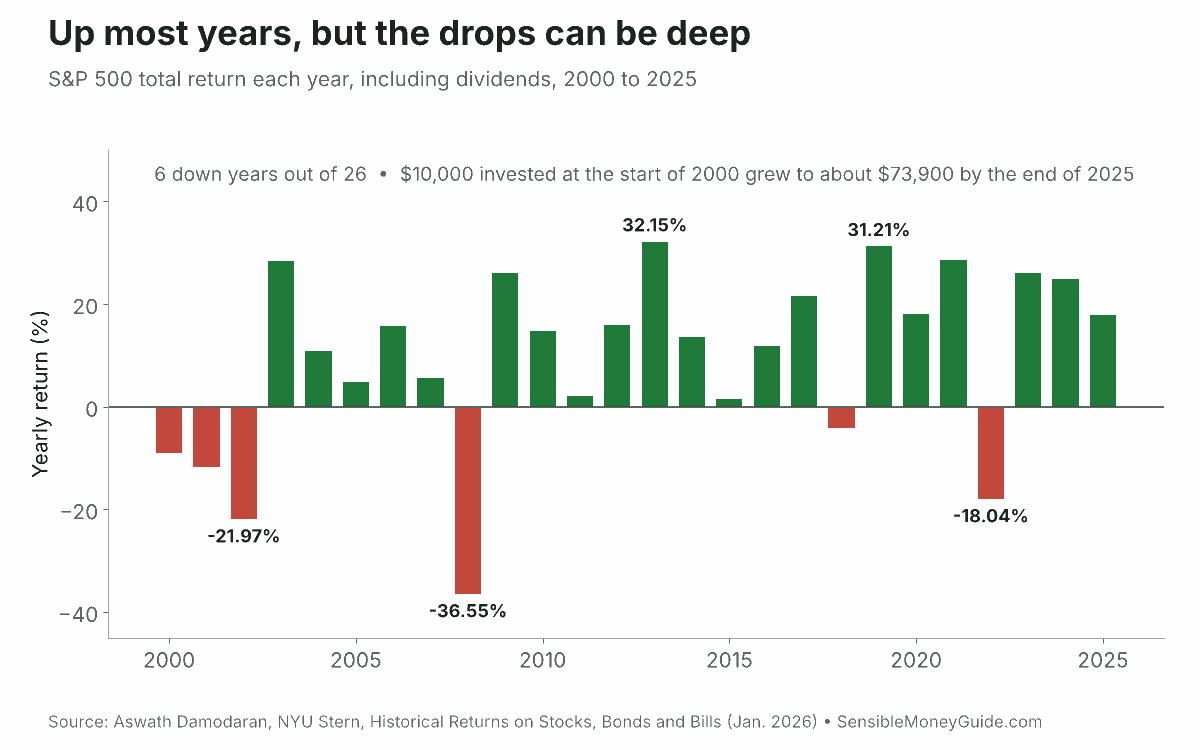
A few things jump out:
- Six of those 26 years were negative. The worst was 2008, when the index lost 36.55%.
- Bad stretches can last. From 2000 through 2009, the S&P 500 lost about 0.95% a year on average, including dividends. $10,000 invested at the start of 2000 was worth about $9,100 ten years later.
- Patience paid off anyway. That same $10,000, held from the start of 2000 through the end of 2025, grew to about $73,900. That’s roughly 8% a year, even though it started with one of the worst decades for stocks in modern history.
Over a much longer period, Fidelity notes the S&P 500 has averaged over 10% a year since 1957, before inflation, taxes and fees. But averages hide the bumps. You have to be able to sit through a year like 2008 without selling.
Risk 2: Your money isn’t insured
Funds are investments, not bank deposits. Even if you buy an index fund through your bank, it isn’t a deposit, so FDIC deposit insurance doesn’t cover it. You can lose money. Vanguard’s own page states that all investing carries risk, including the possible loss of the money you invest.
That’s why money you’ll need soon belongs somewhere else. NerdWallet suggests index funds for long-term goals like retirement, and savings accounts, CDs or money market funds for short-term needs. If you don’t have a cushion yet, start with our emergency fund guide before you invest.
Risk 3: Big companies can dominate the fund
Because most indexes are weighted by company size, a few giant companies can make up a big share of your fund. When those companies stumble, your fund feels it. Holding a total market fund and an international fund alongside an S&P 500 fund spreads that risk out.
Risk 4: Narrow funds can swing wildly
Not every index fund is broad. A fund that tracks one industry or one country is still an index fund, but it carries much more risk. Vanguard warns that sector funds face the risk of bigger price swings, and that small and mid-size company stocks often move more than large ones.
Risk 5: Small tracking gaps and taxes
A fund may not match its index exactly. That’s tracking error, and it’s usually tiny in big, low-cost funds. In a regular taxable account, funds can also pay out dividends and capital gains that you owe tax on each year, even if you didn’t sell anything.
What index funds don’t protect you from
Index funds take away the risk of picking the wrong company. They don’t take away the risk of the whole market falling. They also can’t protect you from your own reactions. The biggest danger for most index investors isn’t the fund. It’s selling in a panic after a big drop and missing the recovery.
How to pick a good index fund
Once you know which part of the market you want, choosing a specific fund is easier than it looks. Two S&P 500 funds from different companies hold nearly the same stocks. So you’re mostly comparing cost and convenience.

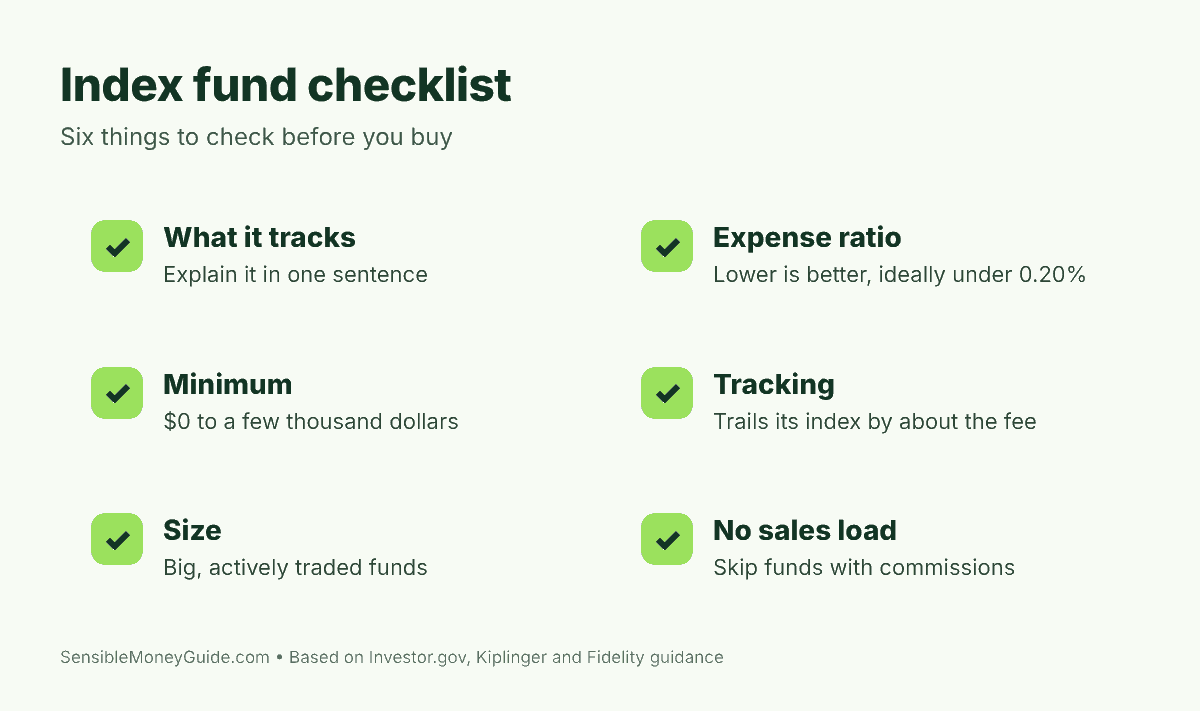
1. Know what it tracks
Read the fund’s name and its one-line objective. “Tracks the S&P 500” or “seeks to track the performance of the total U.S. stock market” tells you a lot. If you can’t explain in one sentence what the fund owns, skip it.
2. Check the expense ratio
For broad stock index funds, lower is better, and you can often find funds under 0.10%. Kiplinger suggests looking for expense ratios under 0.2%. For a plain S&P 500 or total market fund, many big providers charge far less than that.
3. Look at the minimum
Some index mutual funds ask for $1,000 or more to start. Many have no minimum. ETFs usually only require the price of one share, or less if fractional shares are offered. Fidelity notes some index funds let you start with as little as $1 or $5.
4. See how closely it tracks
Compare the fund’s returns with its index over 5 and 10 years. A good index fund should trail the index by about its expense ratio, and not much more.
5. Check size and trading volume
Kiplinger also suggests checking a fund’s size and trading volume. Big, popular funds tend to trade smoothly. Tiny funds with little trading can be harder to buy and sell at a fair price, and they’re more likely to close.
6. Skim the documents
Investor.gov recommends reading a fund’s prospectus and its latest shareholder report. The prospectus is the fund’s official description of what it owns, how it works and what it costs. You don’t have to read every word. Focus on the fees table, the strategy summary and the main risks.
Putting it together: comparing two funds
Here’s a made-up example to show how the checklist works. Say your brokerage shows two funds that both track the S&P 500.
- Fund A charges 0.03%, has no minimum and no sales load, and trailed its index by about 0.03% a year over 10 years.
- Fund B charges 0.45%, asks for $2,500 to start, and trailed its index by about 0.47% a year.
Both hold the same companies. On a $25,000 balance, Fund A costs about $7.50 a year and Fund B about $112.50. Fund B isn’t doing anything extra for that money. Fund A is the easy pick.
Notice what you didn’t need: a forecast, a hot tip or a guess about which companies will win next year.
How to build a simple index fund portfolio
A portfolio is just everything you’ve invested, taken together. With index funds, you can build a strong one with one, two or three funds. Here are three common approaches.
Option 1: The one-fund portfolio
A target-date index fund does everything for you. You pick the fund with the year closest to when you plan to retire, like a 2060 fund if you’re in your early 30s. It holds U.S. stocks, international stocks and bonds, and it shifts toward more bonds over time. You never have to rebalance.
The trade-off: you get the fund company’s idea of the right mix, not your own. And target-date funds cost a bit more than the cheapest single index funds, though index-based versions are still low cost.
Option 2: The two- or three-fund portfolio
This is a favorite of do-it-yourself investors. You hold:
- a total U.S. stock market index fund,
- a total international stock index fund, and
- a total U.S. bond market index fund.
You choose how much goes in each. A younger investor with decades to go might choose mostly stocks. Someone close to retirement might hold much more in bonds. Some people skip international and use just two funds.
Option 3: A robo-advisor
A robo-advisor is an online service that builds and manages a portfolio of index funds for you. It bases the mix on a short quiz about your goals and comfort with risk. CNBC Select notes that robo-advisors can also rebalance automatically. You’ll usually pay a small yearly fee on top of the funds’ own costs.
How much in stocks vs. bonds?
There’s no single right answer, and experts disagree. Warren Buffett’s 90/10 stock-and-bond split is one view. Target-date funds take another: they start mostly in stocks for young workers and add bonds year by year as retirement nears. What matters most is a mix you’ll stick with in a year like 2008.
A simple test: imagine your account dropped by a third in a year. If that would make you sell, hold more bonds. If you’d shrug and keep investing, you can probably handle more stocks.


Worked example 2: rebalancing
Rebalancing means moving money around to get back to the mix you chose. Here’s how it works.
Say you have $20,000 invested: 70% in a stock index fund ($14,000) and 30% in a bond index fund ($6,000). Over the next year, stocks rise 25% and bonds rise 2%.
- Stocks are now worth $17,500.
- Bonds are now worth $6,120.
- Your total is $23,620, and stocks are now about 74% of it.
To get back to 70%, you’d want $16,534 in stocks. So you’d move about $966 from stocks to bonds, or simply send your next few deposits to bonds instead. Once a year is plenty for most people.
Rebalancing feels backward because you’re trimming what did well. But it keeps your risk where you want it, and it makes you buy low and sell high in a calm, rules-based way.
Worked example 3: dollar-cost averaging
Investor.gov defines dollar-cost averaging as investing equal amounts at regular intervals, no matter what the market is doing. It’s what happens automatically when you invest part of every paycheck.
Imagine you invest $200 a month for five months in a fund whose price moves around like this:
| Month | Price per share | Amount invested | Shares bought |
|---|---|---|---|
| 1 | $50 | $200 | 4 |
| 2 | $40 | $200 | 5 |
| 3 | $25 | $200 | 8 |
| 4 | $40 | $200 | 5 |
| 5 | $50 | $200 | 4 |
| Total | $1,000 | 26 |
You paid an average of about $38.46 per share ($1,000 divided by 26 shares), even though the average price was $41. Why? Your fixed $200 bought more shares when prices were low. And at the end, with the price back at $50, your 26 shares are worth $1,300.
Dollar-cost averaging doesn’t guarantee a profit. If prices keep falling, you’ll still lose money. But it takes the timing question off your plate, and it turns scary drops into sales.
Want a quick visual recap of the basics? Watch “What The Heck Is An Index Fund?” from Two Cents, a personal finance series from PBS.

Where to hold your index funds
The fund is what you buy. The account is where it lives. The account type decides how your money is taxed, and that can matter as much as the fund you pick.
Your workplace 401(k) or 403(b)
If your employer offers a retirement plan, look at its fund list for anything with “index” in the name, or a target-date index series. If there’s an employer match, contribute at least enough to get all of it. A match is free money.
For 2026, the IRS says you can put up to $24,500 into a 401(k). If you’re 50 or older, you can add $8,000 more in catch-up contributions. People aged 60 to 63 can add $11,250 instead.
An IRA
An IRA (individual retirement account) is one you open yourself at a brokerage. You pick from nearly any index fund or ETF. For 2026, the IRS limit is $7,500, plus an extra $1,100 if you’re 50 or older.
There are two main kinds. A traditional IRA may give you a tax break now, and you pay tax when you take the money out. A Roth IRA gives no break now, but qualified withdrawals in retirement are tax-free. Income limits and other rules apply, so check the details before you choose.
A regular brokerage account
A taxable brokerage account has no contribution limits and no special rules about when you can take money out. The catch is that you’ll owe taxes on dividends and on gains when you sell. This is where low-turnover index funds and tax-efficient ETFs really shine.

Worked example 4: maxing out an IRA
The 2026 IRA limit of $7,500 works out to $625 a month. If you put $625 a month into a low-cost index fund for 30 years, and it earned 7% a year before a 0.05% fee, you’d have about $759,000. You’d have put in $225,000 yourself. The rest would be growth. Again, real returns won’t be a smooth 7%, and future limits will likely change, but the example shows how steady deposits add up.
Your step-by-step action plan
Here’s the whole process, start to finish. Most people can do steps 1 through 6 in an afternoon.
- Cover the basics first. Before you invest, have some emergency savings and a plan for any high-interest debt. Paying off a credit card charging 20% or more is a guaranteed return no fund can promise. Our guide to paying off credit card debt can help.
- Pick a monthly amount. Look at your budget and choose a number you can keep up, even if it’s $50. Consistency matters more than size. If you need help finding the money, start with our guide to making a budget that works.
- Grab any employer match. If your job offers a 401(k) match, sign up and choose an index or target-date index fund from the plan’s list.
- Choose an account. If you’re investing beyond your 401(k), open an IRA, usually a Roth IRA if you qualify, or a regular brokerage account at a large, low-cost brokerage.
- Choose your fund or funds. Keep it simple: one target-date index fund, or a two- or three-fund mix of broad U.S. stock, international stock and bond index funds.
- Check the expense ratio. Aim for well under 0.20% for broad index funds. Use FINRA’s Fund Analyzer if you want to compare.
- Set up automatic deposits. Schedule a transfer for the day after payday, and turn on automatic investing so the cash actually buys shares. Money that sits as cash in an account isn’t invested.
- Reinvest dividends. Turn on dividend reinvestment so the small payouts buy more shares automatically.
- Leave it alone. Check in once or twice a year, not daily. Rebalance about once a year if your mix has drifted.
- Raise your amount over time. Each time you get a raise, bump your monthly investment by a little. You won’t miss money you never got used to spending.
What this could look like for Jordan
Let’s go back to our hypothetical HVAC tech. Jordan’s employer offers a 401(k) with a match, so he starts there and picks the plan’s target-date index fund. Then he opens a Roth IRA at a big brokerage and sets up $300 a month into a total U.S. stock market index fund with an expense ratio under 0.05%.
He turns on automatic investing and dividend reinvestment, deletes the trading app from his phone’s home screen, and puts a reminder on his calendar for one check-in each January. That’s the whole plan.
If his investments earned 7% a year before fees, our fee example shows his $300 a month could grow to about $364,500 in 30 years. Real markets won’t deliver a smooth 7%, and some years will hurt. But Jordan doesn’t have to pick a single stock, follow the news or guess what happens next. He just has to keep going.
Common mistakes to avoid
Index investing is simple. That doesn’t mean it’s foolproof. These are the mistakes that trip people up most often.
Selling after a big drop
This is the costliest mistake by far. When the market falls 20% or 30%, it feels like the smart move is to get out. But selling locks in the loss, and recoveries can come quickly. After the S&P 500 lost 36.55% in 2008, it gained 25.94% in 2009. Anyone who sold near the bottom missed that rebound.
Paying too much for an “index” fund
Two funds can track the same index and charge wildly different fees. Some charge 0.02%. Others charge 0.50% or add a sales load. You’re buying the same thing either way, so buy the cheaper one.
Buying too many overlapping funds
Owning an S&P 500 fund, a total market fund, a large-company growth fund and a tech fund might feel diversified. But they all hold many of the same big companies. More funds isn’t the same as more variety.
Chasing last year’s winner
A narrow fund that soared last year is tempting. But hot sectors cool off, and buying after a big run often means buying high. Stick with broad funds for the core of your money.
Leaving money uninvested
When you move money into an IRA or brokerage account, it often lands in a cash setting first. If you don’t actually buy a fund, your money just sits there. Double-check that your deposits are buying shares.
Investing money you’ll need soon
If you’ll need the money for a house down payment in two years, it doesn’t belong in a stock index fund. A bad year could leave you short right when you need it.
Checking your balance every day
Daily swings are noise. Watching them makes it more likely you’ll react emotionally. A monthly or quarterly glance is plenty.
Myths vs. facts
A lot of what people “know” about index funds isn’t quite right. Here are the most common myths.

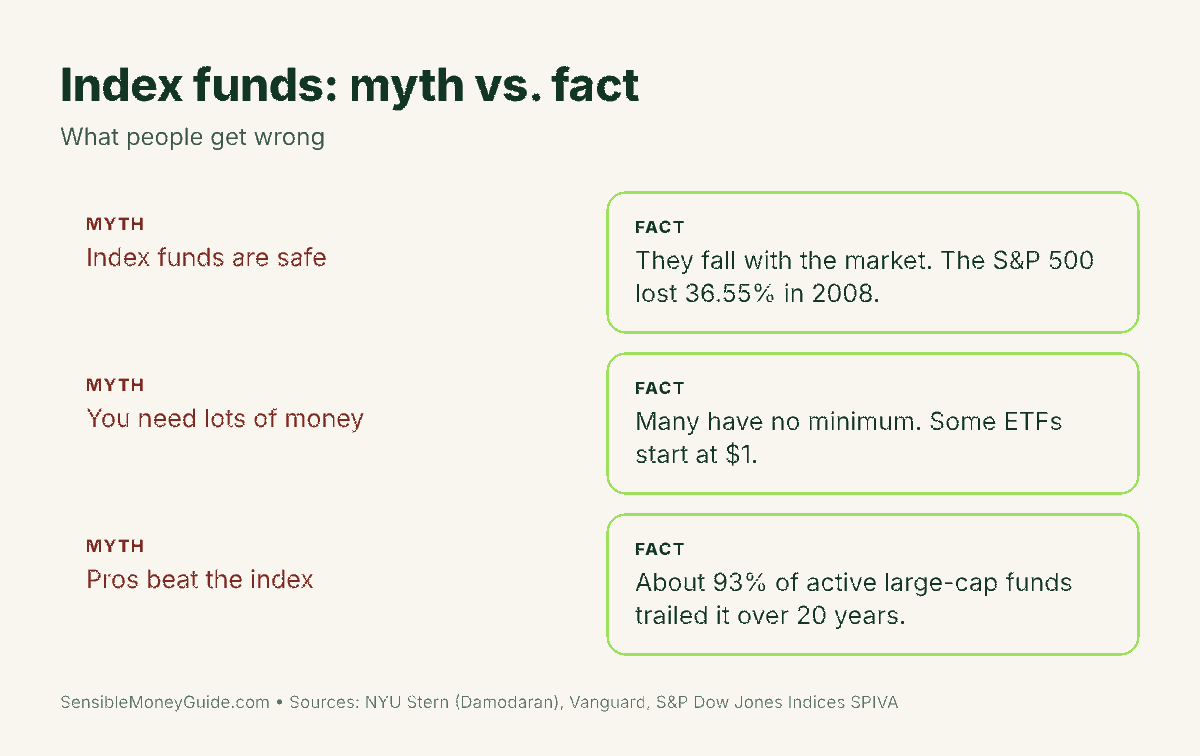
Myth: “Index funds are only for beginners.”
Fact: Plenty of experienced investors and some of the most successful professionals use them. Buffett’s own advice for his family’s money was to put most of it in a low-cost S&P 500 index fund. Simple isn’t the same as basic.
Myth: “Index funds are safe.”
Fact: Broad index funds remove the risk of betting on one company, but not the risk of the whole market falling. The S&P 500 lost 36.55% in 2008. Index funds aren’t FDIC insured, and you can lose money.
Myth: “You need a lot of money to start.”
Fact: Many index mutual funds have no minimum, and some ETFs can be bought for as little as $1 through fractional shares.
Myth: “All index funds are cheap.”
Fact: Most big ones are, but not all. Investor.gov warns that not all index funds cost less than actively managed funds. Always check the expense ratio.
Myth: “A good fund manager will beat the index.”
Fact: Some do for a while, but few keep it up. Over 20 years, nearly 93% of active large-company funds trailed the S&P 500, according to S&P Dow Jones Indices.
Myth: “The S&P 500 is the whole market.”
Fact: It covers large U.S. companies only. It leaves out smaller U.S. companies, international stocks and bonds. That’s why many people add a total market, international or bond fund.
Key takeaways
- An index fund buys everything on a market list, like the S&P 500, so you get the market’s return instead of guessing at winners.
- Over 20 years, about 93% of active large-company U.S. stock funds trailed the S&P 500.
- Fees are the biggest thing you control. A 1% fee instead of 0.05% could cost about $61,600 over 30 years of $300 monthly deposits in our example.
- Index mutual funds make automatic dollar-amount investing easy. ETFs often have no minimum and can be more tax-efficient in regular accounts.
- Index funds still fall when the market falls. They’re best for long-term goals, not money you’ll need in the next few years.
- One target-date index fund, or two or three broad index funds, is enough for most people.
- Use tax-advantaged accounts first. For 2026, the limits are $24,500 for a 401(k) and $7,500 for an IRA.
- Automate your deposits, rebalance about once a year, and don’t sell in a panic.
Frequently asked questions
Are index funds good for beginners?
Yes, they’re one of the easiest ways to start. One purchase spreads your money across hundreds or thousands of companies, and the costs are low. You don’t need to research individual stocks.
How much money do I need to start investing in index funds?
Often very little. Many index mutual funds have no minimum, and some brokerages sell ETFs in fractional shares starting at $1. Others ask for $1,000 or more, so check before you buy.
What’s the difference between an index fund and an ETF?
An index fund is a strategy: tracking an index. An ETF is a type of fund that trades on an exchange. Many ETFs are index funds. Index funds also come as mutual funds, which trade once a day at a set price.
Can you lose money in an index fund?
Yes. If the market falls, your index fund falls with it, and the money isn’t insured. That’s why index funds are for long-term goals, not money you’ll need in the next few years.
Is an S&P 500 index fund enough on its own?
Some people, including Warren Buffett in his advice for his family, are comfortable with mostly an S&P 500 fund. Others prefer to add small U.S. companies, international stocks and bonds for more balance. A target-date index fund does that mixing for you.
How do index funds make money for me?
In two ways. The companies in the fund grow in value over time, which raises the fund’s price. And many pay dividends, which the fund passes along to you. Reinvesting those dividends helps your money grow faster.
How often should I check or change my index funds?
Once or twice a year is enough for most people. Use that check-in to rebalance if your mix has drifted and to raise your monthly amount if you can.
Should I invest all at once or a little at a time?
If you get paid regularly, investing a set amount each payday is the natural choice. If you have a lump sum, investing it right away gives it more time in the market, while spreading it over a few months can make a sudden drop easier to stomach. Pick the approach that you’ll actually stick with.
Your next step this week
Log in to your 401(k) or brokerage account and find one broad index fund, either a target-date index fund or a total stock market index fund. Write down its expense ratio. If it’s under 0.20%, set up an automatic monthly investment, even if it’s only $50. That single step puts you ahead of years of “I’ll figure it out later.”
Sources
- U.S. Securities and Exchange Commission (Investor.gov), Investor Bulletin: Index Funds, Aug. 6, 2018.
- U.S. Securities and Exchange Commission (Investor.gov), How Fees and Expenses Affect Your Investment Portfolio – Investor Bulletin, July 23, 2025.
- U.S. Securities and Exchange Commission (Investor.gov), Glossary: Dollar Cost Averaging, accessed October 2026.
- Internal Revenue Service, 401(k) limit increases to $24,500 for 2026, IRA limit increases to $7,500 (IR-2025-111), Nov. 13, 2025.
- Board of Governors of the Federal Reserve System, Changes in U.S. Family Finances from 2022 to 2025: Evidence from the Survey of Consumer Finances, October 2026.
- FINRA, Compare Funds With FINRA’s Fund Analyzer, Sept. 5, 2024.
- S&P Dow Jones Indices, SPIVA U.S. Year-End 2025, March 3, 2026.
- Investment Company Institute, Trends in the Expenses and Fees of Funds, 2025, March 2026.
- Morningstar, US Fund Fee Study, May 19, 2026.
- Vanguard, What is an index fund?, accessed October 2026.
- Fidelity Investments, What is an index fund?, March 26, 2026.
- Charles Schwab, ETF vs. Mutual Fund: It Depends on Your Strategy, May 22, 2026.
- Berkshire Hathaway, 2013 Letter to Shareholders (Warren Buffett), February 2014.
- NerdWallet, The Best Index Funds and How to Start Investing, updated Sept. 3, 2026.
- Kiplinger, What Is an Index Fund and Should I Invest in One?, updated April 17, 2026.
- CNBC Select, What is an index fund?, accessed October 2026.
- Aswath Damodaran, NYU Stern School of Business, Historical Returns on Stocks, Bonds and Bills, updated Jan. 5, 2026.
This article is for educational purposes only and isn’t financial advice. Consider talking with a qualified professional about your situation.
You must be logged in to post a comment Login