Saving Strategies
Emergency Fund Guide: How Much You Need and Where to Keep It
How much should you keep in an emergency fund, and where? Learn how to find your number, where to keep it safe, and how to build it on any budget.

Picture someone like Maria, a 34-year-old nurse. (She’s a made-up example, but you probably know someone just like her.) It’s a Tuesday night in February. She’s driving home from a long shift when the “check engine” light comes on. The next morning, the mechanic calls with the news: $1,400 for a new alternator and a belt.
Maria has two choices. She can put it on a credit card and pay it off slowly, with interest. Or she can move money from a savings account she set up two years ago, pay the bill, and go back to work without losing sleep.
That second option is what this guide is about. An emergency fund is boring. It doesn’t grow fast, and nobody brags about it at parties. But it’s the one money tool that makes almost every other money goal easier, from paying off debt to investing for retirement.
By the end of this guide, you’ll know how much you need and where to keep it. You’ll also know how to build it, even if money is tight right now.
What you’ll learn
- What counts as an emergency fund, and what doesn’t
- Why even $500 to $2,000 can change how you feel about money
- How to figure out your own target number, step by step
- The safest places to keep your fund so it earns something
- Simple ways to build it, even on a tight budget
- Whether to save first or pay off debt first
Table of contents
- What an emergency fund is (and isn’t)
- Why it matters more than you think
- How much you need: the starter goal and the full goal
- How to find your own number
- How many months is right for you?
- Where to keep your emergency fund
- How to build it, even on a tight budget
- When to use it (and when not to)
- Emergency fund or debt payoff first?
- Common mistakes to avoid
- Myths vs. facts
- Your step-by-step action plan
- Key takeaways
- Frequently asked questions

What an emergency fund is (and isn’t)
An emergency fund is money you set aside only for surprise costs and income loss. The Consumer Financial Protection Bureau (CFPB) describes it as cash for unplanned expenses like car or home repairs, medical bills, or a drop in income (CFPB).
Think of it as your own private insurance policy. You pay the “premium” a little at a time. When something goes wrong, you file a claim with yourself. No phone calls, no forms, no interest.
Here’s what an emergency fund is not:
- It’s not your checking account. Money that sits next to your grocery and gas spending tends to get spent. Keep it separate.
- It’s not a vacation fund. Planned costs, like a trip, holiday gifts or back-to-school shopping, deserve their own savings buckets.
- It’s not an investment. The job of this money is to be there, at full value, the day you need it. Growth is a nice bonus, not the goal.
- It’s not a credit card. A credit limit can feel like a safety net. But it’s a loan, and the bill comes with interest.
That last point matters a lot. A card can be cut or lowered right when times get hard. Your own cash can’t.
The two jobs your fund does
Most people think of an emergency fund as “car repair money.” That’s one job. But it actually does two different jobs.
Job 1: Absorb small shocks. A broken phone screen. A vet bill. A $600 dental crown. These pop up a few times a year for most households.
Job 2: Replace your income for a while. A layoff, a long illness, or a big cut in hours. These are rarer but much more expensive.
A starter fund handles Job 1. A full fund handles Job 2. We’ll get to the right size for each in a minute.
Why it matters more than you think
Surprise bills aren’t rare. They’re normal. In the Federal Reserve’s latest survey of U.S. households, 59% of adults said they’d had at least one major unexpected expense in the past year (Federal Reserve). The most common were car repairs or replacement (30%), home or appliance repairs (22%) and big medical bills (21%).
So the question isn’t whether you’ll face one. It’s whether you’ll have the cash when you do.
Many households are one bill away from debt
Each year, the Fed asks people how they’d pay for a surprise $400 expense. In the most recent survey, done in October 2025, 63% said they’d use cash or its equivalent. That means money in savings, or a credit card they’d pay off in full at the next statement (Federal Reserve).
That number climbed steadily for years, hit a high of 68% in 2021, and then slipped back. It’s been stuck at 63% for four years in a row (Federal Reserve SHED data).
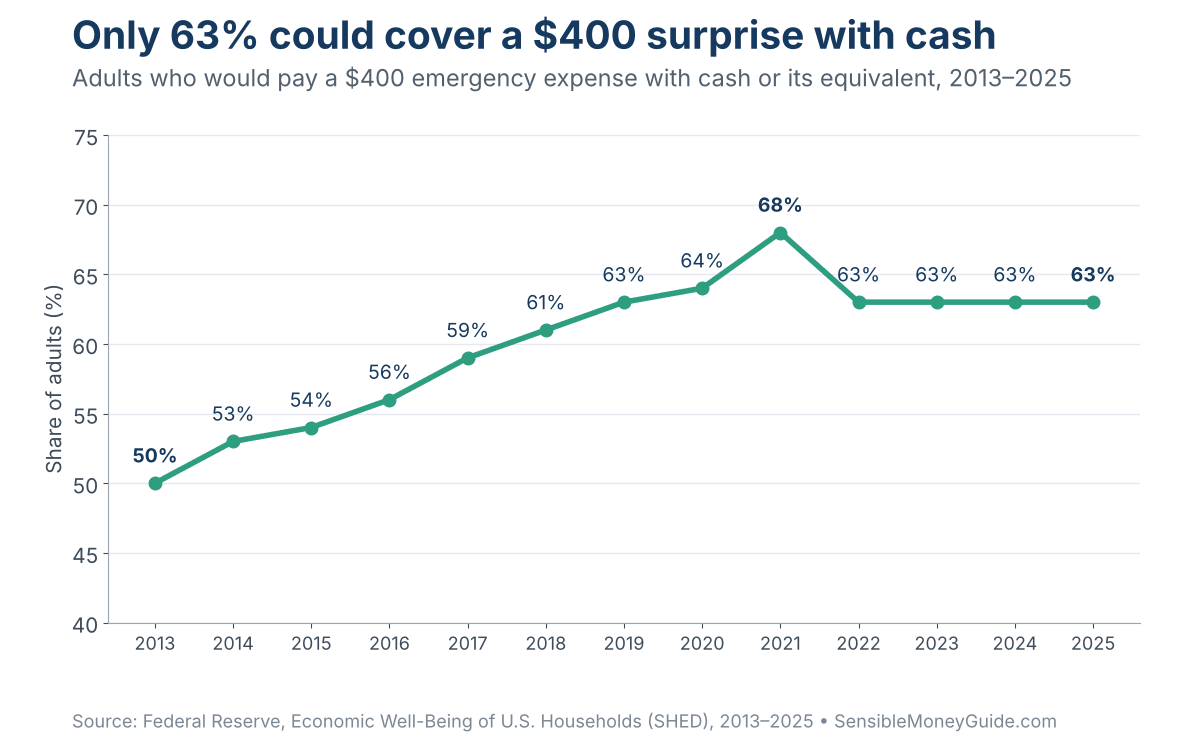
The other 37% would have to borrow, sell something, or skip the bill. Respondents could pick more than one answer: 15% said they’d put it on a credit card and pay it off over time, 10% would borrow from a friend or family member, and 12% couldn’t pay it right now at all (Federal Reserve).
A broader measure tells a similar story. Just 55% of adults said they had enough savings to cover three months of expenses if they lost their main source of income (Federal Reserve). Younger adults have it hardest. Only 37% of people ages 18 to 29 had that cushion in 2025, compared with 71% of people 60 and older (Federal Reserve SHED data).
Private surveys tell a similar story. Bankrate’s 2026 Annual Emergency Savings Report, based on surveys done in 2025, found that 46% of U.S. adults have enough saved to cover three months of expenses, and 27% could cover six months or more (Bankrate). Six in 10 said they felt uncomfortable with how much they had saved.
It’s not just about money. It’s about stress.
Here’s the part that surprised a lot of people, including financial pros. In 2025, Vanguard published a study of more than 12,000 of its investors. The researchers looked at what predicted how good people felt about their finances (Vanguard).
Having at least $2,000 in emergency savings was linked to a 21% higher financial well-being score than having no emergency savings. Having three to six months of expenses saved added another 13% on top of that.
The day-to-day differences were striking, too:
- Investors with no emergency savings said they spent about 7.3 hours a week dealing with their finances. Those with at least $2,000 spent about 3.7 hours.
- About half (51%) of people with no emergency savings said their financial stress went up over the past year, versus 15% of those with $2,000 or more.
- People with no emergency savings said money worries distracted them at work for about 6.1 hours a week. For those with $2,000 or more, it was 1.5 hours.
One honest caveat: this study shows a link, not proof of cause. People who have savings may differ in other ways. And Vanguard’s investors aren’t a perfect mirror of all Americans. Still, the pattern makes sense to anyone who’s lain awake worrying about a bill.
Cash beats credit when things go wrong
When there’s no cash, the backup plan is usually a credit card. That gets expensive fast. In the second quarter of 2026, the average interest rate on credit card accounts that were charged interest was 22.15% (Federal Reserve G.19).
We’ll run the real math on that later. For now, just know this: a $1,500 repair can quietly turn into a $1,900 repair if you pay it off slowly on a card.
Want a quick, friendly overview before we dig into the numbers? This short video from Two Cents, a personal finance series from PBS Digital Studios, makes the case for why you need an emergency fund.
How much you need: the starter goal and the full goal
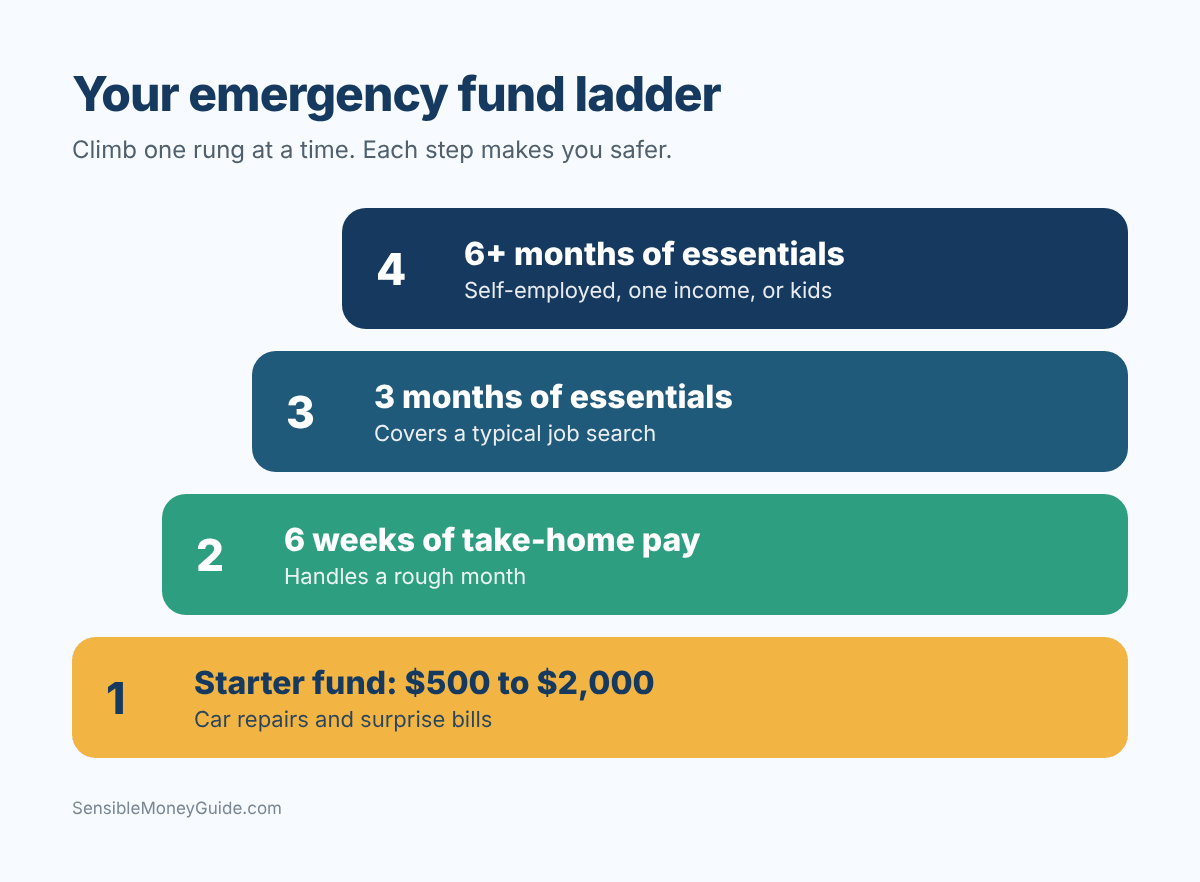
You’ve probably heard “three to six months of expenses.” That’s a good rule. But if you’re starting from zero, a number like $15,000 can feel so far away that you never start. So it helps to break it into steps.
Most experts agree on a two-stage plan: a small starter fund first, then a full fund later. Where they differ is on the exact amounts.
Stage 1: The starter fund
Your starter fund handles the everyday surprises, like a tow, a co-pay or a broken appliance. Here’s what some well-known voices suggest:
- NerdWallet suggests $500 as a first goal if the bigger target feels out of reach. It notes that saving just $10 a week would get you past $500 within a year (NerdWallet).
- Fidelity suggests starting with $1,000 (Fidelity).
- Ramsey Solutions makes a $1,000 starter fund Baby Step 1 in Dave Ramsey’s plan, before paying off debt (Ramsey Solutions).
- Vanguard’s research found that having at least $2,000 saved was linked to a 21% higher financial well-being score, a bigger boost than the extra 13% linked to having three to six months saved (Vanguard).
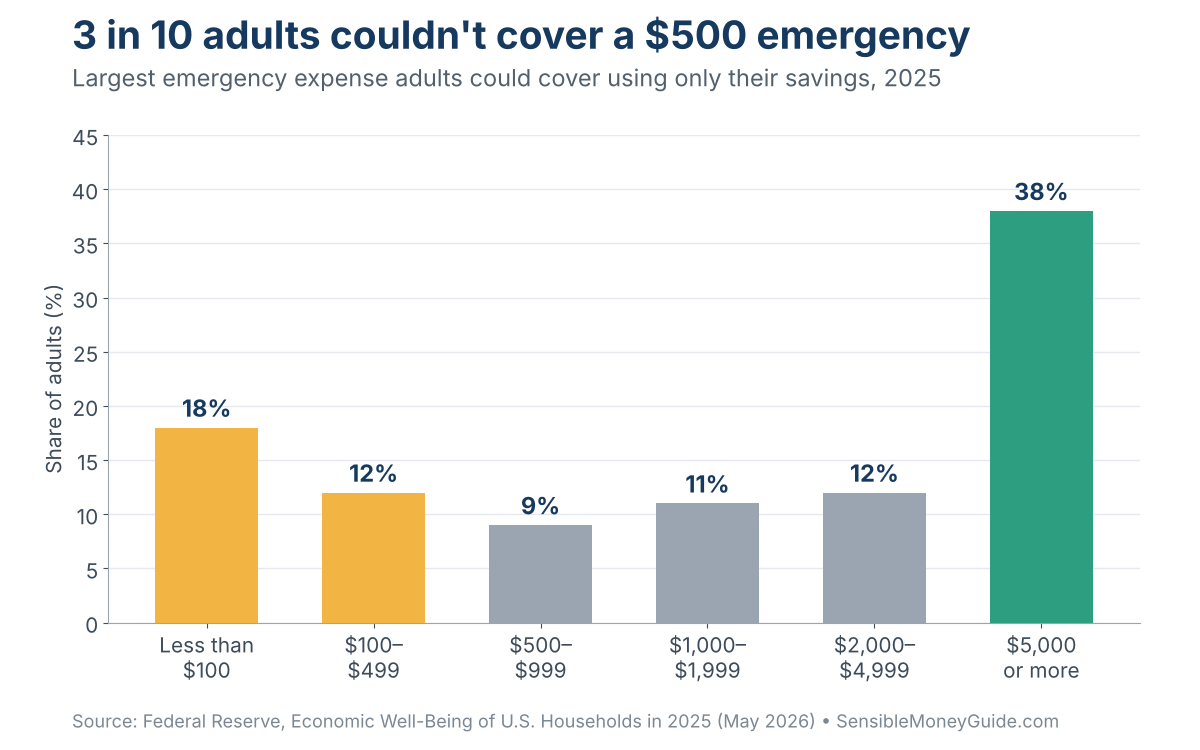
So which is right? Any of them is a great start. If money is very tight, aim for $500. If you can stretch, go for $1,000 to $2,000. The Fed’s data shows why that range matters. In 2025, 18% of adults said the largest emergency they could cover using only savings was under $100, and another 12% said $100 to $499 (Federal Reserve).
Stage 2: The full fund
Your full fund is the one that covers a job loss or a long illness. The common guideline is three to six months of essential expenses. Fidelity, NerdWallet and Ramsey Solutions all use that range (Fidelity; NerdWallet; Ramsey Solutions).
Not everyone agrees, though. Personal finance author Suze Orman has long argued for a much bigger cushion. In a 2017 talk covered by CNBC, she said people should keep eight to 12 months of living expenses saved. One reason: a job search can take far longer than expected (CNBC). In her words, “You need to know that you are going to be secure.”
Who’s right? It depends on your life. Orman’s bigger target gives more peace of mind, but it can take years to reach. For many households, money beyond six months might do more good paying down high-interest debt or going into a retirement account. On the other hand, if you’re self-employed or your field has frequent layoffs, a bigger number makes a lot of sense. We’ll help you pick in the next two sections.
A third view: weeks, not months
Researchers at the JPMorgan Chase Institute studied the bank accounts of millions of families. They found that a typical family needed about six weeks of take-home pay in cash. That’s enough to get through a month when income drops and spending spikes at the same time (JPMorgan Chase Institute). And 65% of families didn’t have that much.
That’s a helpful middle step. Six weeks of pay is smaller than three months of expenses, and it protects you from the most common money squeezes. Think of it as a checkpoint on the way to your full fund.
How to find your own number
Rules of thumb are fine. Your own number is better. Here’s how to figure it out in about 20 minutes with your last few bank statements.
Step 1: List only your essential expenses
Your emergency fund doesn’t need to cover your whole lifestyle. It needs to cover the bills you’d still have to pay if your income stopped tomorrow. Fidelity’s list of essentials is a good guide: rent or mortgage, utilities, basic groceries, health care, insurance premiums, child care or tuition, transportation, and minimum debt payments (Fidelity).
Leave out the nice-to-haves. Dining out, streaming services, vacations and new clothes can pause in a real emergency.
Step 2: Use real numbers, not guesses
Pull the last three months of bank and card statements. Add up each essential category and divide by three. Real numbers are often higher than what we guess, especially for groceries and gas.
Step 3: Multiply by your months
Multiply your monthly essentials by three to get the low end of your target. Multiply by six for the high end.
Worked example 1: Maria’s number
Let’s go back to Maria, our made-up nurse. Here’s what her essential spending looks like each month:
| Essential expense | Monthly cost |
|---|---|
| Rent | $1,450 |
| Utilities (power, water, gas) | $210 |
| Groceries | $520 |
| Insurance (car and renters) | $260 |
| Car payment and gas | $480 |
| Phone and internet | $120 |
| Minimum debt payments | $150 |
| Health costs (co-pays, prescriptions) | $90 |
| Total essentials | $3,280 |
Here’s the simple math:
- Three months: $3,280 × 3 = $9,840
- Six months: $3,280 × 6 = $19,680
So Maria’s full-fund target is somewhere between about $10,000 and $20,000. Her starter goal could be $1,000 to $2,000. That’s a much friendlier first number than $20,000.
Watch out: If you have a high-deductible health plan, add your deductible to your target, or keep it in a health savings account. A single ER visit can use up a big chunk of a small fund.
How many months is right for you?
Three months or six? Or more? The honest answer is that it depends on how likely you are to lose income and how long it might take to replace it.
How long job searches actually take
The Bureau of Labor Statistics (BLS) tracks how long unemployed people have been looking for work. In September 2026, the median length of unemployment was 11.5 weeks, or a little under three months (BLS). “Median” means half of unemployed people had been out of work for less time, and half for longer.
But look at the full picture. About 27% of unemployed people had been looking for 27 weeks or more. That’s over six months.
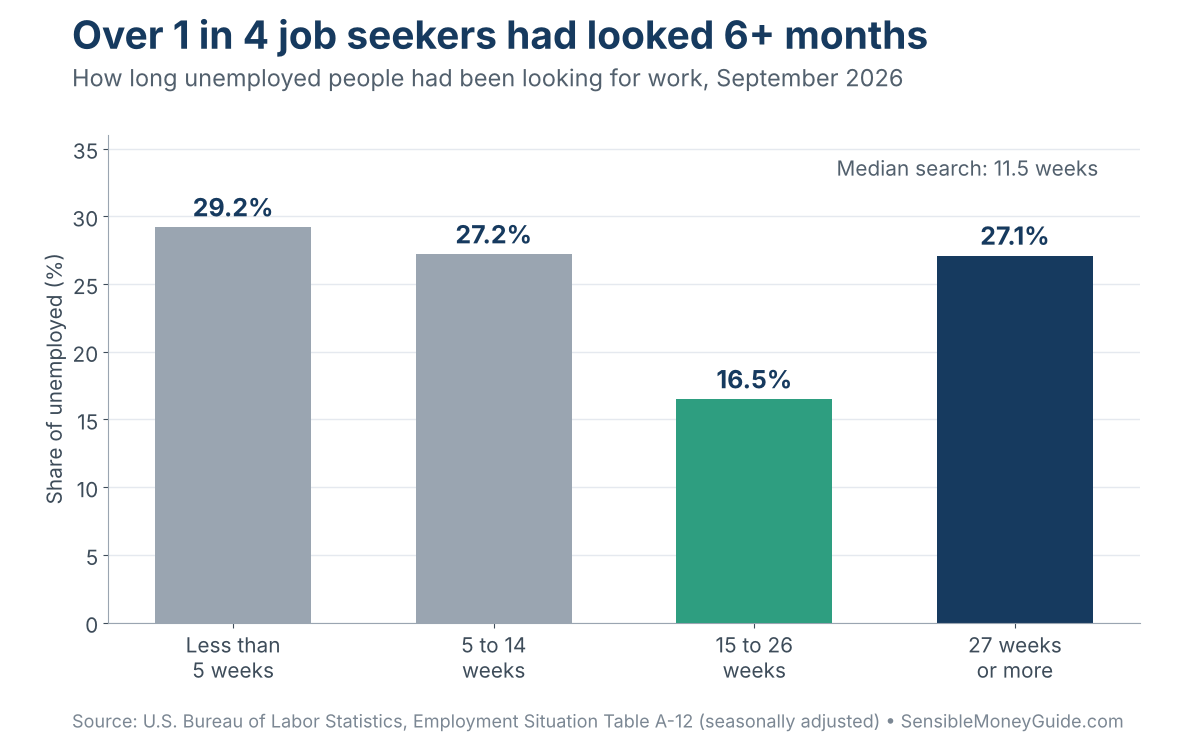
This is why three months is a floor, not a ceiling, for many people. Right now, more than one in four unemployed people have been looking for over six months, so a long search is far from rare. Unemployment benefits can help, but they usually replace only part of your pay, for a limited time.
Lean toward three months if:
- You have a stable job in a field with steady demand, like health care or teaching.
- Your household has two steady incomes, and you could live on one.
- You have no kids or other people who depend on you.
- You rent and drive a newer, reliable car.
Lean toward six months (or more) if:
- You’re self-employed, work on commission, or have income that changes month to month.
- You’re the only earner in your home, or you support kids or aging parents.
- You work in an industry with frequent layoffs.
- You own an older home or drive an older car.
- You have a health condition that could keep you from working.
- You’re retired or living on a fixed income.
Fidelity’s guide lists many of these same reasons for saving more than the basic range (Fidelity).
Special situations
If you’re self-employed or a gig worker. Your income may swing a lot from month to month, and you don’t get unemployment benefits in most cases. Six months or more is a sensible place to start. It also helps to keep your tax money in a separate account, so a quarterly tax bill never eats into your emergency cushion.
If you own a home. Homeowners pay for every repair themselves. A new water heater, a roof patch or a broken air conditioner can cost thousands of dollars. Some homeowners keep a separate home repair fund on top of their emergency fund, so a big repair doesn’t wipe out their job-loss cushion.
If you’re retired. You may not face a layoff, but you do face market drops, health costs and big repairs. Fidelity notes that retirees and people on fixed incomes may want to save more than the usual range (Fidelity). Some retirees choose to keep extra cash on hand so they don’t have to sell investments when prices are down. A financial planner can help you find the right mix.
If you’re young and just starting out. The Fed’s numbers show that adults under 30 are the least likely to have a three-month cushion (Federal Reserve SHED data). That’s normal, since early-career pay is lower. Focus on the starter fund first, then build toward six weeks of take-home pay, then three months. Each step makes you safer than the last.
Pro tip: Two-income couples sometimes think they need less. That’s true only if you could cover essentials on the smaller paycheck alone. Run that test before you settle on three months.
Where to keep your emergency fund
Where you park your fund matters almost as much as how big it is. The right spot checks three boxes:
- Safe. The money won’t lose value or disappear.
- Easy to reach. You can get it within a day or two, without penalties.
- A little out of sight. It’s not so handy that you dip into it for everyday spending.
Earning some interest is a fourth box. It’s nice, but it comes last.
Why FDIC and NCUA insurance matters
Before you pick an account, check that it’s insured. The Federal Deposit Insurance Corporation (FDIC) insures deposits at member banks up to $250,000 per depositor, per bank, for each account ownership category (FDIC). That covers checking, savings, money market deposit accounts and certificates of deposit (CDs). It does not cover stocks, bonds, mutual funds or crypto.
Credit unions have their own version. The National Credit Union Administration (NCUA) insures individual accounts at federally insured credit unions up to $250,000 (NCUA).
For almost everyone, that means an emergency fund in an insured bank or credit union account is as safe as money gets. The CFPB says a bank or credit union account is “generally considered one of the safest places to put your money” (CFPB).
Your main options, compared
| Option | Safety | Access | Earnings | Best for |
|---|---|---|---|---|
| High-yield savings account (online bank) | FDIC or NCUA insured | Usually 1 to 2 business days | Often well above average | Most people’s main fund |
| Regular savings at your local bank | FDIC or NCUA insured | Same day | Low; national average 0.37% | Quick-access starter cash |
| Money market deposit account (bank) | FDIC or NCUA insured | Same day to 2 days | Varies; can be competitive | People who want check-writing |
| Money market fund (brokerage) | Not FDIC insured; low risk | About 1 business day | Tracks short-term rates | Larger funds held at a brokerage |
| Short-term CDs or Treasury bills | Insured (CDs) or U.S. government-backed (T-bills) | Locked until maturity, or a penalty or sale | Fixed for the term | The “back half” of a large fund |
| Cash at home | Not insured | Instant | None | A small amount for power outages |
High-yield savings accounts: the best fit for most people
A high-yield savings account is simply a savings account that pays a higher interest rate than average. Most are offered by online banks, which have lower costs than banks with branches.
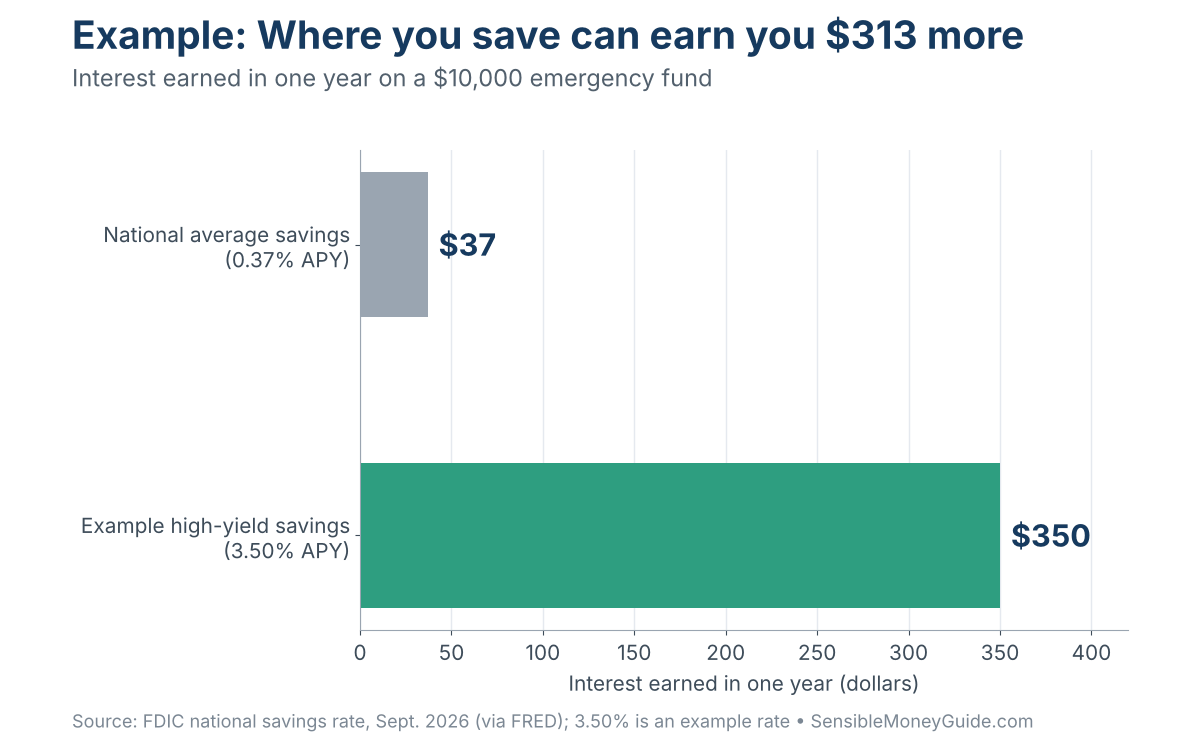
The gap can be big. The FDIC’s national average rate for savings accounts was just 0.37% in September 2026 (FDIC national rate, via FRED). Meanwhile, NerdWallet’s October 2026 list of top high-yield accounts showed rates from 3.10% to 5.00% APY, with the top rate being a limited-time promotion with strings attached (NerdWallet).
APY, or annual percentage yield, is the amount your money earns in a year, including interest on your interest. Rates on savings accounts can change at any time, so treat any number as a snapshot.
Worked example 2: What $10,000 earns in a year
Let’s say you’ve built a $10,000 emergency fund. Here’s what it could earn in one year at two different rates, using APY so compounding is already included:
- At the 0.37% national average: $10,000 × 0.0037 = $37
- At an example 3.50% high-yield rate: $10,000 × 0.035 = $350
That’s a $313 difference for doing nothing more than picking a better account. Over five years, that adds up to a nice chunk of extra cushion.
Watch out: A high-yield account at an online bank may take a business day or two to move money to your checking account. That’s fine for most emergencies. But keep a few hundred dollars in your regular checking or a linked savings account for same-day surprises, like a tow truck that wants payment on the spot.
Money market accounts vs. money market funds
These two sound alike, but they’re different products.
A money market deposit account is a bank account. It’s FDIC insured, just like savings (FDIC).
A money market fund is a type of mutual fund sold by brokerages. It holds very short-term debt and cash. According to the SEC’s Investor.gov, money market funds are not FDIC insured, and while they’re low risk, it’s possible to lose money in one (Investor.gov). Government money market funds, which invest at least 99.5% of their assets in cash, government securities and similar holdings, are the most conservative type. Some funds can also charge fees when lots of investors cash out at once.
Money market funds can be a reasonable home for a large emergency fund, especially if you already invest at a brokerage. Just know the trade-off: a little less protection in exchange for convenience and, often, a competitive yield.
CDs and Treasury bills: good for the back half
A certificate of deposit (CD) pays a set rate if you leave the money alone for a set time, like six months or a year. Pull it out early, and you usually pay a penalty. Treasury bills are short-term loans to the U.S. government that come due in a year or less.
Both can work for the “deep reserve” part of a large fund, the money you’d only need if a crisis lasted many months. Some people build a “ladder,” with CDs or T-bills coming due every few months so some cash is always about to free up. Just don’t lock up your starter fund this way.
A simple setup that works for most people
You don’t need to pick just one place. Many people use a simple two- or three-layer setup:
- Layer 1: A few hundred dollars in checking or a linked savings account at your everyday bank, for same-day needs.
- Layer 2: Your starter fund and most of your full fund in a high-yield savings account, reachable in a day or two.
- Layer 3 (optional): The deep reserve, money you’d only need many months into a crisis, in short-term CDs, Treasury bills or a government money market fund.
If that feels like too much to manage, skip Layer 3. One good high-yield savings account is plenty for most households.
Places to avoid
- The stock market. Stocks can drop sharply, and they often do in the same recessions that cause layoffs. You don’t want to sell low because your car broke down.
- Your retirement account. Pulling money from a 401(k) or IRA early can mean taxes, penalties and lost growth. It’s a last resort, not a plan.
- A big stash of cash at home. As the CFPB notes, “cash can be stolen, lost, or destroyed” (CFPB). A small amount for a power outage is fine.

How to build it, even on a tight budget
If saving feels impossible right now, you’re not alone. The trick is to make saving small, automatic and hard to undo. Here are the methods that work best.
1. Know where your money goes
You can’t save money you can’t find. If you don’t have a budget yet, our guide on how to make a budget that actually works walks you through it. Even one pass through last month’s spending often turns up money you didn’t realize was leaking out.
2. Open a separate account and give it a name
Open a savings account that’s just for emergencies. Many banks let you nickname accounts. Call it “Car Breaks Down” or “Job Loss Cushion.” Giving money a clear job makes it much easier to leave alone.
3. Automate it
Set up an automatic transfer from checking to savings on payday. The CFPB recommends this approach, and it suggests watching your checking balance so the transfers don’t cause overdraft fees (CFPB). If your employer allows it, you can also split your direct deposit so part of each paycheck goes straight into savings.
Start with whatever you can. Even $25 a week works.
Worked example 3: How long will it take?
Here’s how fast small amounts add up toward a $1,000 starter fund:
- $25 a week: $1,000 ÷ $25 = 40 weeks (about nine months)
- $50 a week: $1,000 ÷ $50 = 20 weeks (under five months)
Now let’s take Maria’s full goal of $9,840 for three months of essentials. If she saves $300 a month, it would take about 33 months ($9,840 ÷ $300 = 32.8). But if she also puts $1,200 from each yearly tax refund into the fund, she reaches her goal in about 25 months. That’s eight months sooner, just by saving windfalls.
4. Save your windfalls
Tax refunds, bonuses, cash gifts and rebates are some of the fastest ways to grow your fund. The CFPB points out that saving all or part of a tax refund could help you set up your fund quickly (CFPB).
The IRS makes this easy. With Form 8888, or the matching option in tax software, you can split your refund into up to three accounts (IRS). You could send part to checking and part straight to your emergency savings, so you never see it in your spending account.
5. Check whether your employer offers emergency savings
A newer workplace option is worth asking about. Since 2024, employers can offer a pension-linked emergency savings account, or PLESA, tied to their retirement plan. According to the U.S. Department of Labor, workers who aren’t highly paid can save up to $2,500 (adjusted for inflation over time) on an after-tax basis, and they must be allowed to withdraw at least once a month. The plan can’t charge fees just for your first four withdrawals each plan year (Department of Labor).
Not every employer offers one. But if yours does, it’s an easy way to save straight from your paycheck.
6. Grow your savings when your income grows
When you get a raise, send part of it to savings before you get used to spending it. Fidelity suggests this as a way to avoid “lifestyle creep,” where spending rises as fast as pay (Fidelity). The same goes for a paid-off loan. When a car payment ends, keep “paying” it, but to your savings account.
7. Find a few quick wins
- Cancel one or two subscriptions you rarely use, and move that amount to savings each month.
- Call your car insurance and phone companies once a year to ask for a better rate.
- Sell things you no longer use, like old phones, gear or furniture.
- Try a no-spend weekend once a month and save what you would have spent.
None of these will make you rich. But stacked together, they can fund your starter goal in a few months.
When to use it (and when not to)
Building the fund is half the battle. The other half is using it for the right things, and then refilling it.
The CFPB suggests setting clear rules ahead of time for what counts as an emergency (CFPB). Deciding when you’re calm is much easier than deciding when you’re stressed or tempted.
A simple three-question test
Before you tap your fund, ask yourself:
- Is it unexpected? A car repair is. Annual car registration isn’t, because it comes every year.
- Is it necessary? Would skipping it hurt your health, safety, income or housing?
- Is it urgent? Does it need to be paid now, or could it wait until you save for it?
If the answer to all three is yes, use the fund. That’s what it’s for.
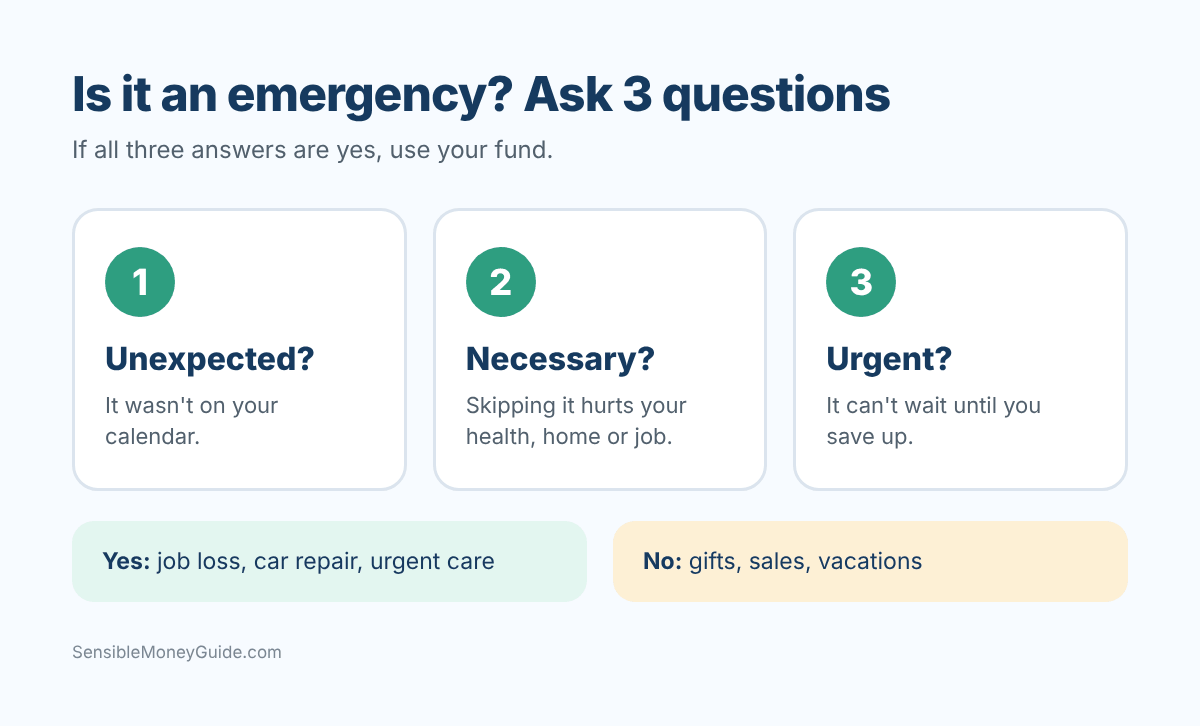
Usually an emergency
- Job loss or a big, sudden cut in hours
- A car repair you need to get to work
- Urgent medical, dental or vet care
- A broken furnace, water heater or roof leak
- Last-minute travel for a family crisis
Usually not an emergency
- Holiday gifts, birthdays or back-to-school shopping (they come every year)
- A sale on something you want
- Vacation or concert tickets
- Planned home upgrades
- Regular bills you forgot to budget for
For predictable costs that don’t come monthly, like car registration or holiday gifts, set up a separate “sinking fund.” That’s a small savings bucket you add to every month for a known future cost. It keeps your emergency fund for true surprises.
Don’t be afraid to use it
Some people work so hard to build their fund that they can’t bring themselves to touch it. They put a $900 repair on a credit card “to protect the savings.” That defeats the purpose. The CFPB’s advice is plain: use the fund if you need it, then rebuild it (CFPB).
After you use it, go back to your automatic transfers, and point your next windfall at refilling it. In a February 2025 Bankrate survey, 37% of U.S. adults said they had used emergency savings in the past 12 months, so refilling is a normal part of the cycle (Bankrate).
Emergency fund or debt payoff first?
This is one of the most common money questions. If you have credit card debt, should every spare dollar go to the card? Or should some go to savings?
Bankrate found that 29% of U.S. adults have more credit card debt than emergency savings (Bankrate). So if this is you, you’ve got lots of company.
Why most experts say “a little of both”
Paying off a card with a 22% interest rate is a great “return” on your money. But if you put every dollar toward debt and have zero savings, the next surprise goes right back on the card. You can end up stuck in a loop.
That’s why many plans start with a small cash cushion, then attack debt hard, then finish the full fund. Ramsey Solutions’ Baby Steps follow this order: $1,000 starter fund, then pay off all non-mortgage debt, then build three to six months of expenses (Ramsey Solutions).
Others suggest working on both at the same time, such as sending most extra money to high-interest debt while still adding a small amount to savings each month. Both approaches can work. The key is to avoid zero savings while carrying high-interest debt.
Worked example 4: The real cost of using a credit card
Let’s say your car needs a $1,500 repair, and you have no savings. You put it on a credit card with a 22.15% APR, the recent average for accounts charged interest (Federal Reserve G.19). You pay $75 a month.
- Months to pay it off: about 26
- Interest paid: about $389
- Total cost of the repair: about $1,889
We figured this by adding one month of interest (22.15% ÷ 12) to the balance each month, then subtracting the $75 payment, until the balance hit zero.
Now picture the same repair paid from savings. It costs $1,500, and you rebuild the fund at $75 a month over 20 months. You save almost $400, and you avoid two years of card payments hanging over you.
Pro tip: If you have both debt and a 401(k) match at work, try to contribute at least enough to get the full match while you build your starter fund. A match is free money that’s hard to beat.
Common mistakes to avoid
1. Waiting until you can save “a real amount”
Many people put off saving until they get a raise or pay off a bill. But small amounts add up, and the habit matters more than the size. Start with $10 or $20 a week if that’s what you have.
2. Keeping it in checking
Money that sits next to your spending money tends to get spent. Keep your fund in a separate account, ideally at a different bank than your checking, so it takes a small step to move it.
3. Leaving it in a low-rate account for years
At a 0.37% average rate, a large fund barely grows. Inflation can shrink its buying power over time. A high-yield savings account can earn many times more with the same safety, as long as it’s FDIC or NCUA insured.
4. Investing it in stocks
It’s tempting to chase higher returns. But stock prices can fall sharply in a bad year, often at the same time that layoffs rise. Your emergency fund needs to be at full value when you need it.
5. Using it for things that aren’t emergencies
A great sale or a last-minute trip isn’t an emergency. Set up separate savings for planned costs so you’re not tempted.
6. Forgetting to refill it
Using your fund is fine. Leaving it empty afterward is the problem. Make refilling it your next money goal after any withdrawal.
7. Never updating your target
Your target should change when your life changes. A new baby, a move, a new car payment or a job change all affect how much you need. Check your number once a year.
Myths vs. facts
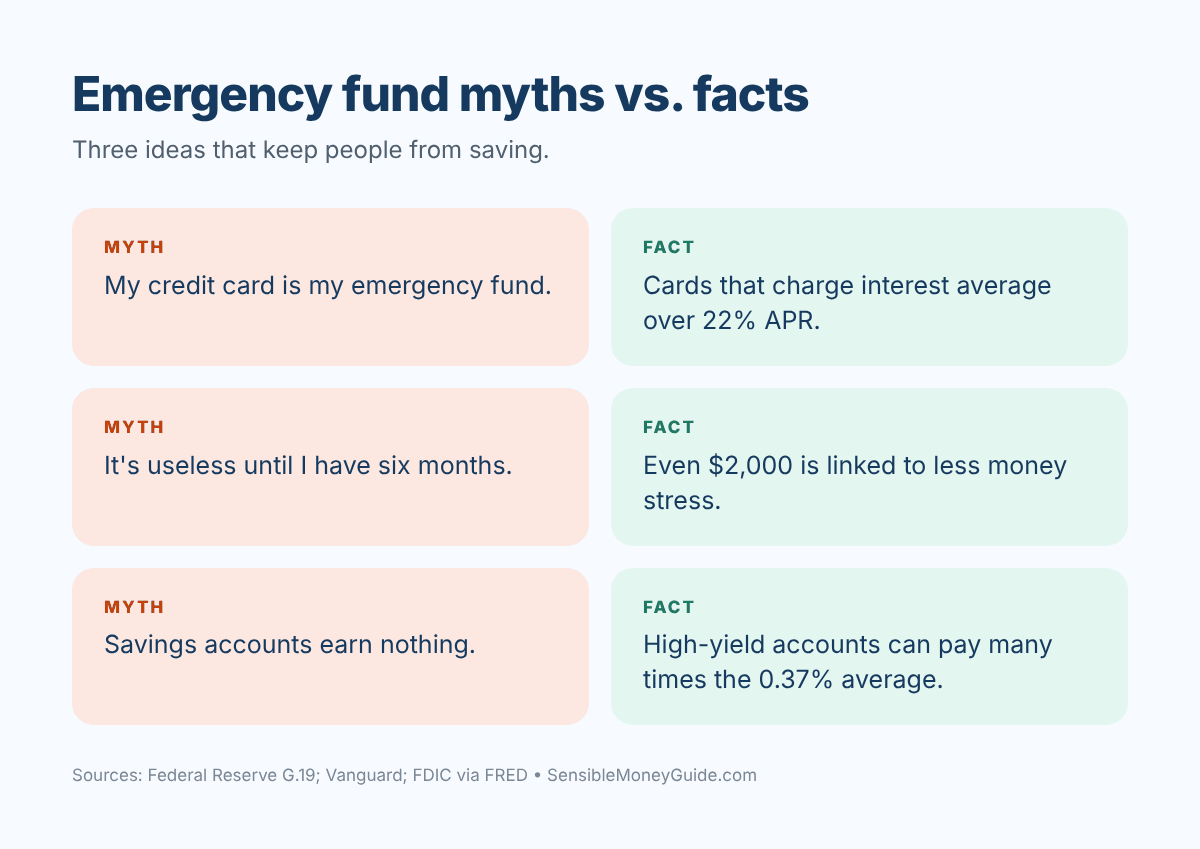
Myth: “I have credit cards, so I don’t need an emergency fund.”
Fact: A credit card is a loan, not savings. Card companies can lower your limit, and the average rate on cards charged interest was over 22% in mid-2026 (Federal Reserve G.19).
Myth: “An emergency fund is a waste because it earns almost nothing.”
Fact: High-yield savings accounts have recently paid several percent, far above the 0.37% national average (NerdWallet; FDIC national rate, via FRED). And the real return is avoiding high-interest debt and stress.
Myth: “I need six months saved before it does any good.”
Fact: Vanguard’s research linked having just $2,000 saved to a 21% higher sense of financial well-being (Vanguard). A small fund already helps.
Myth: “Money market funds are the same as bank accounts.”
Fact: Money market deposit accounts at banks are FDIC insured. Money market funds at brokerages are not, though they’re generally low risk (Investor.gov; FDIC).
Myth: “My 401(k) is my emergency fund.”
Fact: Early withdrawals can trigger taxes, penalties and lost growth. Keep retirement money for retirement.
Your step-by-step action plan
Here’s the whole guide boiled down into steps you can actually follow. Don’t try to do them all today. Just start with the first one.
- Add up your essentials. Use your last three months of statements to find your monthly must-pay costs.
- Set two goals. A starter goal of $500 to $2,000, and a full goal of three to six months of essentials.
- Open a separate, insured savings account. Look for a high-yield account with no monthly fees and FDIC or NCUA insurance.
- Name it. Give the account a nickname that reminds you why it exists.
- Automate a transfer. Set up a weekly or payday transfer, even if it’s just $20.
- Plan for windfalls. Decide now that part of your next tax refund, bonus or gift goes to the fund. Use Form 8888 to split your refund.
- Write your “what counts” rules. List what you’ll use the fund for, and what you won’t.
- Balance debt and savings. Once your starter fund is in place, send extra money to high-interest debt, then come back to finish your full fund.
- Refill after every use. Restart your transfers right away after a withdrawal.
- Review once a year. Update your target when your income, family or bills change.
Key takeaways
- An emergency fund is cash set aside only for surprise costs and income loss.
- Only 63% of U.S. adults would cover a $400 surprise with cash or its equivalent, according to the Federal Reserve.
- Start with a $500 to $2,000 starter fund. Vanguard’s research ties $2,000 in savings to much lower financial stress.
- Your full goal is usually three to six months of essential expenses, and more if your income is less steady.
- Keep it in an FDIC- or NCUA-insured high-yield savings account, separate from checking.
- Automate your savings and send windfalls like tax refunds straight to the fund.
- Use the fund for real emergencies without guilt, then refill it.
- If you have high-interest debt, build a starter fund first, then pay down debt.
Frequently asked questions
How much should I have in my emergency fund?
A common target is three to six months of essential expenses, like housing, food, insurance, transportation and minimum debt payments. If you’re just starting, aim for $500 to $2,000 first. Save more if you’re self-employed, the only earner, or work in a field with frequent layoffs.
Where is the best place to keep an emergency fund?
For most people, it’s a high-yield savings account at an FDIC-insured bank or NCUA-insured credit union. It’s safe, you can reach the money within a day or two, and it pays far more than the average savings account. Keep it separate from checking.
Is $1,000 enough for an emergency fund?
It’s a great starting point and covers many common surprises, like a car repair or urgent dental visit. But it won’t carry you through a job loss. Think of $1,000 as step one, then keep building toward three to six months of expenses.
Should I save or pay off debt first?
Most experts suggest doing both, in order. Build a small starter fund first so new surprises don’t go on a card. Then put extra money toward high-interest debt, and finish your full emergency fund after.
Should I invest my emergency fund?
Generally, no. Stocks can drop sharply, often at the same time that layoffs rise. Your emergency fund needs to be there at full value. A high-yield savings account, money market account or short-term CDs are safer choices.
How do I save an emergency fund on a low income?
Start small and automate it, even at $10 a week. Save part of every windfall, like tax refunds or gifts. Cut one or two expenses and move that money to savings. Small, steady amounts add up faster than you’d think.
What counts as an emergency?
An emergency is a cost that’s unexpected, necessary and urgent. Job loss, urgent medical care and a car repair you need to get to work all count. Holiday gifts, sales and vacations don’t, because they’re planned or optional.
Do I need an emergency fund if I have good credit?
Yes. Credit can be cut or reduced when you need it most, and borrowing costs interest. The average rate on credit card accounts charged interest was over 22% in mid-2026. Your own cash is cheaper and more reliable.
Your next step this week
Open a separate savings account this week, give it a name like “Emergency Fund,” and set up an automatic transfer of any amount, even $20, on your next payday. That’s it. Once the money starts moving on its own, you’ve done the hardest part.
Sources
- Federal Reserve Board: Economic Well-Being of U.S. Households in 2025. Accessed October 15, 2026.
- Federal Reserve Board: Report on the Economic Well-Being of U.S. Households: Unexpected expenses data. Accessed October 15, 2026.
- Federal Reserve Board: Report on the Economic Well-Being of U.S. Households: Emergency savings data. Accessed October 15, 2026.
- Federal Deposit Insurance Corporation (FDIC): Understanding Deposit Insurance. Accessed October 15, 2026.
- FDIC, via Federal Reserve Bank of St. Louis (FRED): National Rate: Savings (SNDR). Accessed October 15, 2026.
- National Credit Union Administration (NCUA): Share Insurance Coverage. Accessed October 15, 2026.
- U.S. Bureau of Labor Statistics: Employment Situation, Table A-12: Unemployed persons by duration of unemployment. Accessed October 15, 2026.
- Federal Reserve Board: Consumer Credit – G.19. Accessed October 15, 2026.
- Consumer Financial Protection Bureau (CFPB): An essential guide to building an emergency fund. Accessed October 15, 2026.
- U.S. Securities and Exchange Commission, Investor.gov: Money Market Funds: Investor Bulletin. Accessed October 15, 2026.
- Internal Revenue Service (IRS): Frequently asked questions about splitting federal income tax refunds. Accessed October 15, 2026.
- U.S. Department of Labor, EBSA: FAQs: Pension-Linked Emergency Savings Accounts. Accessed October 15, 2026.
- Vanguard: The relationship between emergency savings, financial well-being, and financial stress. Accessed October 15, 2026.
- Fidelity Investments: Guide to emergency savings. Accessed October 15, 2026.
- JPMorgan Chase Institute: Weathering Volatility 2.0: A Monthly Stress Test to Guide Savings. Accessed October 15, 2026.
- Bankrate: Bankrate’s 2026 Annual Emergency Savings Report. Accessed October 15, 2026.
- NerdWallet: Emergency Fund Calculator: How Much Will Protect You?. Accessed October 15, 2026.
- NerdWallet: Best High-Yield Savings Accounts of October 2026. Accessed October 15, 2026.
- Ramsey Solutions: The 7 Baby Steps. Accessed October 15, 2026.
- CNBC: Suze Orman explains how much money to keep in your emergency fund. Accessed October 15, 2026.
This article is for educational purposes only and isn’t financial advice. Consider talking with a qualified professional about your situation.