Budgeting
How to Lower Your Monthly Bills: The Complete Guide
Learn how to lower your monthly bills with a quick bill audit, a simple call script and real numbers on phone, internet, insurance and energy savings.
Picture someone like Dana, a 41-year-old school bus driver with two kids. (Dana is made up, but her month probably looks familiar.) On the first of the month she opens her banking app and scrolls. Rent. Car insurance. Phone. Internet. Electric. Three streaming services, a gym she hasn’t visited since spring, and a $9.99 charge she can’t place at all.
None of these bills is huge by itself. Together, they eat most of her paycheck before she buys a single grocery. And every few months, one of them quietly goes up.
Here’s the good news. Most monthly bills aren’t fixed the way they feel. Prices for phone plans, internet, insurance and even electricity often have wiggle room. Some bills can be cut with one phone call. Others can be cut with a setting you change once and forget about.
This guide walks you through all of it, one bill at a time. You’ll see where the average household’s money really goes and which bills have the most room to shrink. You’ll also get a script for calling companies and a simple plan you can start this week. No extreme couponing. No giving up everything you enjoy.
What you’ll learn
- Which bills take the biggest bite, based on the latest federal spending data
- How to run a 30-minute bill audit and find money you’re wasting
- How to cut phone, internet, insurance and energy costs, with real numbers
- Exactly what to say when you call a company to ask for a lower price
- Where to get help if you’re already behind on bills
- A 7-day plan to put it all into action
Table of contents
- Where your money goes (and why bills feel heavier)
- Start with a 30-minute bill audit
- Cut the subscription creep
- Phone and internet: pay for what you use
- How to negotiate almost any bill
- Car and home insurance: shop, then adjust
- Electricity, heating and water
- Groceries, gas and bank fees
- If you’re already behind on bills
- Your 7-day action plan
- Common mistakes to avoid
- Myths vs. facts
- Key takeaways
- FAQ
- Sources


Where your money goes (and why bills feel heavier)
Before you cut anything, it helps to know where the money actually goes. The best source for that is the U.S. Bureau of Labor Statistics. Every year it surveys households across the country about what they spend.
In its latest report, the BLS found that the average household spent $78,535 in 2024, about 1.8% more than the year before. Average income before taxes was $104,207. That sounds like a comfortable gap. But taxes, savings and debt payments come out of that gap too, and many households earn far less than the average.
Here’s how the spending broke down:
- Housing: $26,266 a year, or 33.4% of spending. This includes rent or mortgage, utilities, furniture and household supplies.
- Transportation: $13,318, or 17.0%. Car payments, gas, insurance and repairs all land here.
- Food: $10,169, or 12.9%. About $6,224 went to groceries and $3,945 to eating out.
- Personal insurance and pensions: $9,797, or 12.5%. This is mostly Social Security taxes and retirement contributions.
- Healthcare: $6,197, or 7.9%.
- Entertainment: $3,609, or 4.6%.

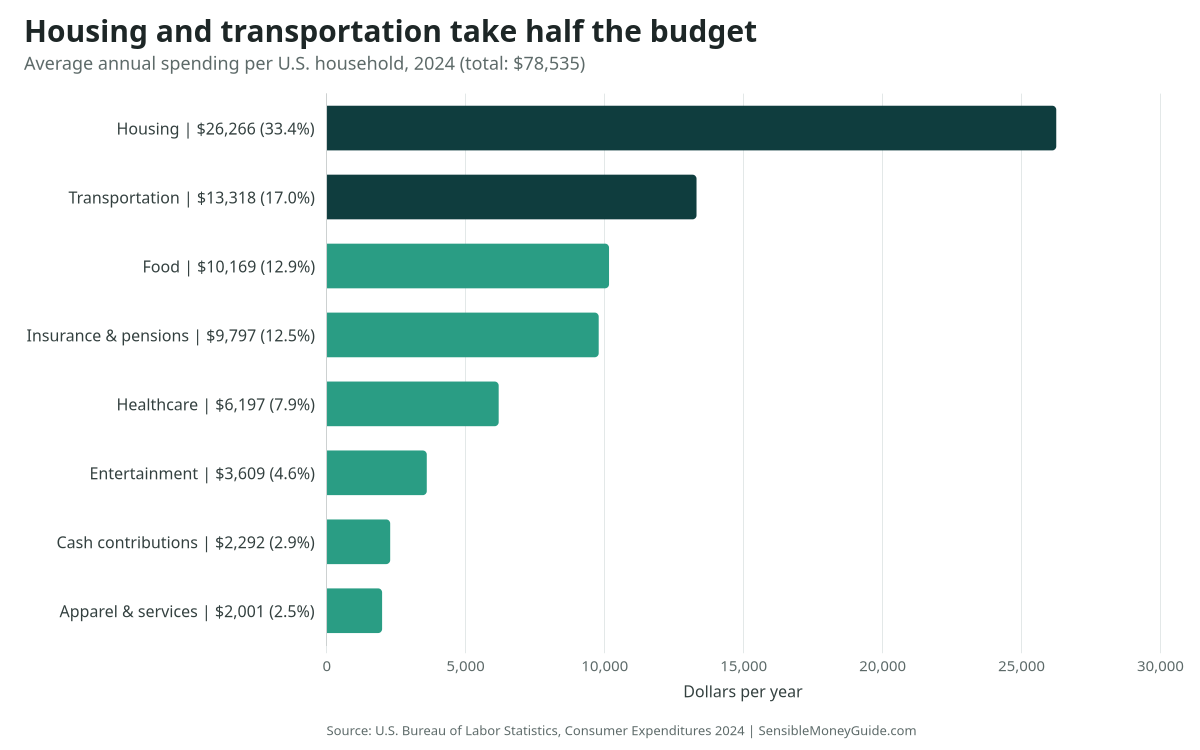
Notice something? Housing and transportation together take about half of the typical budget. Add food and you’re past 60%. That’s where the big wins hide.
This doesn’t mean you need to move or sell your car tomorrow. It means that when you look for savings, start with the bills tied to those big categories: your utilities, your car insurance, your phone and internet, and your groceries. A 10% cut on a big bill beats a 50% cut on a tiny one.
Why it feels like everything costs more
It’s not your imagination. Prices have been rising unevenly, and some bills have jumped far faster than others.
The Consumer Price Index, or CPI, tracks how prices change over time. Think of it as a giant shopping cart of goods and services that the government prices every month. In the September 2026 CPI report, overall prices were up 3.7% from a year earlier. But that average hides some big swings:
- Gasoline was up 34.2%.
- Energy overall was up 20.4%.
- Piped natural gas service was up 5.0%, and electricity was up 4.4%.
- Groceries (food at home) rose just 1.8%.
- Motor vehicle insurance actually fell about 5% over the year.
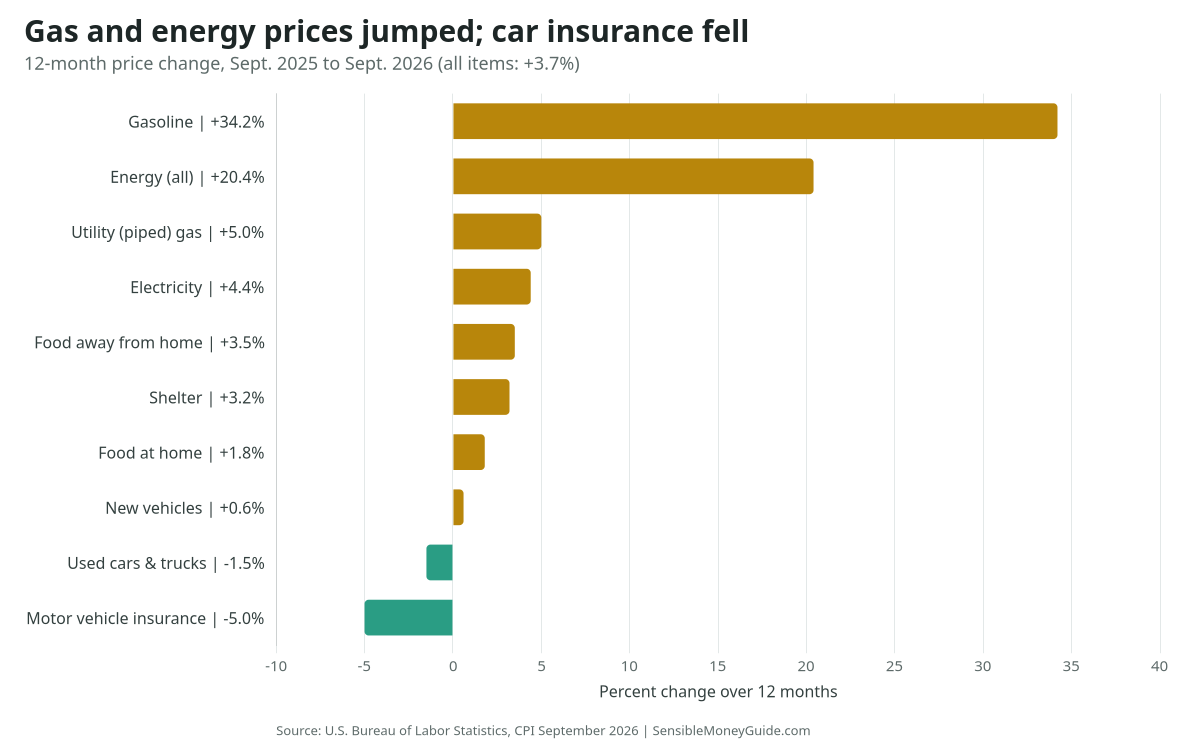
That last point matters. If your car insurance bill went up at renewal while prices across the market eased, that’s a strong sign it’s time to shop around. We’ll cover how in the insurance section.
Price worries are widespread. In the Federal Reserve’s latest survey of household finances, 91% of adults said rising prices were a concern, and 53% called it a major concern. You’re far from alone in feeling squeezed.
Start with a 30-minute bill audit
You can’t cut what you can’t see. A bill audit is just a careful look at every recurring charge, so you know exactly what you pay, to whom and when.
Why bother? Because a little breathing room changes a lot. The same Federal Reserve survey found that 63% of adults would cover a surprise $400 expense with cash or its equivalent in 2025. That number climbed from 50% in 2013 to a high of 68% in 2021, then slipped back and has held flat for four years. Put another way, more than a third of adults would have to borrow, sell something or simply not pay.
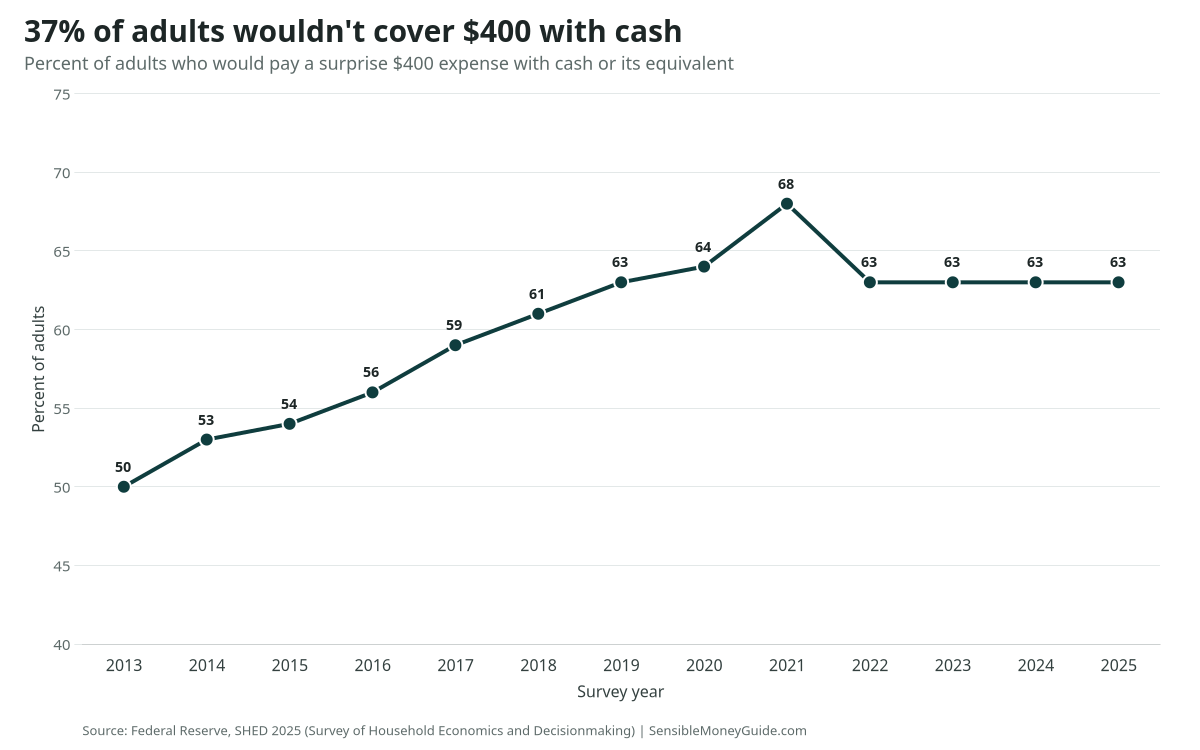
Every dollar you free up from your bills is a dollar that can go toward that cushion. If you haven’t started one yet, our emergency fund guide explains how much to aim for and where to keep it.
How to do the audit
Grab your last two or three months of bank and credit card statements. Two months is the minimum, because some charges come every other month. Then follow these steps.
- List every bill and recurring charge. Write down the company, the amount and the due date. Include the small stuff: apps, cloud storage, memberships and warranties.
- Mark what changed. Compare each bill with an older one. Bank of America’s Better Money Habits suggests checking statements regularly to catch fee increases, such as a promotional rate that quietly ended.
- Sort into three groups. Must-keep (rent, utilities, insurance), can-shrink (phone, internet, insurance coverage levels) and can-cut (things you rarely use).
- Find the mystery charges. Any charge you can’t explain gets looked up. Sometimes it’s a forgotten free trial. Sometimes it’s fraud.
- Put due dates on a calendar. The Consumer Financial Protection Bureau offers a free bill calendar worksheet for this. It suggests paying about 7 days early when you mail a check and 2 days early when you pay online.

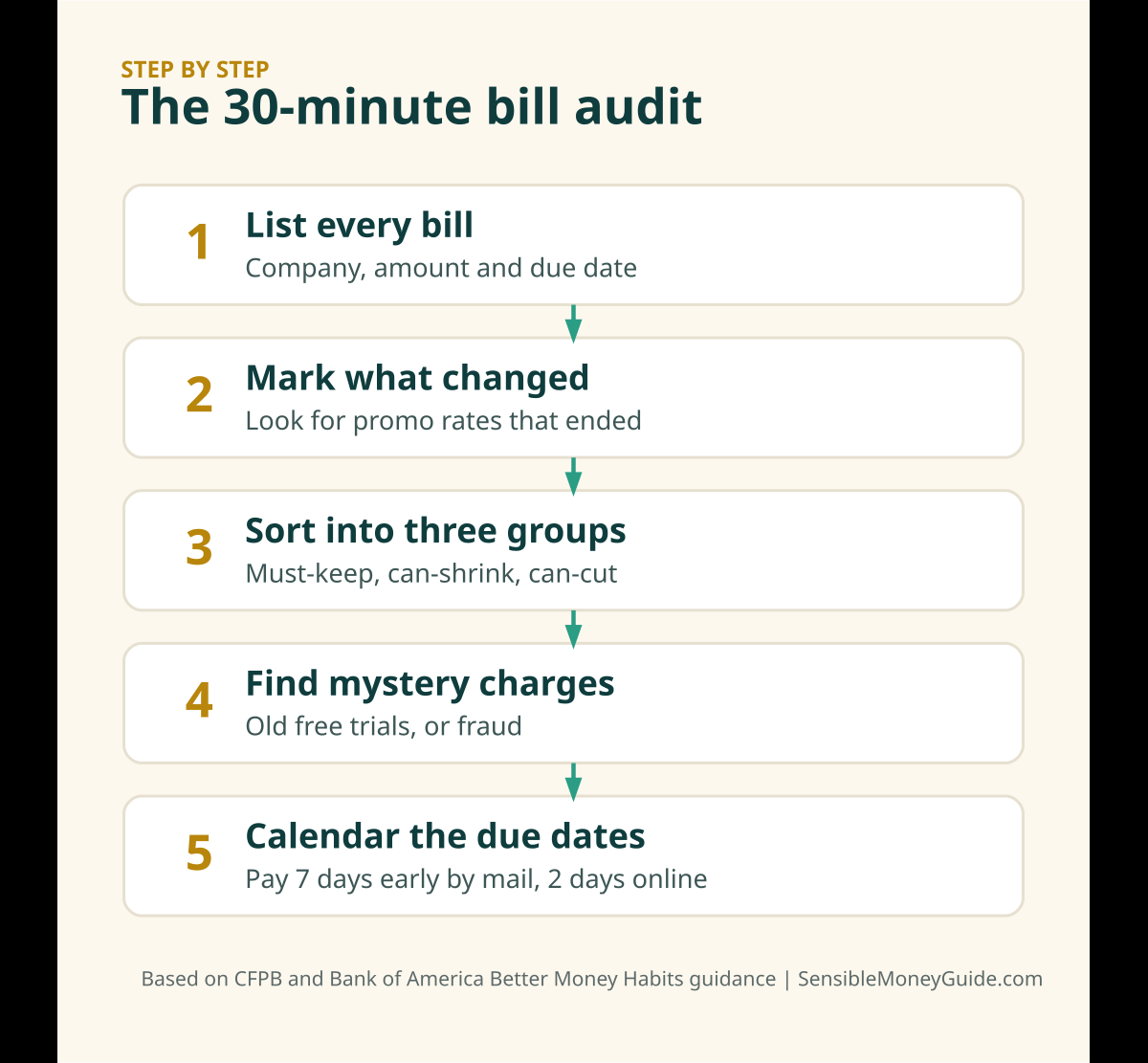
A spreadsheet works fine for this. So does a sheet of paper. If you already have a budget, this list slides right into it. If you don’t, our guide on how to make a budget that actually works shows you how to build one around these numbers.
Pro tip: If your due dates are bunched up right before payday, call and ask to move them. Many billers will shift a due date if you ask, and both the CFPB and Bank of America suggest it. It doesn’t lower the bill, but it can stop late fees.
Cut the subscription creep
Subscriptions are built to be easy to start and easy to forget. A free trial turns into a monthly charge. A $7.99 plan becomes $10.99. Each one feels too small to worry about, and that’s exactly why they pile up.
How much do people lose this way? A survey by C+R Research, reported by CNBC, found that consumers spent an average of $133 a month more on subscriptions than they thought. That’s about $1,600 a year. The same survey found that 42% had forgotten about a subscription they no longer used but were still paying for.
The survey is a few years old, but the pattern hasn’t changed. If anything, there are more apps and streaming services to sign up for now.
Worked example: trimming a list of seven subscriptions
Let’s say your audit turns up these monthly charges:
| Subscription | Monthly cost | Keep or cut? |
|---|---|---|
| Streaming service A | $15.49 | Keep |
| Streaming service B | $17.99 | Cut (watched once last month) |
| Music | $11.99 | Keep |
| Cloud storage | $2.99 | Keep |
| Gym | $39.99 | Cut (no visits in 3 months) |
| Meal-kit app | $9.99 | Keep |
| Fitness app | $14.99 | Cut (forgot it existed) |
| Total | $113.43 |
The three you cut add up to $72.97 a month. Here’s the math:
- $17.99 + $39.99 + $14.99 = $72.97 a month
- $72.97 × 12 months = $875.64 a year
That’s nearly $900 a year, and you kept the four services you actually use. This lines up with advice from Fidelity, which suggests listing your expenses and dropping the bottom few. As one saver quoted by Fidelity put it, “Cut out the bottom 3 to 5 items. You may hardly notice they’re gone.”
How to cancel without a headache
The Federal Trade Commission has clear advice on getting out of subscriptions and free trials:
- Before you sign up, read the terms. Know how long the trial lasts and how to cancel.
- Set a reminder a few days before any free trial ends.
- Read renewal notices closely. Promo prices often jump at renewal.
- Keep proof when you cancel: a screenshot, a confirmation email or notes from the call.
- If you’re still charged, contact your card company and dispute the charge. You can also report the problem at ReportFraud.ftc.gov and to your state attorney general.
One more trick: before you cancel, ask whether you can pause instead. Ramsey Solutions points out that some services let you pause a membership. That’s handy for a gym you’ll go back to in January, or a streaming service you only want for one show.
Pro tip: Rotate your streaming services. Keep one or two at a time, binge what you want, then cancel and switch. You’ll pay for a few services a year instead of all of them every month.
Phone and internet: pay for what you use
Phone and internet bills are two of the easiest to lower, because competition is fierce. Companies spend big money to win new customers. That gives you bargaining power, whether you switch or stay.
Cell phone: look at the smaller carriers
Most people know the big three carriers. Fewer know about the smaller brands that run on those same networks for much less. These are often called MVNOs, which stands for mobile virtual network operators. In plain English, they rent space on a big carrier’s towers and resell it at a lower price.
Consumer advocate Clark Howard has long been a fan of this approach. His team’s 2026 guide to cell phone plans puts it simply: “Budget carriers often deliver the lowest prices while still running on major networks”. The guide lists options such as:
- Visible, on Verizon’s network: $25 a month for unlimited talk, text and data
- Tello, on T-Mobile’s network: $10 a month for unlimited talk and text with 2GB of data
- Mint Mobile: $15 a month for 6GB when you prepay for a year (new customers start with at least three months up front)
Prices change often, so check the current rates before you switch. There are also trade-offs. Some cheap plans slow your data after a certain amount. Some require you to pay several months up front. And coverage can vary by neighborhood, even on the same network. Clark’s team suggests checking coverage maps for the places you spend the most time.
Worked example: switching a two-line plan
Say you and your partner pay $70 a line on a major carrier’s unlimited plan. That’s $140 a month. You both mostly use Wi-Fi at home and at work. You switch both lines to a $25 unlimited plan on the same network.
- Old bill: 2 lines × $70 = $140 a month
- New bill: 2 lines × $25 = $50 a month
- Savings: $90 a month, or $1,080 a year
Even if you only cut one line, or land on a $40 plan instead of $25, the savings add up fast. Before you switch, check whether you still owe money on a phone. Leaving a carrier can make the remaining payments due right away.

Internet: right-size your speed
Many households pay for more internet speed than they use. Speed is measured in megabits per second, or Mbps. A couple who streams shows, scrolls social media and joins a video call now and then usually doesn’t need the top-tier plan.
Here’s how to check: run a free speed test at the busiest time of day in your home. Then look at your plan. If you pay for 1,000 Mbps and you rarely use a fraction of it, ask about a lower tier.
Also check these:
- Equipment fees. Many providers charge a monthly rental fee for a modem or router. Buying your own can pay for itself within a year or two. Just make sure it’s on your provider’s approved list.
- Promo expirations. Many internet deals last 12 months, then jump. Put the end date on your calendar.
- Bundles. A TV-plus-internet bundle isn’t always cheaper. Price each piece separately.
Help for lower-income households
If money is very tight, the federal Lifeline program can help. According to the Federal Communications Commission, Lifeline gives eligible households up to $9.25 a month off phone or internet service, or up to $34.25 on Tribal lands. You may qualify if your income is at or below 135% of the federal poverty guidelines, or if you get benefits like SNAP, Medicaid or Supplemental Security Income.
How to negotiate almost any bill
Here’s a secret that feels too simple: you can often just ask for a lower price. Companies would rather keep you at a smaller profit than lose you to a competitor. That’s especially true for internet, cable, phone, satellite radio and some insurance.
NerdWallet’s bill negotiation guide makes a sharp point here: “If a company can offer the lower price to new customers, it can offer the price to you, too.”
Before you call
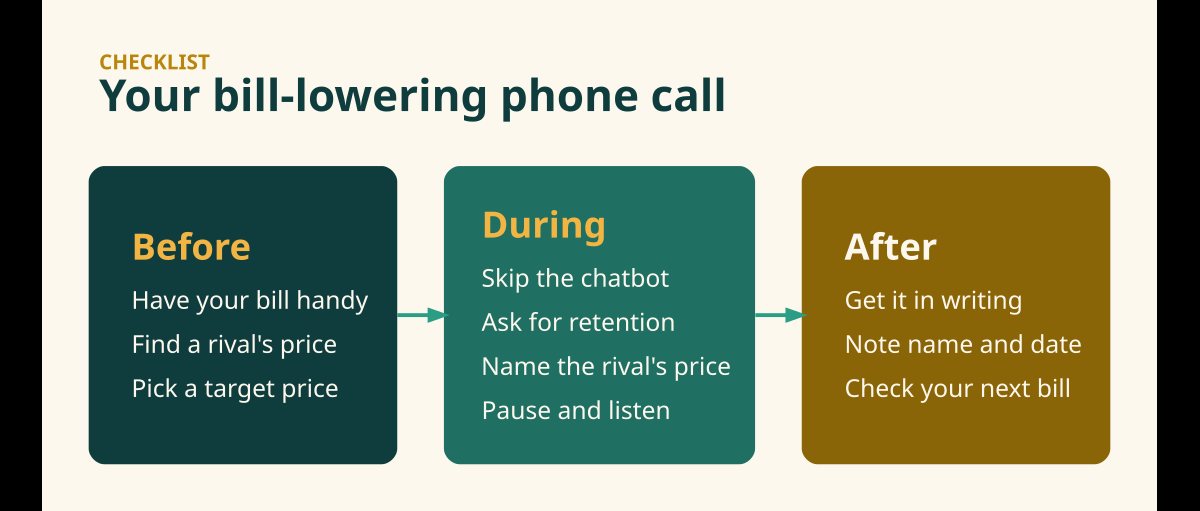
- Know your numbers. Have your current bill, how long you’ve been a customer and your payment record handy.
- Know the competition. Look up what other companies charge new customers in your area. Write down one or two specific offers.
- Pick a goal. Decide on a target price and the lowest offer you’d accept.
- Block out time. NerdWallet notes a negotiation can take anywhere from 30 minutes to a few hours, so don’t squeeze it in between meetings.
On the call
NerdWallet suggests skipping the chatbot and talking to a live person. If the first person can’t help, ask for the retention or cancellation department. Those teams usually have more room to offer a deal.
A simple script might go like this:
“Hi, I’ve been a customer for four years and I’ve always paid on time. My bill has gone up to $85 a month, and I see that [competitor] is offering similar service for $55. I’d like to stay, but I need a better price. What can you do for me?”
Then stop talking and let them answer. If the offer is weak, say so politely and mention the competitor’s price again. If they offer a free add-on you don’t want, ask for a lower monthly bill instead. If nothing works, ask for a one-time credit.

After the call
Get the new price in writing. Ask for a confirmation email, or write down the rep’s name, the date and any reference number. Then check your next bill to make sure the change went through.
Watch out: Only say you’ll cancel if you’re truly willing to. Sometimes the company says “okay” and shuts off your service. Have a backup plan lined up first.
What about bill negotiation services?
Some companies will negotiate for you. That sounds great until you see the fee. According to NerdWallet, some of these services keep 40% to 50% of what they save you. If they save you $30 a month, you might pay them $15 a month. That’s still a win if you truly hate making calls, but doing it yourself means you keep the full amount.
Worked example: a 20-minute internet call
Say your internet bill rose to $85 after a promo ended. You call, mention a competitor’s offer and settle on $65 for the next 12 months.
- $85 − $65 = $20 a month
- $20 × 12 = $240 a year
That’s $240 for a single phone call. Not bad for 20 minutes on hold and on the line.
Car and home insurance: shop, then adjust
Insurance is one bill most people set and forget. That’s a costly habit. Rates for the same driver can differ quite a bit from one company to the next, because each insurer weighs risk in its own way.
The timing is good right now, too. As we saw earlier, the September 2026 CPI showed motor vehicle insurance prices down about 5% from a year earlier, after a period of steep increases. If your renewal notice still shows a higher price, other companies may be willing to beat it.
Step 1: Get at least three quotes
The Insurance Information Institute, a nonprofit industry group, recommends getting at least three price quotes before you choose a policy. Compare the same coverage amounts and deductibles, so you’re comparing apples to apples.
A good time to shop is about a month before your policy renews. You can also shop after any big life change: a move, a marriage, a new car, a teen driver or a ticket falling off your record.
Step 2: Look at your deductible
Your deductible is the amount you pay out of pocket before insurance kicks in on a claim. A higher deductible means a lower premium, which is the price you pay for the policy.
According to the Insurance Information Institute, raising your deductible from $200 to $500 could cut the cost of your collision and comprehensive coverage by 15% to 30%. Going to a $1,000 deductible could save 40% or more.
Worked example: raising a deductible
Say your total car insurance bill is $2,400 a year. Of that, $900 is for collision and comprehensive coverage, which pays to fix your own car. You raise your deductible from $200 to $1,000.
- 40% of $900 = $360 saved a year
- New total: $2,400 − $360 = $2,040 a year
Your real savings will depend on your insurer and your state. But here’s the catch: you now need $1,000 on hand if you have an accident. Only raise your deductible if you have that money set aside. Otherwise, a fender bender could push you into credit card debt.
Step 3: Rethink coverage on an older car
Collision and comprehensive coverage pay to repair or replace your own car. On an older car worth only a few thousand dollars, you may be paying more than the coverage is worth. The Insurance Information Institute’s rule of thumb: dropping it may make sense if your car is worth less than 10 times the premium for that coverage.
For example, if collision and comprehensive cost you $600 a year and your car is worth $4,000, the car is worth less than 10 × $600 = $6,000. Dropping that coverage might be worth it, as long as you could afford to replace the car yourself. If you have a car loan or lease, your lender will likely require it.
Step 4: Ask about discounts and bundling
Many insurers offer a discount if you buy two or more types of insurance from them, such as home and auto. Others give discounts for a clean driving record, good grades for student drivers, low mileage or a good credit record. Ask for a list.
| Move | How much it can save | The trade-off |
|---|---|---|
| Compare 3+ quotes | Varies widely by driver | An hour or two of your time |
| Raise deductible $200 → $500 | 15–30% on collision and comprehensive | More out of pocket after a claim |
| Raise deductible to $1,000 | 40% or more on collision and comprehensive | You need $1,000 saved |
| Drop collision on an old car | The full cost of that coverage | You pay for your own repairs |
| Bundle home and auto | A multi-policy discount | Check that the bundle is truly cheaper |
The same approach works for homeowners and renters insurance. Shop it, check your deductible and ask about bundling. Just don’t cut liability coverage to the bone. That’s the part that protects you if someone gets hurt and sues.
Electricity, heating and water
Energy bills are a little different. You usually can’t negotiate with your electric company. But you have a lot of control over how much energy you use, and some of the best fixes cost little or nothing.
According to the U.S. Energy Information Administration, the average American household paid about $144 a month for electricity in 2024. That varies a lot by state, from about $89 a month in Utah to $213 in Hawaii.

Your thermostat is the biggest lever
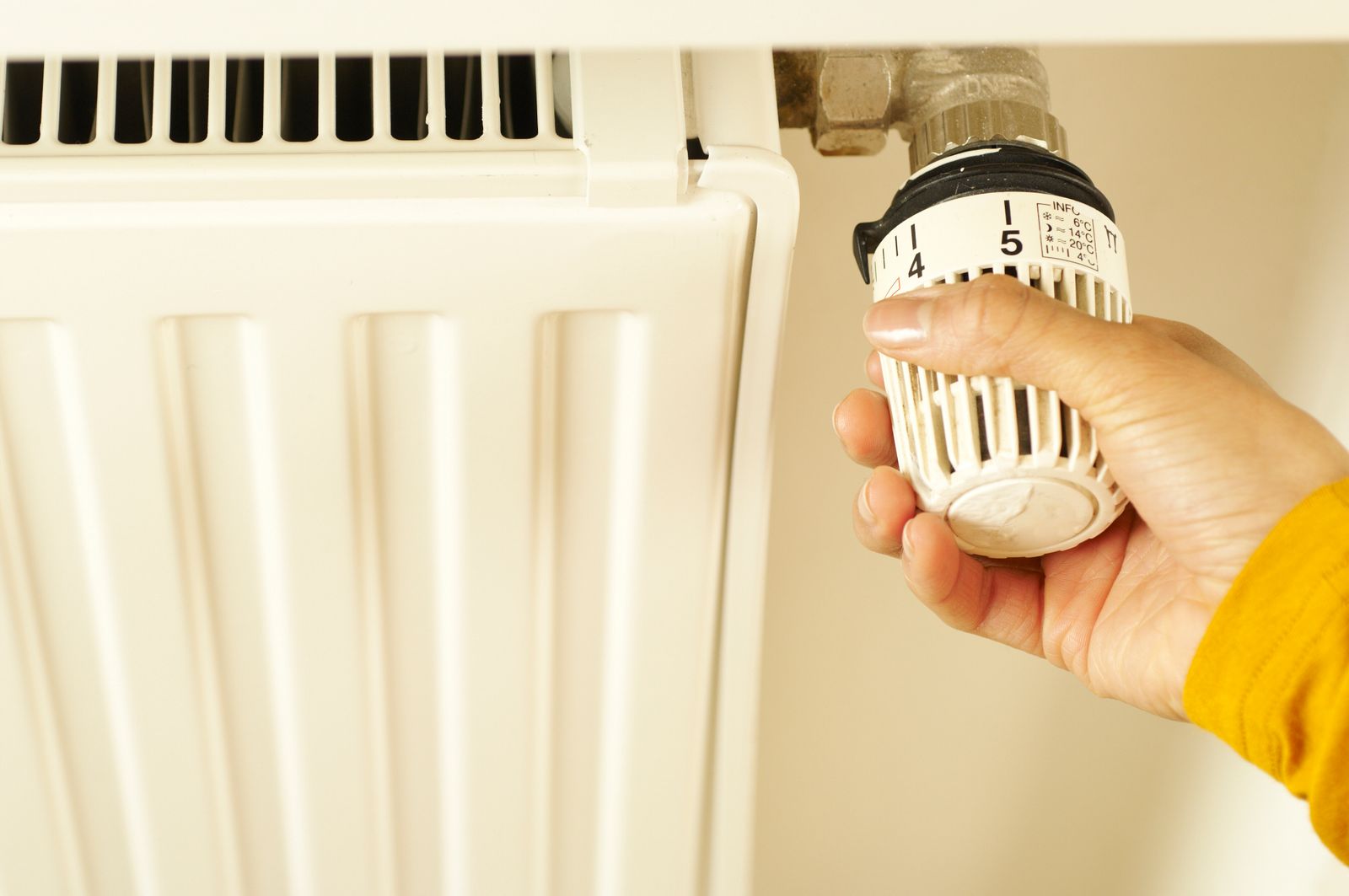
Heating and cooling make up about 32% of the energy used in a typical home, according to the U.S. Department of Energy’s Energy Saver Guide. The DOE says you can save as much as 10% a year on heating and cooling with one simple habit. Turn your thermostat down 7 to 10 degrees for 8 hours a day in the fall and winter. The easiest time to do it is while you sleep or while you’re at work.
A programmable or smart thermostat makes this automatic. You set it once, and it does the work every day. If you have a heat pump, the DOE says not to set it back unless your thermostat is made for heat pumps. Otherwise it can switch on costly backup heating.
Worked example: the thermostat setback
Say your household spends $1,100 a year to heat and cool your home. You set the thermostat back 8 degrees every night.
- Up to 10% of $1,100 = up to $110 a year
That’s from a habit that takes zero effort once it’s programmed.
More energy savers that cost little or nothing
- Turn down your water heater. Water heating is about 18% of home energy use, per the DOE. The DOE suggests setting it to 120°F, which it calls safe for most people. Many water heaters come set higher.
- Wash clothes in cold water. According to the DOE, switching from hot to warm cuts a load’s energy use about in half, and cold saves even more.
- Swap old bulbs for LEDs. An ENERGY STAR LED uses up to 90% less energy than an old incandescent bulb. The DOE says each one can save about $55 in electricity over its lifetime.
- Kill phantom power. Electronics that are “off” but still plugged in can add 5% to 10% to your monthly utility bill, according to the DOE. An advanced power strip can shut them off for you.
- Seal air leaks. Caulk and weatherstripping around windows and doors are cheap. The DOE says sealing leaks can cut heating and cooling bills by 10% to 20%.
Some utilities also charge more at certain times of day. This is called time-of-use pricing. Fidelity describes one Dallas resident who estimates she saves about $100 a month by running her dishwasher, washer and dryer outside of peak hours. Your results will depend on your utility’s rates, so check whether your provider offers this kind of plan.
For a quick visual walk-through of more ideas, this short video from NerdWallet covers simple ways to bring your energy bill down:

Also ask your utility about free home energy audits, budget billing (which spreads costs evenly across the year) and rebates for things like smart thermostats or insulation. Many offer at least one of these.
Groceries, gas and bank fees
These aren’t “bills” in the usual sense, but they come around just as reliably. Small changes here add up because you repeat them every week.
Groceries and eating out
Remember that BLS data? The average household spent about $3,945 a year eating out, on top of $6,224 on groceries. Restaurant prices are also rising faster than grocery prices right now. In the September 2026 CPI, food away from home was up 3.5% over the year, while food at home was up 1.8%.
A few habits that work for most families:
- Plan meals for the week. Then shop from a list. Ramsey Solutions suggests building meals around leftovers and store sales.
- Buy store brands. Ramsey Solutions suggests buying generic when you can. Store brands usually cost less than name brands.
- Order online for pickup. You see your total before you check out, which makes it easier to remove impulse items. Watch for pickup fees, though.
- Pack lunch a few days a week. Fidelity estimates that cutting $20 a week in fast-food lunches saves about $1,000 a year.


Gas
With gasoline prices up 34.2% over the past year in the latest CPI report, fuel may be the bill that’s grown fastest in your budget. You can’t control prices at the pump, but you can control how much you buy.
- Use a gas price app to find the cheapest station on your normal route.
- Check whether your grocery store or warehouse club offers fuel discounts.
- Keep your tires properly inflated and drive smoothly. Hard braking and fast starts burn more fuel.
- Combine errands into one trip.
Bank fees and interest
Bank fees are the most wasteful bill of all, because you get nothing for them. The Consumer Financial Protection Bureau found that banks collected $5.83 billion in overdraft and insufficient-funds fees in 2023. That’s down sharply from $11.96 billion in 2019, and as of 2024 some banks still charged as much as $37 per overdraft.
To stop paying them:
- Turn on low-balance alerts in your banking app.
- Link a savings account to your checking account as a backup.
- Ask your bank to waive a fee, especially if it’s your first in a while.
- Switch to a bank or credit union with no monthly fees and low or no overdraft fees.
Credit card interest is the other big drain. If you carry a balance, the interest you pay each month is a bill too, and often a large one. Our guide on how to pay off credit card debt walks through the fastest ways to shrink it.
If you’re already behind on bills
Everything above assumes you’re paying your bills and want to pay less. But if you’re already behind, the order of operations changes. The goal shifts from saving money to protecting the things you can’t lose.
Decide what gets paid first
The CFPB’s Your Money, Your Goals toolkit suggests weighing the risk of not paying each bill. Ask yourself what happens if this one goes unpaid. Losing your home, your utilities or the car you need to get to work is far more serious than a late fee on a store card.
In general, the bills that keep you housed, keep the lights on and keep you working come first. That usually means rent or mortgage, utilities, car payments and car insurance if you drive to work, and food.
Call before you miss a payment
This feels hard, but it works more often than people expect. The CFPB suggests calling the company, explaining what happened and asking about options. You may be able to get a short-term payment plan, a waived late fee or a new due date that lines up with your paycheck.
Timing matters for your credit, too. According to the CFPB, utility and credit card payments made within 30 days of the due date typically don’t show up as late on your credit report. Once a payment hits 30 days late, it can hurt your score. Our guide on how credit scores really work explains why payment history matters so much.
Help with energy and phone bills
- LIHEAP. The Low Income Home Energy Assistance Program is a federal program that helps households with low incomes pay heating and cooling bills. According to the U.S. Department of Health and Human Services, it can also help in a crisis, such as a shutoff notice, and with low-cost weatherization. You apply through your state or local office, not the federal government. If you’re not sure where to start, call the National Energy Assistance Referral hotline at (866) 674-6327.
- Utility hardship programs. Many utilities have their own payment plans and assistance funds. Call and ask what’s available.
- Lifeline. As covered above, this FCC program cuts up to $9.25 a month off phone or internet service for eligible households.
Watch out: Be careful with anyone who promises to fix your bills or debts for you. The CFPB suggests sticking with unbiased help, such as a certified credit counselor, and avoiding anyone who asks for payment up front.
Your 7-day action plan
Reading about savings doesn’t save money. Doing it does. Here’s a simple plan that spreads the work across one week, about 20 to 40 minutes a day.
- Day 1: Run your bill audit. Pull two or three months of statements and list every recurring charge, its amount and its due date.
- Day 2: Cancel or pause subscriptions. Cut anything you haven’t used in the last month. Save your cancellation confirmations.
- Day 3: Check your phone plan. Look at how much data you use. Compare your bill with two or three smaller carriers on the same network.
- Day 4: Call your internet provider. Use the script above. Ask for the retention department if you need to.
- Day 5: Get three insurance quotes. Compare the same coverage. Ask your current insurer about discounts and deductibles.
- Day 6: Make your energy changes. Program your thermostat, turn the water heater to 120°F and plug electronics into a power strip.
- Day 7: Move the savings. Add up what you saved each month and set up an automatic transfer of that amount into savings, or toward debt.
That last step is the one people skip, and it’s the most important. If you don’t give the freed-up money a job, it tends to disappear into everyday spending.
Make it a habit
Lowering your bills isn’t a one-time job. Prices creep back up, promos end and new subscriptions sneak in. A quick checkup twice a year keeps your savings from leaking away.
Pick two dates that are easy to remember, like the start of spring and the start of fall. On those days, pull up your bill list from your audit and compare it with your latest statements. Look for anything that went up, anything new and anything you stopped using. It usually takes less than an hour once you’ve done the first audit.
What it can add up to
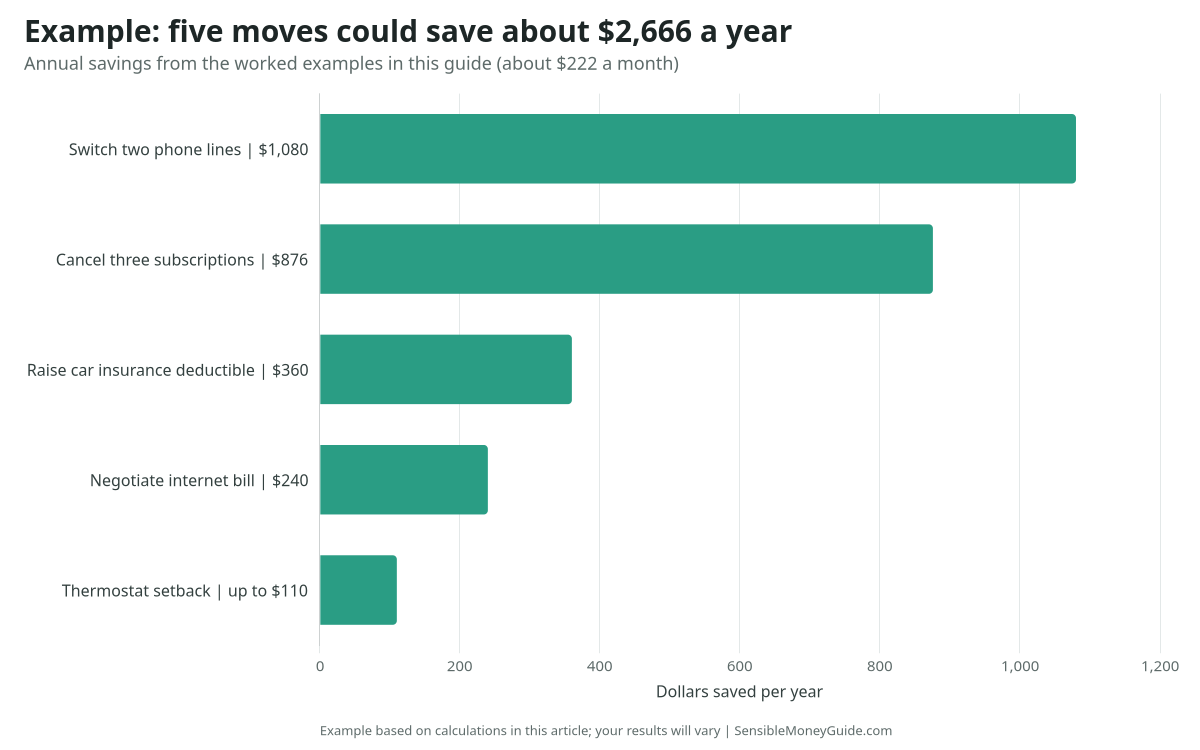
Let’s put the worked examples from this guide together. They’re examples, not promises, but they show how quickly a few moves stack up:
- Cancel three unused subscriptions: $875.64 a year
- Switch two phone lines to a cheaper plan: $1,080 a year
- Negotiate your internet bill down $20 a month: $240 a year
- Raise your car insurance deductible: $360 a year
- Set back your thermostat: up to $110 a year
Total: about $2,666 a year, or roughly $222 a month. For many families, that’s enough to build a starter emergency fund in under a year.
Common mistakes to avoid
- Only cutting the small stuff. Skipping one latte feels good, but a single call about your insurance could save more than months of skipped coffee. Start with the big bills.
- Forgetting promo end dates. A great first-year price that jumps in month 13 isn’t a great deal unless you’re ready to call again. Put the date on your calendar.
- Cutting insurance coverage too far. Lowering your premium by dropping liability coverage or raising a deductible you can’t afford can cost you far more after an accident.
- Switching phone carriers without checking coverage. A cheap plan is no bargain if it doesn’t work at your house or job.
- Ignoring device payments. If you still owe on a phone, leaving your carrier may make the full balance due.
- Setting autopay and never looking again. Autopay prevents late fees, but it also hides price increases and mystery charges. Bank of America suggests keeping an eye on your bills even after you automate them.
- Letting the savings vanish. If you don’t move the money on purpose, it won’t stay saved.
Small habits vs. big bills: a friendly debate
Money experts don’t all agree on where to start. Ramsey Solutions often highlights daily habits. One of its examples: a $6-a-day coffee shop habit costs about $180 a month, and brewing at home could save roughly $155 a month. Fidelity makes a similar point about fast-food lunches.
Others put the focus on big recurring bills, like insurance and phone plans, because you make the change once and save every month after. NerdWallet’s negotiation advice and Clark Howard’s phone plan advice fall into this camp.
The fair answer is that both work. The big bills usually give you more money for less effort. The small habits matter too, because you repeat them so often. Start with the big ones, then trim the small ones you won’t miss.
Myths vs. facts
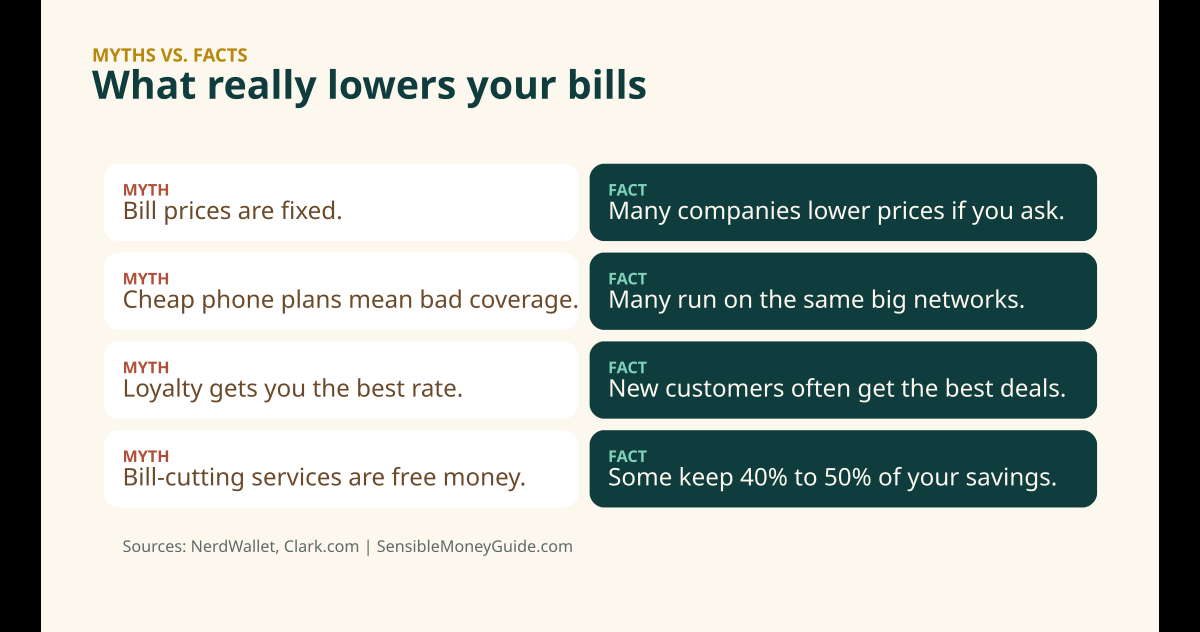
Myth: Bill prices are fixed, so there’s no point calling.
Fact: Many companies, especially for internet, phone and TV, have room to lower prices for customers who ask. NerdWallet notes that if a company offers a lower price to new customers, it can usually offer it to you.
Myth: Cheaper phone plans mean worse coverage.
Fact: Many budget carriers run on the same networks as the big three. The trade-offs are usually data caps, slower speeds after a limit or paying months up front, not the towers themselves.
Myth: Turning the heat way down and back up uses more energy than leaving it steady.
Fact: The DOE says setting your thermostat back 7 to 10 degrees for 8 hours a day can save as much as 10% a year on heating and cooling.
Myth: Loyalty gets you the best rate.
Fact: Often the reverse is true. Promotional prices go to new customers, and longtime customers can end up paying more. Shopping around keeps your current company honest.
Myth: Bill negotiation services are free money.
Fact: Some keep 40% to 50% of what they save you. Doing it yourself takes a phone call and lets you keep it all.

Key takeaways
- Housing and transportation take about half of the average household’s spending, so look for savings there first.
- Prices are rising unevenly. Gas and energy have jumped, while car insurance prices fell over the past year, making it a good time to shop.
- A 30-minute bill audit often turns up forgotten subscriptions and expired promo rates.
- Smaller phone carriers that run on major networks can cut a phone bill by more than half.
- You can often lower internet, phone and TV bills just by calling and asking, especially with a competitor’s price in hand.
- Get at least three insurance quotes, and only raise your deductible if you have that money saved.
- Simple energy habits, like a thermostat setback and a 120°F water heater, cut bills with no ongoing effort.
- Move what you save into savings or debt payments right away, or it will slip back into spending.
Frequently asked questions
What bills can I negotiate?
Internet, cable or satellite TV, cell phone, and some insurance bills are the most common. Medical bills, gym memberships and even some credit card interest rates can sometimes be lowered too. Bills from regulated utilities, like electricity, usually can’t be negotiated, but you can ask about payment plans and assistance programs.
How much can I save by lowering my bills?
It depends on what you pay now. In the worked examples in this guide, five changes add up to about $2,666 a year. Someone already on a cheap phone plan will save less, while someone paying top prices for everything could save more.
Is it rude to ask for a lower price?
Not at all. Companies expect it, and customer service reps field these calls every day. Be polite, be clear about what you want and be ready to switch if the offer isn’t good enough.
How often should I review my bills?
Do a full bill audit once or twice a year. Shop your car and home insurance before each renewal. Also check any bill right after a promotional price ends.
Does lowering my thermostat really save money?
Yes. The U.S. Department of Energy says turning your thermostat down 7 to 10 degrees for 8 hours a day can save as much as 10% a year on heating and cooling. A programmable or smart thermostat makes it automatic.
Will switching phone carriers hurt my credit?
Switching to a prepaid plan usually doesn’t involve a credit check. Some postpaid carriers do check credit when you open an account. The bigger risk is leaving with an unpaid phone balance, which can become due right away.
What if I can’t pay my bills this month?
Call the company before the due date and ask about a payment plan or a new due date. Pay the bills that protect your housing, utilities and ability to work first. For heating and cooling bills, ask your state about LIHEAP, or call the National Energy Assistance Referral hotline at (866) 674-6327.
Your next step this week
Pick one bill, just one, and call about it before Friday. Your internet or phone bill is a great place to start. Look up one competitor’s price, set aside 30 minutes, and use the script in this guide. Then move whatever you save into your savings account the same day.
Sources
- U.S. Bureau of Labor Statistics, “Consumer Expenditures–2024” (news release), December 19, 2025.
- U.S. Bureau of Labor Statistics, “Consumer Price Index – September 2026” (news release), October 14, 2026.
- Board of Governors of the Federal Reserve System, “Economic Well-Being of U.S. Households in 2025” (press release), May 13, 2026.
- Board of Governors of the Federal Reserve System, “Report on the Economic Well-Being of U.S. Households: Unexpected Expenses” (data table), accessed October 2026.
- U.S. Department of Energy, “Energy Saver Guide: Tips on Saving Money and Energy in Your Home”, 2022, accessed October 2026.
- U.S. Energy Information Administration, “Residential electric bills in Hawaii and Connecticut are twice those in New Mexico, Utah”, May 12, 2025.
- Federal Trade Commission, “Getting In and Out of Free Trials, Auto-Renewals, and Negative Option Subscriptions”, accessed October 2026.
- Federal Communications Commission, “Lifeline: Overcoming the digital divide and opening doors to opportunity”, accessed October 2026.
- U.S. Department of Health and Human Services, Administration for Children and Families, “LIHEAP FAQs for Consumers”, accessed October 2026.
- Consumer Financial Protection Bureau, “Your Money, Your Goals: Behind on Bills? Start with One Step”, accessed October 2026.
- Consumer Financial Protection Bureau, “Overdraft/NSF Revenue in 2023 Down More Than 50% Versus Pre-Pandemic Levels”, April 24, 2024.
- Fidelity Investments, “Real tricks to spend less and save more”, September 8, 2026.
- Bank of America Better Money Habits, “Paying Bills on Time: Ways to Better Manage Your Bills”, accessed October 2026.
- NerdWallet, “Bill Negotiation: Get a Better Deal on Cable, Internet and More”, updated March 23, 2026.
- Clark.com (Clark Howard), “Best Cell Phone Plans & Deals (2026): Find the Cheapest Option for Your Needs”, October 1, 2026.
- CNBC, “‘It’s a slippery slope’: Most consumers underestimate monthly subscription costs by at least $100, study says”, September 6, 2022.
- Ramsey Solutions, “How to Cut Spending”, updated December 30, 2024.
- Insurance Information Institute, “9 Ways to Lower Your Auto Insurance Costs”, accessed October 2026.
This article is for educational purposes only and isn’t financial advice. Consider talking with a qualified professional about your situation.
You must be logged in to post a comment Login