Debt Management
How to Pay Off Credit Card Debt: The Complete Guide
Learn how to pay off credit card debt step by step: how interest works, avalanche vs. snowball, balance transfers, help options and a plan to start this week.

Picture someone like Jasmine, a 38-year-old dental hygienist. She’s careful with money most months. But a car repair, a few holiday gifts and one rough stretch between paychecks left her with about $6,000 spread across three credit cards.
Every month she pays the minimum on each card. Every month the balances barely move. She opens the app, sees a number that looks almost the same as last month, and closes it again. Jasmine isn’t real, but her story is one millions of people would recognize.
If that sounds familiar, you’re far from alone. Americans owed about $1.263 trillion on credit cards in mid-2026, according to the Federal Reserve Bank of New York. The good news is that credit card debt follows simple math. Once you understand it, you can make that math work for you instead of against you.
This guide walks you through the whole process. You’ll see how interest really piles up, which card to pay first, which tools can cut your rate, and which traps to avoid. Grab a coffee. By the end, you’ll have a plan you can start this week.
What you’ll learn:
- Why credit card debt grows so fast, and how to read the numbers on your statement
- How long minimum payments really take (the answer may shock you)
- The avalanche and snowball methods, and how to pick the right one for you
- When a balance transfer or a consolidation loan makes sense, and when it doesn’t
- How to spot a legitimate credit counselor and avoid debt relief scams
- A step-by-step plan, plus the most common mistakes people make
In this guide:
- How credit card interest really works
- The minimum payment trap
- Step one: see the whole picture
- Stop adding new debt and build a small cushion
- Avalanche vs. snowball: picking your payoff order
- How to lower your interest rate
- Finding extra money to put toward your cards
- When you need outside help
- Your step-by-step payoff plan
- Common mistakes to avoid
- Myths vs. facts
- Key takeaways
- Frequently asked questions
- Your next step this week
- Sources
How credit card interest really works
Before you can beat credit card debt, it helps to know exactly how it grows. The engine behind it is the APR, or annual percentage rate. That’s the yearly cost of borrowing, shown as a percentage of what you owe.
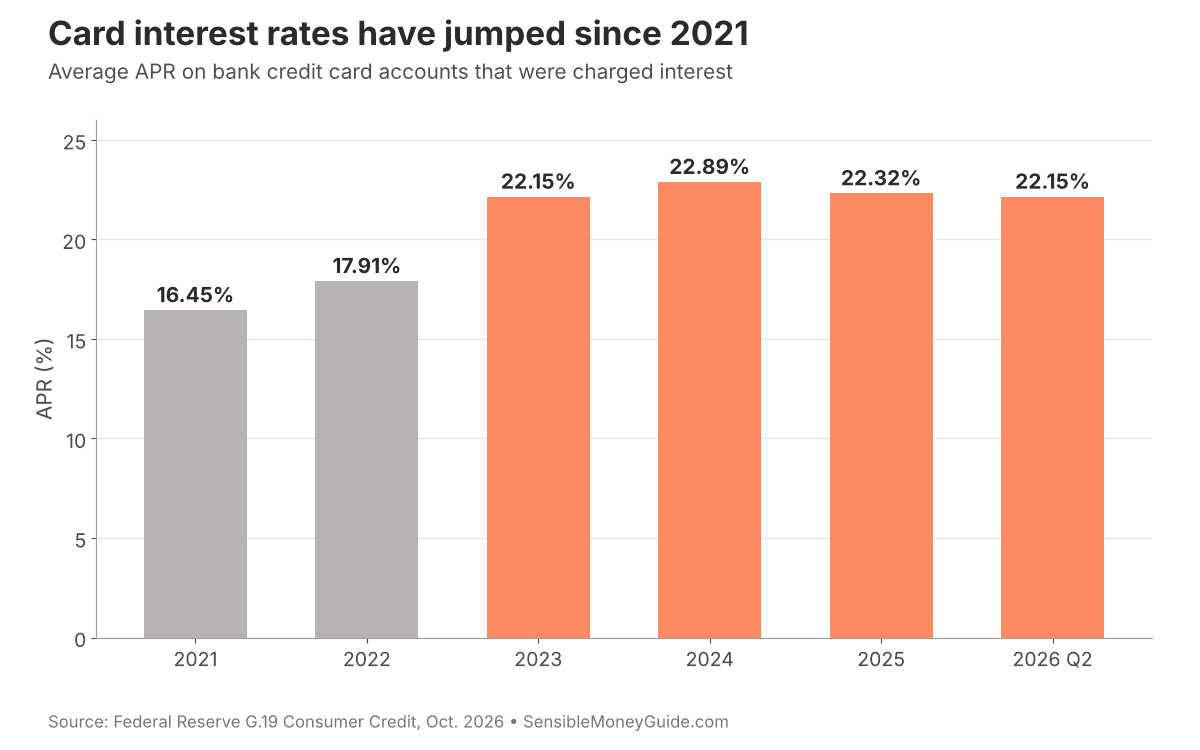
Card rates are high right now. The Federal Reserve tracks the average rate banks charge on card accounts that actually pay interest. In 2025, that average was 22.32%. Back in 2021, it was 16.45%. Bankrate’s weekly average of APRs on popular credit cards put the average at 19.67% in mid-October 2026, down a bit from a record 20.79% in August 2024. The two numbers differ because they measure different things, but both tell the same story: carrying a balance is expensive.
Interest is charged daily, not yearly
Here’s the part most people never see. Your card company doesn’t wait until the end of the year to charge interest. Most card companies divide your APR by 365 (some use 360) to get a daily periodic rate. Then it applies that tiny rate to your balance every single day.
At a 22% APR, the daily rate is about 0.06%. That sounds harmless. But on a $6,000 balance, it works out to roughly $110 of interest a month. And because unpaid interest gets added to your balance, next month you pay interest on last month’s interest too. That’s called compounding, and it’s why card debt can feel like running up a down escalator.
Your grace period disappears when you carry a balance
Most cards give you a grace period. That’s the window between the end of your billing cycle and your due date. If you pay your full statement balance by the due date, you usually pay zero interest on purchases.
The catch is that once you carry a balance from one month to the next, you typically lose that grace period. New purchases then start collecting interest right away. So every coffee or tank of gas you put on a card with a balance costs more than its sticker price. This is one reason the first rule of payoff is to stop using the cards you’re paying down.
How to read your statement in two minutes
Your monthly statement holds almost everything you need. Look for four numbers. The new balance is what you owe today. The minimum payment due is the least you can pay on time. The interest charged line shows what borrowing cost you this month. And the APR section lists each rate on the account.
Circle the interest line. Seeing “$112.47 interest charged” in black and white tends to wake people up faster than any article can. That number is money you paid and got nothing for. Your goal is to shrink it every month until it reaches zero.
Why this matters for your plan
Every dollar of interest you avoid is a dollar that goes toward the real balance. That’s the whole game. The faster you shrink the balance, the less interest gets charged, which means more of each payment chips away at the debt. Payoff speeds up as you go, the same way compounding sped up the debt in the first place.
The minimum payment trap
Your minimum payment is the smallest amount you can pay by the due date without a late fee or a hit to your credit. It feels like the “right” amount because the card company printed it on your bill. But it’s designed to keep you current, not to get you out of debt.
Many issuers set the minimum at the month’s interest plus about 1% of the balance, with a floor of around $25. Formulas vary by card, so check your card agreement. Let’s see what that formula does to a typical balance.
Worked example: $6,000 at 22% APR
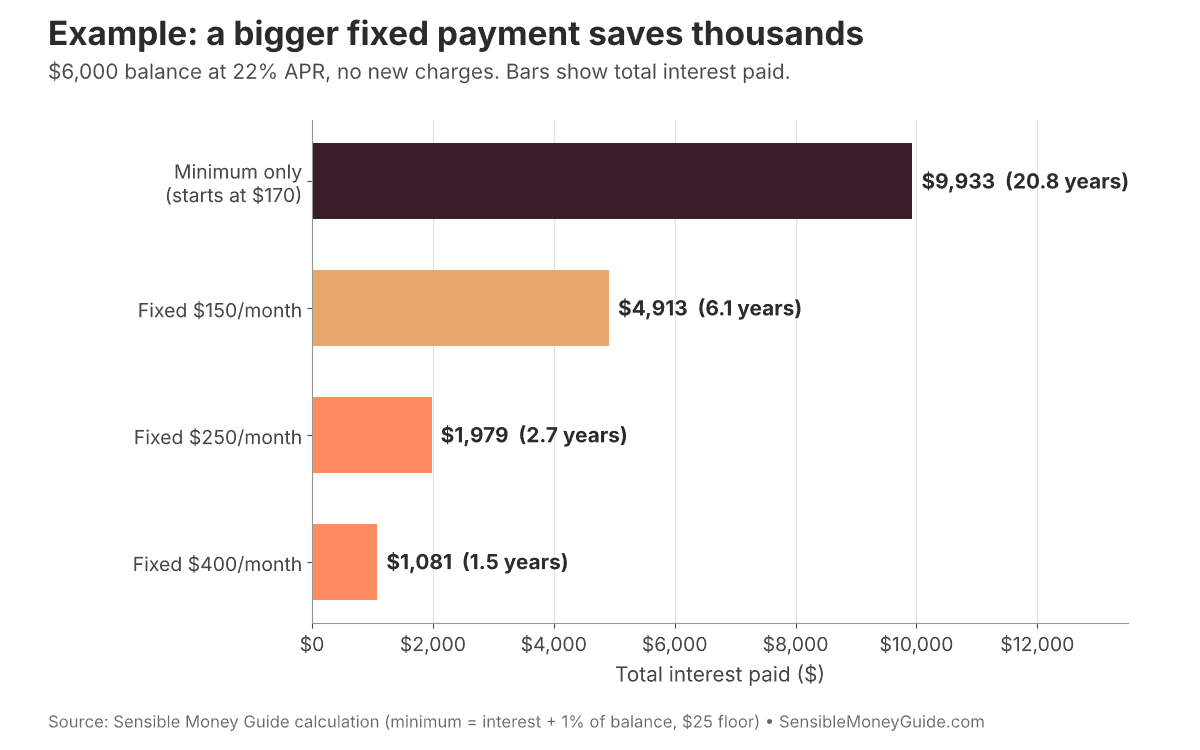
Say you owe $6,000 at a 22% APR and you stop using the card. Your first minimum payment would be about $170: $110 of interest plus $60 (1% of the balance).
- Paying only the minimum (it shrinks as your balance shrinks): about 20.8 years to pay off, with roughly $9,933 in interest. You’d pay back more than $15,900 in total.
- Paying a fixed $150 a month: about 6 years and $4,913 in interest.
- Paying a fixed $250 a month: about 2.7 years and $1,979 in interest.
- Paying a fixed $400 a month: 18 months and about $1,081 in interest.
Look at the jump between the first and third lines. Going from the shrinking minimum to a steady $250 saves you almost $8,000 and about 18 years. You don’t need a windfall to change your future. You need a fixed payment that doesn’t shrink.
Pro tip: Look for the “minimum payment warning” box on your statement. By law, it shows how long payoff takes if you pay only the minimum, plus the monthly amount that would clear the balance in three years. The Consumer Financial Protection Bureau (CFPB) notes these figures assume you make no new purchases. That three-year number is a great starting target.
Why minimums shrink, and why that’s a problem
As your balance drops, a percentage-based minimum drops too. That feels like relief. It’s really the card company stretching your payoff out longer. The simple fix is to pick a dollar amount and keep paying it, even when the minimum gets smaller. Set it as an automatic payment so you don’t have to decide again each month.
Step one: see the whole picture
A lot of people avoid looking at their card balances. That’s normal. It can feel scary to add it all up. But you can’t make a plan for a number you don’t know, and most people feel calmer once it’s written down. The fog is usually worse than the facts.
Charles Schwab suggests listing every card with its balance, interest rate, minimum payment, credit limit, available credit and annual fee. Pull up each account online or grab your latest statements, and fill in a simple list like the one below.
| Card | Balance | APR | Minimum | Credit limit | Due date |
|---|---|---|---|---|---|
| Store card | $900 | 29.99% | $35 | $1,500 | 5th |
| Card B | $3,500 | 18.99% | $90 | $6,000 | 12th |
| Card C | $5,600 | 24.99% | $150 | $8,000 | 20th |
| Total | $10,000 | $275 | $15,500 |

Find your APR (it may not be the one you think)
Your APR is printed on your monthly statement, usually in a box near the end labeled “Interest Charge Calculation.” Some cards have more than one rate. Purchases, cash advances and balance transfers can each have their own APR. Write down the rate for each type of balance you carry.
Figure out what you can pay each month
Next, look at your budget and decide how much you can put toward all your cards combined. Be honest but a little bold. If your minimums add up to $275 and you can find $450, that extra $175 is your secret weapon. If you don’t have a budget yet, our guide to making a budget that actually works walks you through it step by step.
This total is your debt payment budget. You’ll use it in every method below. The more you can raise it, even by $25 or $50, the faster the whole thing goes.
Stop adding new debt and build a small cushion
Paying down a card while still using it is like bailing water out of a boat without plugging the hole. So step two is simple, even if it isn’t easy: stop adding new charges to the cards you’re paying off.
You don’t have to cut up your cards. Closing old accounts can actually hurt your credit score, because it lowers your total available credit. (Our guide to how credit scores really work explains why.) Instead, make the cards harder to use. Remove them from your phone wallet and online shopping accounts. Some people go further. Suze Orman has long suggested putting cards somewhere inconvenient, even in a bag in the freezer, according to CNBC.
Why a small emergency fund comes first
This might sound backward. Why save money when you have expensive debt? Because life keeps happening while you pay off cards. Without any cash cushion, the next flat tire or vet bill goes right back on the card, and you lose ground.
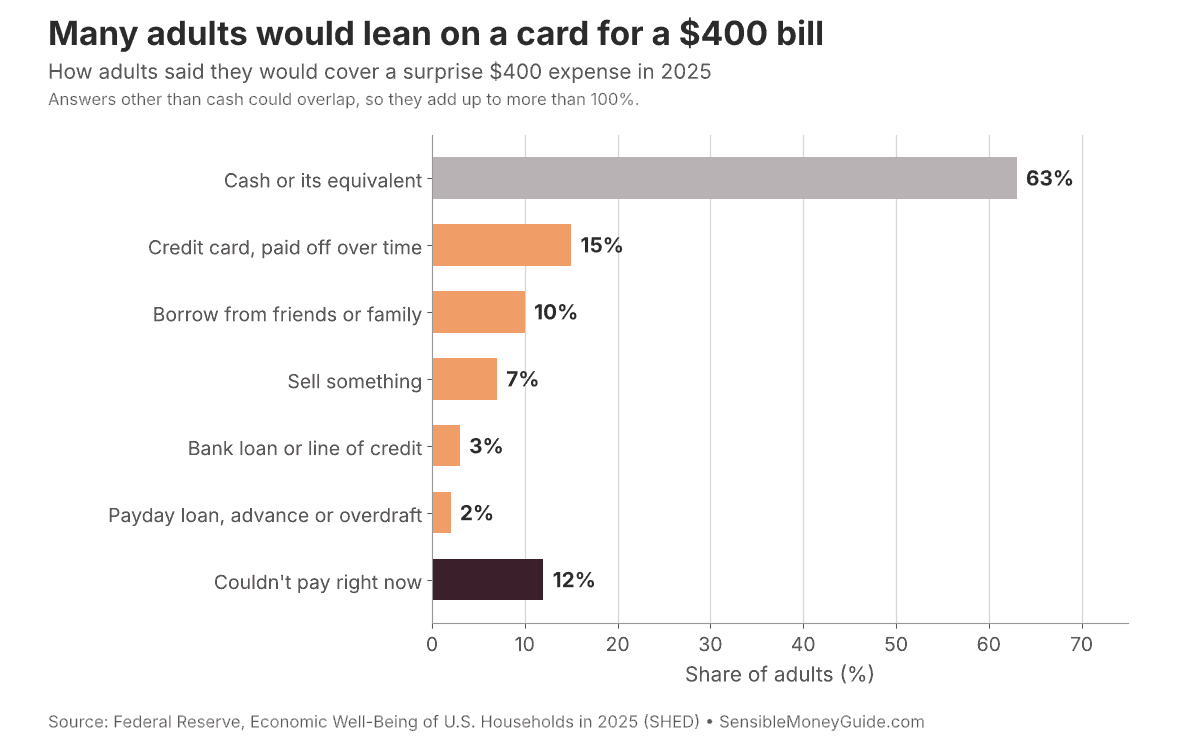
The Federal Reserve’s annual survey of household finances shows how common this is. In its 2025 report, 63% of adults said they’d cover a surprise $400 expense with cash or its equivalent. Among everyone else, putting it on a credit card and paying it off over time was the most common answer, chosen by 15% of all adults. Another 12% said they couldn’t pay a $400 bill right now at all.
A starter cushion of $500 to $1,000 breaks that cycle for small surprises. Keep it in a separate savings account so it’s not mixed with spending money. Once your cards are paid off, you can grow it into a full emergency fund. Our emergency fund guide covers how much you’ll eventually want and where to keep it.
Watch out: Don’t put every spare dollar into savings while your cards charge 22% or more. A savings account might earn a few percent. Your debt costs far more. Build the small starter cushion, then send the extra to your cards.
Be kind to yourself about how you got here
Credit card debt often comes with a heavy dose of shame. People hide statements from a partner or avoid opening mail. But most card debt doesn’t come from wild shopping sprees. It comes from car repairs, medical bills, a gap between jobs, or simply prices rising faster than paychecks. Using credit bureau data, the Fed’s report found that since 2023, average card balances rose more than 35% among adults who said they were finding it hard to get by.
If you share finances with someone, have the money talk early. Pick a calm time, not right after a big bill arrives. Show them your debt list and the plan. Most partners react better to “here’s the problem and here’s how I’m fixing it” than to a surprise later on.

Keep paying every minimum, on time
Whatever plan you choose, pay at least the minimum on every card, every month. Bank of America’s Better Money Habits site puts on-time payments at the top of its list, since late payments add fees and grow your debt. A late payment can also trigger a higher penalty APR and hurt your credit score. Set up autopay for at least the minimum on each card. Then make your extra payment by hand or with a second automatic transfer.
Avalanche vs. snowball: picking your payoff order
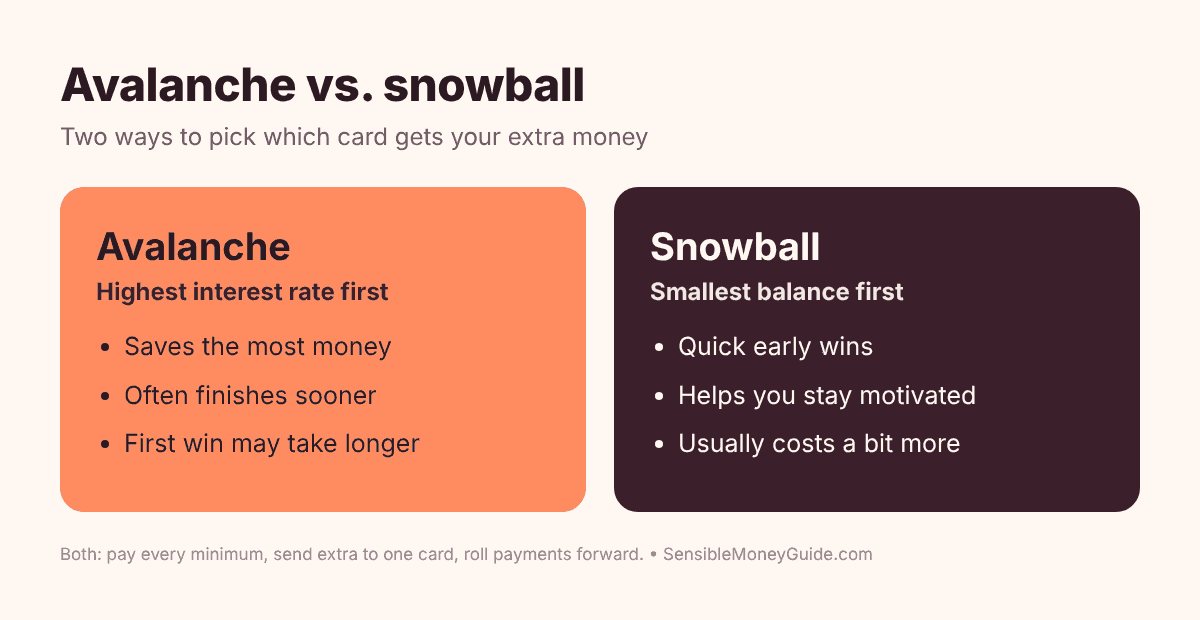
Once you know your total debt payment budget, you need to decide where the extra money goes. You’ll pay the minimum on every card, then send all the extra to one “target” card. When that card hits zero, you roll its whole payment onto the next target. There are two popular ways to choose the order.
The debt avalanche: highest interest rate first
With the avalanche method, you rank your cards by APR, from highest to lowest. The extra money goes to the card with the highest rate first. Bank of America calls this the “high-rate method.”
The math favors this approach. As Fidelity puts it, “You’ll save more on interest with the avalanche method.” That’s because you’re wiping out the most expensive debt first. Suze Orman’s advice leans the same way. CNBC reported that she suggests adding at least 20% to the total of your minimum payments and aiming that extra at the highest-rate card.
The debt snowball: smallest balance first
With the snowball method, you rank your cards by balance, from smallest to largest, and ignore the interest rates. You knock out the tiniest balance first, then roll that payment into the next smallest. The payment you’re rolling forward grows like a snowball rolling downhill.
Dave Ramsey is the best-known fan of this method. Ramsey Solutions argues that quick wins keep people motivated, and that “personal finance is 80% behavior and only 20% head knowledge.” In other words, a plan you stick with beats a “perfect” plan you quit.
There’s some research behind that view. Kellogg School of Management researchers David Gal and Blakeley McShane studied about 6,000 people in a debt settlement program. They found that people who paid off small balances first were more likely to clear their total debt, even though it wasn’t the cheapest order.
Worked example: same cards, two methods
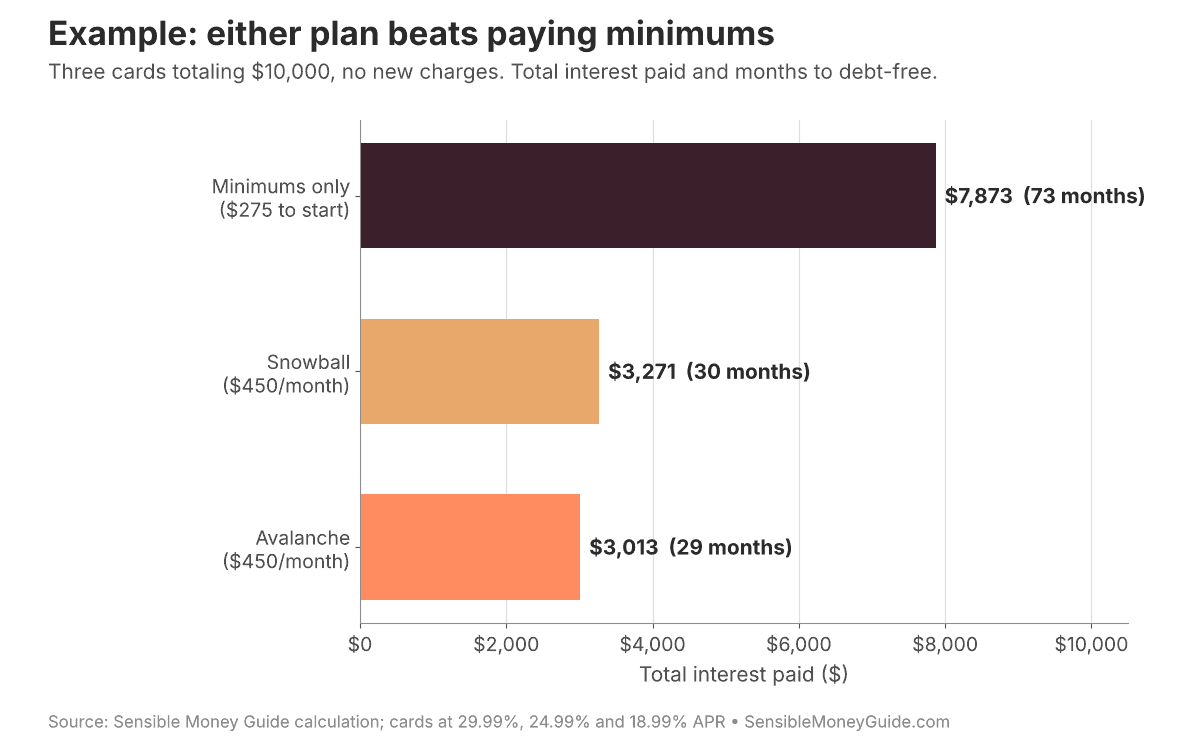
Let’s go back to the three cards in the table above: a $900 store card at 29.99%, a $3,500 card at 18.99%, and a $5,600 card at 24.99%. That’s $10,000 total, with $275 in combined minimums. Now say you can put $450 a month toward the cards and you stop using them.
- Minimums only (each card’s own minimum, $275 to start): about 73 months (over 6 years) and roughly $7,873 in interest.
- Avalanche ($450 a month): debt-free in 29 months, with about $3,013 in interest.
- Snowball ($450 a month): debt-free in 30 months, with about $3,271 in interest.
Notice two things. First, the extra $175 a month matters far more than which method you pick. Either method saves more than $4,000 compared with paying minimums. Second, the avalanche saves about $258 more and finishes a month sooner. In this example, the store card happens to have both the smallest balance and the highest rate, so both methods attack it first. They only split after that.
How the rollover works, month by month
Here’s what the avalanche looks like in real life with those three cards. In months one through five, you pay the minimums on Card B and Card C and send everything else to the store card. By month five, the store card is gone.
Now its $35 minimum, plus all the extra, flows to Card C, the 24.99% card. That card is paid off around month 23. Finally, everything goes to Card B, which hits zero in month 29. Your total payment never changes. It just keeps moving to the next target, getting bigger as it goes.
With the snowball, the order is store card, then Card B (paid off around month 17), then Card C (month 30). Same total payment, same discipline. Only the order changes.
So which should you choose?
Here’s the honest answer: it depends on you. Experts disagree, and both sides have a point.
- Choose the avalanche if you’re motivated by saving money, your rates differ by a lot, and you trust yourself to stay on track even if the first payoff takes a while.
- Choose the snowball if you’ve started and quit before, you have several small balances, or you need early wins to stay motivated.
- Try a blend if you’re torn. Knock out one tiny balance for a quick win, then switch to the highest rate. Fidelity notes that when rates are similar, the difference between methods is small anyway.
The worst choice is spending three months deciding. Pick one today. You can always switch later.
If you’d like to hear this explained another way, this video from PBS’s Two Cents series offers tips for getting out of debt in plain, friendly language.
How to lower your interest rate
Suze Orman calls a lower rate “the biggest key to get out of credit card debt,” CNBC reported. That makes sense. When less of your payment goes to interest, more goes to the balance. Here are three ways to get there, from easiest to most involved.
Option 1: Call your card company and ask
This costs nothing and takes about 15 minutes. Call the number on the back of your card and ask if they can lower your APR. It helps if you’ve been a customer for a while and have paid on time. Be polite and specific: “I’m working hard to pay this balance down. Is there any way you can lower my rate?”
They may say no. That’s fine. Ask whether they have a hardship program. That’s a temporary plan with a lower rate or smaller payment for people facing a job loss, illness or other setback. The Federal Trade Commission’s guide to getting out of debt recommends contacting your creditors early, before an account goes to collections. Creditors may agree to lower payments when you reach out first.

Option 2: A balance transfer card
A balance transfer means moving debt from one card to another, usually one with a 0% introductory APR for a set time. You still owe the money, but for a while none of your payment goes to interest.
There’s almost always a fee. NerdWallet says balance transfer fees typically run 3% to 5% of the amount you move. Intro periods vary by card. NerdWallet’s examples use 15 and 18 months. You’ll usually need good credit to qualify for the best offers.
Worked example: Say you move $6,000 from a card charging 22% to a card with a 0% intro APR for 18 months and a 3% fee.
- The fee is $180, so your new balance is $6,180.
- To pay it off before the 0% rate ends, divide $6,180 by 18 months. That’s about $343 a month.
- Paying that same $343 a month on the old 22% card would take 22 months and cost about $1,300 in interest.
So the transfer saves you about $1,120 and gets you done four months sooner. That’s a great deal, but only if you follow three rules. Pay off the balance before the intro rate ends. Don’t run up new charges on the old card. And make every payment on time. A late payment brings fees and can hurt your credit, and paying more than 60 days late can end the 0% rate.
Watch out: Some store cards offer “no interest if paid in full” deals. These are different from true 0% APR offers. If you don’t pay the full amount by the deadline, you can be charged all the interest that built up from day one. Read the terms carefully.
Option 3: A debt consolidation loan
A debt consolidation loan is a personal loan you use to pay off your cards. Then you make one fixed payment to the lender for a set number of months. It’s an installment loan, which means it has a fixed end date, unlike a card balance that can drag on.
The Federal Reserve reports that banks charged an average of 11.86% on 24-month personal loans in the second quarter of 2026. Compare that with about 22% on cards that charge interest. Your own rate will depend on your credit, income and the lender, and many lenders charge an origination fee taken out of the loan amount.
Worked example: You borrow $10,000 at 11.86% for 24 months to pay off cards charging 22.15%.
- Your loan payment is about $470 a month, and total interest is about $1,282.
- Paying that same $470 a month on the cards would take 28 months and cost about $2,817 in interest.
- The loan saves about $1,535 and finishes four months sooner, before any fees.
The big risk is the same as with a balance transfer. Once your cards show a zero balance, it’s tempting to use them again. If that happens, you’ll have the loan payment and new card debt. Only do this if you’ve already stopped the new spending.
Comparing your options
| Option | Typical cost | Best for | Main risk |
|---|---|---|---|
| Call your issuer | Free | Anyone with a decent payment history | They may say no |
| Balance transfer card | 3%–5% fee, then 0% for a set time | Good credit and a balance you can clear in the promo window | High rate returns if the balance isn’t paid in time |
| Consolidation loan | Fixed rate (bank average 11.86% for 24 months) plus possible fees | Steady income and fair-to-good credit | Running the cards back up |
| Debt management plan | Small setup and monthly fees | Struggling to keep up, any credit level | Must finish the plan, often 4–5 years |
Finding extra money to put toward your cards
We saw earlier that the size of your payment matters more than the method. So let’s talk about raising it. Even $100 more a month can cut years off your payoff.
Trim, don’t starve
You don’t have to give up everything you enjoy. A plan that feels miserable won’t last. Instead, look for a few big cuts rather than dozens of small ones.
- Subscriptions: Go through your bank and card statements and cancel the ones you forgot about. Three $15 services add up to $540 a year.
- Phone and internet: Call your providers and ask about cheaper plans or loyalty discounts. A 20-minute call can save $20 to $40 a month.
- Insurance: Shop your car and home or renters insurance once a year. Raising a deductible can lower your premium, but only if your emergency cushion can cover it.
- Food: Plan meals for the week and cut back on delivery. Swapping two delivery orders a week for home-cooked meals can free up $150 or more a month.
Bring in a little more
Earning more can work faster than cutting. Ask about overtime, pick up a few weekend shifts, or sell things you no longer use. Some people take on a short-term side gig with a firm end date, like “until the store card is gone.”
Try paying twice a month
Because card interest is charged on your balance each day, paying sooner can save a little money. If you’re paid every two weeks, try splitting your card payment in half and paying on each payday. Your average balance during the month will be lower, so you’ll be charged slightly less interest. It also lines up your payments with your cash flow, which makes it easier to stick with.
This won’t change your life on its own. But combined with a fixed payment and a focus card, it’s one more small edge, and it costs you nothing.
Put windfalls to work
Tax refunds, work bonuses and cash gifts are perfect for debt. Try a simple rule: send at least half of any windfall to your target card and enjoy the rest. You still get a treat, and your payoff date moves up.
Every time a card hits zero, don’t let that payment amount disappear into your spending. Roll it straight into the next card. That’s where the real speed comes from.
When you need outside help
Sometimes the numbers just don’t work. Maybe your minimums eat up most of your paycheck, or you’ve already missed payments. That’s not a personal failure. It’s a sign you need a different tool, and there are good ones out there. There are also some bad ones, so it pays to know the difference.
Nonprofit credit counseling
Credit counseling is help from a trained counselor who looks at your whole budget and debts, then suggests a plan. The CFPB says these organizations are usually nonprofit and their counselors are typically certified. Many charge low fees, but ask what they charge up front.
The FTC suggests looking for counseling at credit unions, universities, Cooperative Extension offices and military financial managers. Suze Orman has pointed people with lower credit scores to the National Foundation for Credit Counseling, CNBC reported.
What to expect on your first counseling call
A good counselor will ask a lot of questions before suggesting anything. Have your debt list, your monthly income and a rough idea of your monthly bills ready. You should leave with a clearer picture of your budget and a few options, which may or may not include a formal plan.
If the first thing you hear is a sales pitch, or you’re pressured to sign up that day, that’s a red flag. The CFPB warns against groups that push a plan before analyzing your finances.
Debt management plans
A counselor may suggest a debt management plan, or DMP. You make one monthly payment to the counseling agency, and it pays your card companies for you. The agency often gets your creditors to agree to lower interest rates or waive some fees.
The FTC notes that a DMP can take 48 months or more to finish. You may have to agree not to apply for or use new credit until it’s done. DMPs cover unsecured debts like credit cards, not car loans or mortgages.
Before you sign up, the CFPB suggests you:
- Get a specific price quote in writing, and look elsewhere if an organization won’t help because you can’t afford its fees
- Be wary of anyone who pushes a DMP before looking at your full finances
- Check the organization with your state attorney general and consumer protection office
- Confirm that each creditor has accepted the plan before you send money
Debt settlement: know the risks
Debt settlement is different. These are typically for-profit companies that try to get your creditors to accept a lump sum that’s less than you owe. To build up that lump sum, they usually have you stop paying your cards and save money in a special account instead.
That approach carries real risks. The FTC warns that you might not finish the program, late fees and interest keep growing, your credit can take serious damage, and creditors may keep calling or even sue. Under FTC rules, debt settlement companies that sell by phone can’t collect fees before they settle a debt. That covers most of the industry.
There’s also a tax surprise many people miss. The IRS says forgiven debt is generally taxable income. If a creditor forgives $4,000 of your balance, you may owe tax on that $4,000, and you might get a Form 1099-C in the mail. There are exceptions, such as being insolvent (owing more than you own) or debt wiped out in bankruptcy, so talk with a tax professional.
How to spot a debt relief scam
The FTC lists several warning signs of debt relief scams. Be careful with any company that:
- Asks for a big fee before it does anything for you
- Reaches you through robocalls or cold calls
- Promises to make your debt disappear or cut it in half
- Claims it can remove accurate negative marks from your credit report
A good rule of thumb: real help starts with questions about your budget, not with a sales pitch.
When bankruptcy might be on the table
If your debt is far larger than you could repay in five years, even with a DMP, it may be worth talking to a bankruptcy attorney. Many offer a free first meeting. Bankruptcy has long-lasting effects on your credit, so it’s a last resort. But it’s a legal tool that exists for a reason, and getting the facts doesn’t commit you to anything.
Your step-by-step payoff plan
Here’s everything above boiled down into a plan you can follow. Don’t try to do it all in one night. Steps one through four can happen this week. The rest becomes your monthly routine.
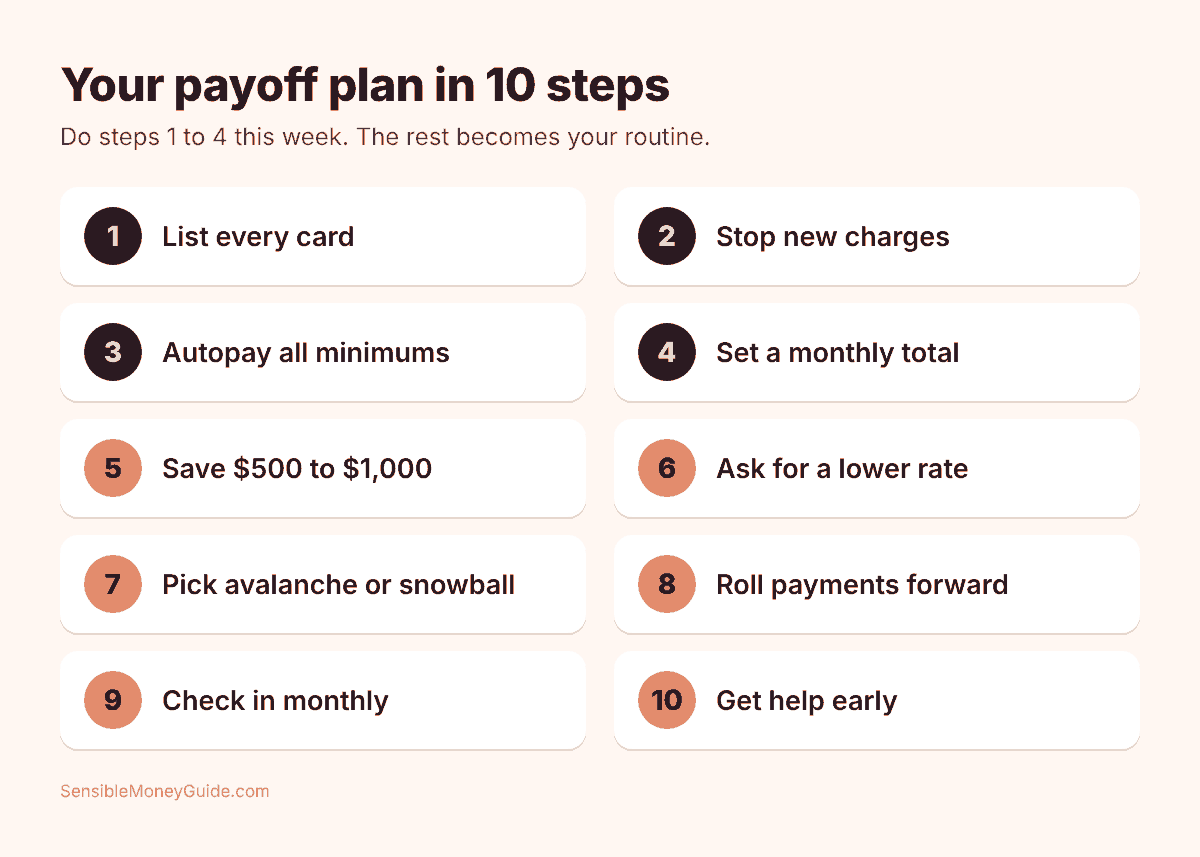
- List every card. Write down the balance, APR, minimum payment and due date for each one.
- Stop new charges. Take the cards out of your phone wallet and saved shopping accounts.
- Set up autopay for every minimum. This protects your credit and avoids late fees.
- Pick your total monthly debt payment. Aim for at least your minimums plus 20%, then push for more.
- Build a starter cushion of $500 to $1,000. Keep it in a separate savings account.
- Call to ask for a lower rate. Then see whether a balance transfer or consolidation loan would save you money.
- Choose avalanche or snowball. Send every extra dollar to your target card.
- Roll payments forward. When a card hits zero, add its full payment to the next target.
- Check in once a month. Update your list and watch the total drop.
- Get help early if you fall behind. A nonprofit credit counselor is a good first call.
Track your progress where you can see it
Bank of America suggests tracking your progress to stay motivated. That can be a simple chart on the fridge where you color in a box for every $100 you pay off. It sounds silly. It works. Seeing the boxes fill up gives you a reason to keep going on the months when the balance feels stuck.
What this could look like for Jasmine
Let’s check back in with our hypothetical Jasmine and her $6,000. Say she finds an extra $230 a month by trimming subscriptions, cooking more and picking up a Saturday shift now and then. That brings her total card payment to a steady $400. She stops using the cards and keeps a $500 cushion in savings.
At an average rate of 22%, she’d be debt-free in about 18 months and pay roughly $1,081 in interest. If she stuck with minimum payments, she’d be paying for about 20 years. Same person, same paycheck, very different future. If she also landed a lower rate, she’d finish even sooner.
After the last payment
When your final card hits zero, take a moment to celebrate. You earned it. Then keep the momentum going. Send the money you were paying toward debt into your emergency fund until it covers three to six months of expenses. After that, point it toward retirement and other goals.

From now on, try to pay your full statement balance every month. Schwab suggests paying new charges in full each billing cycle and keeping your balances under about 30% of your credit limits. Do that, and your card becomes a handy tool with rewards and protections, not a 22% loan.
Common mistakes to avoid
Most people who struggle to pay off cards aren’t doing anything crazy. They’re making a few common mistakes that quietly slow everything down.
- Paying only the minimum. As we saw, this can turn a $6,000 balance into a 20-year problem. Choose a fixed amount and stick with it.
- Spreading extra money evenly. An extra $30 on each of five cards feels fair, but it’s slower than putting $150 on one card. Focus wins.
- Using the cards while paying them off. New charges erase your progress and often start collecting interest right away.
- Running the cards back up after a transfer or loan. This is how people end up with double the debt.
- Raiding your retirement account. Early 401(k) withdrawals can bring taxes and penalties, and you lose years of growth. Talk to a professional before you do this.
- Closing all your old cards. This can lower your available credit and hurt your score. Keep paid-off cards open if they don’t charge an annual fee.
- Skipping the emergency cushion. Without one, the next surprise bill lands right back on a card.
- Ignoring the interest rate on new offers. A “low monthly payment” can hide a long term and high total cost. Always compare total interest paid.
- Waiting until you’ve missed payments to ask for help. Card companies and counselors have more options when you’re still current.
- Falling for “erase your debt” offers. If a company wants money up front and promises miracles, hang up.
Don’t beat yourself up if you’ve made some of these. Almost everyone has. The point is to spot them now so they stop costing you.
Myths vs. facts
There’s a lot of bad advice floating around about credit card debt. Here are a few myths worth clearing up.
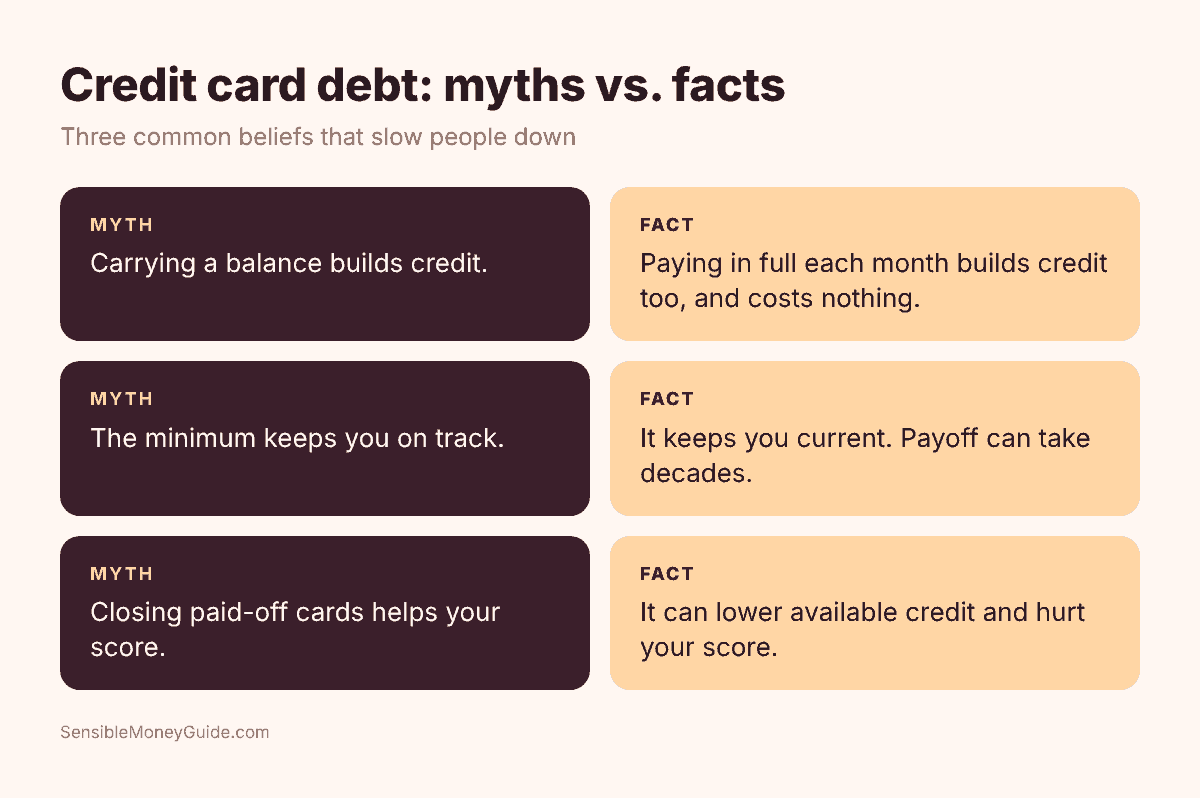
Myth: Carrying a small balance helps your credit score.
Fact: You don’t need to pay interest to build credit. Paying your statement balance in full each month shows lenders you use credit well, and it costs you nothing.
Myth: Paying the minimum keeps you on track.
Fact: It keeps you current, which protects your credit. But at today’s rates, minimum payments alone can take many years and cost more than the original balance in interest.
Myth: Closing a card after paying it off helps your score.
Fact: It often does the opposite. Closing a card can lower your total available credit, which can raise your credit utilization and lower your score.
Myth: Debt settlement is a quick, clean fix.
Fact: It usually means missed payments, credit damage, fees and possible taxes on the forgiven amount. It may still be the right move for some people, but it’s rarely quick or clean.
Myth: You need a big raise to get out of debt.
Fact: In our example, adding $175 a month to $275 of minimums cut payoff from over six years to under three. Small, steady changes add up.
Key takeaways
- Credit card interest is charged daily and compounds, so balances grow fast. Banks charged an average of 22.32% in 2025 on cards that carried interest.
- Minimum payments are built to keep you current, not to get you out of debt. Pick a fixed monthly amount and stick with it.
- Stop adding new charges, set up autopay for every minimum, and build a $500 to $1,000 starter cushion.
- The avalanche method (highest rate first) saves the most money. The snowball method (smallest balance first) gives quicker wins. Either beats paying minimums.
- How much extra you pay matters more than which method you pick.
- Ask your card company for a lower rate, and consider a balance transfer or consolidation loan if you can avoid new charges.
- Nonprofit credit counseling can help if you’re falling behind. Be very careful with debt settlement and anyone who wants fees up front.
Frequently asked questions
What’s the fastest way to pay off credit card debt?
Pay as much as you can above the minimum, and aim it all at one card at a time. The avalanche method, which targets the highest interest rate first, usually saves the most money and time. Lowering your rate through a balance transfer or a lower-rate loan can speed things up even more.
Should I use my savings to pay off my credit cards?
It depends on how much you have. Keep a starter cushion of $500 to $1,000 so a surprise expense doesn’t go back on a card. Savings above that amount often do more good paying down a card that charges 20% or more. Just don’t drain every last dollar.
Does paying off credit cards raise my credit score?
Usually, yes. Lower balances reduce your credit utilization, which is the share of your available credit you’re using. Utilization is a big factor in most credit scores, so paying down balances often helps your score over time.
Is it better to pay off the smallest card or the highest interest card first?
Paying the highest interest card first saves more money. Paying the smallest card first gives you a fast win, which can help you stay motivated. If you’re not sure, try knocking out one small balance first and then switching to the highest rate.
Will a balance transfer hurt my credit?
Applying for a new card can cause a small, temporary dip in your score. Over time, a balance transfer can help if it lets you pay down your debt faster. The real danger is running up new balances on the old card after you transfer.
How long does it take to pay off $10,000 in credit card debt?
It depends on your rate and your payment. In our example with three cards totaling $10,000, paying $450 a month took about 29 to 30 months. Paying only each card’s minimum took over six years and cost more than twice as much interest.
Is debt consolidation a good idea?
It can be, if you get a lower rate than your cards charge and you stop using the cards. A fixed loan also gives you a clear end date. Compare the total cost, including any fees, before you sign.
What happens if I just stop paying my credit cards?
You’ll be charged late fees and possibly a higher penalty rate, and your credit score will drop. Eventually the debt may be sent to collections, and the creditor could sue you. If you can’t keep up, call your card company or a nonprofit credit counselor before you fall behind.
Your next step this week
Set aside 30 minutes this weekend to make your debt list. Log in to each card account and write down the balance, APR, minimum payment and due date. Then pick one card to target and set up an automatic payment that’s at least $25 more than its minimum. That’s it. You’ll have a plan, and your first extra payment will be on its way.
Sources
- Federal Reserve Board, Consumer Credit – G.19, October 7, 2026.
- Federal Reserve Bank of New York, Household Debt Balances Decreased Slightly; Credit Card Delinquency Transition Rates Remained Steady, August 2026.
- Federal Reserve Board, Economic Well-Being of U.S. Households in 2025, May 2026.
- Consumer Financial Protection Bureau, What is credit counseling?, accessed October 2026.
- Consumer Financial Protection Bureau, A box on my credit card bill says that I will pay off the balance in three years if I pay a certain amount. What does that mean?, reviewed January 2024.
- Federal Trade Commission, How To Get Out of Debt, December 2025.
- Federal Trade Commission, Debt Relief and Credit Repair Scams, accessed October 2026.
- Internal Revenue Service, Topic No. 431, Canceled Debt – Is It Taxable or Not?, accessed October 2026.
- Fidelity, Debt snowball method vs. debt avalanche method: Which is right for you?, January 21, 2026.
- Charles Schwab, How to Create a Credit Card Debt Exit Plan, August 27, 2025.
- Bank of America Better Money Habits, 5 Simple Tips to Pay Off Your Credit Card Debt Fast, accessed October 2026.
- NerdWallet, What Is a Balance Transfer Fee on a Credit Card?, November 8, 2025.
- Bankrate, Current Credit Card Interest Rates, October 14, 2026.
- Ramsey Solutions, How the Debt Snowball Method Works, accessed October 2026.
- CNBC, Here are some strategies to pay off credit card debt before interest rates rise, May 13, 2022.
- Kellogg School of Management, Northwestern University, The “snowball approach” to debt, August 7, 2012.
This article is for educational purposes only and isn’t financial advice. Consider talking with a qualified professional about your situation.



How to Pay Off Credit Card Debt: The Complete Guide

How Credit Scores Really Work: A Complete Guide

Emergency Fund Guide: How Much You Need and Where to Keep It

How to Make a Budget That Actually Works: A Complete Guide
How to Make a Budget That Actually Works: A Complete Guide
Emergency Fund Guide: How Much You Need and Where to Keep It
How Credit Scores Really Work: A Complete Guide
You must be logged in to post a comment Login