Budgeting
How to Make a Budget That Actually Works: A Complete Guide
Learn how to make a budget step by step: find your real take-home pay, track spending, pick a method like 50/30/20, and build an emergency fund.

Picture someone like Maria. She’s 34, a dental hygienist, and she makes decent money. About $4,200 lands in her bank account every month. She isn’t careless. She doesn’t buy designer bags or take fancy trips.
But every month ends the same way. Her checking account dips close to zero a few days before payday. Her credit card balance creeps up a little more. And when her car needed $900 in brake work last spring, it went straight on the card.
If you asked Maria where her money goes, she’d shrug. “Rent, the car, groceries… the usual stuff?” She honestly doesn’t know.
Maria isn’t real. She’s a made-up example. But her story is one of the most common money stories in America. And the fix for it isn’t earning more or giving up everything fun. It’s a simple, honest plan for your money. In other words, a budget.
This guide will walk you through building one from scratch. No spreadsheet skills needed. No guilt. Just a clear system you can set up this week and keep using for years.
What you’ll learn
- Why a budget matters more than most people think, with real numbers from the Federal Reserve
- How to find out where your money actually goes (it’s usually not where you’d guess)
- The four most popular budgeting methods, and how to choose one that fits your life
- A complete, line-by-line example budget you can copy
- How to handle surprise bills, irregular pay, and credit card debt
- The mistakes that make most budgets fall apart, and how to avoid them
Table of contents
- Why a budget matters (the $400 test)
- What a budget really is
- Step 1: Know your real take-home pay
- Step 2: Track where your money goes
- Step 3: Sort needs, wants, and goals
- Step 4: Pick a budgeting method
- Step 5: Build your budget (a full example)
- Step 6: Put it on autopilot
- Step 7: Check in and adjust every month
- How to make your budget stick
- Build your emergency cushion first
- Where debt fits in
- Common budgeting mistakes
- Budget myths vs. facts
- Free tools that make it easier
- Frequently asked questions
Why a budget matters (the $400 test)
Every year, the Federal Reserve asks thousands of Americans a simple question. If you had a surprise $400 expense today, how would you pay for it?
In its latest survey, 63% of adults said they’d cover it with cash or money they already had. Those are good odds, until you flip them around. It means more than 1 in 3 adults would have to borrow, sell something, or simply couldn’t pay.
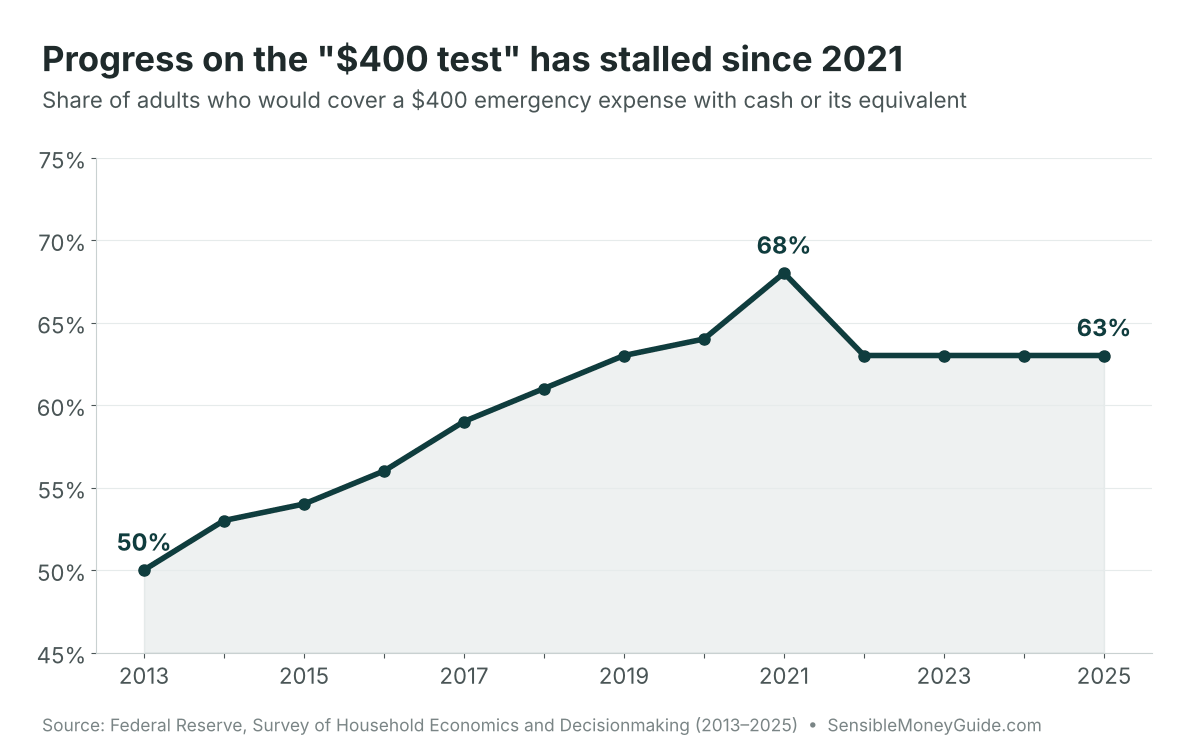
The good news is that things have gotten better over time. In 2013, only half of adults could handle that $400 surprise with cash. The number climbed every year until it peaked at 68% in 2021. Since then, it has stalled at 63% for four years in a row.
Age makes a big difference. Only 45% of adults ages 18 to 29 said they’d pay that $400 with cash. For people 60 and older, it was 78%. Much of that gap comes down to time. Older adults have had more years to build a cushion. But a budget helps you build one faster, at any age.
Another survey tells a similar story. Bankrate’s 2026 Emergency Savings Report found that 24% of Americans have no emergency savings at all. Almost 3 in 10 have more credit card debt than emergency savings.
Here’s why this matters for you. A surprise bill is not a question of “if.” It’s “when.” Cars break. Teeth crack. Kids need things. When you don’t have a plan, those surprises go on a credit card that can charge more than 20% interest. Then the next surprise piles on top of that one.
A budget breaks that cycle. It’s not about being cheap. It’s about deciding ahead of time what your money is for, so the surprises don’t decide for you.
What a budget really is (and what it isn’t)
A lot of people hear “budget” and think “diet.” They picture saying no to everything they enjoy. No wonder they avoid it.
A better word is spending plan. A budget is simply a plan for every dollar you expect to earn this month. It tells your money where to go, instead of wondering later where it went.
The Federal Trade Commission’s consumer guide to budgeting boils it down to three parts:
- List your bills and expenses.
- Figure out your monthly income.
- Subtract what you spend from what you earn. The number should be above zero.
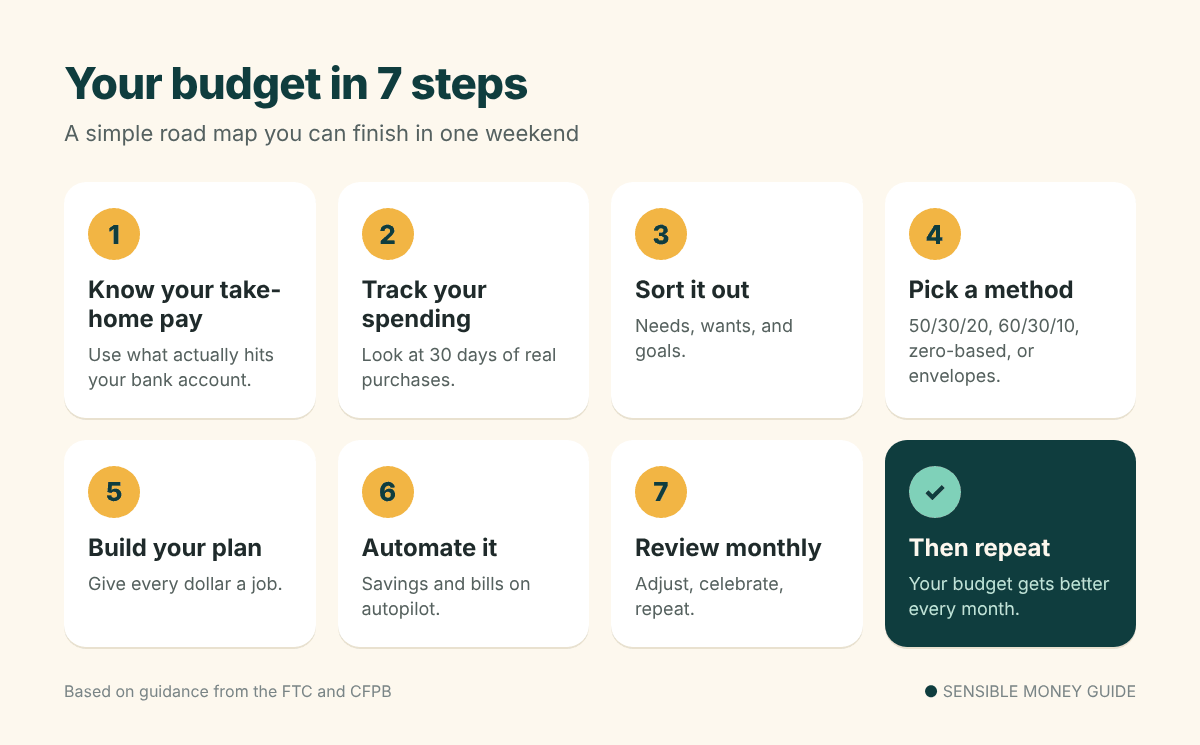
That’s really it. Everything else in this guide is about making those three steps easier, more accurate, and more likely to stick. Here’s the full road map we’ll follow:
Here’s what a budget is not:
- It’s not a punishment. A good budget includes money for fun. If it doesn’t, you won’t stick with it.
- It’s not just for people who are struggling. People with high incomes run out of money too. They just run out of more of it.
- It’s not set in stone. Your budget will change as your life changes. That’s normal.
- It’s not about being perfect. You will go over in some categories. The goal is progress, not a perfect score.
Think of it like a map for a road trip. You can still take a detour to see something cool. But you’ll always know how to get back on track.

Step 1: Know your real take-home pay
The first number you need is your income. But not the one in your job offer. You need your take-home pay.
Take-home pay (also called net pay) is what actually lands in your bank account after taxes and other deductions come out. Your gross pay is the bigger number before anything is taken out.
The gap between them can be large. Between federal and state taxes, Social Security, Medicare, health insurance, and retirement contributions, your paycheck can shrink by a quarter or more. That’s why budgeting from your salary is one of the most common early mistakes. You end up planning to spend money you never actually receive.
How to find your number
- If you get a regular paycheck: Look at the “net pay” line on your last two or three pay stubs. If you’re paid every two weeks, multiply one check by 26 and divide by 12. That gives you a true monthly average. (Paid every two weeks means two months a year have three paychecks. Treat those as a bonus.)
- If you’re paid twice a month: Just add your two checks together.
- If you have other income: Add child support, a side gig, or benefits. Only count money you can count on.
What if your income changes month to month?
If you work for tips, commission, or freelance, your income might swing a lot. There are two smart ways to handle that.
The FTC suggests a simple average. Add up last year’s income and divide by 12. That gives you a monthly estimate.
Ramsey Solutions suggests a more careful approach. Budget based on your lowest recent month. When you earn more than that, use the extra for goals like savings or debt.
Which is better? If your income is fairly steady with small dips, the average works fine. If you’ve ever had a really rough month that caught you off guard, go with the lowest month. It’s safer. A good month then feels like a bonus, not a cushion you were already counting on.
Pro tip: Don’t forget money that comes out of your paycheck before you see it, like a 401(k) contribution or health insurance. You’re already “spending” that money. NerdWallet’s budget calculator suggests adding those deductions back in when you figure out where your money goes, so you get the full picture.
Step 2: Track where your money actually goes
This is the step most people want to skip. Please don’t. It’s the one that changes everything.
Most of us are pretty good at remembering our big bills. Rent, car payment, phone. But we’re terrible at remembering the small stuff. The $6 coffee. The $14 lunch. The $9.99 app you forgot you signed up for. Those small charges add up to real money.
The Consumer Financial Protection Bureau (CFPB) has a free spending tracker built for exactly this. It suggests tracking every purchase for a full month. If a whole month feels like too much, start with one or two weeks.
How to track without losing your mind
- Pull your last 30 days of statements. Download your bank and credit card transactions. This gives you a head start, since most spending is already recorded.
- Add the cash. For the next few weeks, keep receipts or jot cash purchases in your phone’s notes app. Cash disappears the fastest because it leaves no trail.
- Put each purchase in a group. Use simple groups like housing, transportation, groceries, eating out, subscriptions, shopping, and fun.
- Total each group. Then add them all up and compare the total to your take-home pay.
- Circle the repeat charges. The CFPB suggests marking your recurring expenses. These are usually your needs, and they’re the base of your budget.
Be honest with yourself here. Nobody is grading you. The point is just to see the truth.
How does your spending compare?
It can help to know what’s typical. The Bureau of Labor Statistics tracks how American households spend their money. In its latest report, covering 2024, the average household spent $78,535 for the year.
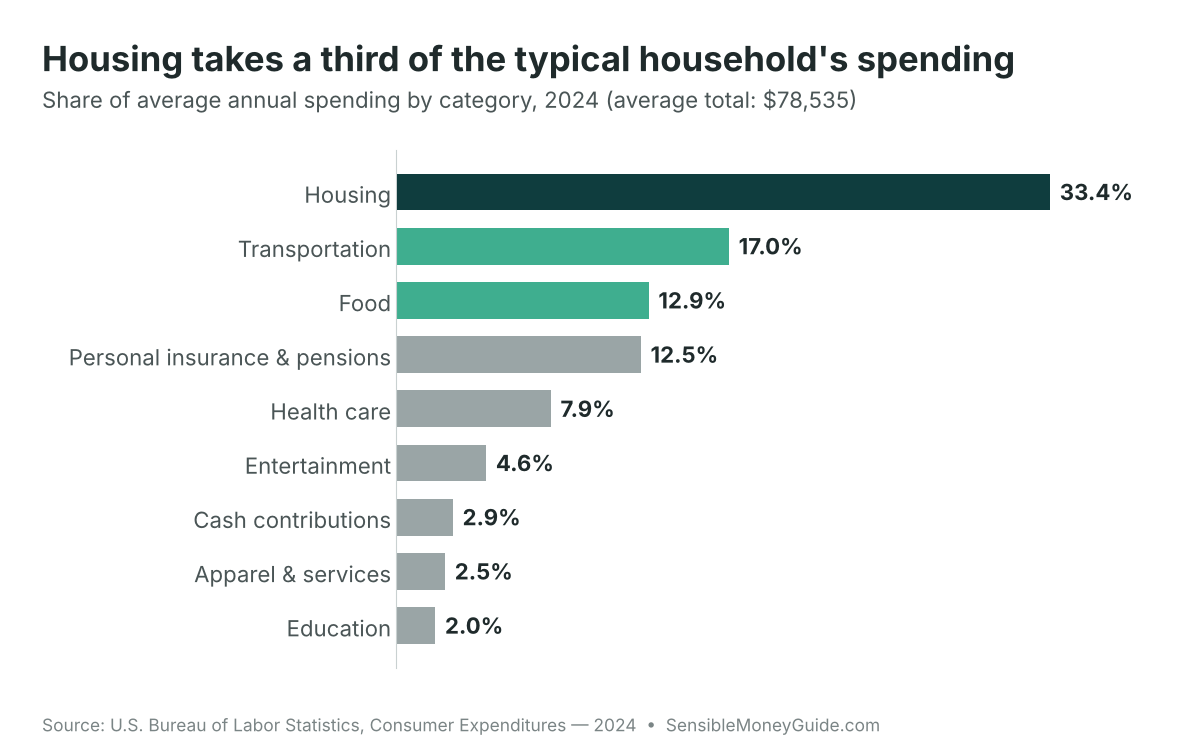
Housing was the biggest cost by far, at 33.4% of spending. That’s about $26,266 a year. Transportation came next at 17%, then food at 12.9%. Personal insurance and pensions, a group that includes Social Security taxes, took 12.5%. Health care took 7.9%.
Your numbers won’t match these exactly. Someone in a big city might spend 40% or more on housing. Someone who works from home might spend much less on transportation. That’s fine. These averages are a reference point, not a rule.
But if one of your groups is way out of line, pay attention. That’s often where you’ll find the money you need.
When Maria tracked her spending for a month, she found something that surprised her. Eating out and takeout came to $410. She had guessed $150. She also had $85 in subscriptions, including two streaming services she rarely watched. And about $455 had simply vanished: ATM withdrawals, payment app transfers, and small purchases she couldn’t remember.
None of that made her a bad person. It just made her normal. But now she knew.

Step 3: Sort your spending into needs, wants, and goals
Once you know where your money goes, sort it into three big buckets. Almost every budgeting method uses some version of these.
Needs
Needs are the things you must pay to live and work. If you stopped paying them, something bad would happen fast. Needs usually include:
- Rent or mortgage
- Utilities like electricity, water, and heat
- Basic groceries
- Transportation to work (car payment, gas, insurance, or transit pass)
- Health insurance and medicine
- Childcare
- Minimum payments on any debts
Wants
Wants make life more enjoyable, but you could live without them for a while if you had to. Wants usually include:
- Eating out and takeout
- Streaming services and subscriptions
- Clothes beyond the basics
- Hobbies, concerts, and trips
- Upgrades, like a newer phone or a nicer car than you need
Goals (savings and extra debt payments)
This is money for your future self. It includes your emergency fund, retirement savings, money for a big purchase, and any payments on debt above the minimum.
The gray areas
Here’s where it gets tricky. Groceries are a need. But a cart full of name-brand snacks and fancy cheese is partly a want. A phone is a need for most people. But a $95-a-month unlimited plan might be part want.
A simple test can help. Ask yourself: What’s the basic version of this that would still meet the need? The cost of the basic version is the need. Anything above it is a want.
Don’t stress too much about getting every line perfect. The point isn’t to label things correctly. It’s to see which costs are flexible and which ones aren’t.
Watch out: It’s easy to call almost everything a need. Be honest. If you’d keep paying for it even during a hard month, it’s probably a need. If you’d cancel it right away in a crisis, it’s a want.
Step 4: Pick a budgeting method that fits you
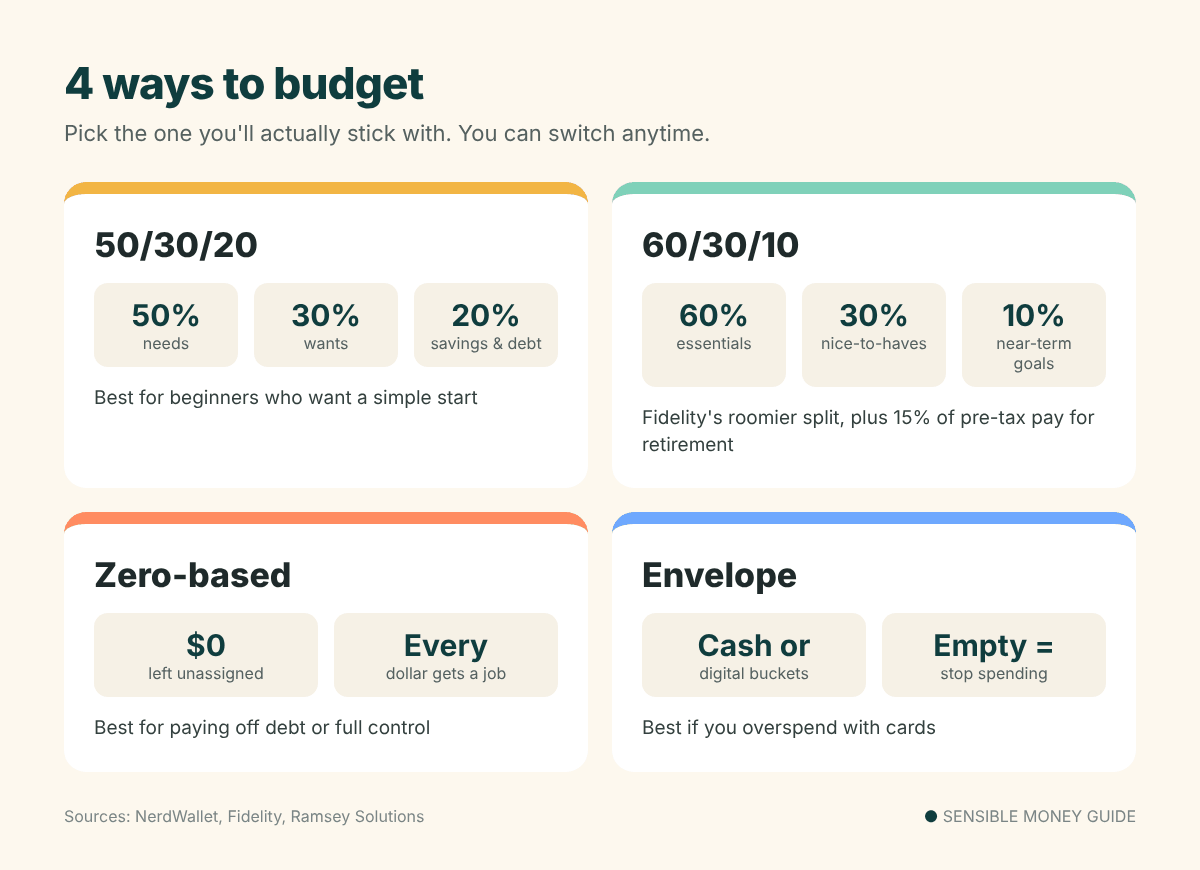
There’s no single “right” way to budget. The best method is the one you’ll actually keep using. Here are the four most popular, plus who each one works best for.
1. The 50/30/20 rule
This is the most famous budgeting rule, and for good reason. It’s simple. It was made popular by Elizabeth Warren and her daughter, Amelia Warren Tyagi, in their 2005 book All Your Worth.
Here’s how it splits your take-home pay, as NerdWallet explains it:
- 50% for needs, like housing, transportation, insurance, utilities, and groceries
- 30% for wants, like dining out, streaming, and hobbies
- 20% for savings and paying down debt
On $4,200 a month, that would be $2,100 for needs, $1,260 for wants, and $840 for savings and debt.
Best for: People who want a quick, big-picture plan without tracking every dollar.
The catch: In many parts of the country, needs eat up far more than 50%. If your rent alone is 40% of your pay, this rule can feel impossible. That doesn’t mean you’re failing. It means you may need to adjust the numbers.
2. Fidelity’s 60/30/10 guideline
Fidelity Investments uses a slightly different split that may feel more realistic for many families. In its budgeting guideline, Fidelity suggests:
- No more than 60% of take-home pay for essential expenses
- 30% for nice-to-haves, like dining out, entertainment, and hobbies
- 10% for near-term goals and emergency savings
On top of that, Fidelity suggests saving 15% of your pre-tax income for retirement, and that 15% can include any match from your employer. Because 401(k) money usually comes out before your paycheck, it isn’t part of the 60/30/10 split. Fidelity calls these numbers goals, not hard rules.
Best for: People who live in higher-cost areas or have families, and want a target that feels reachable.
3. Zero-based budgeting
With a zero-based budget, you give every single dollar a job before the month starts. Ramsey Solutions describes the goal this way: “your income minus your expenses equals zero.”
That doesn’t mean your bank account hits zero. It means every dollar is assigned to something, whether it’s rent, groceries, savings, or fun. If you have $200 left over after your bills, you decide right then where it goes. Maybe $150 to savings and $50 to a night out. Ramsey also suggests keeping a small buffer of $100 to $300 in checking so a slightly-off guess doesn’t cause an overdraft.
Best for: People who want full control, are paying off debt, or keep wondering where their money went.
The catch: It takes more time. You’ll need to make a new plan each month and track as you go.
4. The envelope system (cash or digital)
This is an old-school method that still works. You decide how much to spend in your problem categories, like groceries, eating out, or fun money. Then you put that amount in an envelope as cash. When the envelope is empty, you’re done spending in that group until next month.
Today, many people use a digital version. Some banks and budgeting apps let you split your money into separate “buckets” or sub-accounts that work the same way.
Best for: People who overspend with cards, or who want a very clear “stop” signal.
Which one should you choose?
| Method | How it works | Time needed | Great for |
|---|---|---|---|
| 50/30/20 | Split pay into needs, wants, and savings | Low | Beginners who want a simple start |
| Fidelity 60/30/10 (+15% retirement) | A roomier split for essentials | Low | Higher-cost areas and families |
| Zero-based | Every dollar gets a job | Medium to high | Paying off debt, full control |
| Envelope | Set cash or digital limits by category | Medium | People who overspend on cards |
You can also mix them. Plenty of people use 50/30/20 as their big-picture guide, then use envelopes just for the one category that always gets away from them. Start with the simplest one that feels doable. You can always switch later.
Step 5: Build your budget (a full example)
Let’s go back to Maria and build her budget line by line. You can follow along with your own numbers.
Remember, Maria takes home $4,200 a month. Here’s what her spending looked like during the month she tracked:
| Category | Before (tracked month) | New plan |
|---|---|---|
| Needs | ||
| Rent | $1,250 | $1,250 |
| Utilities | $150 | $150 |
| Phone | $70 | $40 |
| Car payment | $320 | $320 |
| Car insurance | $135 | $135 |
| Gas | $150 | $150 |
| Groceries | $450 | $475 |
| Health costs | $50 | $50 |
| Credit card minimum | $125 | $125 |
| Needs total | $2,700 | $2,695 |
| Wants | ||
| Eating out and takeout | $410 | $220 |
| Subscriptions | $85 | $35 |
| Shopping | $260 | $150 |
| Entertainment | $150 | $120 |
| Coffee shops | $95 | $40 |
| Gym | $45 | $45 |
| Fun money (no questions asked) | $0 | $80 |
| Wants total | $1,045 | $690 |
| Goals | ||
| Emergency fund | $0 | $300 |
| Extra credit card payment | $0 | $175 |
| Sinking funds (car repairs, gifts, holidays) | $0 | $140 |
| Goals total | $0 | $615 |
| Unknown or untracked spending | $455 | $0 |
| Small buffer (stays in checking) | $0 | $200 |
| Grand total | $4,200 | $4,200 |
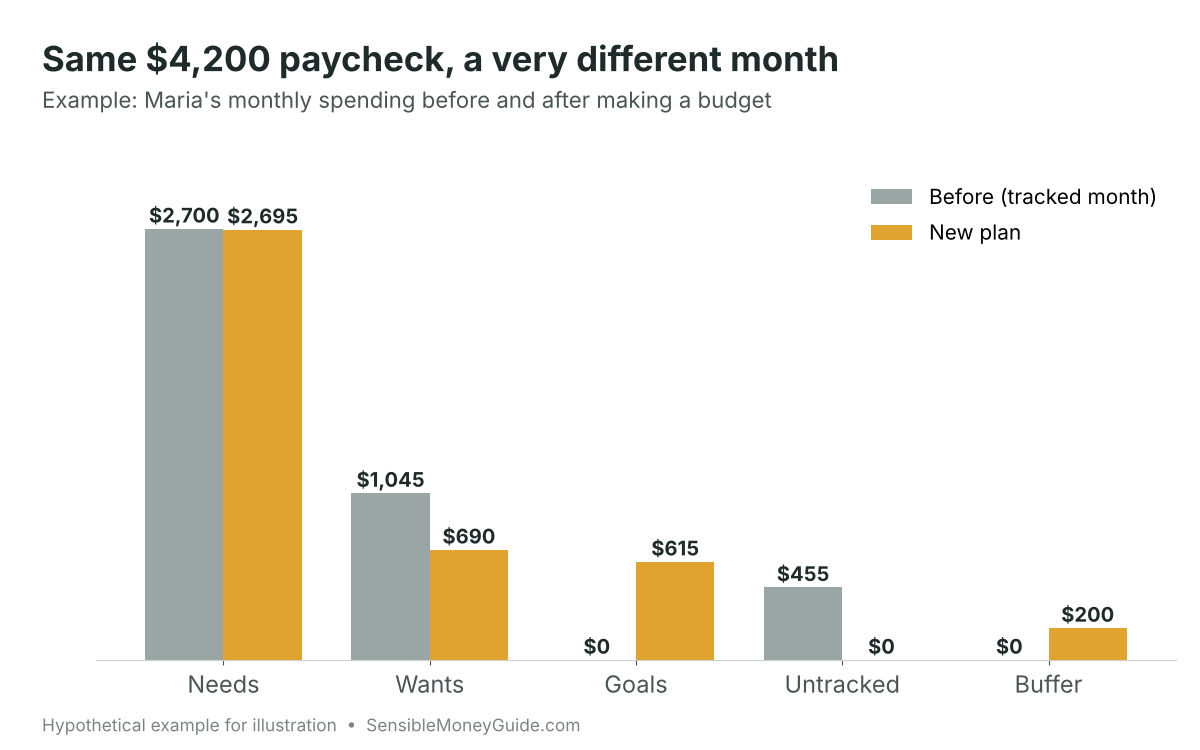
Let’s walk through what she changed and why.
She didn’t touch the big bills (yet)
Rent and the car payment are hard to change quickly. Maria left them alone for now. She did make one smart switch. She moved to a cheaper phone plan and saved $30 a month. She actually raised her grocery budget by $25, because cooking more at home means buying more groceries. That’s a trade worth making.
She trimmed wants, but didn’t erase them
Maria cut eating out from $410 to $220. That’s still about one takeout night a week and a lunch out with friends. She canceled two subscriptions she barely used. She cut back on coffee shops, but kept a weekly treat.
She also added something new: $80 of “fun money.” She can spend it on anything, with no guilt and no tracking. This sounds strange in a budget, but it’s one of the most important lines. Budgets that leave zero room for fun almost always fail.
She gave her “mystery money” a job
The $455 that used to vanish now has a purpose. Most of it went to goals. Some of it became a $200 buffer that stays in checking so a small mistake doesn’t cause an overdraft fee.
The result
Maria went from saving $0 a month to putting $615 toward her goals. That’s about $7,380 a year. And she still eats out, still goes to the gym, and still has fun money.
Notice that Maria’s needs are about 64% of her take-home pay. That’s above the 50/30/20 target. It’s also a little above Fidelity’s 60% guideline. That’s okay. It tells her that someday, when her lease is up or her car is paid off, those big costs are where her next win will come from. For now, she’s moving in the right direction.
Pro tip: Notice those “sinking funds”? A sinking fund is money you set aside each month for a cost you know is coming, just not every month. Car repairs, holiday gifts, back-to-school clothes, and yearly bills like car registration all fit here. If you spend $840 on holidays every year, saving $70 a month means December no longer wrecks your budget.
Build your own in 30 minutes
- Write your monthly take-home pay at the top.
- List every need with its monthly cost. For yearly bills, divide by 12.
- List your goals: emergency fund, extra debt payments, and sinking funds.
- List your wants, using what you learned from tracking.
- Add it all up and subtract from your income.
- If you’re over, cut wants first, then look for cheaper versions of needs.
- If you’re under, give the leftover dollars a job, usually a goal.

Step 6: Put your budget on autopilot
Here’s a secret that people who are good with money know. They don’t rely on willpower. They set things up so the right thing happens automatically.
Bank of America’s Better Money Habits program suggests setting up automatic transfers from checking to savings. Another option is to split your direct deposit, so part of each paycheck goes straight into savings. If the money never sits in your checking account, you won’t be tempted to spend it.
This idea is often called “paying yourself first.” Your future self gets paid before the restaurants, the online stores, or anyone else.
What to automate
- Savings: Schedule a transfer to savings for the day after payday. Even $25 counts.
- Retirement: If your job offers a 401(k) with a match, contribute at least enough to get the full match. That’s free money.
- Fixed bills: Set up autopay for bills that are the same every month, like rent, car payments, insurance, and phone. Late fees are pure waste.
- Debt minimums: Put at least the minimum payment on every card on autopay, so you never miss one. Then pay extra by hand when you can.
Try a two-account setup
Many people find it easier to use two checking accounts. One is for bills. Your fixed costs get paid from it automatically. The other is for everyday spending, like groceries, gas, and fun. When the spending account runs low, you know it’s time to slow down. You don’t have to check a spreadsheet to know where you stand.
Watch out: Autopay is great, but don’t set it and forget it. Check your accounts at least once a week. Make sure you have enough to cover what’s coming out, and look for charges you don’t recognize.
Step 7: Check in and adjust every month
Your first budget won’t be perfect. Nobody’s is. The secret is to treat it like a draft that gets better each month.
The FTC’s budgeting guide recommends a simple rhythm. Plan your spending at the start of the month. Keep track as you go. At the end of the month, see whether you stuck to the plan, and use what you learned to fix next month’s budget.
Your 20-minute monthly money check-in
- Compare plan vs. real life. For each category, did you spend more or less than you planned?
- Find the one that went sideways. Was it a one-time thing, like a birthday gift? Or does it happen every month? If it’s every month, your plan needs to change, not just your behavior.
- Look ahead. What’s coming next month? A wedding? A school trip? Car registration? Plan for it now.
- Move the leftovers. If you came in under budget anywhere, send that money to a goal.
- Celebrate a win. Seriously. Notice what went right. Progress is what keeps you going.
Pick a regular day, like the first Sunday of the month. Put it on your calendar. If you share money with a partner, do it together. A short, calm money talk once a month beats a big fight once a year.
Want to see these ideas in action? This short video from PBS’s Two Cents series shares some clever tricks for making a budget stronger.
How to make your budget stick
Making a budget is the easy part. Sticking with it for months and years is where most people struggle. The good news is that a few small habits make a big difference.
Start smaller than you think
If you try to change every habit at once, you’ll burn out. Pick one or two categories to work on first, usually the ones that surprised you most when you tracked. Once those feel normal, pick the next one.
Give every goal a name
“Savings” is boring. “Beach trip in June” or “No more credit card by next summer” is not. Many banks let you name your savings accounts. Do it. When you can picture what the money is for, it’s much easier to leave it alone.
Use the 48-hour rule for wants
Before you buy something that isn’t in your plan, wait two days. Bank of America’s Better Money Habits suggests waiting a few days before nonessential purchases, since you may find you don’t really want the item. Often the urge just fades. If you still want it after two days, check your budget and see where the money would come from.
Expect a messy first three months
Your first budget is a guess. Your second one is a better guess. By month three, you’ll know your real numbers. Most people who quit do it in the first few weeks, right before things start to click. Give yourself a full three months before you decide whether budgeting “works” for you.
Make it a little bit fun
Some people love savings challenges. One popular one is the 52-week challenge from Bank of America’s tips. You save $1 the first week, $2 the second week, and so on, up to $52 in the last week. By the end of the year, you’ve saved $1,378. Others do a “no-spend weekend” once a month. Find the game that works for you.
Budgeting with a partner or family
If you share money with someone, your budget has to be a team plan. Here’s how to keep it fair and calm:
- Start with goals, not spending. Talk about what you both want first, like a house, a trip, or less stress. It’s easier to agree on a plan when you agree on where you’re going.
- Give each person some personal money. A set amount each month that the other person doesn’t question. This one rule prevents a lot of fights.
- Split the work. One person might pay the bills while the other tracks spending. Then switch every so often, so you both know how things work.
- Include the kids in small ways. Older kids can help plan the grocery list or a family outing on a set budget. It’s one of the best money lessons they’ll ever get.
Plan for life changes
Your budget should change when your life does. A new job, a move, a new baby, or a paid-off car all deserve a fresh look at your plan. When you get a raise, try a simple trick. Put at least half of it toward your goals before you get used to spending it. You’ll still feel the raise, and your future self will thank you.
Build your emergency cushion first
If you take just one thing from this guide, make it this: start an emergency fund, even a small one.
An emergency fund is money you set aside only for true surprises. Think job loss, a medical bill, or an urgent car repair. It’s not for vacations or holiday shopping. Those belong in sinking funds.
Why even a little helps a lot
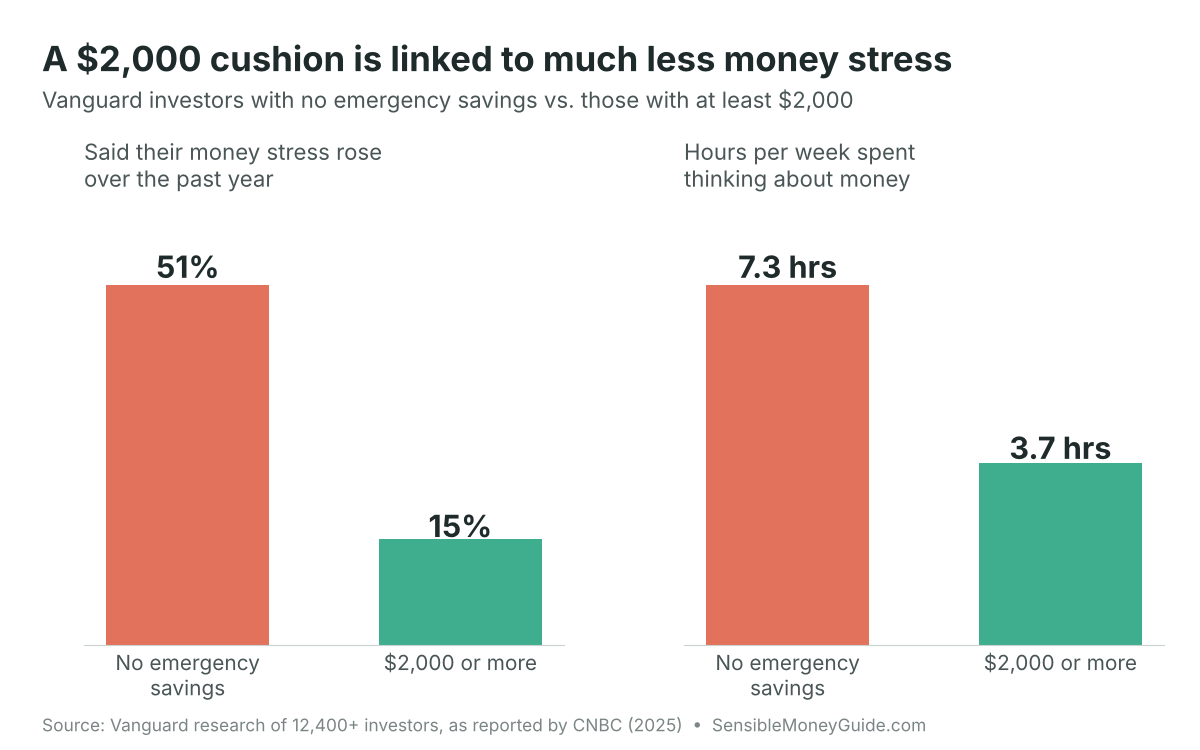
A study from Vanguard looked at this closely. As reported by CNBC, the firm surveyed more than 12,400 of its investors. Those with at least $2,000 set aside for emergencies reported financial well-being that was 21% higher than those with no emergency savings. Higher income and more assets helped too, but the $2,000 cushion gave the biggest boost.
The same research found something else. Among investors with no emergency savings, 51% said their money stress went up over the past year. Among people with at least $2,000, only 15% said the same.
That’s the real power of an emergency fund. It doesn’t just protect your wallet. It protects your peace of mind.
How much do you need?
Most experts suggest working toward three to six months of essential expenses. Bank of America’s Better Money Habits suggests three to nine months. If your job is less steady, or you’re the only earner in your home, aim for the higher end.
But don’t let a big target scare you off. Build it in stages:
- Starter goal: $500 to $1,000. This covers most small surprises, like a vet bill or a new tire.
- Next goal: $2,000. The level Vanguard’s research linked to much lower financial stress.
- Big goal: one month of essentials. Then two. Then three.
Using Maria’s numbers, her essentials are about $2,700 a month. Three months would be about $8,100. Saving $300 a month, she’d hit $2,000 in about seven months and her three-month goal in about 27 months. That might sound slow. But in seven months, she’ll be in a much stronger spot than she is today.
Where to keep it
Keep your emergency fund in a separate savings account. Make sure it’s insured by the FDIC (for banks) or the NCUA (for credit unions). Many online banks offer high-yield savings accounts that pay more interest than a regular savings account. The money should be easy to reach in a day or two, but not so easy that you dip into it for a pizza.

Where debt fits in your budget
If you have credit card debt, your budget is your best weapon against it. Here’s why it matters so much.
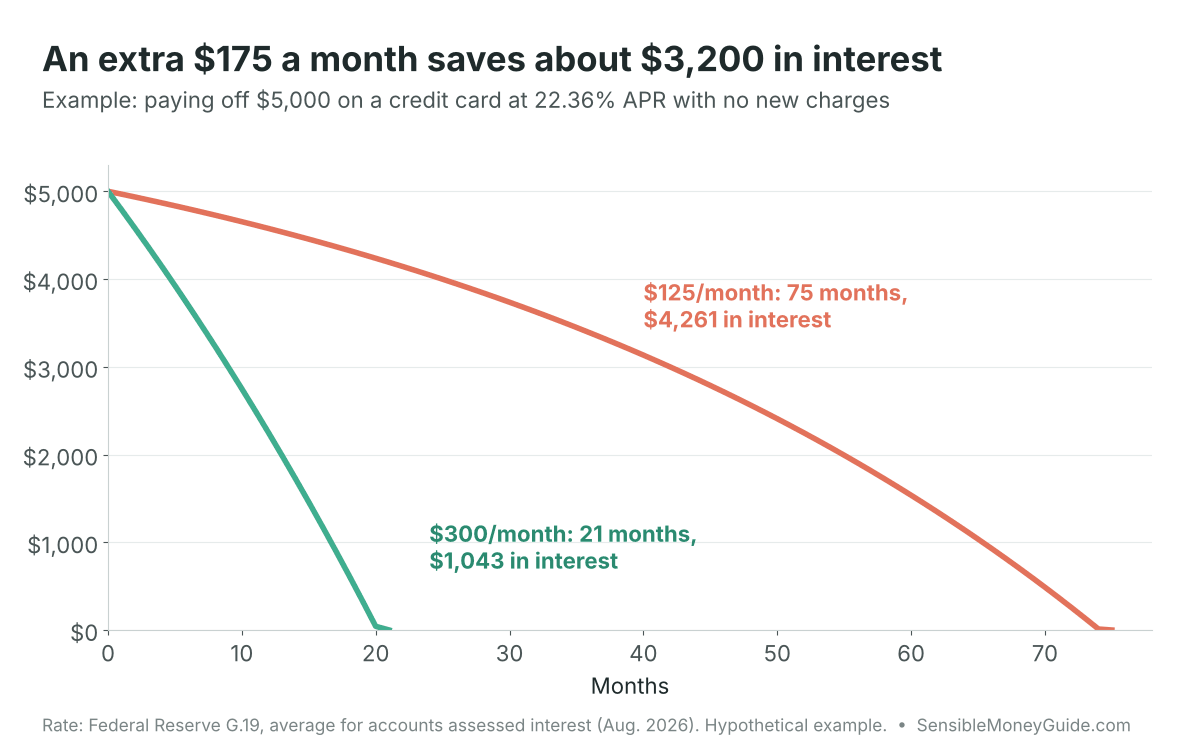
According to the Federal Reserve’s latest consumer credit report, the average interest rate on credit card accounts that were charged interest was 22.36% in August 2026. That’s an incredibly high rate. It’s very hard to get ahead when your debt grows that fast.
How much difference does an extra payment make?
Let’s go back to Maria one more time. Say she owes $5,000 on a card at that 22.36% rate, and she stops adding new charges.
- If she pays $125 a month, it will take her about 75 months (over six years) to pay it off. She’ll pay about $4,261 in interest. That’s almost as much as she borrowed.
- If she adds her extra $175 and pays $300 a month, she’ll be done in about 21 months. She’ll pay about $1,043 in interest.
That one budget change saves her about $3,200 and gets her out of debt more than four years sooner.
Should you save or pay off debt first?
This is one of the most common questions people ask. A balanced approach works well for most people:
- Pay the minimum on every debt, every month. Always.
- Build a small starter emergency fund, around $1,000. Without it, the next surprise goes right back on the card.
- Put as much extra as you can toward your highest-interest debt (often a credit card) until it’s gone.
- Then roll that payment into the next debt, and keep going.
- Once high-interest debt is gone, build your emergency fund up to three to six months.
Some experts, including Ramsey Solutions, suggest paying off your smallest balance first instead of your highest-rate one, for the quick win. Paying the highest rate first saves the most money. Paying the smallest balance first can keep you motivated. Either way, you’re winning. Pick the one you’ll stick with.
One more rule: stop the leak
Paying off a card while still adding new charges is like bailing water out of a boat with a hole in it. While you’re paying down debt, try to use cash or a debit card for everyday spending. Your budget tells you exactly how much you can afford.
Common budgeting mistakes (and how to avoid them)
Most budgets don’t fail because people are lazy. They fail because of a few very common, very fixable mistakes.
1. Budgeting with your salary, not your take-home pay
We covered this one, but it’s worth saying twice. Always start from the money that actually reaches your account.
2. Forgetting about irregular expenses
Car registration. Annual memberships. Holiday gifts. Back-to-school shopping. These aren’t surprises. You know they’re coming. Divide each yearly cost by 12 and save that amount every month in a sinking fund.
3. Making the budget too strict
If your budget has no room for anything fun, you’ll quit within a few weeks. Leave room for small joys. A little fun money keeps the whole plan alive.
4. Quitting after one bad month
You’ll overspend. Everyone does. One bad month doesn’t ruin anything. Just look at what happened, adjust, and start fresh next month.
5. Not tracking at all
A plan you never check is just a wish. You don’t need to track every penny forever. But checking in at least once a week keeps small slips from turning into big problems.
6. Ignoring small, repeating charges
A $15 subscription doesn’t seem like much. But five of them add up to $75 a month, or $900 a year. Go through your statements and cancel what you don’t use.
7. Keeping it a secret from your partner
If you share expenses with someone, budgeting alone rarely works. You don’t have to agree on everything. But you do need to agree on the big picture.
Budget myths vs. facts
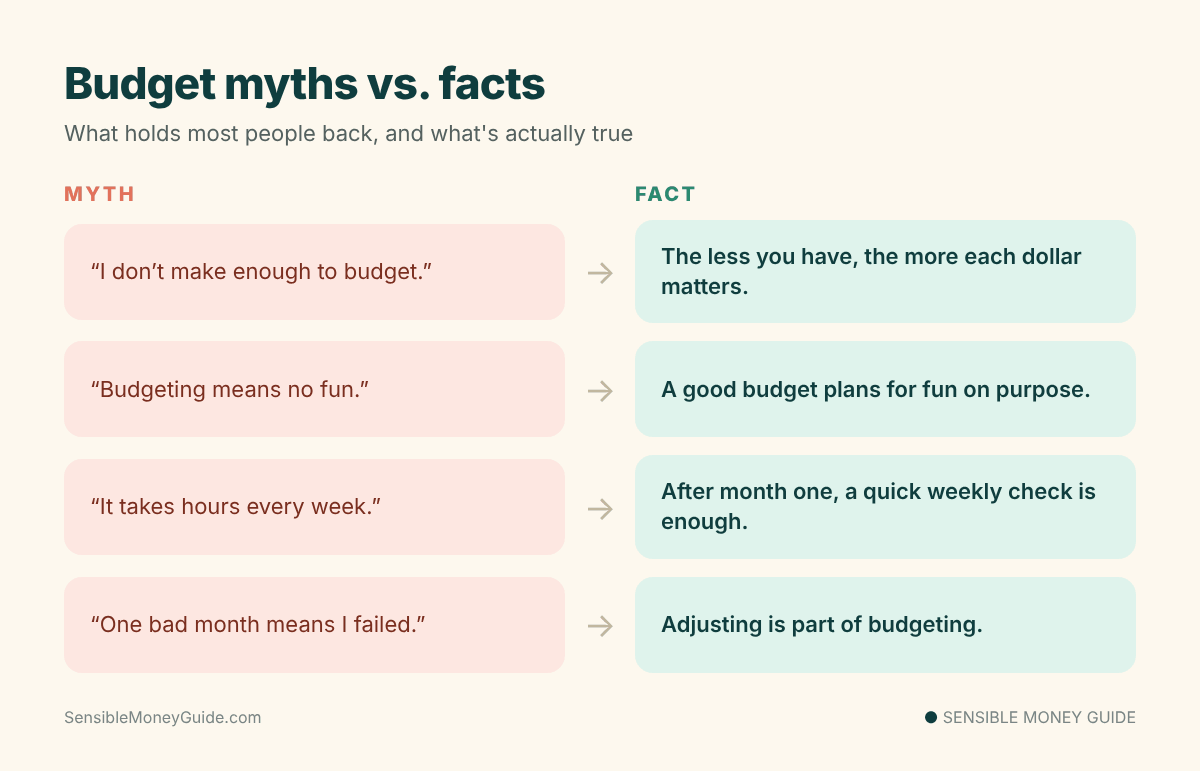
Myth: “I don’t make enough money to budget.”
Fact: The less money you have, the more each dollar matters. A budget helps you stretch what you have and avoid costly fees and late charges.
Myth: “I make good money, so I don’t need a budget.”
Fact: Spending tends to rise with income. Without a plan, a raise can disappear into a nicer car and more takeout, leaving you no better off.
Myth: “Budgeting means I can’t have any fun.”
Fact: A good budget plans for fun on purpose. That way you can enjoy it without guilt.
Myth: “Budgeting takes hours every week.”
Fact: The first month takes the most work. After that, a quick weekly check and a 20-minute monthly review are usually enough.
Myth: “I need a fancy app.”
Fact: A notebook, a free worksheet, or a simple spreadsheet works just as well. The best tool is the one you’ll actually use.
Myth: “If I mess up, I’ve failed.”
Fact: A budget isn’t a test. It’s a tool. Adjusting it is part of using it.
Free tools that make budgeting easier
You don’t need to pay for anything to budget well. Here are some trusted free resources:
- The CFPB’s spending tracker. A simple printable tracker from the Consumer Financial Protection Bureau that helps you see where your money goes.
- The FTC’s budget worksheet. The Federal Trade Commission’s Making a Budget page walks you through it step by step, with a free worksheet.
- FDIC Money Smart. The FDIC’s Money Smart for Adults program is a set of 14 lessons on basic money topics, with materials you can download right away.
- NerdWallet’s 50/30/20 calculator. Plug in your take-home pay and see your targets in seconds.
- Your bank’s app. Many banks now sort your spending into categories for you and let you set alerts when your balance gets low.
- A simple spreadsheet. List your categories in one column, your plan in the next, and what you really spent in a third. That’s all you need.
Budgeting apps can be helpful too. Some are free, and some charge a monthly fee. Before you pay for one, try a free method for a month. If you like the habit and want more features, then consider an upgrade.
Key takeaways
- A budget is simply a plan for your money. It’s not a punishment.
- Always start with your take-home pay, not your salary.
- Track your spending for at least a few weeks. The truth is usually surprising.
- Sort expenses into needs, wants, and goals.
- Choose a method you’ll stick with, like 50/30/20, Fidelity’s 60/30/10, zero-based, or envelopes.
- Automate your savings and bills, so good habits happen without willpower.
- Build an emergency fund in steps, starting with $500 to $1,000, then $2,000.
- Check in every month, adjust, and don’t quit after a bad month.
Frequently asked questions
How do I start a budget if I’m living paycheck to paycheck?
Start by tracking your spending for two weeks. Look for one or two small leaks, like an unused subscription or frequent takeout. Use that money to start a tiny emergency fund, even $20 a week. Small wins build momentum, and a small cushion helps you avoid costly fees.
What is the easiest budgeting method for beginners?
For most beginners, the 50/30/20 rule is the easiest. You only need to know three numbers. If your needs cost more than 50% of your pay, try Fidelity’s 60/30/10 guideline instead.
How much of my income should go to rent?
Many experts suggest keeping housing at or below about 30% of your income, though that’s hard in many cities. Housing averaged about a third of all household spending in the latest federal data. If yours is much higher, you’ll need to spend less in other areas or look for ways to earn more.
Should I include my 401(k) in my budget?
Yes, at least on paper. Even though it comes out of your paycheck before you see it, it’s part of your savings. Counting it helps you see your full picture. Fidelity suggests aiming for 15% of your pre-tax income for retirement, including any employer match.
How do I budget with irregular income?
Base your budget on a low but realistic month, not your best one. When you earn more, send the extra to savings or debt. Over time, build a bigger cushion, so slow months don’t throw you off.
What should I do if I go over budget?
Don’t panic. First, see if you can move money from another category this month. Then figure out why it happened. If it was a one-time cost, no change is needed. If it happens every month, adjust your plan to match real life.
How often should I update my budget?
Do a quick check every week and a full review once a month. Also update it after any big life change, like a new job, a move, a new baby, or paying off a debt.
Is it okay to spend money on fun things while paying off debt?
Yes, in small amounts. A little planned fun money helps you stay on track. Cutting out all fun often leads to burnout and overspending later.
Your next step this week
Don’t try to do everything at once. This week, do just one thing. Pull up your last 30 days of bank and credit card statements and add up how much you spent on eating out and subscriptions.
That’s it. It will take about 20 minutes. Whatever number you find, you’ll know more about your money than you did yesterday. And knowing is where every good budget begins.
Maria started the same way. Our made-up friend didn’t fix everything in a month. But a year from now, with an emergency fund growing and a credit card shrinking, she won’t be dreading the end of the month anymore. Neither will you.
Sources
- Board of Governors of the Federal Reserve System. Report on the Economic Well-Being of U.S. Households in 2025: Unexpected Expenses. Updated May 13, 2026.
- U.S. Bureau of Labor Statistics. Consumer Expenditures — 2024. December 19, 2025.
- Board of Governors of the Federal Reserve System. Consumer Credit — G.19. October 7, 2026.
- Consumer Financial Protection Bureau. Spending Tracker (Your Money, Your Goals).
- Federal Trade Commission, Consumer.gov. Making a Budget.
- Federal Deposit Insurance Corporation. Money Smart for Adults.
- Fidelity Investments. Fidelity’s easy budgeting guideline. January 5, 2026.
- Bank of America, Better Money Habits. Simple ways to save money for the future.
- CNBC (Kamaron McNair), via NBC Washington. Having this amount in your emergency fund can make you happier and less stressed, new research finds (reporting on Vanguard research). May 30, 2025.
- Ramsey Solutions (George Kamel). Zero-Based Budgeting: What It Is and How to Make It Work for You. Updated May 8, 2026.
- NerdWallet. 50/30/20 Budget Calculator. Updated June 8, 2026.
- Bankrate (Karen Bennett). 2026 Annual Emergency Savings Report. February 4, 2026.
- Elizabeth Warren and Amelia Warren Tyagi. All Your Worth: The Ultimate Lifetime Money Plan. Free Press, 2005.
- Ramsey Solutions. How the Debt Snowball Method Works.
- Two Cents (PBS Digital Studios). YouTube video on budgeting.
All links were accessed in October 2026.
This article is for educational purposes only and isn’t financial advice. Consider talking with a qualified professional about your situation.