

Insurance Essentials
Term Life Insurance: How Much You Need and What It Costs
Term life insurance explained: size coverage with a worksheet, see sample 2026 prices by age, pick a term length and learn what work coverage misses.

Term life insurance pays your family a set amount of money if you die during a fixed period, usually 10, 20 or 30 years. If you outlive the term, the coverage ends and nothing is paid. If you have kids, a mortgage or a partner who relies on your paycheck, you likely need it. A healthy 30-year-old nonsmoker can find $500,000 of 20-year coverage for about $180 to $215 a year in NerdWallet’s sample rates as of October 1, 2026.
This guide shows you how to size a policy with a fill-in worksheet. You’ll also see what it costs at each age, how long a term to pick and how to buy one without overpaying.
In 60 seconds
- What it does: replaces your income and pays off big debts if you die while people still depend on you.
- Who needs it: parents, anyone with a co-signed mortgage or loan, and people whose partner couldn’t cover the bills alone.
- Who usually doesn’t: single people with no dependents and retirees whose savings already cover a spouse.
- How much: add up what your family would need, then subtract what they’d already have. The worksheet below walks you through it.
- How long: until your youngest child is on their own or your mortgage is paid off, whichever comes later.
- Cost: cheaper than most people think. Prices climb fast after 40, so buying sooner usually costs less.
- Work coverage: helpful, but it’s often only one or two years of pay, and it can end when you leave the job.
| Your situation | Your first move |
|---|---|
| New parent or expecting | Use the worksheet and get quotes this month. A 20- to 30-year term usually fits. |
| Just bought a home with a partner | Cover at least the mortgage balance plus a few years of income. See term length. |
| Only have coverage through work | Check the amount and whether you can take it with you. See employer coverage. |
| Single, no dependents, no co-signed debt | You probably don’t need it yet. Build your emergency fund first. |
| Someone is selling you whole life | Read term vs. whole life before you sign. |
| Your term ends in a few years | Look up your conversion deadline now. See when the term ends. |
In this guide
- How a term policy works
- Do you need it? A quick checklist
- How much coverage: a fill-in worksheet
- How long a term to buy (and laddering)
- What a policy costs
- Life insurance through work
- Term vs. whole life insurance
- How to buy a policy, step by step
- Riders: which extras are worth it
- When the term ends: renew, convert or let it go
- How the payout works (and taxes)
- FAQ
How term life insurance works
You pick an amount of coverage (the “death benefit”) and a length of time (the “term”). You pay a premium, usually monthly or yearly. If you die while the policy is in force, the insurer pays the death benefit to the people you named as beneficiaries.
Level term is the most common type of term policy. Fidelity describes it as having “fixed monthly payments and a fixed death benefit” in its guide What is term life insurance and how does it work? Your price is locked in for the whole term, as long as you keep paying.
The NAIC is the group of state insurance regulators. It puts it simply in its Life Insurance Buyer’s Guide: term insurance “is intended to provide lower cost coverage for a specific period of time.” There’s no savings account inside it. That’s why it costs so much less than permanent insurance.
Why it’s so cheap: most people outlive the term
Insurers can charge low prices because most buyers don’t die during the term. We used the Social Security Administration’s 2023 period life table, the one used in the 2026 Trustees Report. From it, we worked out the odds of dying within 20 years of buying a policy at each age.
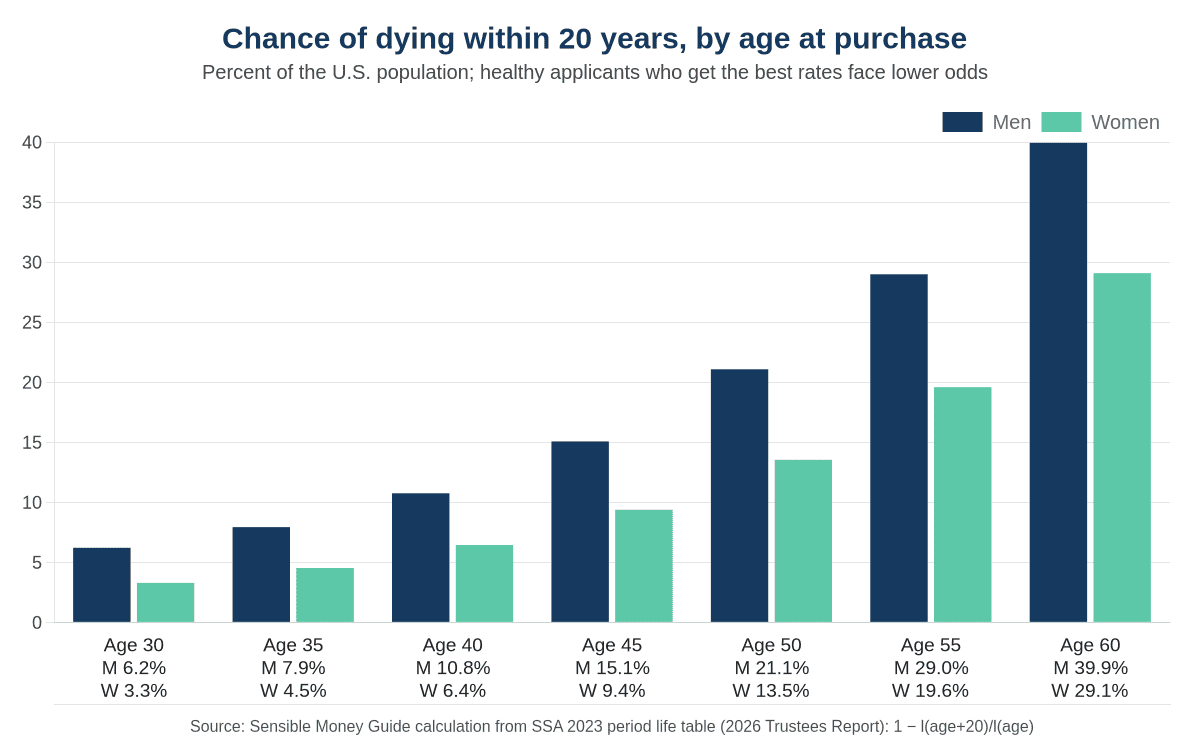
For a 30-year-old man, the chance is about 6%. Put another way, about 94 of every 100 outlive a 20-year term. By 50, the odds are about 21% for men and 14% for women. That jump is a big reason prices rise so fast with age.
These figures cover the whole U.S. population, including people with serious health problems. Healthy people who qualify for the best rates die less often than this during the term. Treat the chart as an upper-end illustration, not your personal odds.
Key terms in your policy
State regulators describe a few rules that show up in nearly every policy. Your contract and your state’s law decide the exact details.
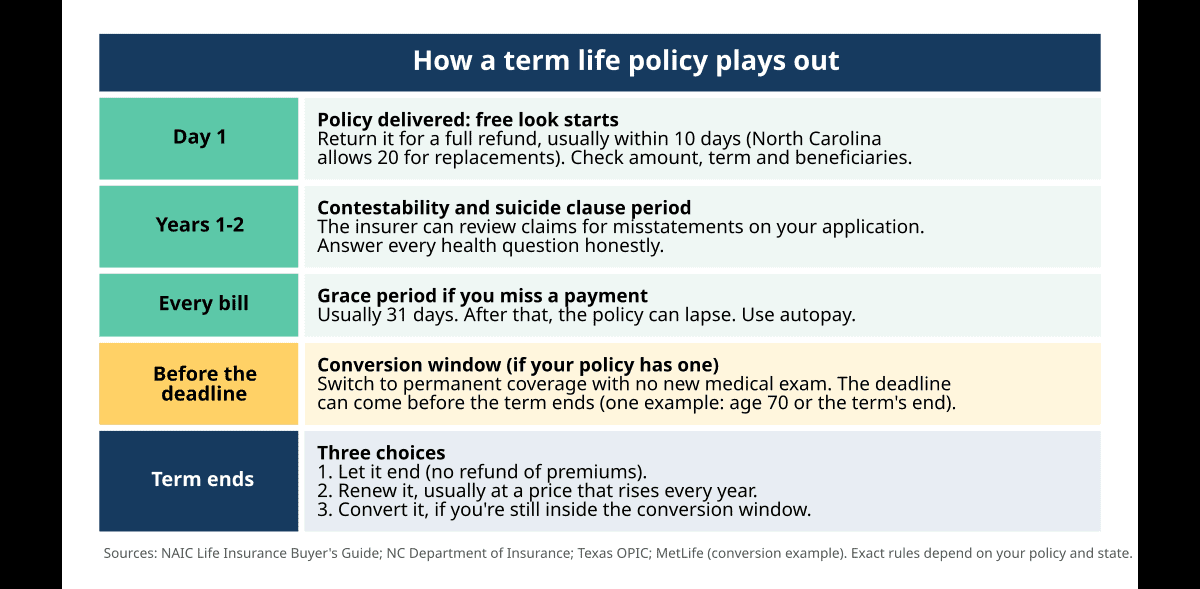
- Free look: you can return a new policy for a full refund within a set window, “usually 10 days after you receive it,” per the NAIC. North Carolina requires at least 10 days, or 20 for a replacement policy (NC Department of Insurance).
- Grace period: if you miss a payment, you usually have 31 days to pay before the policy lapses (Texas Office of Public Insurance Counsel).
- Contestability period: usually for the first two years, the insurer can challenge a claim or void the policy. That can happen if your application had material misstatements (NC Department of Insurance). Answer every health question honestly.
- Suicide clause: if death by suicide happens in the first two years (the usual window), the payout is generally limited to a refund of premiums paid (NC Department of Insurance; Texas OPIC).
Do you need it? A quick checklist
Life insurance is for the people you’d leave behind. If nobody would struggle with money after your death, you may not need any. Answer these questions:
- Does anyone rely on your income to pay rent, the mortgage, groceries or child care?
- Do you have children who are years away from supporting themselves?
- Do you share a mortgage, car loan or private student loan with someone who would be stuck with it?
- Do you do unpaid work at home, like child care, that your family would have to pay for?
- Would your family have trouble paying for a funeral out of savings?
If you answered yes to any of these, term life insurance is worth pricing. A stay-at-home parent counts, too. Replacing child care and household work costs real money, even though there’s no paycheck to replace.
Many people who need coverage don’t have it. LIMRA and Life Happens’ 2026 Insurance Barometer Study found that 52% of Americans own life insurance. It also found that 38%, about 92 million adults, need it or need more, according to the 2026 Barometer press toolkit.
Who can usually skip it? Single adults with no dependents or co-signed debts. Also retirees whose savings and pensions would already support a surviving spouse. If that’s you, money spent on premiums may do more good in an emergency fund or retirement account.

How much coverage: a fill-in worksheet
Rules of thumb are a fine starting point. Fidelity puts it this way in How much life insurance do I need?: “A common starting point is to have life insurance coverage equal to roughly 10 to 12 times your annual income.” But a multiple of income ignores what your family already has. A needs-based worksheet gets you closer to the right number.
The worksheet
Fill in your own numbers in the right column. Round to the nearest thousand. The middle column shows a hypothetical household. It has a 35-year-old parent earning $75,000, a partner, two kids ages 3 and 6, and a $240,000 mortgage.
| Line | What to enter | Example | You |
|---|---|---|---|
| A | Yearly amount your family would need to live on, not counting the mortgage | $55,000 | $_____ |
| B | Yearly Social Security survivor benefits you expect (average over the years) | $30,000 | $_____ |
| C | Yearly gap (A minus B) | $25,000 | $_____ |
| D | Years of support needed (until your youngest is about 18; college is on line I) | 15 | _____ |
| E | Income need (C times D) | $375,000 | $_____ |
| F | Mortgage balance | $240,000 | $_____ |
| G | Other debts (car, cards, private loans) | $15,000 | $_____ |
| H | Funeral and final costs | $15,000 | $_____ |
| I | College or other goals you want funded | $100,000 | $_____ |
| J | Total needs (E + F + G + H + I) | $745,000 | $_____ |
| K | Savings and investments your family could use (not counting retirement accounts you’d rather leave alone) | $40,000 | $_____ |
| L | Life insurance you already own outside of work | $0 | $_____ |
| M | Coverage to buy (J minus K minus L) | About $705,000; round to $750,000 | $_____ |
Notice that we didn’t subtract work life insurance. If you count a work policy worth 1 times pay ($75,000), this example drops to about $630,000. But group coverage usually ends when you leave the job, so it’s safer to treat it as a bonus rather than a base. More on that in the employer coverage section.
Read this before you trust the numbers: every figure in the example is a hypothetical assumption, not a recommendation. The worksheet doesn’t adjust for inflation or for interest the payout could earn. We assume investment returns roughly keep pace with inflation. Social Security survivor benefits change as kids grow up, so line B is a rough average. Your own Social Security statement at ssa.gov shows survivor estimates for your family.
Where line B comes from: Social Security survivor benefits
Many families forget that Social Security pays survivors. According to the SSA’s Survivors Benefits booklet (April 2026):
- A surviving spouse of any age who cares for your child under 16 generally gets 75% of your benefit.
- Each unmarried child under 18 (or up to 19 if still in elementary or secondary school full time) generally gets 75%.
- The family total is capped at between 150% and 180% of your benefit amount.
- There’s also a one-time $255 payment to an eligible spouse or child.
- You must have worked long enough under Social Security for your family to qualify.
- If your partner works, the earnings test can reduce or eliminate their own survivor check until full retirement age. Your children’s checks aren’t affected by your partner’s pay. Remarrying before 60 usually ends the spouse’s benefit, too.
Those checks stop or shrink as kids grow up. The spouse’s child-in-care benefit ends when the youngest turns 16, and each child’s ends at 18 or 19. That’s why line B uses an average, and why you shouldn’t count on survivor benefits for the full term.
Rules of thumb vs. the worksheet
Here’s how popular shortcuts compare for the same hypothetical household.
| Method | How it works | Result for the example | What it misses |
|---|---|---|---|
| 10 times income (Clark Howard; low end of Fidelity and Ramsey) | $75,000 x 10 | $750,000 | Savings, debts and Social Security |
| 12 times income (high end of Fidelity and Ramsey) | $75,000 x 12 | $900,000 | Same as above |
| Suze Orman: 25 times yearly costs | $55,000 x 25 | $1,375,000 | Leaves a bigger pot that can last much longer; costs more |
| Needs worksheet (above) | Needs minus resources | About $705,000 | Only as good as your estimates |
Ramsey Solutions tells readers to “aim for life insurance coverage equal to 10–12 times your annual income” (How Much Life Insurance Do I Need?). Clark Howard suggests 10 times your salary on Clark.com. Suze Orman’s method, in her Life Insurance 101 post, is to “purchase a policy that is 25 times” what your dependents need each year.
Some planners use a similar “pot that lasts” approach, sized at roughly 20 times the yearly income you want to leave behind:
“You may want to add in $1 million of coverage for every $50,000 of residual income that you’d like to leave behind.”
Andrew Rosen, CFP, then executive chairman, partner and financial adviser at Diversified, LLC, in Kiplinger (2024)
The bigger methods aim to leave a pot that’s never spent down. The worksheet assumes the money will be used up by the time your kids are grown. Neither is wrong. The bigger number buys more safety, and the smaller one leaves more room in your budget. Price both and see what fits your budget.
How long a term to buy (and laddering)
Match the term to how long people will depend on you. Common lengths are 10, 15, 20, 25 and 30 years. Ramsey suggests “a term life insurance policy lasting 15–20 years.” Suze Orman writes that “you probably do not need a policy that is longer than 20 to 25 years.”
“Many times, term insurance would be used for circumstances that have a finite length, like a mortgage or to get their children through college.”
Dan White, ChFC, CLU, RICP, founder and CEO of Daniel A. White & Associates, to GOBankingRates
A simple test: take your youngest child’s age and your mortgage payoff date. Pick a term that lasts until your youngest is about 22 and the house is close to paid off. For a newborn, that points to 25 or 30 years. For a 12-year-old, 10 or 15 may be enough.
Laddering: two or three smaller policies instead of one big one
Your need for coverage usually shrinks over time. The mortgage gets smaller, savings grow and kids leave home. A “ladder” matches that by stacking policies that end at different times.
Policygenius published sample rates (as of April 1, 2024) in its life insurance ladder guide. They’re for a 35-year-old nonsmoking man in the Preferred health class. We used them to total the cost over 30 years:
| Years | Ladder: coverage in force | Ladder: monthly cost | Single $1 million 30-year policy |
|---|---|---|---|
| 1–10 | $1,000,000 (all three policies) | $53.01 | $75.91 |
| 11–20 | $500,000 (20- and 30-year) | $38.25 | $75.91 |
| 21–30 | $200,000 (30-year only) | $21.56 | $75.91 |
| 30-year total | Shrinks over time | About $13,538 | About $27,328 |
The ladder is a $500,000 10-year policy, a $300,000 20-year policy and a $200,000 30-year policy. It costs about $13,800 less over 30 years, roughly half. (Policygenius lists the ladder total as $51.21 a month, but the three premiums it shows add to $53.01, so we used $53.01.) The trade-off is less coverage in later years. If you have another child at 45 or your debts don’t shrink, you could end up underinsured. You also have more bills to track. These are sample rates from 2024, so real quotes for you will differ.

What term life insurance costs
Price depends mainly on your age, sex, health, tobacco use, the amount and the term length. Here are NerdWallet’s sample annual rates for a $500,000, 20-year policy for a nonsmoker in good health. The rates come from LifeStein and average the three lowest quotes at each age. NerdWallet says they were valid as of October 1, 2026 (Average Life Insurance Rates in 2026).
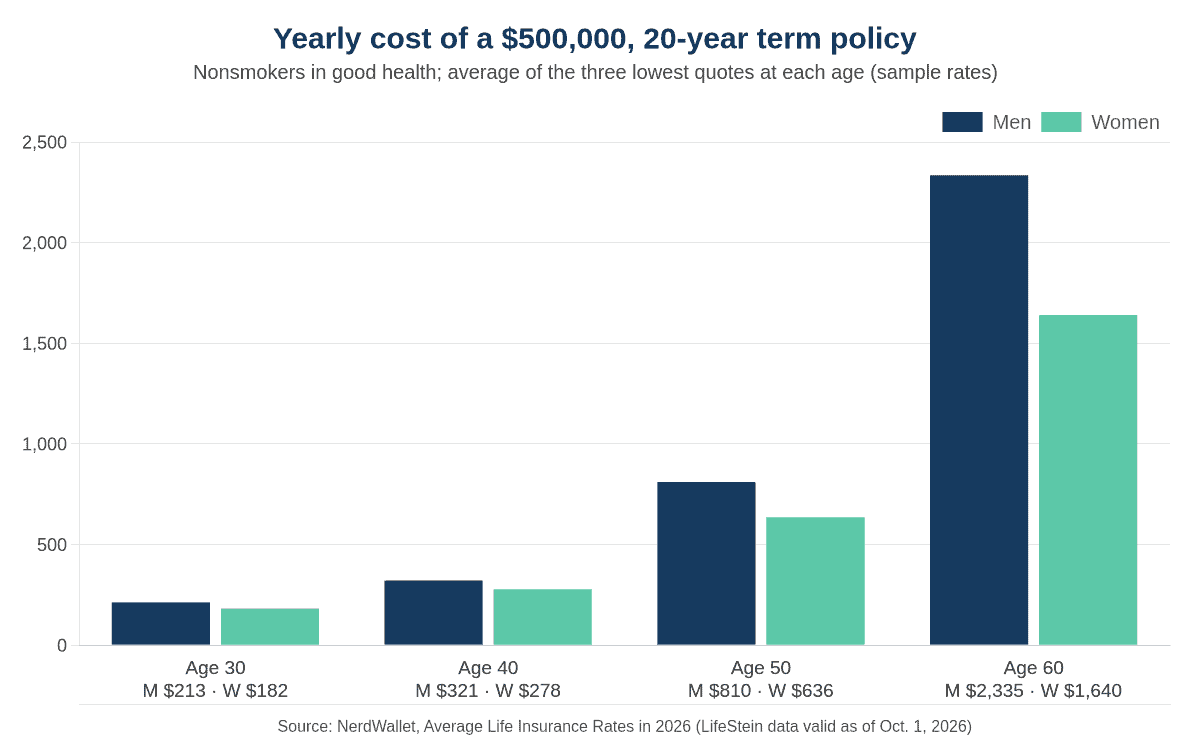
| Age | Men, per year | Women, per year | Men who smoke, per year |
|---|---|---|---|
| 30 | $213 | $182 | $788 |
| 40 | $321 | $278 | $1,448 |
| 50 | $810 | $636 | $3,495 |
| 60 | $2,335 | $1,640 | $8,435 |
These are the best prices for healthy applicants. If you have a health condition, expect to pay more. Policygenius’s averages from 2024 run noticeably higher. For example, a 30-year-old man pays $29.32 a month (about $352 a year). That’s because they average many insurers rather than the cheapest three (How much is life insurance?).
Most people guess far too high
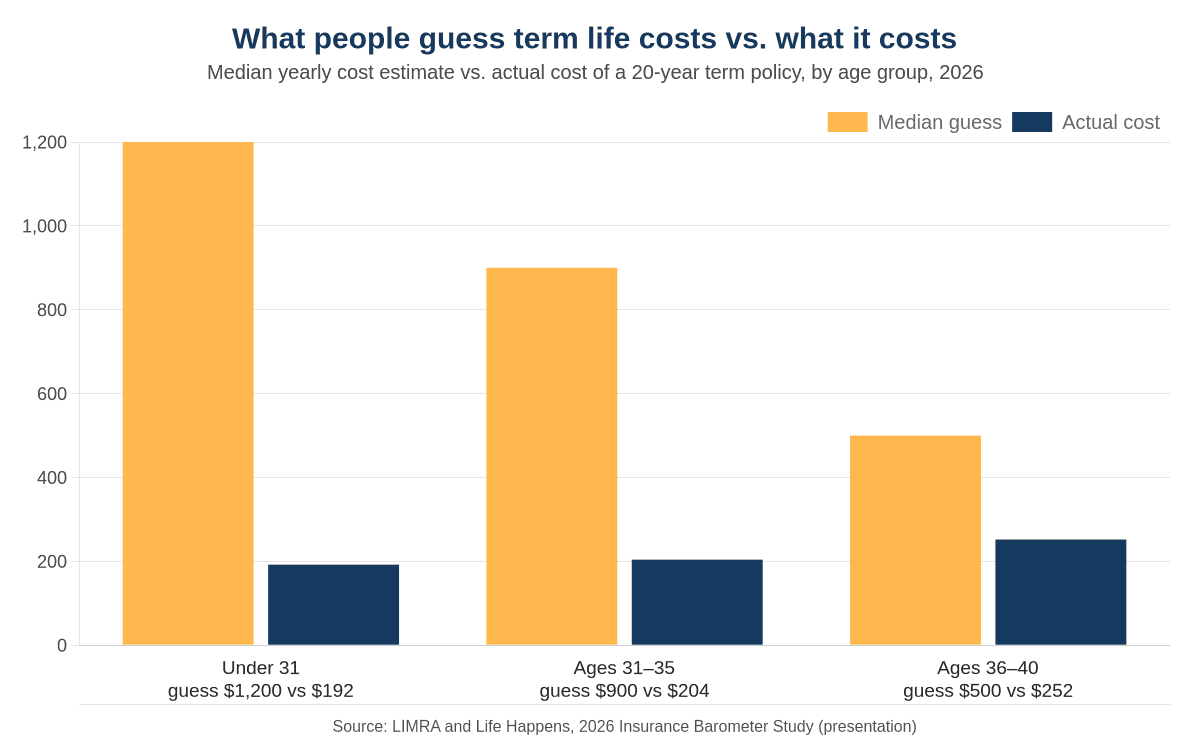
Cost is the top reason people give for not buying. In the 2026 Barometer, 45% of people with a coverage gap named cost. Yet the study’s own numbers show how far off the guesses are. LIMRA says adults under 31 overestimate the cost of a $250,000, 20-year term policy by about five to six times. Its 2026 study presentation shows their median guess was $1,200 a year, compared with an actual cost of $192 (2026 Insurance Barometer Study presentation).
What waiting costs you
Using NerdWallet’s rates for a man, here’s what a $500,000, 20-year policy costs in total if he buys at different ages. This assumes he stays healthy enough to get the same rate class. Keep in mind that each later start also ends coverage 10 years later.
| Buy at age | Yearly premium | Total over 20 years | Coverage ends at |
|---|---|---|---|
| 30 | $213 | $4,260 | 50 |
| 40 | $321 | $6,420 | 60 |
| 50 | $810 | $16,200 | 70 |
Waiting from 30 to 40 adds about $2,160 over the life of the policy. The bigger risk is health. A diagnosis in your 30s can push you into a pricier class or make coverage hard to get at any price.
“Term life insurance is the cheapest and most simple option. There aren’t a lot of bells and whistles, but it pays out the largest benefit for the cheapest amount of money.”
Riley Saunders, Certified Financial Planner at Cassaday & Company, to CNBC Select (December 2025)
Life insurance through work
Group life insurance at work is often free or cheap, and basic coverage doesn’t require a medical exam. In March 2026, 59% of private industry workers had access to life insurance through work, according to the Bureau of Labor Statistics (Employee Benefits in the United States, March 2026). Access varies a lot by job.
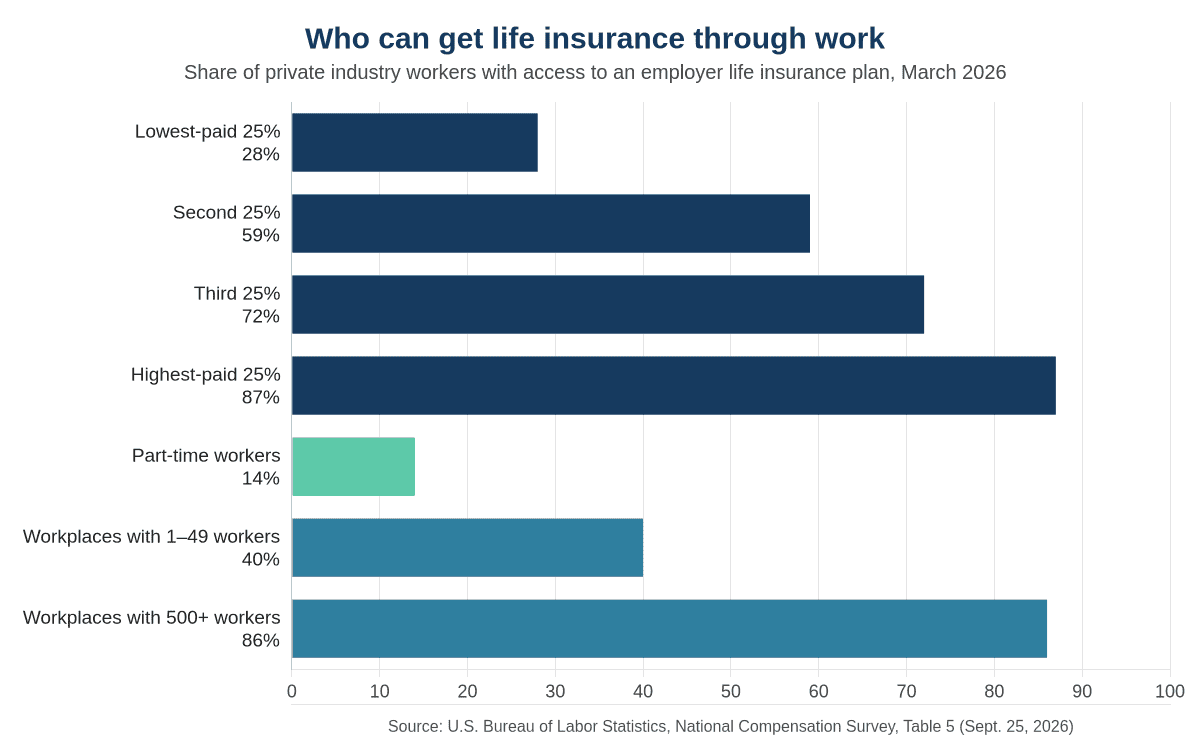
Only 28% of the lowest-paid quarter of private workers had access, compared with 87% of the highest-paid quarter. Part-time workers had 14% access, and workers at places with fewer than 50 employees had 40% (BLS Table 5).
Why work coverage usually isn’t enough
- It’s small. The last detailed BLS breakdown uses March 2010 data. Most workers with a salary-based benefit got 1 times their pay. The median flat benefit was $15,000 (BLS Program Perspectives, 2010). That’s old data, so check your own plan.
- It’s tied to your job. If you quit, get laid off or retire, the coverage usually ends. Some plans let you “port” the coverage, which means you keep the group term policy and pay the premiums yourself. Others let you convert it to an individual policy without a medical exam, usually at a higher price. Both options can have short deadlines after you leave, so ask HR before your last day.
- You don’t control it. Your employer can change or drop the benefit.
“If they give you two years’ worth of your salary, then you’re basically giving your dependents two years’ worth of your lifestyle after you die. And unless your dependents are going to become independent within two years, it’s never enough.”
Keith Singer, certified financial planner in Boca Raton, Florida, to USA TODAY (February 2026)
The tax catch on coverage over $50,000
The first $50,000 of employer-paid group term life coverage is tax-free. The IRS says employers “must include in your employee’s wages the cost of group-term life insurance beyond $50,000 worth of coverage,” minus anything you paid toward it, in Publication 15-B (2026). It shows up in box 12 of your W-2 with code C and is subject to Social Security and Medicare tax.
The cost comes from an IRS table, not from what your employer actually pays. Here’s a worked example:
- A 45-year-old gets coverage of 2 times a $75,000 salary: $150,000.
- The amount over $50,000 is $100,000, or 100 units of $1,000.
- The IRS rate for ages 45 to 49 is $0.15 per $1,000 per month (Table 2-2).
- Taxable “imputed income”: 100 x $0.15 x 12 = $180 a year.
- Assuming a 22% federal bracket plus 7.65% Social Security and Medicare tax, that’s about $53 a year in extra tax. State tax may add a little.
That’s still a good deal. But the IRS rate jumps to $0.43 at ages 55 to 59, which would make the same coverage $516 a year of imputed income. If your plan lets you choose, older workers with a private policy may want a smaller work benefit.
Term vs. whole life insurance
Whole life is a type of permanent insurance. It lasts your whole life as long as you pay, and it builds a cash value you can borrow against. It also costs much more. Take NerdWallet’s sample rates (data as of February 17, 2026) for a $500,000 policy on a 40-year-old man. Twenty-year term costs $330 a year, and whole life costs $5,524, about 17 times as much (Term vs. Whole Life Insurance).
| Feature | Term life | Whole life |
|---|---|---|
| How long it lasts | A set number of years | Your whole life, if premiums are paid |
| Cost for the same death benefit | Low | Many times higher |
| Cash value | None | Builds slowly; fees and surrender charges apply |
| Best for | Replacing income during working and child-raising years | Lifelong needs, such as some estate plans or a dependent who will always need support |
What the experts say
The case for term. Many well-known voices favor term for most families. Ramsey Solutions says “we recommend term life insurance over whole life because of term’s simplicity, affordability and focus on income replacement.” Suze Orman writes, “You want a policy that is called term life insurance— not whole life.” NerdWallet’s view is more measured. “Term life is sufficient for most people,” it says, though “whole life and other forms of permanent coverage can be useful in certain situations.”
The case for permanent. Schwab’s Center for Financial Research writes that “permanent life insurance can make sense if you have complex needs.” Examples include a dependent with special needs, or estate and business planning (Life Insurance: Do I Need It?). Dan White, quoted above, told GOBankingRates that permanent coverage can be used “for burial expenses, to pay inheritance taxes, or to leave a tax-free inheritance to loved ones.”
“Buy term and invest the difference”
Using NerdWallet’s sample numbers above, term saves the 40-year-old about $5,194 a year compared with whole life. If that money were invested and earned an assumed 4% a year, it would grow to about $155,000 in 20 years, before taxes and fees. That’s a hypothetical return, not a promise. It only works if you actually invest the difference every year, for example in low-cost index funds.
A whole life policy’s cash value depends on the insurer’s guarantees and dividends, which vary. If someone pitches you a permanent policy, ask for the illustration showing guaranteed (not just projected) values and the surrender charges.
Be extra careful with variable life insurance. Its cash value is invested in the market, and it’s regulated by both state insurance departments and the SEC. Investor.gov warns that “you can lose money in a variable life insurance policy, including potential loss of your initial investment” (Investor Bulletin: Variable Life Insurance).
This short video from PBS’s Two Cents (February 2020) walks through why many planners prefer term. It was published in 2020, so any prices it mentions are dated.
How to buy a policy, step by step
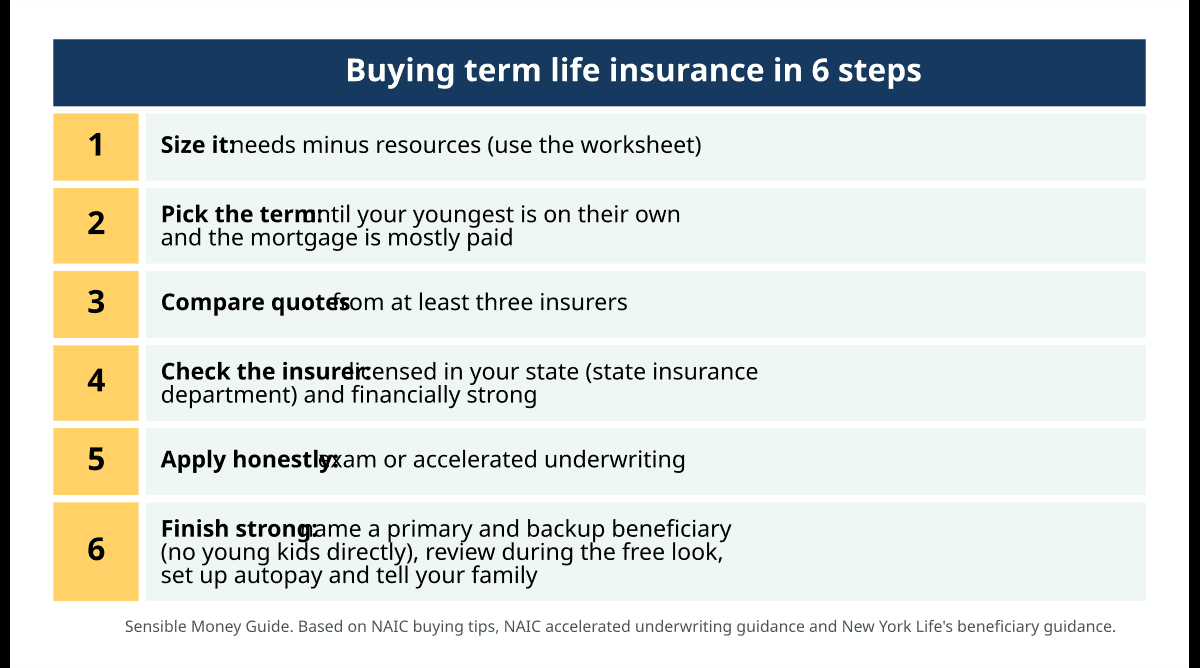
- Pick your amount and term. Use the worksheet above. Round up to a common amount, like $500,000 or $750,000.
- Get several quotes. Prices for the same person can vary a lot between insurers. Use an independent agent or an online marketplace that quotes several companies, or get quotes directly.
- Check the insurer. The NAIC says to “check with your state insurance department to verify that the company is authorized to do business in your state” (Tips for Buying Life Insurance). Look at its financial strength ratings, too.
- Apply honestly. You’ll answer health questions. Some insurers use “accelerated underwriting,” which the NAIC says lets them “forgo a physical exam” and supplement the application with data from external sources (NAIC: Accelerated Underwriting). Some applicants still get sent for an exam. No-exam policies can cost more.
- Name your beneficiaries carefully. Name a first and a backup (contingent) beneficiary. See naming beneficiaries below if you have young kids.
- Review the policy during the free look. Check the amount, term, beneficiaries, conversion deadline and riders. You can cancel for a refund during this window.
- Set up autopay. A lapse means you’d have to reapply, at an older age and maybe in worse health.
- Tell someone. Make sure your beneficiaries know the policy exists and which company holds it.
Naming beneficiaries when you have young kids
Don’t name a young child directly. New York Life explains that state law then requires a guardian to be appointed to manage the money until the child reaches adulthood (Minors as policy beneficiaries). Instead, you can name a custodian under your state’s Uniform Transfers to Minors Act (available in all states except South Carolina and Vermont, per New York Life). The custodian manages the money until the child reaches the age set by state law, usually 18 to 21. A trust gives you more control over how and when the money is used. An estate-planning attorney can help you choose.
Replacing a policy you already have?
Pro tip: Keep the old policy until the new one is approved and in force. Canceling first could leave your family uncovered if the new application is denied.
What if your insurer fails?
One more safety net: if an insurer fails, your state’s life and health insurance guaranty association steps in, up to a limit. In most states that limit is $300,000 in death benefits per person, and in a few states it’s $500,000, according to NOLHGA (figures as of June 1, 2025). Coverage above the limit may not be protected, so large policies are one more reason to check an insurer’s financial strength.

Riders: which extras are worth it
Riders add features to a policy, usually for an added cost. Here are the common ones.
| Rider | What it does | Worth a look if… |
|---|---|---|
| Waiver of premium | Stops your premiums if you become disabled and can’t work | You don’t have strong disability insurance |
| Accelerated death benefit | Pays part of the benefit early if you’re terminally ill | Some policies include it; ask about fees |
| Child term rider | Small coverage on your kids | You want a small amount to cover a child’s funeral costs |
| Return of premium | Refunds premiums if you outlive the term | Rarely worth it; The Zebra says it can cost two to three times as much |
Thrivent explains that an accelerated death benefit typically requires a terminal illness “with a likely life expectancy of 12-24 months.” The early payout reduces what your beneficiaries get, may be discounted and may carry a fee. Thrivent adds that it “may be taxable in limited situations” (How the accelerated death benefit rider works).
The most useful feature isn’t really a rider. It’s the conversion privilege, if your policy has one. It lets you switch to permanent coverage without a new medical exam (Fidelity). Ask about it before you buy, because deadlines vary.
When the term ends: renew, convert or let it go
When the level period ends, you usually have three choices.
- Let it end. If your kids are grown and the mortgage is paid, you may not need coverage anymore. The Texas Office of Public Insurance Counsel notes that the company “will not refund your premiums if you outlive a term policy.”
- Renew it. The NAIC says most term coverage “can be continued (“renewed”) at the end of the term, even if your health has changed,” but at a higher premium. State Farm says that after the level period, “your premiums will likely increase each year based on your age” (What happens when term life insurance expires?).
- Convert it. Switch to a permanent policy without new medical questions. The new premium is usually based on your age at conversion, and permanent coverage costs far more than term, so expect a much higher bill. Some policies let you convert only part of the coverage.
Conversion deadlines are set by your contract, and they can end before the term does. Take MetLife’s Guaranteed Level Term policies issued before age 65. They are “convertible until the earlier of the end of the initial term period” or the policy anniversary at age 70 (MetLife policy change guide). Find the deadline in your policy and put it on your calendar.
To see the price jump, compare NerdWallet’s new-policy rates for a healthy man: $321 a year at 40, $2,335 at 60 and $9,702 at 70. If you still need coverage at the end of your term, plan for that cost or start saving to replace it.

How the payout works (and taxes)
Your beneficiary files a claim with a copy of the death certificate. The money goes straight to the named beneficiaries, not through your will, unless you name your estate or no beneficiary is alive. That’s one more reason to keep your beneficiary forms up to date after a marriage, divorce or new baby.
The death benefit is generally not taxable income. The IRS says life insurance proceeds you receive as a beneficiary because of the insured person’s death generally aren’t taxable and don’t need to be reported. But “any interest you receive is taxable,” for example if the insurer pays the benefit in installments (IRS: Life insurance & disability insurance proceeds).
Can’t find a policy you think a family member had? The NAIC’s free Life Insurance Policy Locator searches participating insurers for you. If a policy is found and you’re the beneficiary, the insurer contacts you. Be wary of letters claiming a stranger left you millions. The FTC warns that “unclaimed life insurance” letters from fake law firms are a scam (FTC consumer alert, July 2026).
The short version
- Term life insurance covers a set number of years and is the cheapest way to protect people who rely on your income.
- Size it with needs minus resources. In our hypothetical example, that came to about 9 to 10 times income. Your numbers may differ.
- Count Social Security survivor benefits, but remember they shrink as kids grow up.
- Pick a term that lasts until your youngest is independent and the mortgage is mostly paid. A ladder can cut the cost.
- Prices rise steeply after 40, and your health can change, so it usually pays to buy sooner.
- Work coverage is a nice extra, but it’s often small and it can end with the job.
- Check your conversion deadline, name a backup beneficiary and never name a young child directly.
FAQ
What happens if I outlive my term life insurance?
The coverage ends and you don’t get your premiums back, unless you paid extra for a return-of-premium rider. That’s how term keeps its price low. Before the term ends, you can usually renew at a higher yearly price or convert to permanent coverage, if your policy allows it.
Can I have more than one life insurance policy?
Yes. Some people have a work policy and a private one, or several private policies that end at different times (a ladder). Expect the application to ask about any coverage you already have.
Do stay-at-home parents need life insurance?
Often, yes. If a stay-at-home parent died, the family might need to pay for child care, school pickups and household help. Use the worksheet and list those costs on line A.
Is term life insurance worth it if I’ll probably outlive it?
Think of it like home insurance. You hope you never use it. You buy it because your family couldn’t absorb the loss without it. The low odds of a claim are exactly why it’s affordable.
Can I cancel term life insurance?
Yes, you can stop paying or cancel at any time. During the free look period, you get a full refund. After that, a term policy has no cash value, so you simply stop paying and the coverage ends.
Do I need a medical exam?
Not always. Some insurers use accelerated underwriting that skips the exam for some healthy applicants. Others still require one, especially for larger amounts. Clark.com notes that instant-issue policies usually cost more.
Is the payout taxed?
Generally, no. The IRS says death benefits received because of the insured’s death usually aren’t taxable income. Interest paid on the benefit is taxable, and there are exceptions, such as a policy that was sold to you for cash.
Your move this week
Take 20 minutes and fill in the worksheet with your real numbers. Log in to your Social Security account for survivor estimates and check your work benefits portal for your group coverage. Then get quotes from at least three insurers for the amount and term you picked. If you can’t afford the full amount right now, buy what you can. Some coverage beats none.
About this guide
Published by Daniel Brienza, founder and editor of Sensible Money Guide (B.S. in Business Administration, University of South Florida). This guide was researched and drafted with the help of AI tools, fact-checked against the primary sources listed below, and reviewed and edited by Daniel before publishing. Daniel is not a licensed financial advisor; this guide is for general education.
Written November 9, 2026. Facts and figures are based on data available on that date.
Sources
Government and official sources
- Social Security Administration, Actuarial Life Table (2023 period life table, 2026 Trustees Report), accessed November 2026.
- Social Security Administration, Survivors Benefits (Publication No. 05-10084), April 2026.
- Social Security Administration, What you could get from survivor benefits, accessed November 2026.
- Internal Revenue Service, Life insurance & disability insurance proceeds, reviewed October 16, 2026.
- Internal Revenue Service, Publication 15-B (2026), Employer’s Tax Guide to Fringe Benefits, accessed November 2026.
- U.S. Bureau of Labor Statistics, Employee Benefits in the United States, March 2026, September 25, 2026.
- U.S. Bureau of Labor Statistics, Table 5. Life insurance benefits: access, participation, and take-up rates, March 2026, September 25, 2026.
- U.S. Bureau of Labor Statistics, Program Perspectives on Life and Disability Insurance Benefits, December 2010.
- U.S. Securities and Exchange Commission (Investor.gov), Investor Bulletin: Variable Life Insurance, accessed November 2026.
- Federal Trade Commission, Unclaimed life insurance money? It’s a scam, July 9, 2026.
Insurance regulators and industry research
- National Association of Insurance Commissioners, Life Insurance Buyer’s Guide, 2026.
- National Association of Insurance Commissioners, Tips for Buying Life Insurance, accessed November 2026.
- National Association of Insurance Commissioners, Accelerated Underwriting, updated April 7, 2026.
- National Association of Insurance Commissioners, Learn How to Use the NAIC Life Insurance Policy Locator, May 14, 2025.
- North Carolina Department of Insurance, FAQs About Life Insurance, accessed November 2026.
- Texas Office of Public Insurance Counsel, Life Insurance – Know Your Rights, March 1, 2023.
- National Organization of Life & Health Insurance Guaranty Associations, How You’re Protected, figures as of June 1, 2025.
- LIMRA and Life Happens, 2026 Insurance Barometer Study member PR toolkit, 2026.
- LIMRA, 2026 Insurance Barometer Study: Rethinking Your Life Insurance (presentation), 2026.
Banks, investment firms and insurers
- Fidelity, How much life insurance do I need?, August 7, 2026.
- Fidelity, What is term life insurance and how does it work?, August 3, 2026.
- Charles Schwab, Life Insurance: Do I Need It?, August 12, 2025.
- MetLife, Guaranteed Level Term policy change guide, accessed November 2026.
- State Farm, What happens when term life insurance expires?, January 28, 2025.
- New York Life, Minors as policy beneficiaries, accessed November 2026.
- Thrivent, How the accelerated death benefit rider in life insurance works, September 22, 2025.
News and personal finance media
- NerdWallet, Average Life Insurance Rates in 2026, data valid as of October 1, 2026.
- NerdWallet, Term vs. Whole Life Insurance, updated February 20, 2026.
- Policygenius, How much is life insurance?, rates as of October 1, 2024.
- Policygenius, Life insurance ladder strategy, rates as of April 1, 2024.
- Ramsey Solutions, How Much Life Insurance Do I Need?, updated May 1, 2025.
- Suze Orman, Life Insurance 101, December 12, 2019 (updated November 2025).
- Clark Howard, What Is Term Life Insurance?, accessed November 2026.
- Kiplinger (Andrew Rosen), How Much Life Insurance Do You Really Need?, September 5, 2024.
- CNBC Select, Here are 3 insurance options to nix in the new year, December 23, 2025.
- USA TODAY via Yahoo Finance, Here are the 3 kinds of people who need life insurance, February 15, 2026.
- GOBankingRates via Yahoo Finance, I’m a Financial Advisor: 3 Cases Where I Strongly Advise My Clients To Get Life Insurance, August 17, 2025.
- The Zebra, Term life insurance, accessed November 2026.
- PBS Two Cents, Is Whole Life Insurance a Scam?, February 19, 2020.
This article is for educational purposes only and isn’t financial advice. Consider talking with a qualified professional about your situation.



Beneficiary Designations: How to Name, Check and Update Them

Term Life Insurance: How Much You Need and What It Costs

How to Start Investing: Accounts, First Buys and Real Risks

Student Loan Repayment Plans: RAP vs. IBR vs. Standard

When to Claim Social Security: Ages, Math and Trade-Offs

Credit Report Errors: How to Find, Dispute and Fix Them
When to Claim Social Security: Ages, Math and Trade-Offs
Student Loan Repayment Plans: RAP vs. IBR vs. Standard
How to Start Investing: Accounts, First Buys and Real Risks
You must be logged in to post a comment Login