


Debt Management
Student Loan Repayment Plans: RAP vs. IBR vs. Standard
Compare student loan repayment plans for 2026: what RAP, IBR and Standard cost at your income, the new-loan trap, taxes on forgiveness and SAVE next steps.

If you’re comparing student loan repayment plans, the choice now comes down to three for most federal borrowers: the Repayment Assistance Plan (RAP), Income-Based Repayment (IBR) and a Standard plan. RAP often costs less per month at middle incomes. IBR often wins at high incomes or if you’re close to forgiveness. Standard often costs less overall if you can afford it. Use this quick worksheet to see your own monthly numbers.
| Step | What to do | Example | You |
|---|---|---|---|
| 1 | Write your adjusted gross income (AGI) | $55,000 | ____ |
| 2 | Find your RAP percent in the band table | 5% | ____ |
| 3 | Multiply step 1 by step 2, then divide by 12 | $229.17 | ____ |
| 4 | Subtract $50 for each dependent you claim. The result is your RAP payment (minimum $10) | $229.17 (no dependents) | ____ |
| 5 | For IBR, subtract 150% of the poverty guideline from step 1 | $55,000 − $23,940 = $31,060 | ____ |
| 6 | Multiply step 5 by 10% if you’re a “new borrower,” or 15% if not, then divide by 12. That’s your IBR payment (it can’t top the 10-year Standard amount) | $258.83 at 10% | ____ |
The example is a hypothetical single borrower with no dependents, using 2026 poverty guidelines. The formulas come from the federal regulation on income-driven plans. Your servicer’s number is the one that counts, so treat this as an estimate.
In this guide:
- The plans at a glance
- How RAP sets your payment
- How IBR sets your payment
- RAP vs. IBR by income
- Total cost: three worked examples
- The new-loan trap and picking a plan
- If you were on SAVE
- Parent PLUS loans
- Married borrowers
- PSLF, forgiveness and taxes
- If you fall behind
- Pay extra or refinance?
- Mistakes to avoid
- Questions people ask

The plans at a glance
A 2025 law, Public Law 119-21, rewrote federal repayment. Most of the new rules took effect on July 1, 2026. Here is where each plan stands as of early November 2026.
| Plan | Payment | Forgiveness | Status |
|---|---|---|---|
| RAP | 1%–10% of AGI, minus $50 per dependent, at least $10 | After 30 years | Open to Direct Loan borrowers, except Parent PLUS |
| IBR | 10% or 15% of income above 150% of poverty line, capped at the 10-year Standard amount | After 20 or 25 years | Stays open only for loans made before July 1, 2026 |
| Tiered Standard | Fixed, 10–25 years by balance, at least $50 | None | For anyone with a loan made on or after July 1, 2026 |
| Older Standard, Graduated, Extended | Fixed or rising, usually 10–25 years | None | Kept if you have no Direct Loan made on or after July 1, 2026 |
| PAYE, ICR | Income-based | Under the old rules | End by July 1, 2028 |
| SAVE | None going forward | None | Ended by court settlement in March 2026 |
Tiered Standard sets your term by your total balance when you enter repayment: under $25,000 is 10 years, $25,000 to under $50,000 is 15, $50,000 to under $100,000 is 20, and $100,000 or more is 25. If you take a new loan on or after July 1, 2026, Kiplinger and Fidelity both note your choices narrow to RAP or Tiered Standard.
Federal rates for loans made from July 1, 2026 through June 30, 2027 are 6.52% for undergraduates, 8.07% for graduate unsubsidized loans and 9.07% for PLUS loans. Your own loans likely carry older rates, so check your servicer’s account page.
How RAP sets your payment
RAP looks only at your AGI and your dependents, not your balance. The percent applies to all your AGI, not just the part inside a band. The Congressional Research Service describes the same one-point-per-$10,000 ladder.
| AGI | Percent of AGI | Monthly payment at the top of the band |
|---|---|---|
| $10,000 or less | $10 flat | $10 |
| $10,001–$20,000 | 1% | $16.67 |
| $20,001–$30,000 | 2% | $50.00 |
| $30,001–$40,000 | 3% | $100.00 |
| $40,001–$50,000 | 4% | $166.67 |
| $50,001–$60,000 | 5% | $250.00 |
| $60,001–$70,000 | 6% | $350.00 |
| $70,001–$80,000 | 7% | $466.67 |
| $80,001–$90,000 | 8% | $600.00 |
| $90,001–$100,000 | 9% | $750.00 |
| Over $100,000 | 10% | No cap |
Three other rules set RAP apart:
- Unpaid interest is waived. If an on-time payment doesn’t cover the month’s interest, the rest isn’t charged. Your balance can’t grow from interest while you pay on time.
- A principal match of up to $50 a month. If your on-time payment would cut principal by less than $50, the government makes up the difference. It’s the lesser of $50 or your payment, minus what already went to principal.
- No payment cap. A big raise can push your RAP bill above what Standard would cost, as Forbes contributor Adam Minsky points out.
A detail many guides miss: the band jump
Because the percent covers all your AGI, crossing a band line raises your bill by more than your raise. At $50,000 you’d pay $166.67 a month. At $50,001 you’d pay $208.34. That’s about $500 a year more for one extra dollar of income.
You can sometimes use this in your favor. Hypothetical example: a single borrower with $50,500 in AGI pays $210.42 a month. If $501 more goes into a pre-tax 401(k), AGI falls to $49,999 and the payment drops to $166.66. That saves about $525 over a year of payments, and the $501 is still yours in the account. Pre-tax contributions lower AGI, while Roth ones don’t. Our guide to how a 401(k) works explains the difference.
Timing note: RAP usually uses your most recent tax return, so a move you make this year shows up when you recertify after filing. Plan for next year’s payment, not this month’s.
How IBR sets your payment
IBR starts with “discretionary income”: your income minus 150% of the federal poverty guideline for your family size. In the 48 contiguous states and D.C., here’s what that protects for 2026:
| Family size | 2026 guideline | 150% (protected) |
|---|---|---|
| 1 | $15,960 | $23,940 |
| 2 | $21,640 | $32,460 |
| 3 | $27,320 | $40,980 |
| 4 | $33,000 | $49,500 |
You then pay 10% or 15% of that amount, divided by 12. You pay 10% and reach forgiveness after 20 years if you’re a “new borrower”: you had no balance on a federal loan when you took your first loan on or after July 1, 2014 (and before July 1, 2026). Other borrowers with older loans pay 15% and wait 25 years. Anyone with a loan made on or after July 1, 2026 can’t use IBR at all.
Two things make IBR different from RAP:
- It has a ceiling. Your payment can’t exceed the 10-year Standard amount. On $40,000 at 6.5%, that’s about $454 a month, even at $200,000 of income.
- It doesn’t waive unpaid interest the way RAP does. A low payment can leave your balance growing while you’re in the plan.
The law also removed the partial financial hardship test for borrowers with existing loans, so a high income no longer blocks you from entering IBR.
RAP vs. IBR: which is cheaper at your income?
We ran both formulas at a range of incomes. Assume a hypothetical single borrower with no dependents, $40,000 in loans at 6.5%, and 2026 guidelines.
| AGI | RAP | IBR at 10% | IBR at 15% |
|---|---|---|---|
| $25,000 | $42 | $10 | $13 |
| $35,000 | $88 | $92 | $138 |
| $45,000 | $150 | $176 | $263 |
| $55,000 | $229 | $259 | $388 |
| $65,000 | $325 | $342 | $454 (cap) |
| $75,000 | $438 | $426 | $454 (cap) |
| $85,000 | $567 | $454 (cap) | $454 (cap) |
| $100,000 | $750 | $454 (cap) | $454 (cap) |
| $120,000 | $1,000 | $454 (cap) | $454 (cap) |
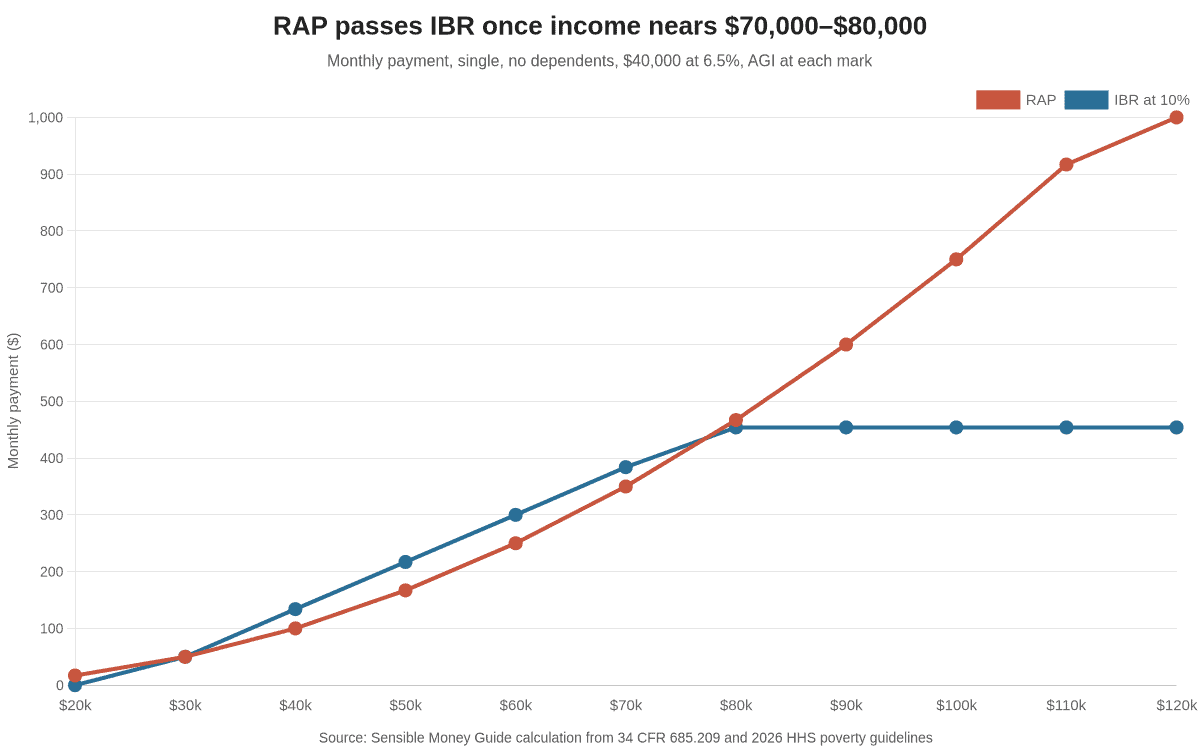
Three patterns stand out for that borrower:
- Very low income: IBR can be cheaper, because the poverty-line cushion can zero out your payment (a figure under $5 becomes $0, and $5 to $10 becomes $10). RAP still charges at least $10.
- Roughly $35,000 to $70,000: RAP is usually lower than 10% IBR, and well below 15% IBR. From about $70,000, 10% IBR edges ahead. 15% IBR catches up near $78,000.
- Above about $80,000: IBR’s cap wins, and the gap grows with income. A bigger balance means a higher cap, so check your own number.
Dependents shift the picture too. At $45,000 with two dependents (household of three), RAP drops to $50 a month, but 10% IBR drops further, to about $34. In that family 10% IBR stays lower up to about $48,000. Other sites reach similar conclusions: The College Investor puts the rough crossover at $80,000 to $90,000 in AGI. Still, your balance and family size can move that line.
“If you are close to the 20-year mark for forgiveness, IBR might be the better option.”
Preston Cooper, senior fellow at the American Enterprise Institute, to Investopedia via Yahoo Finance
Cooper added in the same piece that he thinks RAP will be the better choice for most other borrowers. Time matters here, and so does the monthly bill.
Total cost: three worked examples
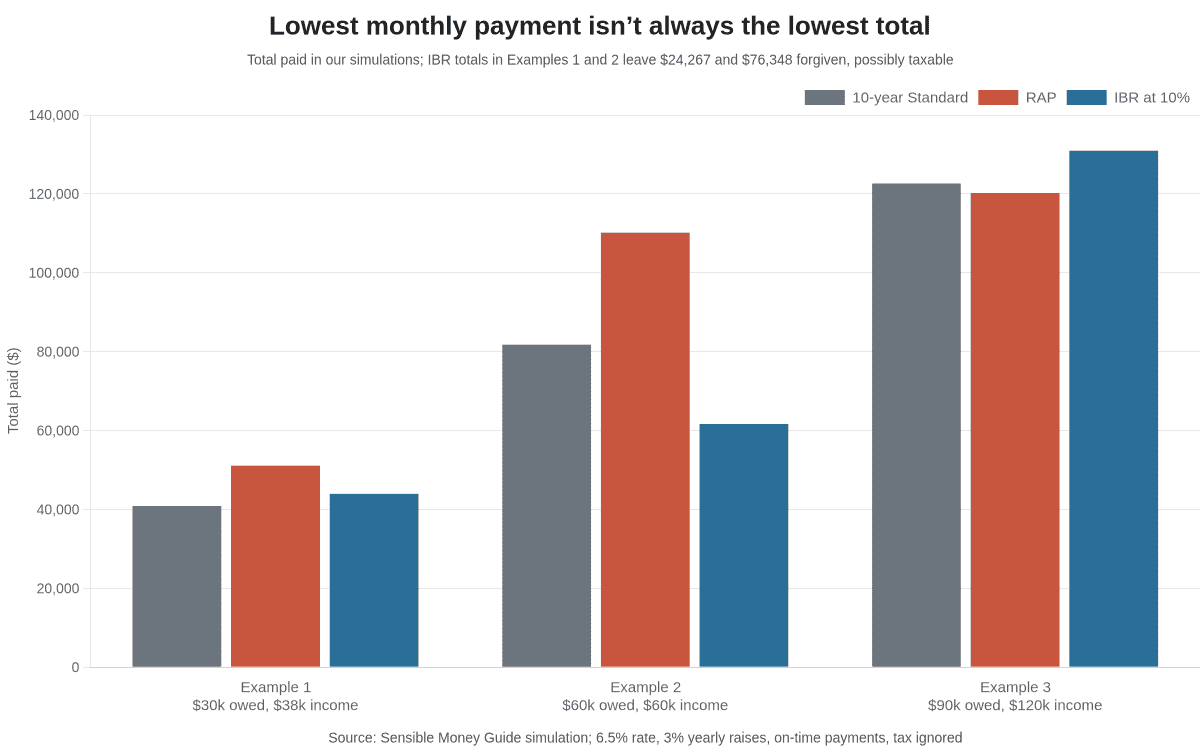
A low monthly payment isn’t the same as a cheap loan. So we simulated each plan month by month for three hypothetical borrowers.
Read this before you trust the numbers: Every example assumes a 6.5% fixed rate, 3% yearly raises, 2% yearly growth in the poverty guideline, RAP bands that stay fixed, on-time payments, no new loans, no past credit toward forgiveness, and no change in family size. IBR examples assume unpaid interest doesn’t get added to principal. Standard here means a 10-year fixed plan. Dollar figures are rounded, ignore any tax on forgiveness, and aren’t predictions.
Example 1: $30,000 balance, $38,000 income, single
| Plan | First monthly payment | Time in plan | Total paid |
|---|---|---|---|
| 10-year Standard | $341 | 10 years | $40,877 |
| RAP | $95 | 20.7 years (paid off) | $51,095 |
| IBR at 10% | $117 | 20 years | $43,940, plus $24,267 forgiven |
RAP frees up about $246 a month next to Standard, but it costs about $10,200 more over time. Standard is lowest in cash. IBR costs less than RAP on paper, but the forgiven $24,267 could be taxable. RAP’s waiver and match added about $6,900 of help here ($1,972 in waived interest, $4,940 in matched principal).
Example 2: $60,000 balance, $60,000 income, two dependents, household of three
| Plan | First monthly payment | Time in plan | Total paid |
|---|---|---|---|
| 10-year Standard | $681 | 10 years | $81,755 |
| RAP | $150 | 20.9 years (paid off) | $110,152 |
| IBR at 10% | $159 | 20 years | $61,652, plus $76,348 forgiven |
| IBR at 15% | $238 | 25 years | $131,010, plus $13,500 forgiven |
This is where the “new borrower” label matters. With 10% IBR, you’d pay about $48,500 less than RAP over the years, though a large forgiven balance could bring a large tax bill. The balance on 10% IBR grows, too: unpaid interest piles up in the early years. With 15% IBR, you’d pay more than under RAP.
Example 3: $90,000 balance, $120,000 income, single
| Plan | First monthly payment | Time in plan | Total paid |
|---|---|---|---|
| 10-year Standard | $1,022 | 10 years | $122,632 |
| RAP | $1,000 | 8.9 years (paid off) | $120,215 |
| IBR at 10% | $801 | 11.7 years (paid off) | $130,940 |
High earners often pay the loan off under any plan. RAP’s higher payment clears the debt sooner here, and IBR’s lower bill gives you room in the budget at a higher lifetime cost. Neither one offers much forgiveness to count on.
The new-loan trap and how to pick
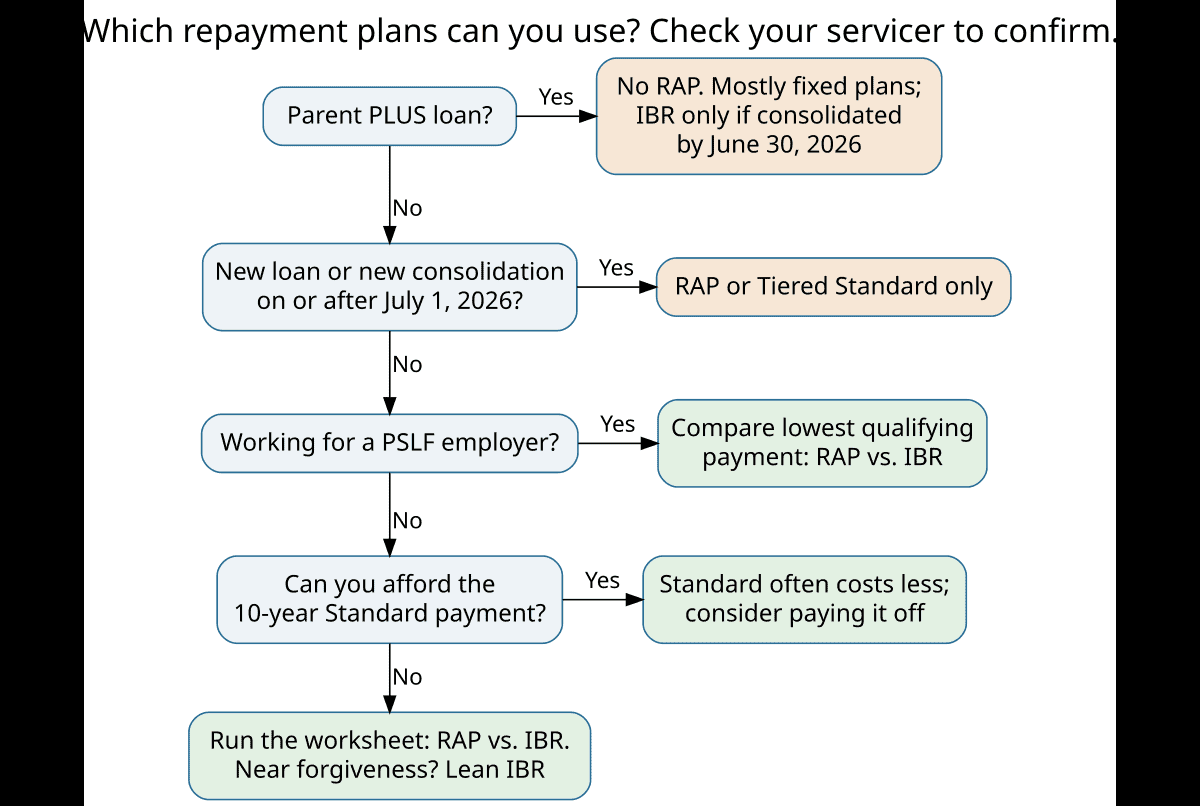
Under the regulation, only Direct Loans made before July 1, 2026 can use IBR. NerdWallet and student loan attorney Stanley Tate both warn that one new Direct Loan or new consolidation on or after that date closes IBR for your whole set of loans. Going back to school? Ask your servicer how a new loan will affect your plan before you accept it.
Switching has its own wrinkle. The regulation says months on RAP don’t count toward IBR forgiveness. Sources differ on whether you can even go back: NerdWallet’s IBR page says no, while Tate and Forbes say yes, and we found no regulation line that settles it. Going the other way, the regulation counts IBR and ICR months toward RAP’s 360 payments. We couldn’t confirm the same for PAYE or SAVE months, even though some sites say they count. So treat a move to RAP as one-way unless your servicer says otherwise in writing.
A quick check before you choose
- Pursuing Public Service Loan Forgiveness? Pick the lowest payment that qualifies. A 10-year Standard payment would leave little or nothing to forgive.
- Near 20 or 25 years of IBR credit? Stay on IBR, or check your count first.
- Can you afford the 10-year payment? Standard often costs less over time, unless real forgiveness is in reach.
- Under about $70,000 with kids or a tight budget? Run RAP and IBR through the worksheet. RAP’s interest waiver helps if your payment won’t cover interest.
- Above about $80,000 with no forgiveness plan? Compare 10% or 15% IBR’s cap against RAP, and consider paying extra.
Then check your options in the federal Loan Simulator and confirm any RAP estimate with your servicer. Reports from earlier this year said the tool hadn’t yet added RAP, so verify it shows the plan you’re comparing.
If you were on SAVE
SAVE ended through a court-approved settlement in March 2026. The Education Department said about 7.5 million borrowers would need to move, with servicer notices starting July 1, 2026, and at least 90 days to choose a plan. The first group’s final deadline passed around the end of October. Business Insider reported on Oct. 27 that nearly 2 million had picked one. Notices are going out in waves, and later groups have later dates.
Interest has been building on SAVE balances since August 2025, and NerdWallet notes the forbearance time doesn’t count toward forgiveness. Waiting costs you.
“For borrowers that don’t choose a new repayment plan, you will be automatically enrolled in the standard or tiered standard repayment plan at the end of that 90-day mark, which may or may not be the best plan choice for you.”
Robert Farrington, with The College Investor, to InvestigateTV on WECT
Missing your deadline isn’t the end of the road. According to Forbes, you should get a bill notice at least 21 days before your first due date, and you can still apply for an income-driven plan. Also check any autopay setting, since a much higher Standard bill could hit your bank account.
Here’s what to do this week if you’re still on SAVE:
- Log in to your servicer’s site and find your notice date.
- Run the worksheet above for RAP and IBR. A SAVE borrower with older loans may have both options.
- Apply for your chosen plan on StudentAid.gov.
- Save a copy of your confirmation, and check that your first bill looks right.

Parent PLUS loans: fewer choices
Parent PLUS loans can’t use RAP, whether or not they’re consolidated. For income-based repayment, a parent needed a consolidation loan disbursed by June 30, 2026, according to the Student Loan Borrower Assistance project. That window has closed.
- If you consolidated in time: The path may run through ICR and then IBR. CRS says you can stay eligible for IBR if you enroll in an income-driven plan before July 1, 2028.
- If you didn’t: Your options are mostly fixed plans. Ask your servicer about Extended (for balances over $30,000) or Graduated. Any new consolidation on or after July 1, 2026 can’t use ICR or IBR.
- If you’re about to borrow more: New Parent PLUS loans are capped at $20,000 a year and $65,000 per student (with a temporary exception for some students already enrolled), and a new loan can end access to income-based plans for older ones.
Married borrowers: the filing choice
Under RAP, filing separately means only your income counts, plus only the dependents you claim. File jointly and combined AGI counts, unless you certify that you’re separated or can’t reach your spouse’s income. When both spouses’ loans count, the payment is split by each person’s share of the combined balance.
Hypothetical example: combined AGI is $100,000, split evenly, with two kids and federal loans held by one spouse.
| Filing status | AGI used | Dependents | RAP payment |
|---|---|---|---|
| Jointly | $100,000 (9%) | 2 | $650 |
| Separately, claiming both kids | $50,000 (4%) | 2 | $67 |
That’s a $583 monthly gap, but it isn’t all savings. Filing separately often raises your tax bill, and the IRS says you can’t take the student loan interest deduction on a separate return. Have a tax pro run both versions before you decide. Our guide to how federal income taxes work covers the basics.
The interest deduction
You may deduct up to $2,500 of student loan interest. For 2026, per IRS Rev. Proc. 2025-32, the deduction phases out between $85,000 and $100,000 of modified AGI for single filers, and between $175,000 and $205,000 for joint filers.
PSLF, forgiveness and taxes
Public Service Loan Forgiveness wipes out your balance after 120 qualifying payments while you work for a qualifying employer. RAP payments qualify, and so do IBR payments. Fidelity says Tiered Standard doesn’t qualify. The PSLF rules generally count other plans only if the payment is at least the 10-year Standard amount, so ask your servicer before relying on a longer tier. A 2025 rule that would have limited which employers count was set aside by two federal courts on June 30, 2026. In October, California’s attorney general and San Francisco announced the government had dropped its appeal in the Massachusetts case.
If PSLF is your goal, your lower payment means less paid before forgiveness. In Example 2, ten years of payments would total about $31,667 on RAP, $23,911 on 10% IBR, $35,867 on 15% IBR and $81,755 on Standard, using the same assumptions. RAP or 10% IBR can leave you ahead by tens of thousands of dollars.

The tax bill on income-driven forgiveness
A pandemic-era tax break on forgiven student debt ended after 2025. According to Thomson Reuters, IDR forgiveness in 2026 and later is generally taxable income, while PSLF forgiveness isn’t. Some borrowers who qualified in 2025 may fall under the old rule, so check your dates. State rules vary. Say $76,348 is forgiven, as in Example 2: at a 22% federal rate, that’s roughly $16,800 in tax for that year alone, though the forgiven amount itself could push you into a higher bracket. If you might be insolvent, ask a tax pro about the insolvency exclusion.
Set aside a little each month if forgiveness is decades away. That way the bill won’t land on you all at once.
If you fall behind
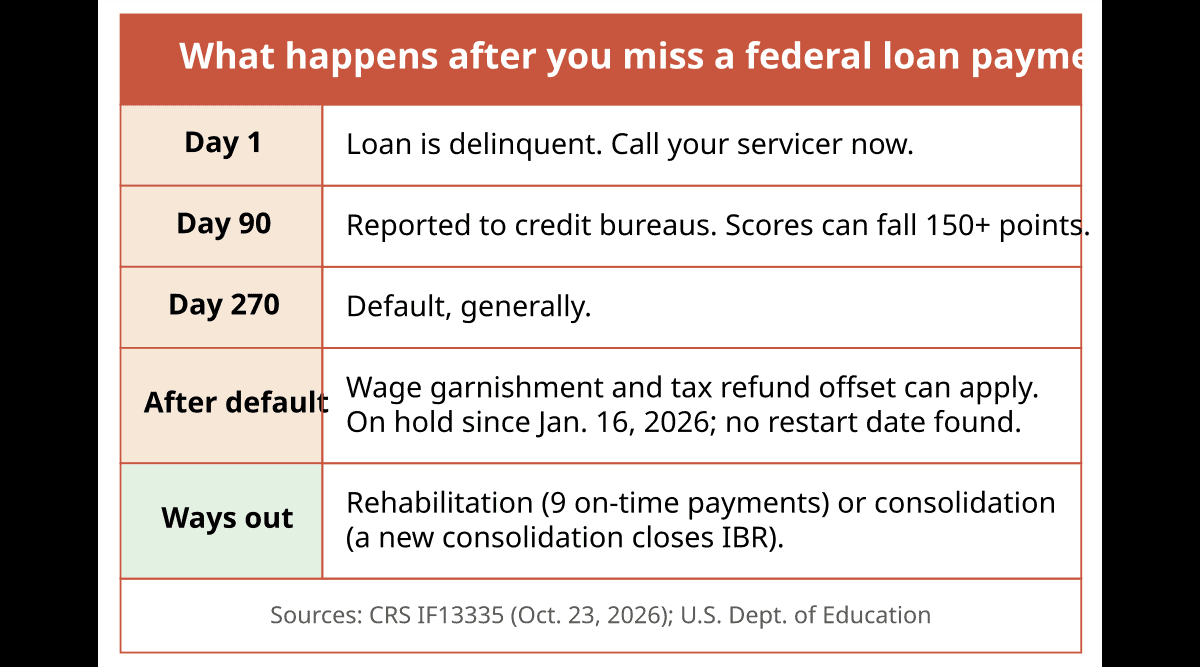
Delinquency starts the day after a missed payment. The CRS timeline says servicers report loans to credit bureaus after 90 days, and default generally comes at 270 days. Credit scores can drop by 150 points or more. For more on rebuilding, see how credit scores work.
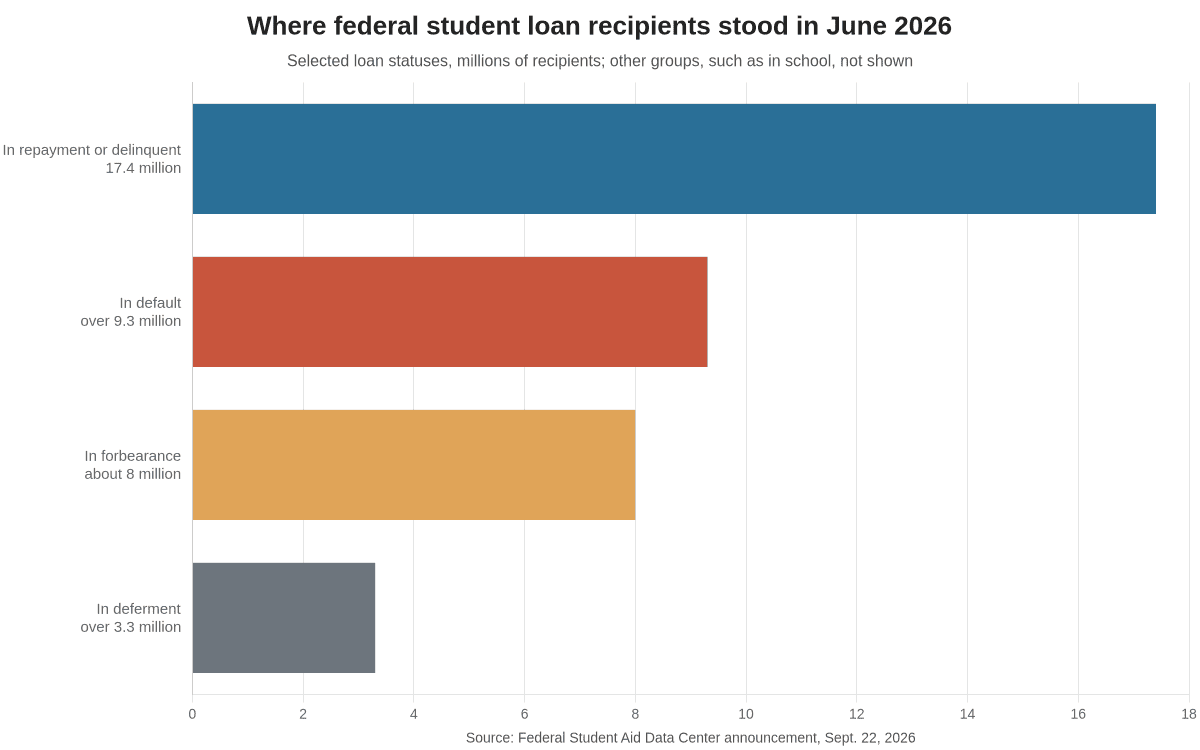
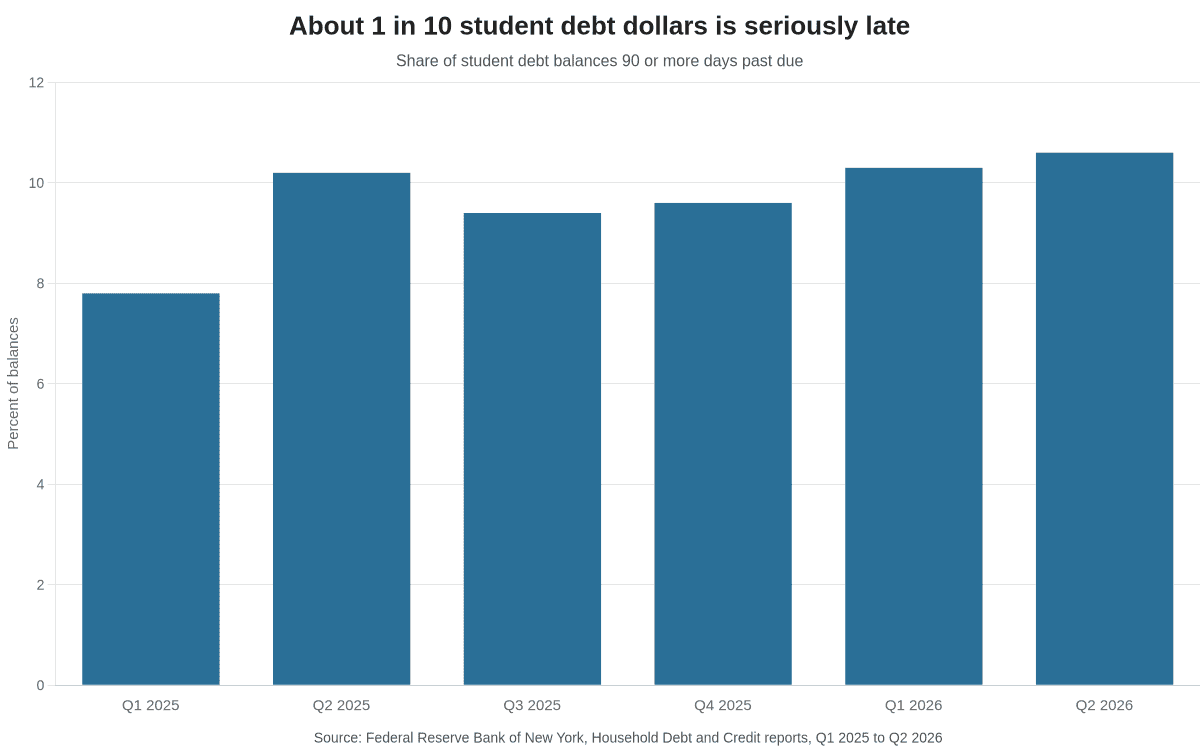
The stakes are real. The New York Fed reported that 10.6% of student debt balances were 90 or more days late in the second quarter of 2026. Federal Student Aid counted over 9.3 million recipients in default as of June 2026.
Wage garnishment and Treasury offsets have been on hold since January 16, 2026, and we found no official restart date as of November 4, 2026. News reports suggest a restart is under discussion, while Forbes reports an Education Department spokesperson denied those rumors. Don’t count on the pause lasting, and note that it may not cover older FFEL loans held by guaranty agencies. Treasury also opened a Defaulted Loans Support Center on Sept. 30, 2026, to help people get out of default.
Your two main ways out are rehabilitation (nine on-time payments, and from July 1, 2027, you can do it twice per loan) and consolidation. Be careful with consolidation: a new one made on or after July 1, 2026 counts as a new loan, which closes IBR. Check with your servicer before you pick.
Don’t let recertification slip. If you miss it under RAP, your payment jumps to a 10-year Standard amount based on your balance when you entered repayment. On $40,000 at 6.5%, that could mean going from $150 to about $454 a month.
“I think everybody should be reevaluating their student loan strategy every year at tax time, because things change.”
Betsy Mayotte, founder of The Institute of Student Loan Advisors, to PBS NewsHour
Should you pay extra or refinance?
Experts really do disagree here, so here’s how the views line up.
- Pay it off fast. Ramsey Solutions argues income-driven plans slow you down and that forgiveness isn’t guaranteed.
- Use the plan, and invest the difference. The College Investor suggests RAP borrowers consider investing rather than prepaying, since extra payments can reduce the waiver and match that month.
- Fit it to your path. Student Loan Sherpa, written by a CFP, recommends the lowest qualifying payment if you’re going for PSLF. Schwab suggests getting your full employer match while you pay down loans.
Our take on the math: if your rate is above what you’d safely earn, and forgiveness isn’t in your plan, paying extra brings a known interest saving. RAP borrowers whose payment doesn’t cover interest should check the waiver first. If PSLF or IBR forgiveness is realistic, extra payments may just reduce what gets forgiven. Build a starter emergency fund first either way. Employer help counts too: up to $5,250 a year of employer student loan payments can be tax-free under IRS rules, if your employer offers it.
Refinancing means giving up federal protections
A private refinance can lower your rate, but the CFPB warns you’ll probably lose certain loan forgiveness benefits. You’d give up income-driven plans and federal hardship options too. And you can’t reverse it. If you were considering a debt consolidation loan for your student debt, the same warning applies.
“I almost never recommend it unless the borrower has a high income, no realistic path to forgiveness, and the spread between the federal rate and a private offer is materially significant.”
Jeff Judge, certified financial planner and managing partner with Chesapeake Financial Planners, on refinancing federal loans, to U.S. News via WTOP

For a walk-through of the two main income-driven plans, this video from The College Investor compares RAP and IBR. It was recorded in November 2025, before RAP opened, so check any detail against the current rules above.
Mistakes that cost borrowers money
- Doing nothing. You may land on a plan you didn’t pick, at a higher bill than you expected.
- Comparing only the monthly payment. Look at total cost and years in the plan too.
- Taking a new loan without checking. It can close IBR for good.
- Skipping recertification. A missed date can spike your bill.
- Paying extra without asking how it’s applied. Tell your servicer where you want it to go, and check the effect on any RAP benefits.
- Ignoring the tax on forgiveness. PSLF is tax-free federally. Income-driven forgiveness generally isn’t.
- Refinancing on rate alone. Protections can matter more than a small rate cut.
What to remember about student loan repayment plans
- RAP, IBR and Standard are the main choices for most federal borrowers today.
- For a single borrower, RAP is often cheapest monthly at about $35,000 to $70,000 of AGI. IBR’s cap often wins above about $80,000.
- RAP’s percent applies to all your AGI, so a small income jump across a band can cost hundreds a year.
- One new loan on or after July 1, 2026 can close IBR for good.
- SAVE is over. Pick a plan before your notice deadline.
- PSLF forgiveness isn’t federally taxed. Income-driven forgiveness generally is, starting in 2026.
- Parent PLUS borrowers can’t use RAP.
Questions people ask
What is the Repayment Assistance Plan?
RAP is an income-driven plan that opened July 1, 2026. You pay 1% to 10% of your AGI, less $50 per dependent, with a $10 minimum. Unpaid interest is waived on on-time payments, and any remaining balance is forgiven after 30 years.
Is RAP better than IBR?
It depends on your income, family size, balance and time already spent in repayment. RAP often has a lower payment at middle incomes. IBR often wins at higher incomes or if you’re near forgiveness.
Can I switch from RAP to IBR later?
Sources disagree. Even if a servicer allows it, the regulation says RAP months don’t count toward IBR forgiveness. Get an answer in writing from your servicer before you move.
What happens if I do nothing after my SAVE notice?
You can be placed on a Standard or Tiered Standard plan when your deadline passes. You can still apply for an income-driven plan after that, but your bill may be higher in the meantime.
Is IBR going away?
No. It stays open for loans made before July 1, 2026, while ICR and PAYE end by July 1, 2028. NerdWallet’s IBR page reports that you must enroll in IBR by July 1, 2028. We didn’t find that deadline in the regulation, but it’s a sensible date to act before.
Does RAP count for PSLF?
Yes, on-time RAP payments count, as long as you meet the other PSLF rules, such as working full time for a qualifying employer.
Do Parent PLUS loans qualify for RAP?
No, not even after consolidation. Parents who consolidated by June 30, 2026 may have a path to IBR through ICR.
Will my credit suffer on an income-driven plan?
Being on the plan itself isn’t a credit problem. Missed payments are. Servicers report loans after 90 days late, so keep your payments on time.
Your next step: 20 minutes this week
Log in to your servicer’s site and write down your balance, rate and loan dates. Then fill in the worksheet at the top of this page. If you were on SAVE, or your AGI is near a RAP band line, do it today and choose your plan before your next notice date.
About this guide
Published by Daniel Brienza, founder and editor of Sensible Money Guide (B.S. in Business Administration, University of South Florida). This guide was researched and drafted with the help of AI tools, fact-checked against the primary sources listed below, and reviewed and edited by Daniel before publishing. Daniel is not a licensed financial advisor; this guide is for general education.
Written November 4, 2026. Facts and figures are based on data available on that date.
Sources
Government and official sources
- U.S. Department of Education, RISE final rule fact sheet, Apr. 30, 2026.
- Federal Register, Reimagining and Improving Student Education final regulations, May 1, 2026.
- Code of Federal Regulations, 34 CFR 685.209, income-driven repayment plans, accessed Nov. 2026.
- Code of Federal Regulations, 34 CFR 685.208, fixed payment repayment plans, accessed Nov. 2026.
- U.S. Department of Education, Next steps for borrowers enrolled in the SAVE plan, 2026.
- U.S. Department of Education, Delay of involuntary collections, Jan. 16, 2026.
- Federal Student Aid, Updated reports in the FSA Data Center, Sept. 22, 2026.
- Federal Student Aid, Loan Simulator, accessed Nov. 2026.
- Federal Register, Annual notice of interest rates, 2026–27, Sept. 2026.
- U.S. Department of Health and Human Services, Poverty guidelines, 2026.
- Internal Revenue Service, Topic 456, Student loan interest deduction, Sept. 24, 2026.
- Internal Revenue Service, Rev. Proc. 2025-32, 2025.
- Internal Revenue Service, Publication 15-B, 2026.
- Consumer Financial Protection Bureau, Should I consolidate or refinance my student loans?, Dec. 3, 2024.
Research and official analysis
- Congressional Research Service, R48727, student loan provisions of P.L. 119-21, updated Jan. 8, 2026.
- Congressional Research Service, IF13075, Repayment Assistance Plan, Jul. 31, 2025.
- Congressional Research Service, IF13335, delinquency and default, Oct. 23, 2026.
- Federal Reserve Bank of New York, Quarterly Report on Household Debt and Credit, Q2 2026, Aug. 2026.
- U.S. Department of the Treasury, Defaulted Loans Support Center announcement, Sept. 30, 2026.
- California Attorney General, Statement on the PSLF appeal, Oct. 22, 2026.
- City of San Francisco, Federal government drops appeal on PSLF, Oct. 2026.
- American Bar Association, Judges halt ruling affecting PSLF, Jul. 2026.
Banks and investment firms
- Fidelity, Repayment Assistance Plan, Jun. 26, 2026.
- Charles Schwab, Should you save for retirement or pay off student loans?, Oct. 28, 2026.
News and personal finance media
- NerdWallet, What is the new Repayment Assistance Plan?, Jul. 30, 2026.
- NerdWallet, Income-based repayment, Jul. 23, 2026.
- Forbes (Adam Minsky), Stopping wage garnishment, Oct. 26, 2026.
- NerdWallet, SAVE plan lawsuits, Sept. 23, 2026.
- Forbes (Adam Minsky), Should you switch to RAP?, May 14, 2026.
- Forbes (Adam Minsky), Final deadline hits some borrowers, Oct. 28, 2026.
- Kiplinger, 2026 student loan changes, Apr. 26, 2026.
- Business Insider via Yahoo, First deadline for student loan borrowers, Oct. 27, 2026.
- Investopedia via Yahoo Finance, A new student loan repayment plan opens soon, May 15, 2026.
- InvestigateTV on WECT, Millions of SAVE plan borrowers getting 90-day notices, Oct. 8, 2026.
- PBS NewsHour, What experts want you to know about federal student loan debt, Feb. 26, 2026.
- U.S. News via WTOP, Is now a good time to refinance your student loans?, Jun. 2026.
- Ramsey Solutions, How to pay off student loans quickly, Dec. 2, 2025.
- Student Loan Sherpa, IBR vs. RAP, accessed Nov. 2026.
- The College Investor, How RAP works, Apr. 30, 2026, and RAP vs. IBR, Feb. 6, 2026.
- Stanley Tate, IBR vs. RAP, Sept. 24, 2026.
- Student Loan Borrower Assistance, Parent PLUS consolidation deadline, 2026.
- Thomson Reuters, Federal student loan and financial aid updates, 2026.
This article is for educational purposes only and isn’t financial advice. Consider talking with a qualified professional about your situation.


Beneficiary Designations: How to Name, Check and Update Them

Term Life Insurance: How Much You Need and What It Costs

How to Start Investing: Accounts, First Buys and Real Risks

Student Loan Repayment Plans: RAP vs. IBR vs. Standard

When to Claim Social Security: Ages, Math and Trade-Offs

Credit Report Errors: How to Find, Dispute and Fix Them
Beneficiary Designations: How to Name, Check and Update Them
When to Claim Social Security: Ages, Math and Trade-Offs
Student Loan Repayment Plans: RAP vs. IBR vs. Standard
You must be logged in to post a comment Login