

Estate Planning
Beneficiary Designations: How to Name, Check and Update Them
Beneficiary designations usually override your will. Learn how to fill out the forms, avoid costly mistakes, and what rules your heirs will face.

The beneficiary designations on your 401(k), IRA, life insurance and bank accounts usually decide who gets that money when you die. That’s true even if your will says something else. So the forms matter as much as the will. Here’s how to fill them out, which rules your heirs will face, and when to check them again.
“Beneficiary forms are extremely powerful and trump whatever it might say in the will in most or all circumstances,”
Ari Weisbard, certified financial planner and attorney at Values Added, to Investopedia (via Yahoo Finance), March 11, 2026
In plain English: a beneficiary designation is a short form that names who inherits an account. You file it with the bank, insurer or retirement plan. The company then pays those people directly, usually without probate. That’s why FINRA warns that these designations “typically override instructions in your will.”
What each piece of the form does
| Piece of the form | What it does | Watch out for |
|---|---|---|
| Primary beneficiary | Gets the money first | An ex-spouse or someone who has died |
| Contingent (backup) beneficiary | Gets the money if every primary has died | Leaving it blank |
| Percentages | Splits the account among several people | Shares that don’t add up to exactly 100% |
| Per stirpes box | Sends a beneficiary’s share to their children if they die before you | Not checking it when you want grandchildren covered |
| Spousal consent | Lets a married 401(k) saver name someone other than a spouse | Missing signature or witness |
What’s in this guide
- Which accounts follow a form, and which follow your will
- How to fill out a beneficiary form, line by line
- Marriage and divorce: the rules that surprise people
- Naming children without creating a court case
- What your heirs will face: inherited IRA and 401(k) rules
- Worked example: three ways to empty a $300,000 inherited IRA
- Should you name a trust or your estate?
- Bank accounts: POD beneficiaries and FDIC coverage
- Life insurance beneficiaries: taxes, probate and lost policies
- When to check your forms again
- Myths and mistakes to skip
- The short version
- Questions people ask about beneficiary designations
- Your next move
- Sources
Which accounts follow a form, and which follow your will
Think of your money in two piles. One pile passes by contract. The company holding it pays whoever is named on its form. The other pile passes through your will, or through your state’s default rules if you don’t have one.
For many people, most of their savings sits in the first pile. The Thrift Savings Plan says it plainly: “We cannot honor a will or any other document.” Fidelity, Vanguard and Schwab also say beneficiary designations generally take precedence over a will.
| Asset | How it usually passes | Where you name someone |
|---|---|---|
| 401(k), 403(b), TSP and other workplace plans | Beneficiary form (spouse rules may apply) | Plan website or HR |
| Traditional and Roth IRAs | Beneficiary form | Your IRA provider |
| Life insurance and annuities | Beneficiary form | The insurer (or HR for group coverage) |
| Bank and credit union accounts | Payable-on-death (POD) beneficiary, if you add one | Your bank |
| Brokerage accounts | Transfer-on-death (TOD) registration, if you add one | Your brokerage |
| Your home | A TOD deed in 35 states and D.C.; otherwise your will or other planning | County records office |
| Social Security | Survivor benefits set by law, not a form | Nothing to fill out |
| Everything else | Your will, or state law if there’s no will | Your will |
Brokerage accounts, homes and cars
A few notes on that table. FINRA says most states have adopted a uniform law for TOD brokerage accounts, “although some have modified it.” Louisiana’s version took effect January 1, 2022. For homes, the National Consumer Law Center counted 35 states plus D.C. with transfer-on-death deed laws as of August 2026. Some states also allow a beneficiary on a car title; Texas handles it through your county tax office.
Social Security follows its own rules
Social Security is the odd one out. Survivor benefits go to people who meet the law’s rules. Examples include a widow or widower age 60 or older and an ex-spouse who was married to you at least 10 years (age and remarriage limits apply). Unmarried children under 18 can qualify too, or up to 19 if still a full-time student in grade 12 or below. You can’t pick someone else.
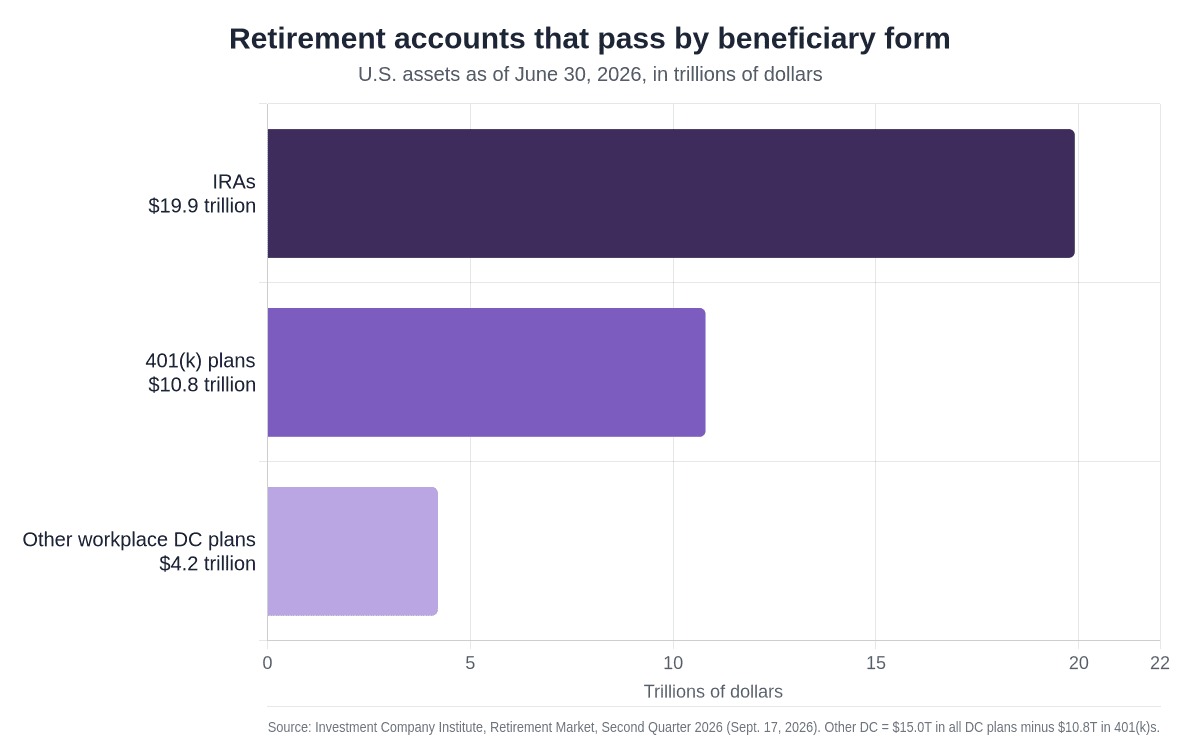
The dollars involved are large. The Investment Company Institute counted $19.9 trillion in IRAs and $15.0 trillion in workplace defined contribution plans as of June 30, 2026. These accounts pass by beneficiary form, not by your will.
How to fill out a beneficiary form, line by line
Most forms are short once you’ve decided who should get what. Here’s what each line asks for and how to get it right.
1. Name your primary beneficiaries
Use full legal names, not “my children.” Fill in whatever identifying details the form asks for. If you name several people, give each a percentage.
2. Make the percentages add up to exactly 100%
J.P. Morgan Wealth Management points out a small trap: three shares of 33.33% add up to 99.99%. Make one share 33.34% to avoid a possible processing delay. J.P. Morgan also suggests percentages instead of fixed dollar amounts, because account values change.
3. Always name a contingent beneficiary
Your backup (contingent) pick gets the money only if all your primary picks have died. Vanguard calls contingents “your backup plan for asset distribution.” Without one, the account may land in your estate if your primary dies first. That brings probate and, for IRAs, faster payout rules (more on that below).
4. Decide what happens if a beneficiary dies before you
This is where per stirpes comes in. It’s a Latin phrase that Cornell Law School’s legal dictionary translates as “by roots” or “by branch.” With it, a beneficiary’s share passes down to their own heirs. It doesn’t go to the other people on your form.
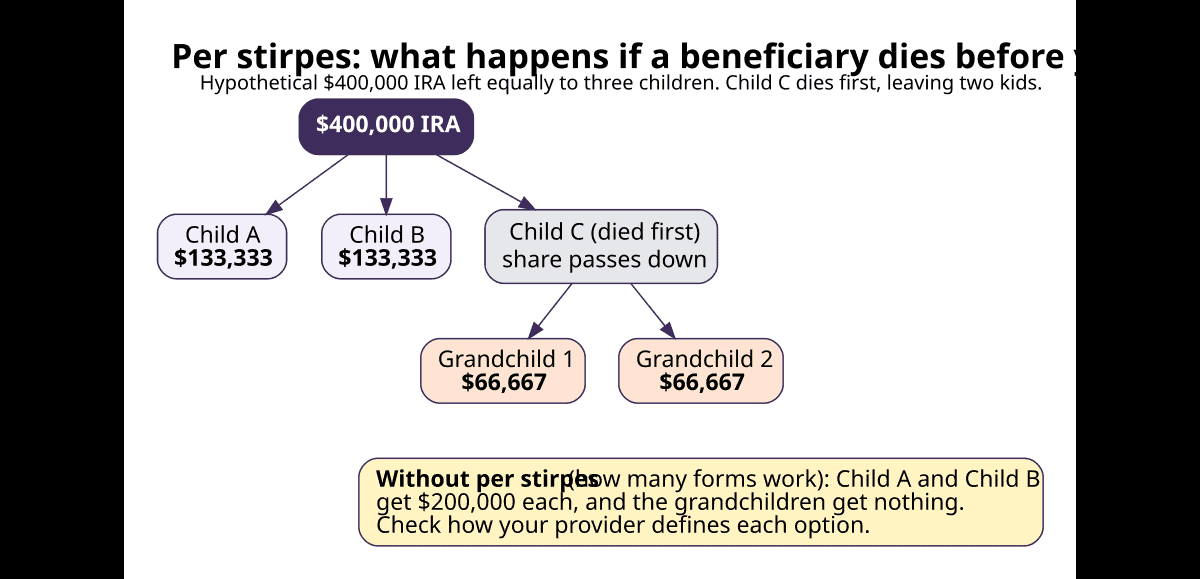
Here’s a hypothetical. You leave a $400,000 IRA equally to three children. One child dies before you and leaves two kids of their own.
| How the form is set up | Each surviving child gets | Each grandchild gets |
|---|---|---|
| Per stirpes | $133,333 | $66,667 |
| No per stirpes | $200,000 | $0 |
Neither choice is wrong. But grandchildren aren’t always covered. At Fidelity, for example, a deceased beneficiary’s share goes to the others “unless you provide what’s called a per stirpes designation.” Labels and defaults vary, so read your provider’s definitions.
5. Submit it and get proof
Fill out the form online if your provider allows it, then save the confirmation. For paper forms, keep a copy and ask for written confirmation. A 2012 ERISA Advisory Council report recorded a MetLife witness citing “a 15 to 40 percent error rate” on paper designation forms. That’s an older figure, but it’s a good reason to double-check what’s on file.

Glossary box
- Designated beneficiary: a person named on the form. Estates, charities and trusts that don’t meet the IRS look-through rules are not designated beneficiaries under the IRA rules.
- Eligible designated beneficiary: a surviving spouse, the owner’s minor child, a disabled or chronically ill person, or someone not more than 10 years younger than the owner.
- POD / TOD: payable on death (bank accounts) and transfer on death (brokerage accounts, some deeds and car titles).
- Required beginning date: generally April 1 of the year after the owner reaches RMD age.
- Per stirpes: a share passes to the heirs of a beneficiary who dies first.
Marriage and divorce: the rules that surprise people
In most 401(k)s, your spouse comes first
Federal law gives spouses strong rights in workplace plans covered by ERISA. The U.S. Department of Labor explains how it works in most defined contribution plans. If you die before you receive your benefits, your spouse “will automatically receive them.” To name someone else, “your spouse must consent by signing a waiver, witnessed by a notary or plan representative.”
The law behind this, 29 U.S.C. § 1055, says the consent must be in writing and must acknowledge its effect. A spousal consent that isn’t properly witnessed, by a notary or plan representative, can make the designation invalid. (Our guide to how a 401(k) works covers the rest of the plan rules.)
IRAs are different. They aren’t covered by that federal consent rule, so you can usually name anyone. Community property states are the exception. There, Vanguard’s IRA beneficiary kit warns, your spouse “may have certain rights to your retirement account.” In those states, ask your provider or an attorney before leaving a spouse off an IRA.
Divorce: change the forms yourself
“It’s very important to update your beneficiary designation whenever there’s a (big) life change.”
Jeffrey R. Gottlieb, estate planning attorney in the northwest suburbs of Chicago, to CNN (via KESQ), September 2025
Many states have “revocation on divorce” laws. These cancel an ex-spouse’s place on a form automatically. The Supreme Court counted 26 states with similar laws in Sveen v. Melin (2018), a life insurance case where Minnesota’s law was allowed to apply.
Don’t count on those laws, though. Two other Supreme Court cases show why:
- In Egelhoff v. Egelhoff (2001), the Court held that federal ERISA law overrides a state’s revocation-on-divorce statute for ERISA-covered workplace plans. The ex-wife on the form kept the benefits.
- In Kennedy v. Plan Administrator for DuPont (2009), an ex-wife had waived the benefits in the divorce decree but was still on the form. The Court said the plan was right to pay her “in conformity with the plan documents.”
The fix is simple. After a divorce, file new forms with every plan, insurer and bank. Some divorce agreements require you to keep an ex as a beneficiary, for example, to protect child support. If yours does, follow it and ask your attorney how to set it up.
Naming children without creating a court case
Children are the people most parents want to protect, and they’re the hardest to name well. Fidelity notes that “minor children can’t take title in their own names to retirement accounts or a life insurance payout.”
Say you name a child directly and don’t set up someone to manage the money. Then, Nolo says, “a court will have to appoint someone to do it.” That means court filings and costs. The money may also go to the child outright at 18.

Three better ways to leave money to a minor
| Option | How it works | Trade-offs |
|---|---|---|
| UTMA custodian | Name an adult “as custodian for [child] under the [state] UTMA” if your provider allows it | Child gets full control at the state’s age, often 21 |
| Trust for the child | Name a trust you’ve set up; your trustee follows its rules | Costs money to draft; IRA trusts need care (see below) |
| Name an adult you trust | The adult inherits outright and you hope they share | No legal duty to use it for the child |
UTMA ages vary by state. Nolo says custodianships last until “21 in most states.” Some states allow longer for gifts made by will or trust. California’s Probate Code § 3920.5, for example, allows up to age 25 for those transfers.
One federal rule doesn’t vary. For inherited IRAs, your own minor child gets special treatment only until age 21, under IRS regulations. After that, the 10-year clock below starts.
What your heirs will face: inherited IRA and 401(k) rules
Who you name decides how fast the money has to come out. That drives the tax bill. The rules come from the SECURE Act of 2019, SECURE 2.0 and final IRS regulations that apply starting in 2025.
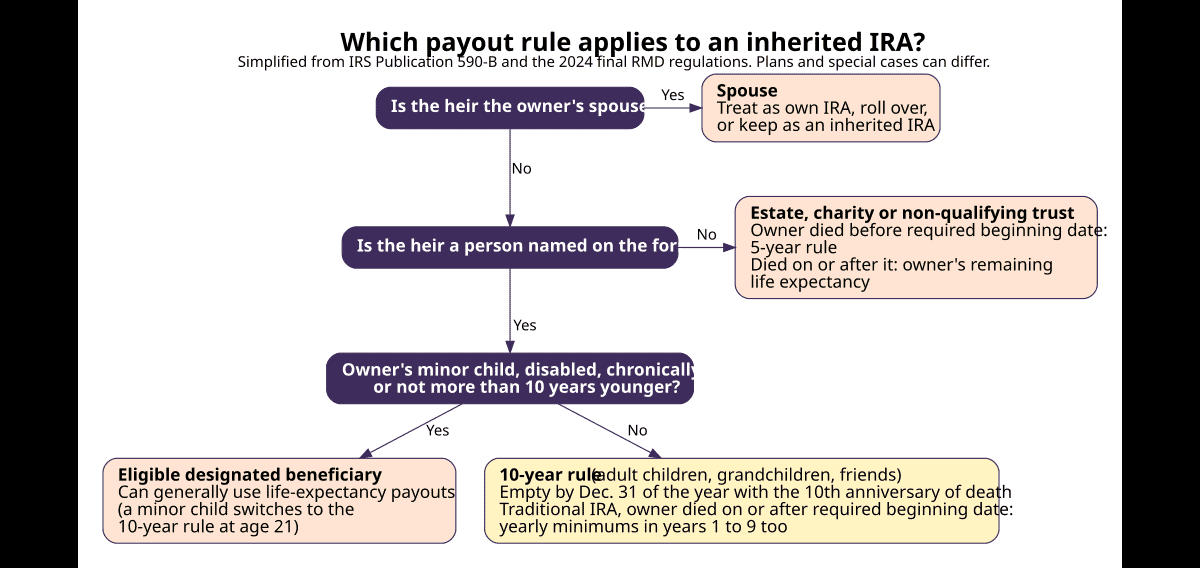
The four groups of beneficiaries
- Your spouse. A surviving spouse has the most choices. Vanguard lists them: treat the IRA as their own (or roll it over), or keep it as an inherited IRA.
- Other eligible designated beneficiaries. Your minor child (until 21), a disabled or chronically ill person, or someone not more than 10 years younger than you. These people can generally stretch withdrawals over their life expectancy, per IRS Publication 590-B.
- Everyone else you name. Adult children, grandchildren, friends, and siblings or partners more than 10 years younger than you. They fall under the 10-year rule: the account must be empty by December 31 of the year containing the 10th anniversary of your death.
- Non-designated beneficiaries. Your estate, a charity, or a trust that doesn’t meet the IRS “look-through” rules. If you died before your required beginning date, the 5-year rule applies. If you died on or after it, payouts can run over your remaining life expectancy.
When yearly withdrawals are required inside the 10 years
This is the part that confused people for years. If the owner died before their required beginning date, Pub. 590-B says “no distribution is required for any year before the 10th year.” If the owner died on or after it, the rules are stricter. Heirs must take yearly minimum withdrawals in years 1 through 9 and empty the account by year 10, according to the IRS and Schwab.
The IRS waived penalties on those missed yearly amounts for 2021 through 2024 (Notice 2024-35). From 2025 on, they’re required. Schwab notes there’s a penalty of up to 25% on a missed required withdrawal.
The required beginning date is generally April 1 of the year after the owner reaches RMD age. Under SECURE 2.0, that age is 73 for people born 1951 through 1959. It’s 75 for people born in 1960 or later, as Thrivent sums it up. Older owners had earlier ages: 72 for people born July 1, 1949 through 1950, and 70½ for people born before July 1, 1949. Workplace plans can have their own rules, so your heirs should ask the plan.
Inherited Roth IRAs
Roth IRAs follow the same 10-year deadline for most heirs. The difference is taxes. Schwab says withdrawals “are generally tax free as long as the original Roth IRA was open for at least five years.” Roth owners have no required withdrawals during life. So most Roth heirs face only the 10-year deadline, not yearly minimums. (Our Roth vs. traditional IRA guide explains the five-year rule.)
Four common situations, side by side
| Who inherits | Owner died before required beginning date | Owner died on or after it |
|---|---|---|
| Spouse | Can treat as own IRA or keep as inherited | Same choices |
| Adult child | Empty by end of year 10; no yearly minimum | Yearly minimums in years 1–9, empty by year 10 |
| Owner’s 12-year-old child | Life-expectancy payouts until 21, then 10-year rule | Same |
| Estate | 5-year rule | Owner’s remaining life expectancy |
Fidelity’s short video walks through these choices for spouses, adult children and trusts.
Worked example: three ways to empty a $300,000 inherited IRA
The 10-year rule sounds generous. But the timing your heir picks can change the tax bill by tens of thousands of dollars. Here’s a hypothetical we ran in Python.
Read this before you trust the numbers: A single adult child earns a $70,000 salary. The parent died in late 2026, and the heir starts withdrawals from the $300,000 traditional IRA in 2027. The parent died before their required beginning date, so no yearly minimum applies. The account grows 5% a year. We used the 2027 federal brackets and $16,600 standard deduction from IRS Rev. Proc. 2026-35 for every year, with no inflation adjustments, no state tax and no other income or credits. Real results will differ.
| Strategy | Total withdrawn | Extra federal tax | Share lost to tax |
|---|---|---|---|
| All in year 1 (2027) | $300,000 | $85,157 | 28.4% |
| Spread over 2027–2036 (balance ÷ years left) | $377,337 | $83,014 | 22.0% |
| All in year 10 (2036) | $465,398 | $143,046 | 30.7% |
Waiting until year 10 lets the account grow the most. But it stacks a $465,398 withdrawal on top of a salary, which reaches the 32% and 35% brackets. Taking it all at once in year 1 does the same thing with less money. Spreading it out keeps every year’s taxable income in the 22% bracket.
Comparing the three on equal terms
The totals withdrawn aren’t directly comparable, since money taken out early can be invested too. So we also checked what each heir would have at the end of 2036. We assumed every after-tax withdrawal was invested at 4% a year after taxes:
- All in year 1: about $305,800
- Spread over 10 years: about $347,800
- All in year 10: about $322,400
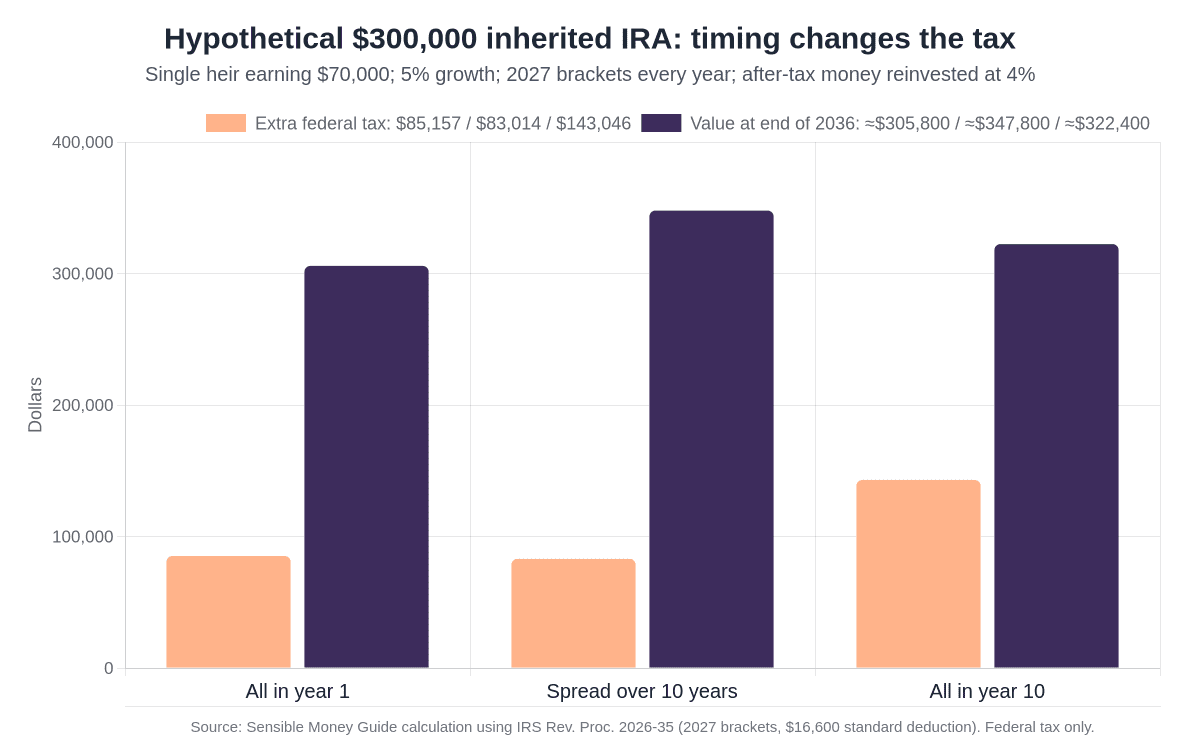
In this example, spreading withdrawals came out about $25,500 ahead of waiting. It beat cashing out by about $42,100. The best plan for a real heir depends on their income each year. Lower-income years, such as a year between jobs, are good years to take more. Our guide to how federal income taxes work explains why bracket stacking matters.
The Roth version: if the same heir inherited a $100,000 Roth IRA that met the five-year rule, there’s no tax either way. Leaving it to grow at 5% until year 10 would turn it into about $162,900, all generally tax-free. So it can pay for Roth heirs to let inherited money grow as long as the rules allow.
Should you name a trust or your estate?
Naming your estate: usually the weakest choice
Naming “my estate” sends the money through probate. NerdWallet says that when your estate is the beneficiary of a life insurance policy, the money “could get held up for months and might even be used to pay off creditors.” For IRAs, an estate is a non-designated beneficiary. So the faster 5-year or remaining-life-expectancy rules apply, not the 10-year rule.
The same thing can happen by accident when every beneficiary on a form has died and there’s no contingent. That’s one more reason to fill in the backup line.
Naming a trust: what the experts say
A trust can control money for young children or someone with special needs. It can also protect an heir who might spend it all at once. But IRS rules for trusts that inherit IRAs are complex. Pub. 590-B notes that “a trust can’t be a designated beneficiary even if it is a named beneficiary,” unless it meets look-through rules. Experts disagree on how often a trust is worth the trouble.
“In general, if you are comfortable naming individuals or charitable entities outright as beneficiaries of your IRA, you should seriously consider that instead of leaving your IRA to a trust,”
Catherine Neijstrom, Fidelity Investments vice president, financial and trust planning lead, in “Can you put an IRA in a trust?” (Fidelity, August 4, 2026)
Neijstrom also says, “Despite the complexities, there can be good reasons to leave an IRA to a trust.” Protecting an heir who can’t manage money is one example. Ed Slott takes a firmer line. Writing after the IRS updated its trust rules, he argued the changes don’t fix the core problem.
“But these changes don’t alter the fact that trusts remain lousy IRA beneficiaries.”
Ed Slott, CPA, writing in InvestmentNews, September 10, 2024
Where does that leave you? If your heirs are responsible adults, naming them directly is simpler. If you need control, a trust can be worth it. Have an estate attorney draft it with your IRA in mind, and name the trust on the form exactly as the attorney tells you.
Bank accounts: POD beneficiaries and FDIC coverage
Most banks let you add a payable-on-death (POD) beneficiary to checking, savings and CD accounts. It keeps the account out of probate. It can also raise your FDIC insurance.
Since April 1, 2024, the FDIC insures trust accounts, including POD accounts, at $250,000 per owner per eligible beneficiary. Coverage goes “up to a maximum of $1,250,000 for five or more beneficiaries.” That cap is per owner, per bank, across all of that owner’s trust accounts there. The FDIC’s formula is owners × beneficiaries × $250,000. To count, a beneficiary must be a living person, a charity or a nonprofit.
| Hypothetical account | Math | Insured | Uninsured |
|---|---|---|---|
| One owner, 3 children named, $600,000 | 1 × 3 × $250,000 | $600,000 (limit $750,000) | $0 |
| Married couple, 3 children named, $1.6 million | 2 × 3 × $250,000 | $1,500,000 | $100,000 |
| One owner, 6 children named, $1.5 million | Capped at 5 beneficiaries | $1,250,000 | $250,000 |
Few families get near those limits. If you do, the fix can be as simple as spreading money across more than one bank. The FDIC’s 2022 rule notice explains the change in more detail.
Life insurance beneficiaries: taxes, probate and lost policies
Life insurance can be the largest single check a family gets. So the beneficiary line matters a lot here.
- Taxes: The IRS says life insurance proceeds paid because of the insured person’s death generally “aren’t includable in gross income.” Any interest paid on top is taxable.
- Estate as beneficiary: As noted above, it can delay the payout and expose it to creditors. Kiplinger notes that when no beneficiary is named, the proceeds typically go to the estate.
- Work policies: Group life insurance through your employer has its own form, separate from your 401(k). Check both.
- Lost policies: Heirs who suspect a policy exists can use the free NAIC Life Insurance Policy Locator. The NAIC reported that it had matched consumers with $16,991,229,586 in benefits through July 31, 2026, from more than 780,000 matches.

Tell your beneficiaries that the policy exists and where the paperwork is. A form they don’t know about can’t help them.
When to check your forms again
Beneficiary forms don’t update themselves. An old 401(k) left at a former employer can still name whoever you picked years ago. FINRA notes they “remain valid even through major life changes,” which is why regular reviews matter. J.P. Morgan suggests checking at least once a year and after major life events. These events should trigger a check right away:
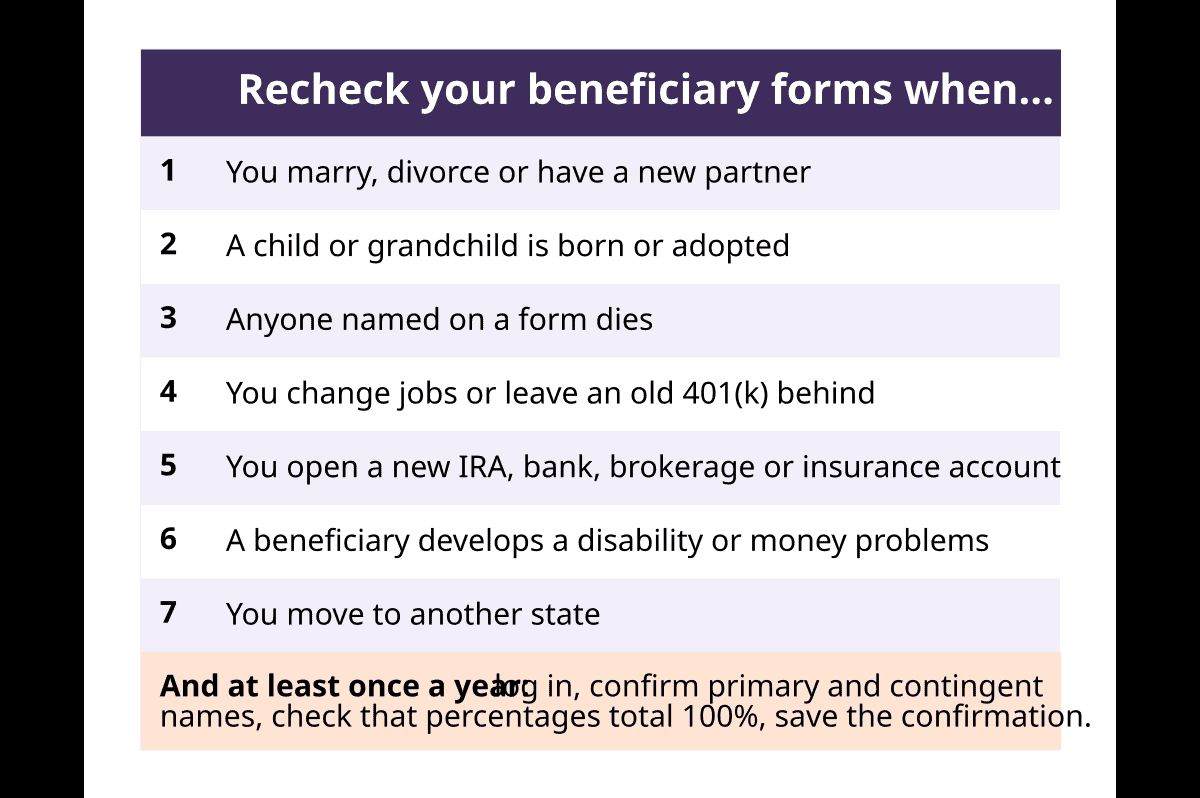
- Marriage, divorce or a new partner
- A birth or adoption, including grandchildren
- The death of anyone named on a form
- A new job, or leaving an old 401(k) behind
- Opening a new IRA, brokerage account, bank account or life policy
- Someone on a form develops a disability or money problems
- A move to a different state, especially a community property state
Most adults haven’t done the rest of their planning either
The Trust & Will 2026 Estate Planning Report found that 56% of U.S. adults have no estate planning documents, and will ownership fell from 31% in 2025 to 26% in 2026. Caring.com’s study shows a similar slide, from 33% with a will in 2022 to 24% in 2025. The surveys use different methods, so compare the trends, not the exact numbers.

That makes beneficiary forms even more important. For some families, they’re the only estate plan that’s actually in place.
Your beneficiary audit worksheet
Print this or copy it into a note. Fill in one row per account.
| Account | Primary (and %) | Contingent (and %) | Last checked |
|---|---|---|---|
| Current 401(k) or 403(b) | |||
| Old 401(k) from a past job | |||
| Traditional or Roth IRA | |||
| Life insurance (personal and work) | |||
| Bank accounts (POD) | |||
| Brokerage accounts (TOD) | |||
| HSA, annuities and other accounts |

Myths and mistakes to skip
Myths vs. facts
| Myth | Fact |
|---|---|
| “My will covers everything.” | Accounts with a beneficiary form usually pass by the form, not the will. |
| “Divorce automatically removes my ex.” | Some state laws do this, but federal law overrides them for ERISA-covered workplace plans. |
| “My kids can inherit directly.” | Minors can’t take title to these accounts; a court may need to step in. |
| “Inherited IRAs can be stretched forever.” | For deaths after 2019, most heirs other than spouses and other eligible designated beneficiaries have 10 years. |
| “Estate tax will eat my heirs’ money.” | Federal estate tax applies only above $15 million per person for 2026 deaths. |
Common mistakes
- Leaving an ex-spouse or a deceased person on a form. Getting divorced and never changing the form is a well-known trap; CPA Ed Slott warned CNBC about it in 2018.
- Skipping the contingent line. If your primary dies first, the money may end up in probate.
- Naming a minor directly. Use a custodian or trust instead.
- Naming your estate “to keep it simple.” It usually adds probate and faster IRA payouts.
- Using a will to “fix” a form. The TSP and most plans won’t follow a will that conflicts with the form.
- Forgetting old accounts. A 401(k) from a job 15 years ago may still name a former partner.
- Treating one child unequally by accident. Naming one child on a big account “to share with siblings” puts that child under no legal duty to share.
- Not telling anyone. Heirs can’t claim what they don’t know about.
The short version
- Beneficiary forms usually beat your will for retirement accounts, life insurance and POD/TOD accounts.
- Name a primary and a contingent on every account, with percentages that total 100%.
- Check the per stirpes box if you want a deceased child’s share to go to grandchildren.
- In most 401(k)s, your spouse gets the money unless they sign a witnessed waiver.
- After a divorce, change every form yourself; don’t rely on state law.
- Don’t name minors directly; use a custodian or a carefully drafted trust.
- Most non-spouse heirs must empty an inherited IRA within 10 years; spreading withdrawals can lower the tax.
- Recheck your forms after every major life event and at least once a year.
Questions people ask about beneficiary designations
Does a beneficiary designation override a will?
Usually, yes. Accounts that let you name a beneficiary, like 401(k)s, IRAs, life insurance and POD bank accounts, pay the people on the form. Your will controls only what’s left. Rare exceptions exist, such as court orders and community property claims, so talk to an attorney if your will and forms conflict on purpose.
What happens if I don’t name a beneficiary?
The account follows its own default rules. Many workplace plans pay a spouse first, then other relatives or the estate; the TSP’s order is spouse, children, parents, then the estate. IRAs and life insurance often go to your estate, which means probate.
Can I name more than one beneficiary?
Yes. Give each person a percentage, and make sure the total is exactly 100%. You can name several people on each line.
Can a beneficiary designation be contested?
It can be challenged, for example over a missing spousal waiver, fraud, or a claim that the owner lacked capacity. But courts and plans generally follow the form on file, as the Kennedy case shows. Clear, current, signed forms are your best protection.
Do beneficiaries pay taxes on what they inherit?
It depends on the account. Withdrawals from an inherited traditional IRA or 401(k) are taxed as ordinary income. Qualified Roth withdrawals and life insurance death benefits are generally tax-free. Federal estate tax applies only to very large estates: $15 million per person for 2026 deaths and $15,480,000 for 2027, per the IRS. Some states have their own estate or inheritance taxes.
How often should I review my beneficiaries?
At least once a year and after any big life change, such as marriage, divorce, a birth or a death. A yearly check takes only a few minutes once your audit worksheet is filled in.
Can I name a charity?
A charity, yes; most forms let you name one. A charity is a non-designated beneficiary under the IRA rules. If you split an IRA between a charity and people, ask your provider how the shares will be handled.
Where can I find my beneficiary forms?
Log in to each account and look for “beneficiaries” in the profile or settings menu. For workplace benefits, check your plan website or ask HR. If you can’t find a form, assume none is on file and add one.
Your next move
Pick your largest account, usually a 401(k) or IRA, and log in this week. Check who’s named on each line and the percentages. Then save a screenshot of the confirmation. Then work through the rest of the worksheet one account at a time.
About this guide
Published by Daniel Brienza, founder and editor of Sensible Money Guide (B.S. in Business Administration, University of South Florida). This guide was researched and drafted with the help of AI tools, fact-checked against the primary sources listed below, and reviewed and edited by Daniel before publishing. Daniel is not a licensed financial advisor; this guide is for general education.
Written November 11, 2026. Facts and figures are based on data available on that date.
Sources
Federal agencies, courts and state law
- FINRA, Retirement Accounts (Choosing Beneficiaries section), accessed November 2026.
- FINRA, Plan Now to Smooth the Transfer of Your Brokerage Account Assets on Death, January 17, 2023.
- U.S. Department of Labor, EBSA, FAQs about Retirement Plans and ERISA, accessed November 2026.
- Cornell Law School, Legal Information Institute, 29 U.S. Code § 1055: Requirement of joint and survivor annuity and preretirement survivor annuity, accessed November 2026.
- ERISA Advisory Council, Current Challenges and Best Practices Concerning Beneficiary Designations in Retirement and Life Insurance Plans, December 2012.
- U.S. Supreme Court (via Cornell LII), Egelhoff v. Egelhoff, 532 U.S. 141, March 21, 2001.
- U.S. Supreme Court (via Cornell LII), Kennedy v. Plan Administrator for DuPont Savings and Investment Plan, 555 U.S. 285, January 26, 2009.
- U.S. Supreme Court (via Cornell LII), Sveen v. Melin, No. 16-1432, June 11, 2018.
- Cornell Law School, Wex, Per stirpes, accessed November 2026.
- FDIC, Your Insured Deposits, accessed November 2026.
- FDIC, FIL-7-2022: Final Rulemaking on Simplification of Deposit Insurance Rules for Trust and Mortgage Servicing Accounts, 2022.
- Thrift Savings Plan, Designating Beneficiaries, September 14, 2026.
- Social Security Administration, Who can get Survivor benefits, December 5, 2024.
- NAIC, NAIC Life Insurance Policy Locator Tool Helps Match Consumers with More Than $16 Billion in Lost and Unclaimed Benefits, September 3, 2026.
- NAIC, Life Insurance Policy Locator, accessed November 2026.
- Louisiana State Legislature, R.S. 9:1711.8, Louisiana Uniform Transfer on Death Security Registration Act, accessed November 2026.
- California Legislature (via california.public.law), California Probate Code § 3920.5, accessed November 2026.
- Texas State Law Library, Wills, Estates & Probate: Transfer Property After Death, October 14, 2026.
- National Consumer Law Center, Protecting the Family Home: Transfer on Death Deeds (issue brief), August 2026.
IRS and Treasury
- IRS, Publication 590-B (2025), Distributions from Individual Retirement Arrangements (IRAs), 2025 edition.
- IRS, Retirement topics: Beneficiary, August 1, 2026.
- IRS, Retirement plan and IRA required minimum distributions FAQs, January 29, 2026.
- IRS, Notice 2024-35, May 2024.
- Federal Register, Required Minimum Distributions (final regulations, T.D. 10001), July 19, 2024.
- IRS, IR-2024-190: Treasury, IRS issue updated guidance on required minimum distributions, July 18, 2024.
- 26 CFR § 1.401(a)(9)-4 (via CustomsMobile), Determination of the designated beneficiary; age of majority, accessed November 2026.
- IRS, IR-2026-133: IRS releases tax inflation adjustments for tax year 2027, November 5, 2026.
- IRS, Interest, dividends, other types of income (FAQs), accessed November 2026.
Banks, investment firms and research
- Fidelity Investments, What is a beneficiary?, February 10, 2026.
- Fidelity Investments, Can you put an IRA in a trust?, August 4, 2026.
- Fidelity Investments (YouTube), Inherited IRA Rules Explained | 5 Questions With Fidelity, accessed November 2026.
- Vanguard, What Is a Beneficiary? Types & How to Choose, December 13, 2024.
- Vanguard, What are inherited IRAs?, accessed November 2026.
- Vanguard, IRA Beneficiary Designation Kit, June 2026.
- Charles Schwab, What Is a Beneficiary? Why Naming Them Is Key, March 28, 2025.
- Charles Schwab, Inherited IRA Rules & SECURE Act 2.0 Changes, October 8, 2025.
- J.P. Morgan Wealth Management, Understanding beneficiary designations: Common mistakes and how to avoid them, July 28, 2026.
- Thrivent, How the SECURE Act 2.0 changed RMDs, revised July 17, 2026.
- Investment Company Institute, Retirement Market, Second Quarter 2026, September 17, 2026.
- Trust & Will, 2026 Estate Planning Report, March 26, 2026.
News and personal finance media
- Investopedia (via Yahoo Finance), Your Will Doesn’t Control Who Gets Most of Your Money. This Does, March 11, 2026.
- CNN (via KESQ), Leaving money to those you choose: Here’s what can override your wishes even if you have a will, September 23, 2025.
- InvestmentNews, Good news: IRS improved the IRA trust rules. Bad news: they still don’t work (Ed Slott), September 10, 2024.
- CNBC, Out-of-date beneficiary designations are a common and costly mistake, April 16, 2018.
- NerdWallet, Life Insurance Beneficiary: A Complete Guide, August 24, 2026.
- Kiplinger, Beneficiary Designations: 5 Critical Mistakes to Avoid, April 5, 2019.
- Nolo, Naming a Beneficiary for Your Life Insurance Policy, September 28, 2022.
- Caring.com, 2025 Wills and Estate Planning Study, updated September 1, 2026.
This article is for educational purposes only and isn’t financial advice. Consider talking with a qualified professional about your situation.



Beneficiary Designations: How to Name, Check and Update Them

Term Life Insurance: How Much You Need and What It Costs

How to Start Investing: Accounts, First Buys and Real Risks

Student Loan Repayment Plans: RAP vs. IBR vs. Standard

When to Claim Social Security: Ages, Math and Trade-Offs

Credit Report Errors: How to Find, Dispute and Fix Them
When to Claim Social Security: Ages, Math and Trade-Offs
Student Loan Repayment Plans: RAP vs. IBR vs. Standard
How to Start Investing: Accounts, First Buys and Real Risks
You must be logged in to post a comment Login