


Investing Basics
How to Start Investing: Accounts, First Buys and Real Risks
How to start investing with a small amount: which account to open first, what to buy, what it costs, and how often stocks have really lost money.

You can start investing with a small amount. The real entry fee isn’t a pile of cash; it’s getting a few things in the right order. Keep a small cushion, grab any employer match, clear high-interest debt, and then set up an automatic buy of a low-cost, diversified fund in a retirement account.
The myth is that investing is for people who already have money. Schwab says it has no minimum to open a brokerage account, and Fidelity says the same for its retail brokerage accounts, including IRAs. The harder part is deciding what to do first and how much loss you can live with. This guide gives you the numbers for both.
This guide in four numbers
| Number | What it is | Why it matters to you |
|---|---|---|
| $0 | Minimum to open a brokerage account at Schwab or a retail brokerage account at Fidelity (checked November 2026) | Your balance isn’t what’s stopping you. Some funds and firms do set minimums, so check before you pick. |
| 22.15% | Average card rate at commercial banks on accounts charged interest, Q2 2026 (Federal Reserve G.19) | Paying off that balance is hard for any investment to beat. |
| 26.5% | Share of single calendar years the S&P 500 lost money, 1928–2025 (our calculation) | A down year is normal, so money you’ll need soon doesn’t belong in stocks. |
| 0 of 79 | 20-year periods since 1928 that ended with a loss (our calculation, before inflation) | Time has been the best protection so far. It’s history, not a promise. |
What’s in this guide
- Seven words to know first
- Should you invest yet? Where your next dollar goes
- How much to invest, and what waiting costs
- Which account to open
- What to buy first
- Fees: the one thing you control
- How often stocks have really lost money
- All at once or a little at a time?
- Six steps to your first investment
- Myths vs. facts
- Warning signs and costly mistakes
- Questions people ask
Seven words to know first
You only need a handful of terms to follow the rest of this guide.
- Stock: a small piece of ownership in a company. Investor.gov notes that stocks have historically had the greatest risk and highest returns of the three major asset types.
- Bond: a loan to a government or company that pays interest. Bonds generally swing less than stocks and offer more modest returns.
- Fund: a basket of many investments you buy as one. Mutual funds and exchange-traded funds (ETFs) are the two main kinds.
- Index fund: a fund that tracks a market index rather than paying a manager to pick winners. Our guide to how index funds work goes deeper.
- Expense ratio: the fund’s yearly fee, shown as a percent of your money. On $10,000, a 0.14% fee is $14 a year.
- Brokerage account: an account at an investment firm that holds what you buy.
- Diversification: spreading money among different investments to reduce risk. It lowers risk but doesn’t remove it.
Should you invest yet? Where your next dollar goes
It’s tempting to jump straight to “open an account.” The better first question is whether investing is the best use of your next dollar right now. Sometimes it isn’t, and that’s fine.
Here’s what the same dollar can do in each place. These aren’t equal kinds of “return,” and the table says why.
| Where the dollar goes | What it can earn or save | How sure is it? |
|---|---|---|
| Employer match (example: 50 cents per $1) | An instant 50% before taxes | Set by your plan’s formula, but check its vesting schedule |
| Credit card balance | About 22% a year in interest avoided, at the 22.15% average rate | Very sure, if you’d otherwise keep carrying that balance at that rate |
| U.S. stocks | About 10.0% a year from 1928 to 2025 (our calculation). Vanguard’s 10-year forecast is 4.8% to 6.8% a year (as of Sept. 30, 2026, before inflation, taxes and expenses) | Not sure at all, especially over short periods |
| Average savings account | 0.38% national average (October 2026). Many online accounts pay more | Very sure, and FDIC-insured up to limits at insured banks |
Inflation matters here too. Prices rose 3.7% in the 12 months through September 2026. Money earning the average 0.38% lost about 3.2% of its buying power over a year like that. So long-term money usually can’t sit in a low-rate account forever, but cash still has a job: being there when you need it.
One $100 bill, three places (hypothetical)
You have $100 extra this month, a card balance at 22.15%, and a plan that matches 50 cents per dollar. In the plan, the $100 becomes $150 right away, assuming the match is vested and before future taxes. Sent to the card, it avoids about $22 of interest over the next year. In a stock fund outside the match, a 10% year would add $10, though a year like 2022 (down about 18%) would cost you about $18. That’s why the match usually comes first and the card comes next.
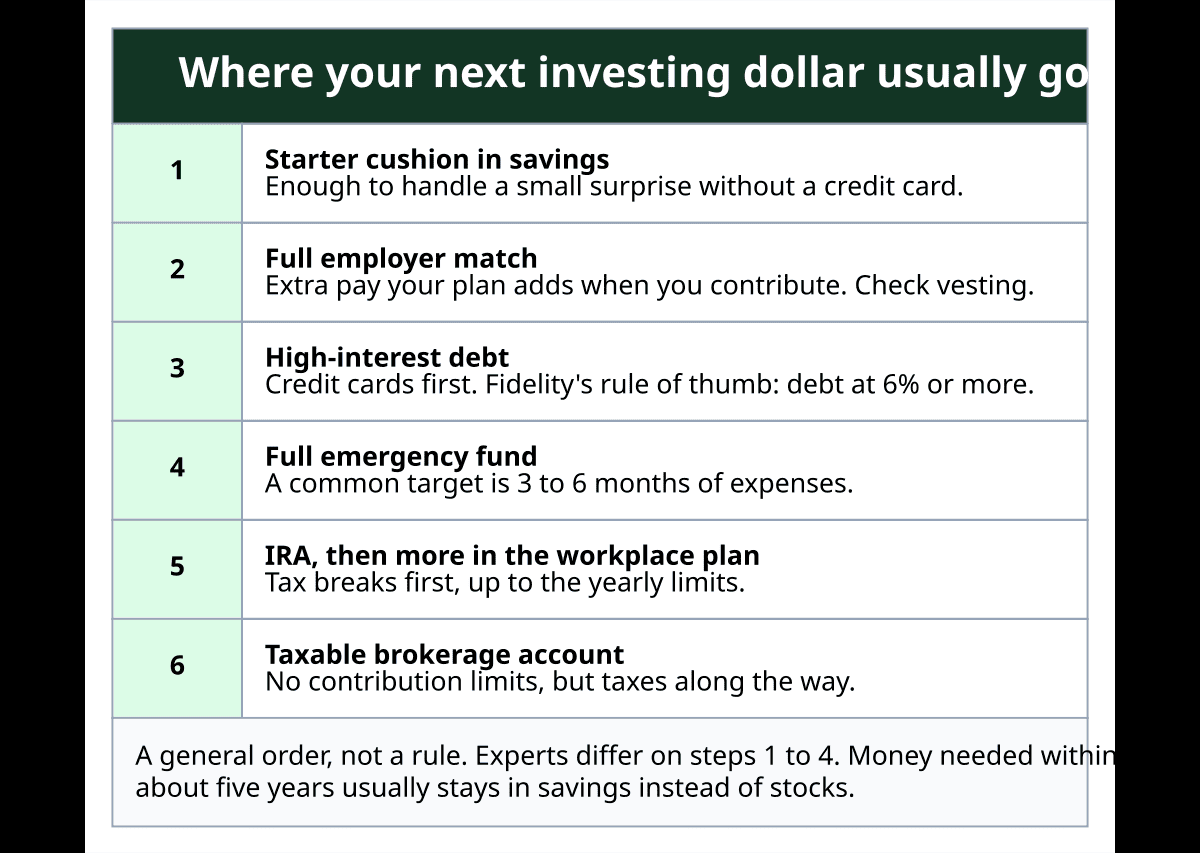
What the experts say: how much must come first?
Respected voices disagree on the order, and you should know that going in.
- Debt and savings first. Ramsey Solutions says to pay off all consumer debt and save 3–6 months of expenses before investing, and then invest 15% of gross income.
- Match first, then a rate test. Fidelity calls a match “essentially ‘free money'” and suggests that, once you have an emergency cash buffer, the full match and no credit card debt, debt at 6% or more should generally come before extra investing. Debt below 6% may not need to. Fidelity bases that figure on assumptions, including at least 10 years until retirement, a balanced mix, a tax-advantaged account and interest that isn’t tax-deductible.
- A typical match beats card debt. Vanguard’s April 2026 research, which treats 50% and 100% matches as common, says contributing up to the match generates a higher return than paying down credit card debt, and that it’s generally best to pay down card debt as quickly as possible after that.
One planner wants a real cushion before you put money in the stock market:
“At the end of the day, I want to see that foundation built by having that reserve before you invest”
Douglas Boneparth, then a certified financial planner and president of Bone Fide Wealth, to CNBC Make It (2023)
Our read: take a full match if you can, because it’s hard to beat. Then the choice between debt payoff and investing comes down to your rate and your nerves. If you need a plan for the debt, see how to pay off credit card debt. For the cushion, use our emergency fund guide.

How much to invest, and what waiting costs
There’s no single right number. NerdWallet points to 10% to 15% of income for retirement, and Ramsey Solutions uses 15% of gross income. If that’s out of reach, start with what you can keep up, then raise it when you get a raise or finish paying off a debt.
“The key to success lies in automating your contributions.”
Alonso Rodriguez Segarra, CFP, founder and CEO of Advise Financial, to GOBankingRates, via Nasdaq
What $100 a month could become
This table shows a hypothetical $100 invested at the start of each month. The rates are assumptions, not forecasts, and they stay steady, which real markets never do.
| Years | At 4% a year | At 6% a year | At 8% a year |
|---|---|---|---|
| 10 ($12,000 put in) | $14,700 | $16,300 | $18,100 |
| 20 ($24,000 put in) | $36,500 | $45,600 | $57,300 |
| 30 ($36,000 put in) | $68,800 | $97,900 | $141,800 |
What waiting costs
Now take a hypothetical $200 a month at 6% until age 65. Starting ten years later doesn’t cost you just ten years of deposits. It costs you the growth those deposits would have earned.
| Start at age | Total put in | Value at 65 |
|---|---|---|
| 25 | $96,000 | $383,400 |
| 35 | $72,000 | $195,900 |
| 45 | $48,000 | $91,100 |
Waiting from 25 to 35 saves $24,000 in deposits and gives up about $187,500 at 65 in this example. If you’re already 45 or 55, don’t read this as bad news. It just means each dollar has less time, so you may need to put in more. The best remaining start date is still the soonest one you can afford.
Read this before you trust the numbers: Every projection here ignores taxes and inflation, and only the fee example includes fees. A 6% return in the future buys less than the same dollars buy today. We use steady rates to show how time works, not to predict what you’ll get. Ramsey Solutions uses an 11% return in key examples and also shows 7%, while Vanguard’s forecast for U.S. stocks over the next 10 years is far lower. Planning with lower numbers leaves more room if returns disappoint.
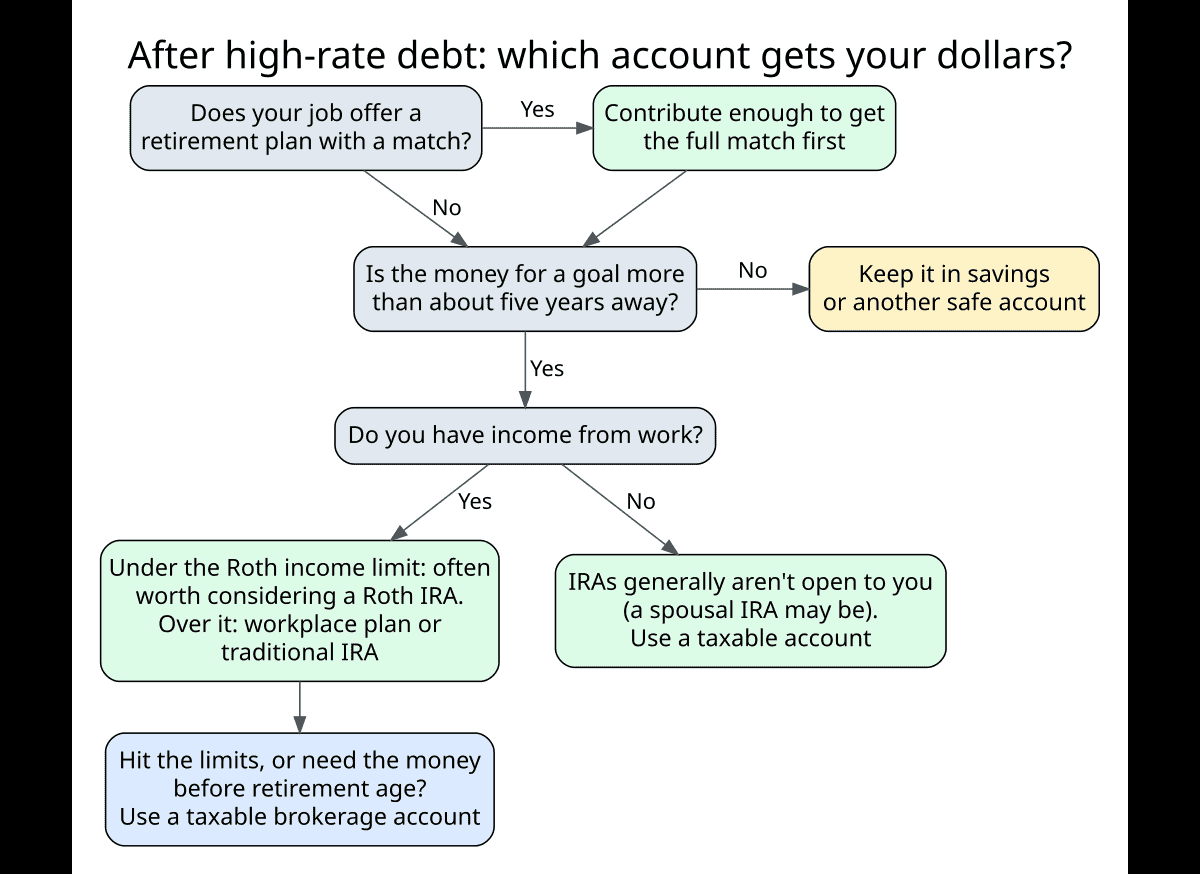
Which account to open
The account is the container. The investment goes inside it. People often mix those up, and it matters: a Roth IRA isn’t an investment, and money that sits in one uninvested won’t grow much.
| Account | Good fit if… | 2026 limit | Tax treatment |
|---|---|---|---|
| 401(k), 403(b) | Your job offers one, especially with a match | $24,500, plus catch-up at 50+ | Traditional: tax break now, taxed later. Roth option if your plan has one |
| Roth IRA | You have income from work and are under the income limit | $7,500 ($8,600 at 50+), shared with traditional IRAs | No deduction. Qualified withdrawals are tax-free |
| Traditional IRA | You want a possible deduction now | Same shared limit | Withdrawals usually taxed. Deduction depends on income and workplace plan |
| Taxable brokerage | You’ve used the above, or need access before retirement | No limit | Dividends and sold gains are taxed along the way |
Rules to get straight
- Roth income limits for 2026. The ability to contribute phases out at $153,000–$168,000 for single filers and heads of household and $242,000–$252,000 for joint filers, based on modified adjusted gross income. Married people filing separately face a much lower range.
- You need income from work. Roth contributions require taxable compensation, and your IRA contribution generally can’t exceed that compensation for the year. A spousal IRA on a joint return is the main exception.
- Limits for 2027. As of November 6, 2026, we couldn’t find the IRS’s 2027 limits. Last year’s announcement came on November 13, so check before you plan next year’s amounts.
- Early withdrawals. Withdrawals before 59½ can bring income tax on the taxable part plus a 10% additional tax, with exceptions (IRA rules, workplace plan rules). Our 401(k) guide and Roth vs. traditional comparison cover the details.
- A credit you might miss. Lower earners may qualify for the Saver’s Credit. For 2026, the income limits are $40,250 for single filers, $60,375 for heads of household and $80,500 for joint filers. You generally must be 18 or older and can’t be a full-time student or someone’s dependent. Starting in 2027, a Saver’s Match is scheduled to largely replace it.
How taxes work in a regular brokerage account
In a taxable account, you owe tax in two main ways:
- When you sell at a gain. Hold more than one year and it’s a long-term gain with lower rates. Hold one year or less and it’s taxed like regular income.
- When the fund pays dividends. Qualified dividends get the lower capital gains rates. Others are taxed as ordinary income. You should receive a Form 1099-DIV from each payer of at least $10, but you must report taxable dividends even without one.
For tax year 2026, the 0% long-term rate applies up to $49,450 of taxable income for single filers and $98,900 for joint filers. The 15% rate then runs up to $545,500 and $613,700.
Worked example (hypothetical). A single filer in the 22% bracket has a $5,000 gain. Sell after more than a year and the federal tax at the 15% rate is $750. Sell within a year and it’s $1,100. Waiting past the one-year mark saves $350 here. State tax may add to either figure.

What to buy first
You don’t need to research companies to get started. Most beginners can pick one of three simple paths, and it’s fine to change later.
| Path | What you do | Trade-off |
|---|---|---|
| One target-date fund | Pick the fund with the year near your retirement. It shifts to a more conservative mix automatically | Very simple, but fees and mixes vary by company. It still can lose money |
| A few broad index funds | Hold a U.S. stock fund, an international stock fund and, if you want, a bond fund | Low cost and flexible, but you choose the mix and rebalance |
| A robo-adviser | Answer questions and let software build and manage a portfolio | Hands-off, but add up the total cost, including the adviser’s fee and the funds’ fees |
How much should be in stocks vs. bonds? That depends on your timeline and how you’d react to a drop. Our asset allocation by age guide walks through sample mixes.
Watch out for overlap. Owning several funds doesn’t always mean you’re diversified. An S&P 500 fund and a total U.S. market fund hold many of the same big companies. Investor.gov suggests checking funds’ top holdings to make sure they’re different. And don’t add a target-date fund on top of other funds unless you’ve checked how the mix adds up, since it’s built to be a full mix on its own.
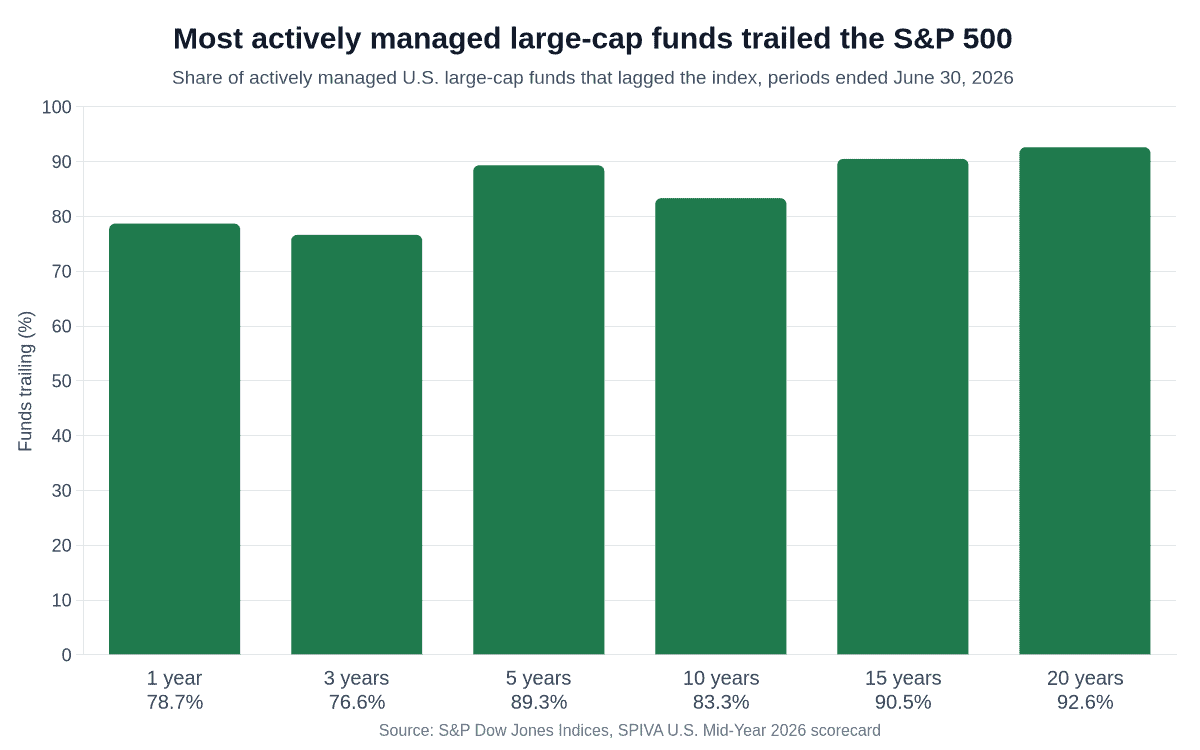
Why not just pick the best manager or stock?
You can, but the odds are poor. In S&P’s SPIVA scorecard, most actively managed large-cap funds trailed the S&P 500 over every period shown.
If you enjoy picking stocks, one approach is to keep the bulk of your money in broad funds and use a small slice for your picks. One stock can fall a long way even when the market doesn’t. That’s a risk a broad fund spreads out.
Fees: the one thing you control
You can’t control the market. You can control what you pay. The SEC’s investor site warns that fees may seem small but can have a major impact over time.
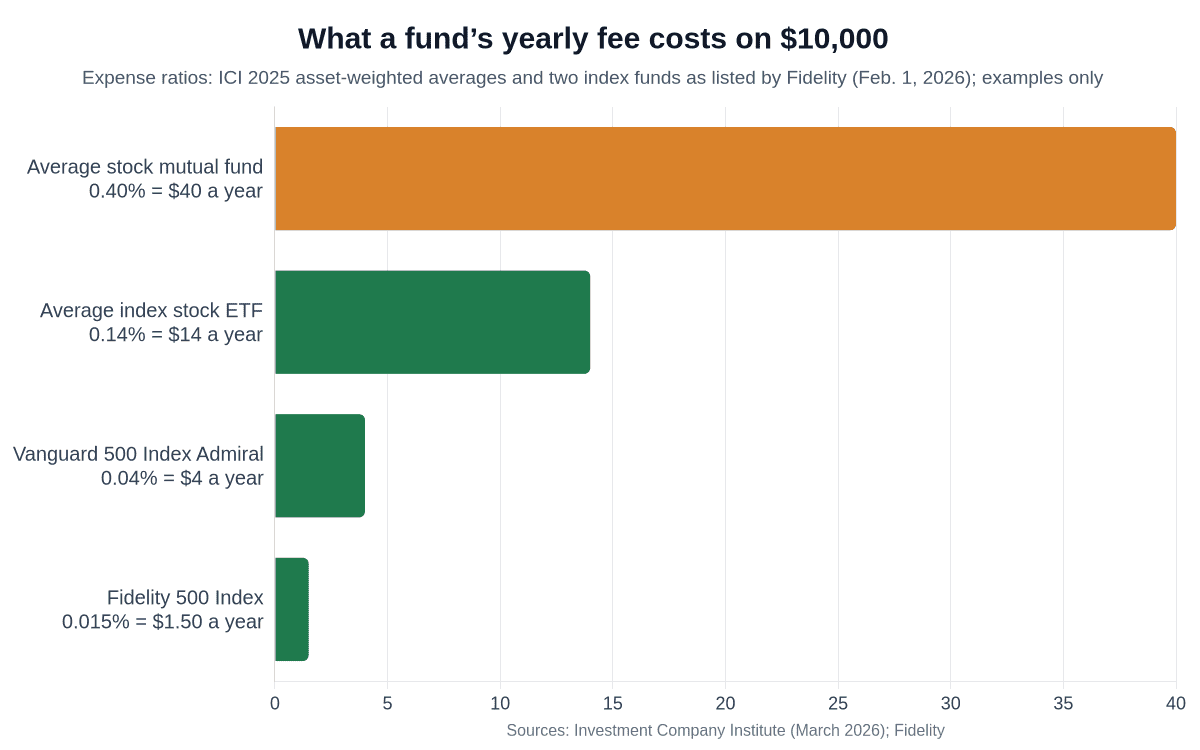
Worked example (hypothetical). You invest $300 at the start of each month for 30 years, for $108,000 in deposits. The portfolio earns 6% a year before fees. Here’s what different total yearly costs leave you with:
| Total yearly cost | What it might be | Balance after 30 years |
|---|---|---|
| 0.14% | Average index stock ETF (ICI, 2025) | $286,400 |
| 0.40% | Average stock mutual fund (ICI, 2025) | $273,300 |
| 1.00% | A pricier fund or a fund plus adviser | $245,600 |
| 1.50% | A costly fund plus adviser fee | $224,900 |
The gap between 0.14% and 1.00% is about $40,800, on the same deposits and same market return. Those ICI averages are asset-weighted, so plenty of funds cost more or less. Paying for advice can be worth it if it keeps you on track, so look at what you get as well as what you pay.
Three costs to check before you buy:
- Expense ratio. It’s on the fund’s page and in its prospectus.
- Sales charge, or “load.” Some mutual fund shares charge one. Ask or look it up first.
- Account fees. The SEC’s brokerage account bulletin lists maintenance, inactivity, closing and transfer fees as possible charges.
How often stocks have really lost money
“Investing involves risk” doesn’t tell you much. We wanted a real answer, so we ran the numbers ourselves. We took NYU Stern professor Aswath Damodaran’s yearly S&P 500 returns, with dividends, for 1928 through 2025. Then we checked every possible holding period that fits in that span.
| Hold for | Periods ending in a loss | Worst stretch | Change in that stretch |
|---|---|---|---|
| 1 year | 26 of 98 (26.5%) | 1931 | Down 43.8% |
| 3 years | 15 of 96 (15.6%) | 1930–1932 | Down 61.6% |
| 5 years | 11 of 94 (11.7%) | 1928–1932 | Down 49.3% |
| 10 years | 5 of 89 (5.6%) | 1929–1938 | Down 15.5% |
| 15 years | 1 of 84 (1.2%) | 1929–1943 | Down 3.0% |
| 20 years | 0 of 79 | 1929–1948 | Up 59.8% |
| 30 years | 0 of 69 | 1929–1958 | Up 898% |
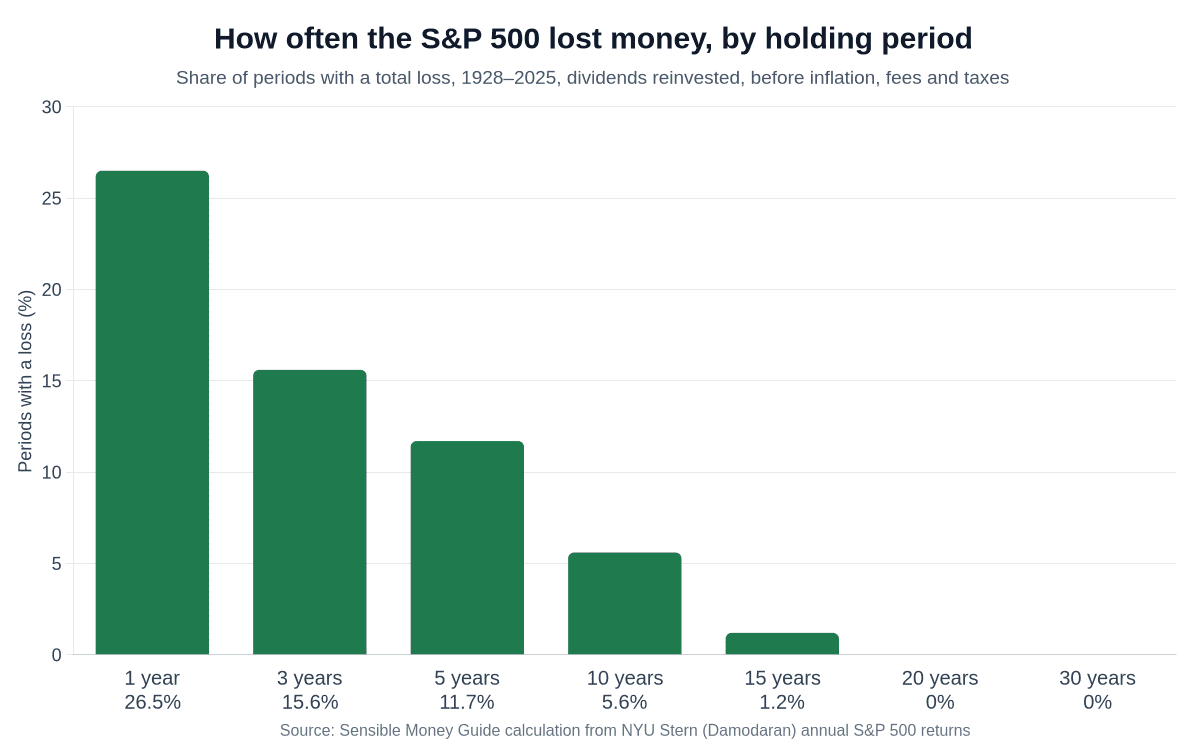
What this means in practice:
- Money you need within about five years is at real risk. More than one in nine five-year periods ended lower, which matches common advice to keep short-term money out of stocks. NerdWallet draws the same line at five years.
- Ten years isn’t a guarantee. Two of the five losing 10-year periods began in 1999 and 2000, within many investors’ memory.
- Long periods have been kinder, but inflation still bites. The 20-year low looks fine at up 59.8%, but that’s about 2.4% a year before inflation, fees and taxes.
Limits of this analysis: These are calendar-year returns for one U.S. index, and the periods overlap, so they aren’t independent trials. They leave out inflation, fund fees and taxes. Real investors don’t buy just once on January 1. And the U.S. has had an unusually good run that may not repeat. Treat this as history, not as odds for your future.
What a bad start actually looked like
The start of the 2000s was one of the worst times to begin. A single $10,000 invested at the start of 2000 would have been worth about $9,090 at the end of 2009, before fees and taxes.
But most people don’t invest once. They invest from each paycheck. So we also modeled a hypothetical $100 a month ($1,200 a year) over the same years. To keep the math simple with yearly data, we treated each year’s money as invested at mid-year.
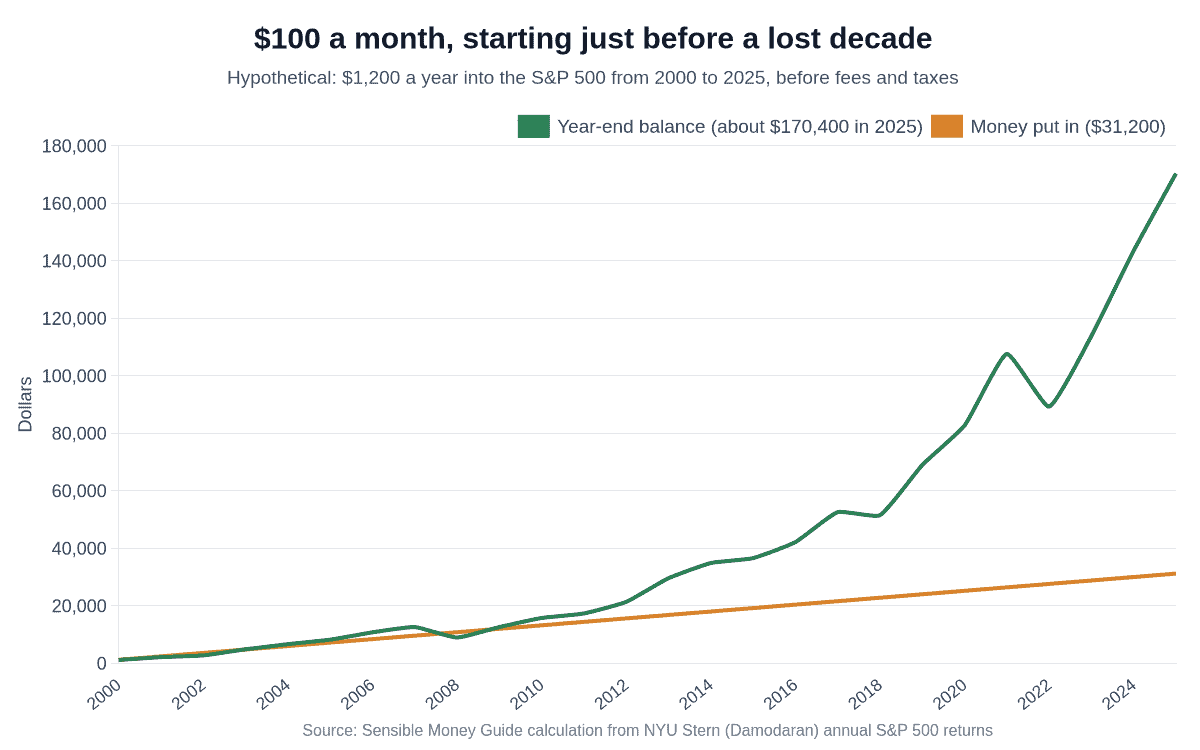
- End of 2008: $10,800 put in, worth about $8,900. That’s a paper loss after nine years of saving.
- End of 2009: $12,000 put in, worth about $12,600. Slightly ahead, helped by low-priced purchases and 2009’s rebound.
- End of 2025: $31,200 put in, worth about $170,400 before fees and taxes.
The hard part is emotional. This hypothetical investor had to keep buying through 2008 after watching years of progress disappear. Morningstar’s Christine Benz makes a related point about leaving things alone:
“So if you’re in there less, if you’re not making changes as the market is volatile, that tends to leave you with a bigger balance in the end.”
Christine Benz, then director of retirement planning at Morningstar, on NPR (2025)

All at once or a little at a time?
If you get a paycheck, you’re already investing a little at a time, and that’s fine. The question comes up when you have a chunk of money, like a bonus or an inheritance.
History favors going in sooner. Vanguard’s 2023 research found a lump sum beat a three-month phase-in about 68% of the time, using global stock returns from 1976 to 2022 and a one-year window. But the phase-in beat sitting in cash 69% of the time. It also noted that investors with significant loss aversion may be better suited to phasing in. Vanguard’s own Joel Dickson puts it practically:
“If the alternative is lump sum versus ‘I keep delaying investing,’ dollar-cost averaging could be an improvement to just get the money invested.”
Joel Dickson, then Vanguard Head of Enterprise Advice Methodology, to Barron’s (2025)
Our take: if a lump sum keeps you up at night, phase it in over a set schedule and write the dates down. The plan that actually gets done is better than the perfect one you keep putting off.
Six steps to your first investment
- Check your workplace plan first. Find out if there’s a match, how it works and when it vests. If there’s a match, set your contribution to get all of it. Your plan’s fund menu may already include a target-date fund.
- Pick your account and firm. Use the chart above. Compare account fees, fund choices and fund minimums. For example, Fidelity’s index fund page shows a $0 minimum for the Fidelity index funds it compares and a $3,000 minimum for the Vanguard Admiral shares it lists. ETFs trade by the share. Some firms sell partial shares, but availability varies and they generally can’t be transferred to another firm.
- Open the account. The SEC says to expect questions about your Social Security number, ID, job, income, net worth and goals. Some applications default to a margin account, so confirm you’re opening a cash account unless you truly want to borrow.
- Move money in, then buy something. Money you transfer generally sits as uninvested cash, often in a sweep program, until you place a buy order or set up automatic investing. Managed accounts can differ.
- Set it on autopilot. Schedule a transfer for just after payday, and turn on automatic investing if your firm offers it for your fund. Then raise it by a percent or so each year.
- Check in once or twice a year. Investor.gov says rebalancing tends to work best when done infrequently. Update your beneficiaries while you’re there, and skip the daily price checks.
This short video from Fidelity walks through getting started. Its product details are Fidelity’s own, and it’s not an endorsement of any firm:
Myths vs. facts
| Myth | Fact |
|---|---|
| “My brokerage account is insured like a bank account.” | SIPC can help if a brokerage firm fails, up to $500,000, including $250,000 in cash. It doesn’t protect you against investments falling in value. |
| “Opening a Roth IRA means I’m invested.” | The account is only the container. You still have to choose and buy something. |
| “I should wait until the market drops.” | Nobody can reliably call it, and waiting has a cost. The market rose in about three of every four years from 1928 to 2025. |
| “Higher fees buy better results.” | In SPIVA’s data, most active large-cap funds trailed their index after fees. Our read: a higher fee is a sure cost for an unsure benefit. |
| “Investing is the same as gambling.” | Short-term trading and single bets can look like it. Owning a broad slice of many businesses for decades is different, though it still isn’t risk-free. |

Warning signs and costly mistakes
FINRA reports a significant spike in investor complaints about social media “investment groups”, where fake experts push tips in encrypted chats and steer people into thinly traded stocks they later can’t sell. Treat these as stop signs:
- A stranger, or a social media account, offers stock tips or moves you to a private chat.
- Someone promises high returns with little or no risk.
- You’re pressed to act today, or to borrow money to get in or win back a loss.
- The person isn’t listed in FINRA’s BrokerCheck, or a video of a famous investor seems off. Deepfakes are in use.
Other mistakes that cost real money:
- Investing money you’ll need soon. A house down payment due in two years belongs in savings.
- Using margin as a beginner. The SEC warns it can magnify losses.
- Selling after a drop. That turns a paper loss into a real one, and you then have to decide when to get back in.
- Stopping contributions in a downturn. In the 2000–2025 example above, the years of low prices were when each dollar bought the most.
- Buying the same thing twice. Several funds with the same top holdings aren’t real diversification.
- Chasing what just went up. Last year’s winner tells you little about next year.
What to remember
- You can start small. Schwab and Fidelity list no minimum to open a brokerage account.
- After a small cushion, get any full employer match, and treat high-rate debt as the next big priority.
- An account is a container. Your money isn’t invested until you buy something inside it.
- A low-cost target-date fund or a few broad index funds can be all a beginner needs.
- Stocks lost money in about one of every four calendar years, but none of the 79 twenty-year periods since 1928 ended lower, before inflation.
- Keep money you’ll need within about five years out of stocks.
- Fees are the part you control, and small gaps compound into large ones.
- Be suspicious of anyone who approaches you with a hot tip.
Questions people ask
How much money do I need to start investing?
Very little at many firms. Schwab and Fidelity list no minimum to open a brokerage account, though individual funds can have their own minimums. Your budget is the real limit, so pick an amount you can keep investing through a bad year.
Can I lose all my money?
You can lose all of it in a single stock if the company fails. A broad index fund holding hundreds or thousands of companies would need nearly all of them to fail, which is why a total loss is far less of a concern. Large drops still happen: the S&P 500 fell about 37% in 2008, including dividends.
What should a complete beginner invest in?
A target-date fund in a retirement account or a broad index fund is a simple place to start. This is general education, not a personal recommendation, so check the fees and the mix first. If your workplace plan has a match, start there.
Should I pay off my student loans or invest?
Take any employer match first, then compare your rate. Fidelity’s general debt rule of thumb treats 6% as a rough dividing line, though it assumes non-deductible interest and doesn’t address student loans specifically, while Ramsey Solutions says to clear all consumer debt first. Federal loans also have repayment options that private loans don’t, so see what yours offer.
Is now a good time to start investing?
No one can tell you where the market goes next. If the money is for a goal many years away and your high-rate debts and cushion are handled, regular investing means you don’t have to guess. If you’ll need the money soon, the answer is no in any market.
Can my teenager or stay-at-home spouse invest?
A minor generally invests through a custodial account managed by an adult. The assets belong to the child, who takes control at an age that varies by state. A Roth IRA for a minor still requires taxable compensation. A spouse without earnings may be able to use a spousal IRA on a joint return; IRS Publication 590-A explains the rule. A taxable brokerage account has no earned-income requirement.
Do I have to pay taxes if I don’t sell?
In a retirement account, generally no, not while the money stays inside. In a taxable account, yes on dividends and fund capital gain distributions, even if you reinvest them. You’ll owe tax on your own gains only when you sell.
Do I need a financial advisor?
Not to get started with a simple fund. Paying for advice can make sense for a complicated situation or if you need someone to keep you from panic-selling. Ask how the advisor is paid and check them on FINRA’s BrokerCheck first.
Do this one thing today
Open your workplace benefits site, or your last pay stub, and find out whether you get a match and how much you’re contributing now. It takes about ten minutes. If you’re leaving match money on the table, change your contribution before your next paycheck. If you don’t have a plan at work, compare two firms and pick an amount for your first automatic buy.
About this guide
Published by Daniel Brienza, founder and editor of Sensible Money Guide (B.S. in Business Administration, University of South Florida). This guide was researched and drafted with the help of AI tools, fact-checked against the primary sources listed below, and reviewed and edited by Daniel before publishing. Daniel is not a licensed financial advisor; this guide is for general education.
Written November 6, 2026. Facts and figures are based on data available on that date.
Sources
Government and official sources
- Internal Revenue Service, 401(k) limit increases to $24,500 for 2026, IRA limit increases to $7,500 (IR-2025-111), November 13, 2025.
- Internal Revenue Service, Topic no. 309, Roth IRA contributions, accessed November 2026.
- Internal Revenue Service, Publication 590-A, Contributions to IRAs, accessed November 2026.
- Internal Revenue Service, Topic no. 409, Capital gains and losses, accessed November 2026.
- Internal Revenue Service, Topic no. 404, Dividends, accessed November 2026.
- Internal Revenue Service, Topic no. 557, Additional tax on early distributions from traditional and Roth IRAs, accessed November 2026.
- Internal Revenue Service, Topic no. 558, Additional tax on early distributions from retirement plans other than IRAs, accessed November 2026.
- Internal Revenue Service, Revenue Procedure 2025-32 (2026 inflation adjustments), 2025.
- U.S. Securities and Exchange Commission, Investor.gov, Beginners’ Guide to Asset Allocation, Diversification, and Rebalancing, accessed November 2026.
- Investor.gov, Asset Allocation and Diversification, accessed November 2026.
- Investor.gov, Investor Bulletin: How to Open a Brokerage Account, June 10, 2021.
- Investor.gov, Understanding Fees, accessed November 2026.
- Investor.gov, Investor Bulletin: Robo-Advisers, February 23, 2017.
- Federal Reserve, G.19 Consumer Credit, October 7, 2026.
- Federal Reserve Bank of St. Louis (FRED), National Rate: Savings (FDIC data), October 2026.
- U.S. Bureau of Labor Statistics, Consumer Price Index, September 2026, October 14, 2026.
- Securities Investor Protection Corporation, What SIPC Protects, accessed November 2026.
- FINRA, Investor Alert: Social Media “Investment Group” Imposter Scams Continue to Rise, December 9, 2025.
- FINRA, BrokerCheck, accessed November 2026.
- FINRA, Investing in Fractional Shares, accessed November 2026.
- Investor.gov, Fractional Share Investing, accessed November 2026.
- Congressional Research Service via EveryCRSReport, The Retirement Savings Contributions Credit and the Saver’s Match, accessed November 2026.
Banks, investment firms and research
- Aswath Damodaran, NYU Stern School of Business, Historical Returns on Stocks, Bonds and Bills, data through 2025, accessed November 2026.
- Vanguard, Vanguard Capital Markets Model forecasts, as of September 30, 2026.
- Vanguard (Finlay and Zorn), Cost averaging: Invest now or temporarily hold your cash?, February 2023.
- Vanguard (de la Fuente and others), Balancing saving and debt paydown, April 2026.
- Fidelity, Should you pay down debt or invest?, September 29, 2026.
- Fidelity, Pricing and fees, accessed November 2026.
- Fidelity, No minimum investment mutual funds, expense ratios as of February 1, 2026.
- Charles Schwab, Open a brokerage account, accessed November 2026.
- Investment Company Institute, Mutual Fund and ETF Fees Remained Near Historic Lows in 2025, March 25, 2026.
- S&P Dow Jones Indices, SPIVA U.S. Mid-Year 2026, 2026.
- Morningstar, What You Need to Know About Capital Gains Distributions, accessed November 2026.
News and personal finance media
- NerdWallet, How to Start Investing: A Guide for Beginners, May 28, 2026.
- NerdWallet, How to Invest Money in 5 Steps, May 22, 2025.
- Ramsey Solutions, How to Start Investing in 2026: A Beginner’s Guide, updated December 23, 2025.
- NerdWallet, What Is a Custodial Account?, accessed November 2026.
- CNBC Make It, Don’t start investing until you’ve accomplished these 2 things, 2023.
- GOBankingRates via Nasdaq, How to start investing with less than $1,000, date not shown, accessed November 2026.
- NPR via WFAE, How to manage your investments during volatile markets, May 3, 2025.
- Barron’s via Tiger Brokers, A Tried-and-True Tactic to Stay Invested, February 1, 2025.
This article is for educational purposes only and isn’t financial advice. Consider talking with a qualified professional about your situation.


Beneficiary Designations: How to Name, Check and Update Them

Term Life Insurance: How Much You Need and What It Costs

How to Start Investing: Accounts, First Buys and Real Risks

Student Loan Repayment Plans: RAP vs. IBR vs. Standard

When to Claim Social Security: Ages, Math and Trade-Offs

Credit Report Errors: How to Find, Dispute and Fix Them
Beneficiary Designations: How to Name, Check and Update Them
When to Claim Social Security: Ages, Math and Trade-Offs
Student Loan Repayment Plans: RAP vs. IBR vs. Standard
You must be logged in to post a comment Login