
Credit Management
How to Build Credit From Scratch: Your First-Year Plan
Learn how to build credit from scratch: how your first score is made, the best starter tools like secured cards, and a simple plan for your first year.

No credit history isn’t the same as bad credit. It just means the credit bureaus don’t have enough information about you yet. The fix is simple: open one or two accounts that report to the bureaus, use them lightly and pay on time, every time. Most people can have a first credit score within about six months.
Pick your starting point
| Your situation | A good first step | Cost to watch |
|---|---|---|
| No credit at all, some savings | A secured credit card that reports to all three bureaus | The deposit (refundable) and any annual fee |
| No credit, little cash to spare for a deposit | A credit-builder loan from a credit union or community bank | Interest and fees, which are usually small |
| A parent or partner with strong credit | Becoming an authorized user on their card | Usually nothing, but their late payments can hurt you too |
| College student with some income | A student credit card | Interest, if you carry a balance |
| You already pay rent and utilities | Ask about rent reporting to add that history | Some services charge a fee, and not every score counts it |
The one rule that matters most: pay your full statement balance by the due date, every month. You never need to carry a balance or pay interest to build credit.
What you’ll learn
- What a credit report and a credit score really are, in plain English
- Why starting from zero is harder than it should be, and how to break the cycle
- The five main tools for getting your first account, and which one fits you
- How to use a secured card or credit-builder loan without paying a dime more than you need to
- The everyday habits that grow a strong score
- A month-by-month plan for your first year
In this guide:
- What “building credit” really means
- Why credit matters, even if you hate debt
- The “no credit” trap and how common it is
- How your first credit score gets made
- Five ways to open your first credit account
- How to use a secured card the right way
- How credit-builder loans work
- The habits that build a strong score
- Your first-year action plan
- Common mistakes to avoid
- Credit-building myths
- Your credit-building cheat sheet
- FAQ

What “building credit” really means
Let’s start with a few words that get tossed around a lot. Once these click, the rest of this guide gets much easier.
Credit
Credit is borrowed money you promise to pay back later. A credit card, a car loan, a student loan and a mortgage are all forms of credit. When you use credit, a lender is trusting you to repay.
Credit report
A credit report is a record of how you’ve handled credit. It lists your accounts, your credit limits, your balances and whether you paid on time. It also shows who has checked your credit recently.
Three big companies keep these records: Equifax, Experian and TransUnion. They’re called credit bureaus (or credit reporting companies). Your report at each one can look a little different, because not every lender reports to all three.
Credit score
A credit score is a three-digit number that sums up your credit report. Lenders use it as a quick way to guess how likely you are to pay on time. The two main brands are FICO and VantageScore. Most of their scores run from 300 to 850, and higher is better.
Here’s the key idea: your score is calculated from your report. No report, no score. So “building credit” really means two things:
- Getting at least one account onto your credit report.
- Filling that report with a long, boring record of on-time payments and low balances.
That’s it. Every tip in this guide serves one of those two goals.
What does and doesn’t count
A lot of people are surprised by what doesn’t show up. Bank of America’s Better Money Habits notes that cash, prepaid cards and debit cards don’t help your credit score, because that activity isn’t reported to the major bureaus. Paying for groceries with your debit card for ten years builds zero credit history.
Things that usually do count include credit cards, car loans, student loans, mortgages and personal loans. Rent, phone and utility bills usually don’t count on their own, though there are ways to add some of them, which we’ll cover later.
Why credit matters, even if you hate debt
You might be thinking, “I don’t want debt, so why do I need a credit score?” It’s a fair question. Your credit history gets checked in places that have nothing to do with borrowing.
- Renting an apartment. Landlords often check credit. Thin or missing credit can mean a bigger deposit or a co-signer.
- Utilities and phone plans. Without credit, some companies ask for a security deposit before they turn on service.
- Big purchases later. A car loan or mortgage with good credit can cost thousands less in interest than the same loan with fair or poor credit.
Even with “good” credit, borrowing isn’t free. But the difference between a great rate and a bad one adds up fast on big loans. Building credit now is like buying cheap insurance for your future self.
The good news is that you don’t need a perfect score to benefit. A solid one opens most doors.
“It doesn’t even have to be perfect credit, it doesn’t have to be an 800 credit score for you to basically have an awful lot of options when it comes to credit cards, mortgages, personal loans on down the line.”
Matt Schulz, chief consumer finance analyst at LendingTree, speaking to CNN in January 2026
The other side: you can live without a score
Not every expert agrees that you need a credit score. Dave Ramsey’s company, Ramsey Solutions, argues that a score mostly measures how well you handle debt, and that “a credit score is not proof of winning financially.” Ramsey points people toward manual underwriting, where a lender reviews your income and bill-paying history by hand instead of using a score. Ramsey’s article says that usually means showing 12 to 24 months of income records and on-time payments on at least four regular bills, such as rent and utilities.
That path is real, and it works for some disciplined savers. But it narrows your choices. Fewer lenders offer it, it takes more paperwork, and it doesn’t help much with landlords, phone companies or insurers that check credit. Most mainstream sources, including the Consumer Financial Protection Bureau (CFPB), focus on how to build credit responsibly rather than avoid it.
Here’s a middle ground most people can live with: you can build excellent credit without ever paying a cent of interest. You use a card for small things you’d buy anyway, and you pay it off in full every month. You get the benefits of a score without the debt Ramsey warns about.
The “no credit” trap and how common it is
Here’s the frustrating part. To get credit, lenders want to see a credit history. To get a credit history, you need credit. It’s the same catch-22 as needing job experience to get your first job.
The CFPB uses two terms for people stuck in this spot:
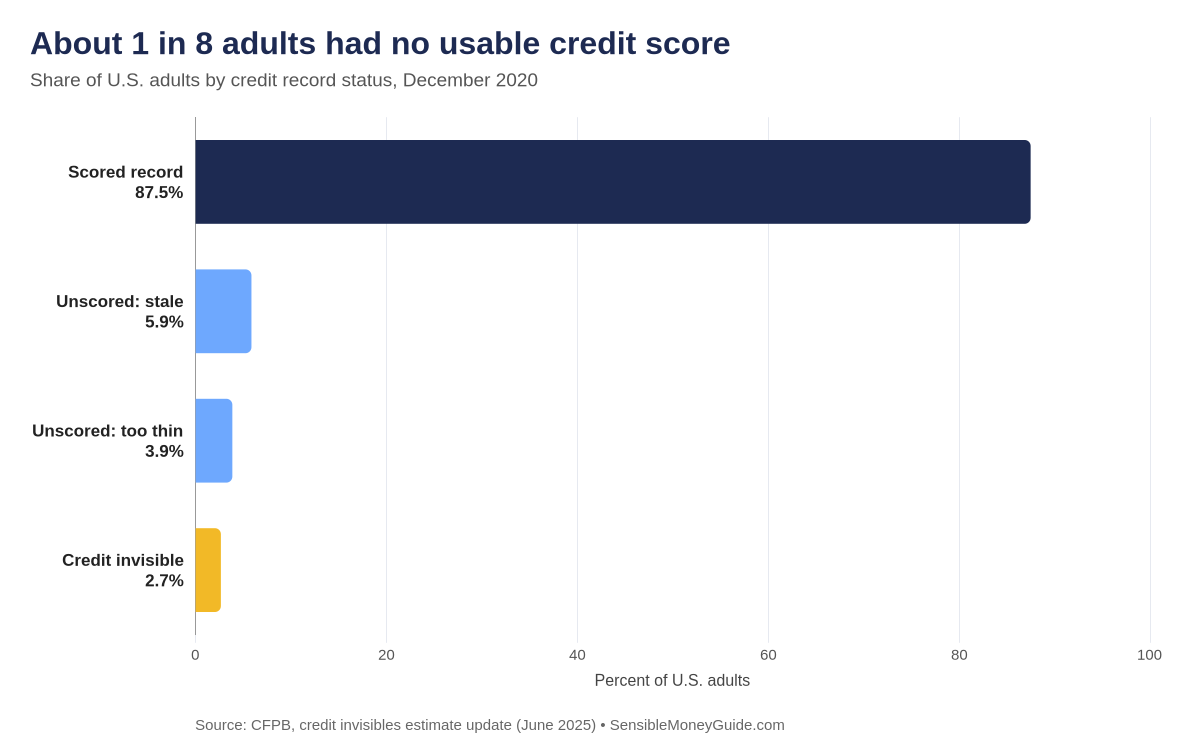
- Credit invisible means you have no credit record at all at a nationwide credit bureau.
- Unscored means you have a record, but it’s too thin or too old to produce a score. “Insufficient” files don’t have enough history yet. “Stale” files haven’t had recent activity.
In June 2025, the CFPB published an updated estimate using data from December 2020. It found that about 2.7% of U.S. adults, or roughly 7 million people, were credit invisible. Another 9.8% had records that couldn’t be scored. That’s about one in eight adults without a usable score.
You may have seen an older, bigger number. A well-known 2015 CFPB report said 26 million Americans were credit invisible, based on data from 2010. In the 2025 update, the CFPB corrected its method and said the original estimate “should be roughly cut in half.” The problem is smaller than people thought, but millions still face it.
Who ends up here? Mostly young adults just starting out, people who are new to the country, people who’ve always paid cash, and people coming back after a divorce or a long gap. If someone else handled the credit in your household, you might be “stale” or invisible without realizing it.
The good news is that it’s usually easy to fix. The tools built for this exact problem are designed so a bank can say yes to someone with no history.
How your first credit score gets made
Before you open anything, it helps to know what the scoring models are looking for. That way, every move you make has a purpose.
You don’t start at zero
A common belief is that everyone starts at a score of zero, or at 300, and works up. That’s not how it works. Experian explains that a score doesn’t exist until there’s credit history to calculate it from. When your first score appears, it usually lands somewhere in the middle. It won’t be 850, because your history is too short, and it probably won’t be 300 unless things have already gone wrong.
The minimum requirements
FICO, the most widely used score, has three basic rules. According to myFICO, your credit report needs:
- At least one account that has been open for six months or more.
- At least one account that has been reported to the bureau in the last six months.
- No indication that you’re deceased.
One account can meet both of the first two rules. So if you open a single card today and use it lightly, you can expect a FICO score in about six months.
VantageScore moves faster. Experian says VantageScore can often calculate a score within about a month of a new account showing up on your report. Lenders usually report a new account at the end of its first billing cycle, so give it a month or two before you check.
Pro tip: Many free credit score apps show a VantageScore. Don’t panic if a lender later sees a different number. FICO and VantageScore use different formulas, and each bureau may have slightly different data.
What goes into the score
FICO publishes the general weight of each part of its score. Here’s the breakdown from myFICO:
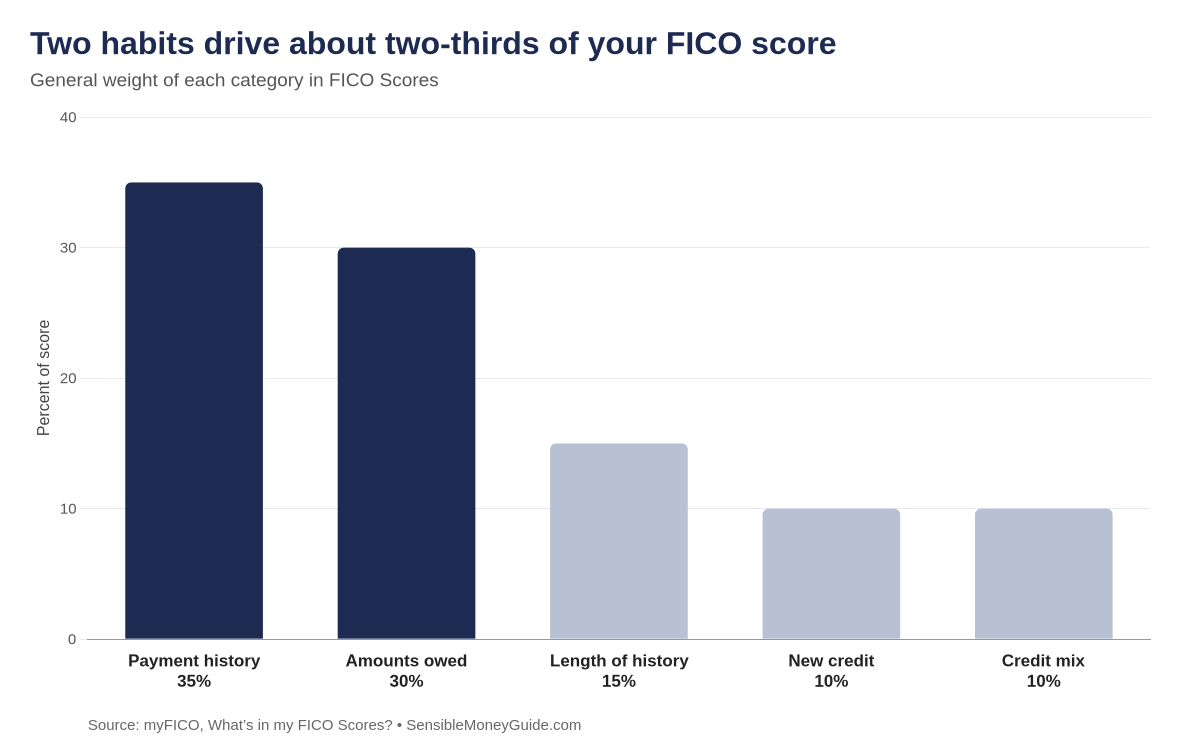
- Payment history (35%). Did you pay on time? This is the biggest piece.
- Amounts owed (30%). How much of your available credit are you using? This share is called your credit utilization.
- Length of credit history (15%). How old are your accounts, on average and at the oldest?
- New credit (10%). Have you opened several accounts or applied a lot recently?
- Credit mix (10%). Do you have different kinds of credit, like a card and a loan?
Look at the top two. Paying on time and keeping balances low make up about two-thirds of your FICO score. Those are also the two things you control completely, starting with your very first account.
The bottom three mostly take care of themselves with time. You can’t rush the age of your accounts. You shouldn’t chase “credit mix” by taking out loans you don’t need. And “new credit” just rewards patience.
A quick word on hard and soft inquiries
When you apply for credit, the lender usually does a hard inquiry, which means it pulls your report to make a decision. A hard inquiry can lower your score a little for a while. myFICO says FICO scores only count inquiries from the last 12 months.
A soft inquiry happens when you check your own credit or when a company checks to send you a pre-approved offer. myFICO says soft inquiries like viewing your own report won’t affect your FICO scores. So checking your own credit as often as you like is perfectly safe.
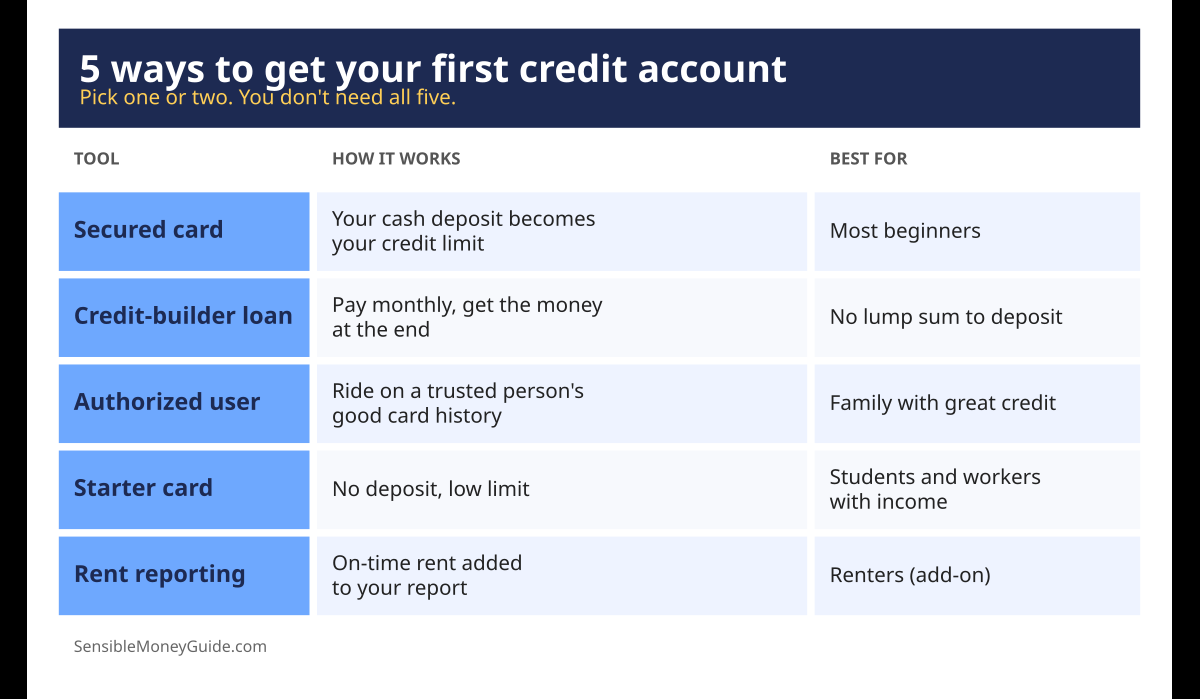
Five ways to open your first credit account
You only need one or two of these to get started. Read through them, then pick the one that fits your situation.
1. A secured credit card
A secured credit card works like a regular credit card, except you put down a cash deposit first. The deposit usually becomes your credit limit. If you put down $300, you can usually charge up to $300.
The deposit protects the bank, which is why it can approve people with no history. According to Bankrate, deposits often start around $50 and can go as high as $2,000 to $3,000. NerdWallet says many start around $200. You typically get the deposit back when you close the account in good standing or “graduate” to a regular card.
Best for: Almost anyone starting from zero who can spare a few hundred dollars for a while.
2. A credit-builder loan
A credit-builder loan is a small loan that works backward. Instead of handing you the money, the lender puts it in a locked savings account or certificate of deposit. You make monthly payments, and those payments get reported to the bureaus. When you’ve paid it off, you get the money.
CNBC Select notes that most are small, generally $300 to $1,000, with terms of 6 to 24 months. They’re common at credit unions and community banks.
Best for: People who can’t spare a lump-sum deposit but can handle a small monthly payment, or who want to add an installment loan to their file.
3. Becoming an authorized user
An authorized user is someone added to another person’s credit card. You get your own card with your name on it, but the main cardholder is the one legally responsible for the bill.
Chase explains that the main cardholder’s history is “often reported on the student’s credit file,” which can give you a head start. If a parent has had a card for 15 years with a perfect record, some of that good history can show up on your report.
The catch cuts both ways. If the main cardholder misses a payment or runs up a big balance, your score can suffer too. NerdWallet adds that not every card company reports authorized users to the bureaus, so ask before you count on it.
Best for: Young adults or partners with a trusted family member who has excellent credit habits.
4. A student or starter card
Some unsecured cards are designed for people with little or no credit, including student cards. They don’t need a deposit, but limits are usually low and interest rates are high.
If you’re under 21, there’s an extra rule. The CFPB explains that card companies generally can’t open a card for someone under 21 unless you can show your own ability to pay, or you have a co-signer who is at least 21.
Best for: Students and new workers with steady income who may qualify without a deposit.
5. A co-signer, or adding rent and bills to your report
A co-signer is someone who signs a loan or card application with you and promises to pay if you don’t. It can help you qualify, but it’s a big ask. Your co-signer is on the hook for the full debt, and a late payment hurts both of you.
Another option is a rent or bill reporting service. These services send your on-time rent or utility payments to one or more bureaus. Some landlords offer this for free, while other services charge a fee. NerdWallet points out that not every scoring model counts these payments, and some tools, like Experian Boost, only affect your Experian data.
Best for: Rent reporting is a good add-on for renters. A co-signer is a last resort when other options don’t work.
Comparing your options
| Tool | Upfront cost | Approval odds with no credit | Main risk |
|---|---|---|---|
| Secured card | Deposit, often $50 to a few hundred dollars | High | Interest if you carry a balance |
| Credit-builder loan | None, but you pay interest and maybe fees | High | Missed payments hurt your new file |
| Authorized user | None | Depends on the main cardholder | Their mistakes can hurt you |
| Student or starter card | None | Medium | High interest rates, low limits |
| Co-signer | None | Medium to high | Strains relationships if you fall behind |
| Rent reporting | Free to a monthly fee | No approval needed | Not every score counts it |
What to do if you get turned down
Getting denied stings, but it’s common. In the Federal Reserve’s survey of 2025, about one-third of people who applied for credit were turned down or approved for less than they asked for. A “no” is information, not a verdict on you.
If you’re denied, the lender will usually send a letter that explains the main reasons. Read it. Then try these steps:
- Pull your free credit reports and make sure nothing is wrong, like an account that isn’t yours.
- Wait before applying again, so you don’t stack up hard inquiries.
- Step down to a tool with easier approval, like a secured card or a credit-builder loan from your own credit union.
- Ask your bank if it has a pre-qualification tool, which can show your odds with only a soft inquiry.
If you’re not sure where to start, here’s a simple rule of thumb. Open one secured card. If you have a trusted family member with great credit, ask to be added as an authorized user too. That combination covers most people well.
Two Cents, a personal finance show from PBS, has a short video that walks through this same “need credit to get credit” problem and some ways out of it.

How to use a secured card the right way
A secured card is the most common starting point, so let’s go deep on it. Used well, it costs you almost nothing. Used carelessly, it can cost more than it should.
Step 1: Pick the right card
Before you apply, check a few things:
- It reports to all three bureaus. Bankrate warns that “Some issuers may not report the status of secured cards.” A card that doesn’t report won’t build anything.
- Low or no annual fee. Many good secured cards charge no annual fee. Read the fine print for fees that kick in after year one.
- A path to graduate. Some banks review your account and offer to switch you to a regular card and return your deposit. Bankrate says this often takes about 12 to 18 months.
- A bank you already use. Your own bank or credit union may be more willing to approve you, and it’s easier to manage.
Step 2: Use it lightly, for things you already buy
Put one small, regular bill on the card. A streaming service, a phone bill or a tank of gas works well. The goal is to show activity every month, not to spend more.
This is where credit utilization comes in. Remember, that’s the share of your limit you’re using. The CFPB notes that experts often suggest keeping it at or below 30%. Lower is generally better.
Worked example: what utilization looks like on a small card
Say your secured card has a $500 limit.
- If your statement shows a $150 balance, your utilization is $150 ÷ $500 = 30%.
- If your statement shows a $40 balance, your utilization is $40 ÷ $500 = 8%.
- If you charge $450 for a new laptop and that balance is still there when your statement closes, your reported utilization is 90%, even if you pay it off in full by the due date.
Small limits make utilization tricky. One normal purchase can push you over 30%. That’s why it’s smart to keep the card for small, planned charges only.
Watch out: Your utilization is usually based on the balance on your statement, not what you owe on the due date. If you made a big purchase, you can pay part of it before the statement closes so a lower balance gets reported.
Step 3: Pay in full, every month, on autopay
This is the single most important habit in this whole guide. Set up automatic payments for the full statement balance. If your bank only lets you autopay the minimum, set that up as a safety net and pay the rest by hand.
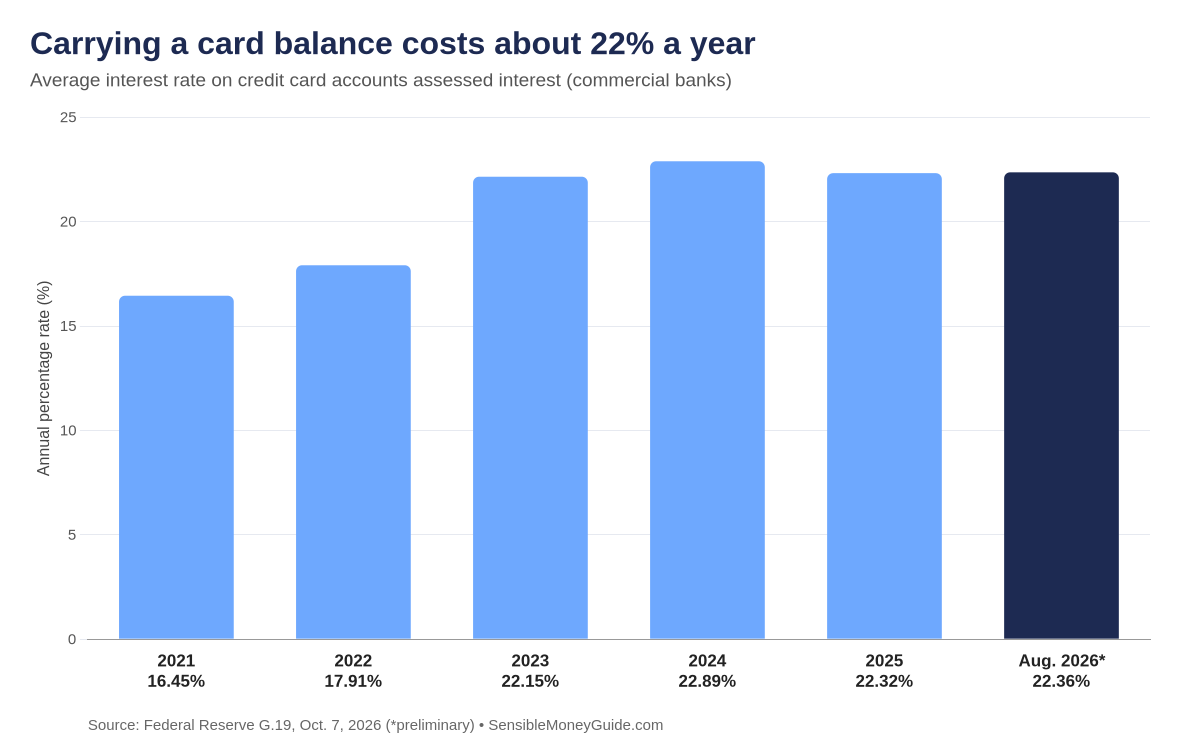
You don’t need to carry a balance to build credit. That’s a stubborn myth. The CFPB says plainly that “Paying off the balance in full each month helps get you the best scores,” and it keeps your interest costs low.
Carrying a balance only costs you money. And credit card interest is expensive right now. The Federal Reserve’s consumer credit report shows that the average rate commercial banks charged on card accounts that paid interest was 22.36% in August 2026, a preliminary figure.
Worked example: what carrying a balance costs
Imagine you keep a $500 balance on a card with a 22.36% annual rate, and you never pay it down.
- One month of interest is about $500 × 22.36% ÷ 12 = $9.32.
- Over a full year, with interest added each month, it’s about $124.
That’s $124 spent on nothing. And it does nothing to help your score. Paying in full gives you the same credit-building benefit for $0.
Step 4: Graduate when you’re ready
After about a year of on-time payments, ask your bank whether you qualify to switch to an unsecured card. Better Money Habits notes that upgrading your existing card may be better for your credit than opening a brand-new account. That way, you keep the account’s age and get your deposit back.
How credit-builder loans work
A credit-builder loan is a quiet favorite of credit counselors. It’s a forced savings plan that happens to build credit, too.
How the money moves
Here’s the basic flow:
- You apply for a small loan, often at a credit union or community bank.
- The lender puts the loan amount into a locked savings account or CD in your name.
- You make fixed monthly payments for 6 to 24 months.
- Each on-time payment gets reported to the credit bureaus.
- When the loan is paid off, the lender releases the money to you.
Because the lender holds the money, there’s very little risk on its side. That’s why approval is easy even with no credit history.

Worked example: what a credit-builder loan costs
Let’s say you take out a $600 credit-builder loan for 12 months at about a 15.5% annual rate. That’s close to the 15.51% to 15.92% CNBC Select reported for one well-known online provider, whose loans run 24 months. Credit unions are often cheaper.
- Your monthly payment would be about $54.30.
- Over 12 months, you’d pay about $651.56 in total.
- That means about $51.56 in interest. At the end, you get your $600 back.
So in this example, you’d pay roughly $52, plus any fees, for a year of on-time payment history and $600 in savings. CNBC Select notes that some lenders refund part of the interest when you finish. Others charge setup or monthly fees, so compare the total cost before you sign.
What the research says
The CFPB studied credit-builder loans with 1,531 credit union members. The results were mixed in a useful way. In its 2020 report, the CFPB found:
- People who didn’t already have a loan were 24% more likely to end up with a credit score after opening one.
- People without existing debt saw their scores rise about 60 points more than people who already had debt.
- On average, the loan was linked to $253 more in savings.
- People who already had debt sometimes saw small score drops, likely because the new payment was hard to fit in with their other bills.
The takeaway is simple. A credit-builder loan works best when you’re truly starting fresh and the monthly payment fits easily in your budget. If you’re already juggling bills, a secured card you barely use may be the safer choice.
Watch out: A missed payment on a credit-builder loan hurts the exact credit file you’re trying to build. Only take one if you’re confident you can make every payment. Setting up autopay from your checking account helps.
Secured card or credit-builder loan?
Many people wonder which to choose. Here’s a simple way to decide:
- Pick a secured card if you can set aside a deposit and you’re disciplined about paying in full. It can cost you nothing.
- Pick a credit-builder loan if you don’t have a lump sum, or if you want help saving. Expect to pay some interest.
- Pick both if you want to build faster and you’re comfortable with two payments. A card plus a loan also gives you a mix of credit types.
The habits that build a strong score
Opening your first account gets you on the board. Your habits after that decide whether your score ends up average or excellent. Here are the ones that matter most.
Never miss a payment
Payment history is the biggest part of your score. One late payment can do real damage, especially on a young credit file with little else in it. NerdWallet notes that a payment more than 30 days late can stay on your report for up to seven years.
Autopay is your best friend here. Set it and check it once a month. Many card companies also let you pick your due date, so choose one a few days after payday.
If you do slip up, act fast. A payment that’s a few days late usually gets a late fee, and sometimes a higher penalty interest rate. But Experian explains that it generally won’t show up on your credit report until you’ve missed a full billing cycle. Pay it as soon as you notice, then call the card company and politely ask if they’ll waive the fee.
Keep balances low
Remember utilization. Aim to keep the reported balance on each card, and across all your cards, at or below 30% of the limit. If you want to build the strongest score, lower is better.
As your history grows, you may get offered a higher limit. A higher limit can lower your utilization, but only if your spending stays the same.
Space out your applications
Each new application can mean a hard inquiry, and a bunch of them in a short time can make you look desperate for credit. NerdWallet suggests spacing applications about six months apart. When you’re building from scratch, one or two accounts in the first year is plenty.
Keep your oldest accounts open
The age of your accounts matters. Your first card will eventually become your oldest account, which helps your score. Unless it has a high annual fee, keep it open and use it for a small purchase now and then so the card company doesn’t close it for inactivity.
Check your credit reports, for free
You can now check your reports from all three bureaus for free every week. The FTC confirms that Equifax, Experian and TransUnion made free weekly reports permanent. The official site is AnnualCreditReport.com. Watch out for copycat sites that charge fees or try to collect your personal information.
When you check, look for:
- Accounts you don’t recognize, which could be a sign of identity theft
- Late payments you know you made on time
- Wrong balances or credit limits
- Your name, address or Social Security number listed incorrectly
If you find a mistake, you can dispute it with the credit bureau and with the company that reported it. The CFPB recommends reviewing your reports and disputing errors. Disputing is free.
“First, check your credit report for FREE using annualcreditreport.com.”
Rod Griffin, senior director of consumer education and advocacy at Experian, in a 2024 interview
Be wary of “credit repair” promises
When you’re starting out, you may see ads promising to raise your score fast. Be careful. The FTC says that no one can legally remove accurate, current negative information from your report. It’s also illegal for credit repair companies to charge you before they’ve done the work. Anything they can legally do, you can usually do yourself for free.
For more on how the score itself is calculated, see our guide to how credit scores really work.
Why young adults have the most work to do
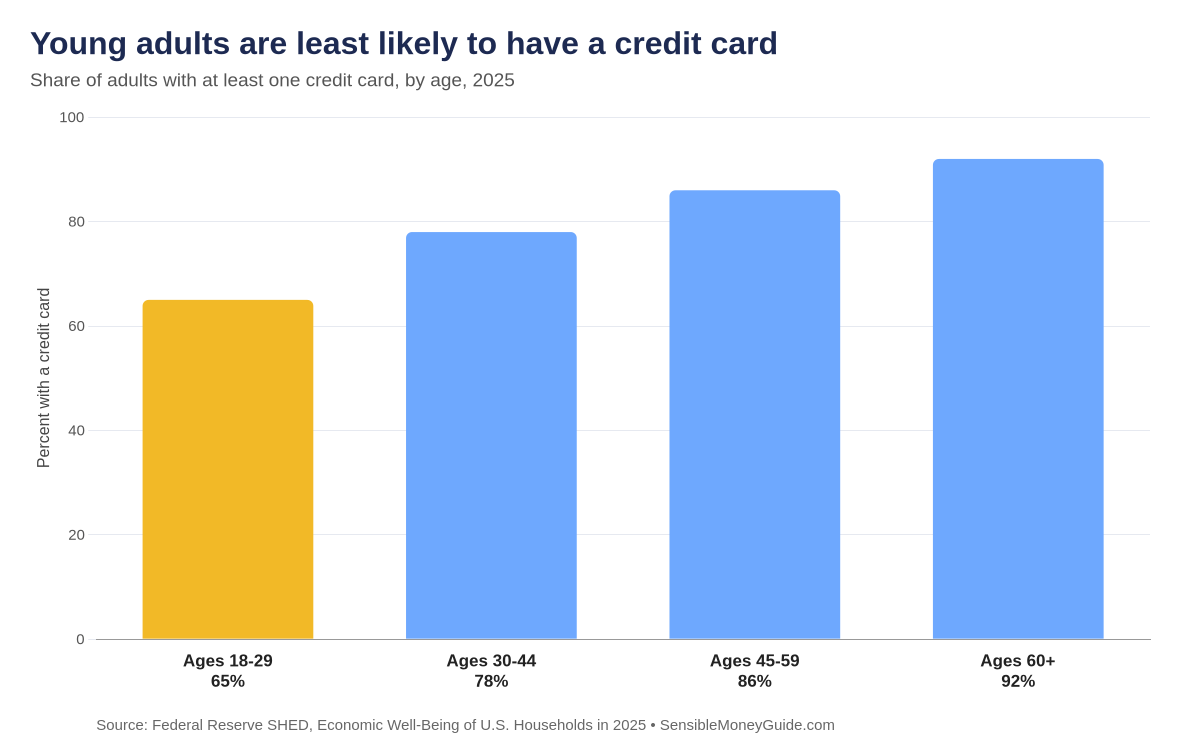
The Federal Reserve’s latest survey of household finances shows how much credit access changes with age. In its report on 2025, 82% of all adults had a credit card. But only 65% of adults ages 18 to 29 had one, compared with 92% of adults 60 and older.
The same survey found that 45% of cardholders carried a balance at least once in the past year. So a lot of people with cards are paying interest. Your goal is to be in the other group: the one that uses a card for history, not for borrowing.
Your first-year action plan
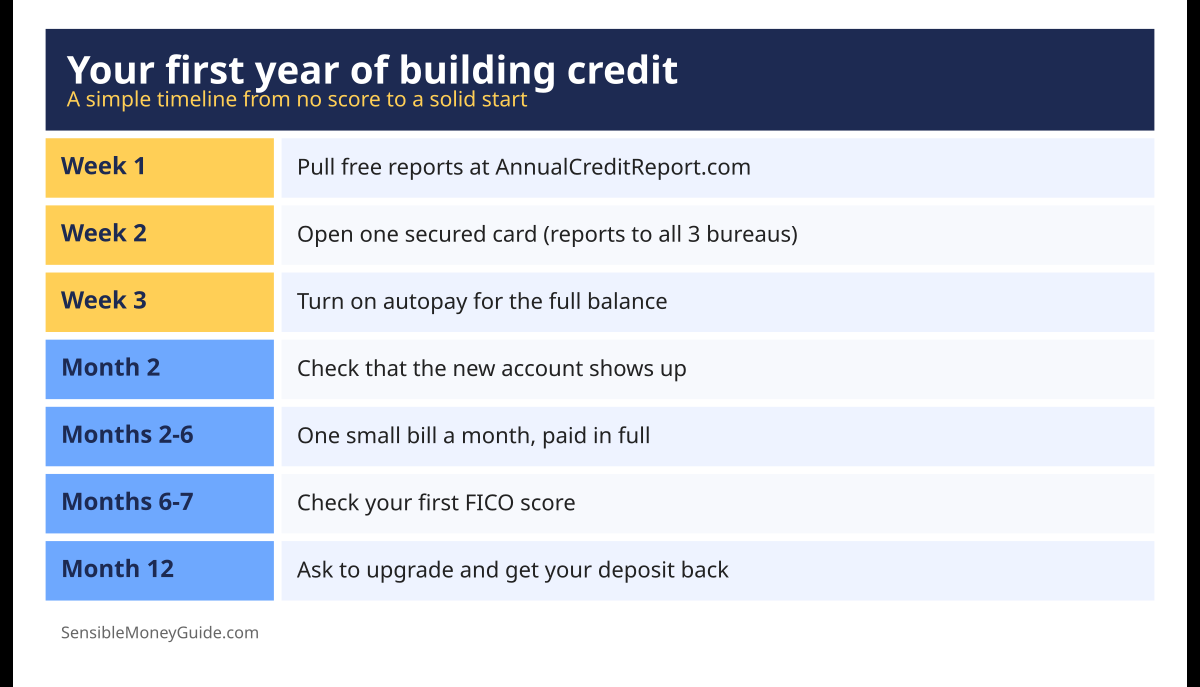
Here’s how to put all of this together. Follow these steps in order, and you’ll likely have a solid score within a year.
- Week 1: Check where you stand. Go to AnnualCreditReport.com and pull your reports from all three bureaus. You might already have a thin file from an old student loan or a phone account. If you find a file you didn’t know about, read it carefully.
- Week 1: Set a small monthly budget for your card. Pick one bill of about $20 to $50 that you’ll put on your card. If you don’t have a budget yet, our guide on how to make a budget that actually works can help.
- Week 2: Choose your first tool. For most people, that’s a secured card from your own bank or a credit union. Make sure it reports to all three bureaus and has a low or no annual fee.
- Week 2: Ask about being an authorized user. If a trusted family member has a long, clean credit history and low balances, ask if they’ll add you. Confirm their card company reports authorized users.
- Week 3: Set up autopay for the full balance. Do this the day your card arrives. Then add that one small bill to the card.
- Month 2: Check that your account is reporting. Pull your reports again. Your new account should appear at one or more bureaus.
- Month 2 to 6: Let it run. Pay in full every month. Don’t apply for anything else. Consider adding rent reporting if your landlord offers it for free.
- Month 6 to 7: Check your first score. Many banks and card companies show a free score in their app. By now, you’ll likely have a FICO score, too.
- Month 6 to 12: Consider a second account. If things are going well, you might add a credit-builder loan or a second card. Only do this if it fits your budget and you want to build faster.
- Month 12 and beyond: Ask to graduate. Call your bank and ask whether your secured card can become a regular card. Keep the account open, keep paying in full and keep checking your reports.
Pro tip: Put a reminder on your phone for the first of every month. Take two minutes to glance at your card balance and confirm autopay is still on. That tiny habit prevents almost every credit-building disaster.
Common mistakes to avoid
Most credit problems for beginners come from a handful of habits. Here’s what to watch for.
Carrying a balance “to build credit”
This is the most expensive myth out there. You don’t need to pay interest to build credit. Paying the full statement balance builds the same history and costs nothing.
Maxing out a small card
With a $300 or $500 limit, it’s easy to use most of it by accident. High utilization can drag your score down even if you pay on time. Keep the card for small, planned charges.
Applying for lots of cards at once
Every denial still leaves a hard inquiry behind. Applying for five cards in a week to “see what sticks” can hurt your score and still leave you without a card. Start with one card that’s built for people with no credit.
Closing your first card too soon
Once you get a shiny new card with rewards, it’s tempting to close your old secured card. If it has no annual fee, keep it. It’s your oldest account, and it helps your score more every year.
Picking a card that doesn’t report
Some prepaid cards and a few secured cards don’t report to all three bureaus. Others don’t report at all. Always confirm before you apply. If it doesn’t report, it won’t build credit.
Co-signing without a plan
Asking a parent or partner to co-sign, or co-signing for someone else, can work. But both people are fully on the hook. Talk openly about what happens if money gets tight, and set up autopay from day one.
Ignoring your credit reports
Errors happen, and so does identity theft. Checking your reports a few times a year takes minutes and costs nothing. Catching a problem early is far easier than fixing it later.

Paying for help you don’t need
You don’t need to pay for credit monitoring or credit repair to build credit from scratch. Free weekly reports, free scores in many banking apps and the dispute process are all available to you at no cost.
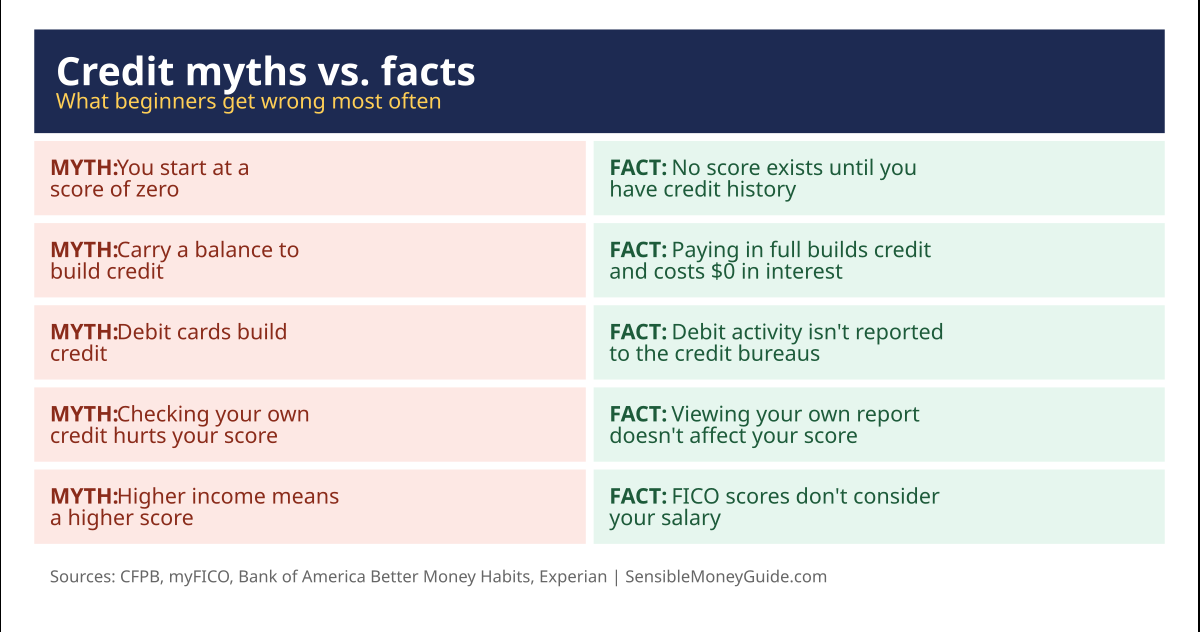
Credit-building myths
Credit is full of half-truths that get passed around. Here are some of the most common ones.
Myth: Everyone starts with a score of zero.
Fact: You don’t have a score at all until you have credit history. When your first score appears, it usually lands somewhere in the middle of the range.
Myth: You have to carry a balance to build credit.
Fact: You don’t. The CFPB says paying in full each month helps get you the best scores, and it saves you interest.
Myth: Using a debit card builds credit.
Fact: Debit card and cash activity isn’t reported to the credit bureaus, so it doesn’t help your score.
Myth: Checking your own credit hurts your score.
Fact: Checking your own reports or score is a soft inquiry and doesn’t affect your score.
Myth: A higher income means a higher credit score.
Fact: myFICO says FICO scores don’t consider your salary, job or employer. Lenders may ask about income when you apply, but the score itself is based on how you handle credit.
Myth: Paying a company to “repair” your credit is the fastest fix.
Fact: The FTC says no one can legally remove accurate, current negative information. Disputing real errors is free, and you can do it yourself.
Your credit-building cheat sheet
- Building credit means getting an account on your credit report and then filling it with on-time payments and low balances.
- Debit cards, cash and most bills don’t build credit on their own.
- FICO needs an account that’s at least six months old and recently reported. VantageScore can score you sooner.
- Payment history and amounts owed make up about two-thirds of a FICO score, and you control both.
- A secured card, a credit-builder loan or becoming an authorized user are the easiest ways to start.
- Pay your full statement balance every month on autopay. You never need to pay interest to build credit.
- Keep your reported balance at or below 30% of your limit, and lower is better.
- Check your free credit reports at AnnualCreditReport.com and dispute any errors.
Frequently asked questions
How long does it take to build credit from scratch?
You can often get a VantageScore within a month or two of opening your first account. A FICO score usually takes about six months, since FICO needs an account at least six months old. Building a strong score takes longer, often a year or more of steady, on-time payments.
What credit score do you start with?
There’s no starting score. You don’t have a score until you have enough credit history. When your first score shows up, it’s usually in the middle of the 300 to 850 range, not at the bottom.
Is it better to have no credit or bad credit?
No credit is usually easier to fix. With no credit, you just need to start building. With bad credit, negative marks like late payments can stay on your report for years. The FTC says most negative information stays for seven years, and bankruptcy can stay for 10.
Can I build credit without a credit card?
Yes. A credit-builder loan is the most common way. You can also become an authorized user on someone else’s card, add rent or utility payments through a reporting service, or take out a small loan with a co-signer. Student loans and car loans also count once you have them.
Does paying rent build credit?
Not by itself. Most landlords don’t report rent to the credit bureaus. You can ask your landlord whether they offer rent reporting, or use a rent reporting service. Keep in mind that some services charge fees and not every scoring model counts rent.
How much should I put on my first credit card?
Keep it small. Try to keep the balance on your statement at or below 30% of your limit. On a $500 card, that means $150 or less. One small monthly bill, paid in full on autopay, is all you need.
Can I get a credit card at 18?
Yes, but it’s harder before 21. Card companies generally can’t approve someone under 21 unless they show their own income or ability to pay, or they have a co-signer who is at least 21. Being an authorized user on a parent’s card is another common way to start.
Will a secured card hurt my credit?
Not if you use it well. Applying may cause a small, short-lived dip from the hard inquiry. After that, on-time payments and low balances help your score. A secured card only hurts if you pay late or run the balance close to the limit.
Do this first
Go to AnnualCreditReport.com and pull your free reports from all three bureaus. It takes about 15 minutes. Then, based on what you find, pick one starter tool from this guide. For most people, that’s a no-annual-fee secured card from the bank or credit union you already use. Apply for that one card, set up autopay for the full balance the day it arrives and put one small monthly bill on it.
That’s it. In about six months, you’ll have a credit score. In a year, you’ll have a credit history that opens doors. And if you’ve got other debts to sort out, our guide on how to pay off credit card debt can help you plan your next move.
About this guide
Written and reviewed by Daniel Brienza, founder and editor of Sensible Money Guide (B.S. in Business Administration, University of South Florida). Every rule, limit and number in this guide was checked against the primary sources listed below. Daniel is not a licensed financial advisor; this guide is for general education.
Reviewed October 23, 2026. This guide was reviewed before publication. We added a “pick your starting point” guide and comments from credit analysts at LendingTree and Experian.
Sources
- Consumer Financial Protection Bureau, “Technical correction and update to the CFPB’s credit invisibles estimate”, June 2025.
- Consumer Financial Protection Bureau, “How do I get and keep a good credit score?”, reviewed December 2024 (accessed October 2026).
- Consumer Financial Protection Bureau, “CFPB Study Shows Financial Product Could Help Consumers Build Credit”, July 2020.
- Consumer Financial Protection Bureau, “Can a credit card company consider my age when deciding to lend me a card?”, accessed October 2026.
- Federal Trade Commission, “You now have permanent access to free weekly credit reports”, updated October 2023.
- Federal Trade Commission, “Fixing Your Credit FAQs”, accessed October 2026.
- Federal Reserve Board, “Consumer Credit – G.19”, October 7, 2026.
- Federal Reserve Board, “Economic Well-Being of U.S. Households in 2025: Credit”, May 2026.
- myFICO, “What’s in my FICO Scores?”, accessed October 2026.
- myFICO, “What are the minimum requirements for a FICO Score?”, accessed October 2026.
- myFICO, “Do Credit Inquiries Lower Your FICO Score?”, accessed October 2026.
- Chase (JPMorgan Chase), “Authorized user vs. student credit card”, accessed October 2026.
- Bank of America Better Money Habits, “What is a secured credit card and how does it work?”, accessed October 2026.
- Experian, “What Credit Score Do You Start With?”, October 2025.
- Experian, “How Long Does It Take to Get a Credit Score?”, May 2022.
- Experian, “Do Companies Report a Late Payment if It’s Only a Few Days Late?”, accessed October 2026.
- NerdWallet, “How to Build Credit From Scratch at Any Age”, March 2026.
- Bankrate, “What Is A Secured Credit Card And How Does It Work?”, August 2025.
- CNBC Select, “What is a credit builder loan?”, updated February 2026.
- Ramsey Solutions, “Can You Buy a House With No Credit?”, updated February 2026.
- CNN (via KY3). Here’s why your credit score means more right now. January 21, 2026.
- WAFF 48 News. Credit expert encourages consumers to ‘know your numbers’ to take control of finances. February 10, 2024.
This article is for educational purposes only and isn’t financial advice. Consider talking with a qualified professional about your situation.


How to Build Credit From Scratch: Your First-Year Plan

How Does a 401(k) Work? Matching, Taxes and 2026 Limits

How Much Do You Need for a House Down Payment?

How to Lower Your Monthly Bills: Calls, Scripts and Savings

How Federal Income Taxes Work: Brackets, Deductions and Credits

How to Make a Budget That Actually Works, Step by Step

How Much Emergency Savings Do You Need? Find Your Number

How to Pay Off Credit Card Debt: Avalanche, Snowball and More

How Credit Scores Work: FICO Factors and Ways to Improve

You must be logged in to post a comment Login