Tax Planning
How Federal Income Taxes Work: A Complete Beginner’s Guide
Learn how federal income taxes work in 2026: brackets, deductions, credits, withholding and new tax breaks, explained in plain English with real examples.


Picture someone like Jordan, a hypothetical 29-year-old dental hygienist. Her boss just offered her a $4,000 raise. She’s thrilled for about ten seconds. Then a coworker leans over and says, “Careful. That raise could bump you into a higher tax bracket, and you’ll end up taking home less.”
Jordan smiles and nods. But that night she’s at the kitchen table with a calculator, wondering if she should turn the raise down.
She shouldn’t. Her coworker is repeating one of the most common money myths in America. Jordan will keep most of that raise. And once you see how federal income taxes really work, you’ll never worry about a raise again.
This guide walks you through the whole system in plain English. You’ll see how your paycheck turns into a tax bill, what brackets actually do, why a credit beats a deduction, and which new tax breaks started in 2025. Then you’ll get a simple plan you can use this week.
What you’ll learn
- How the IRS turns your total income into a tax bill, step by step
- Why moving into a higher tax bracket never shrinks your take-home pay
- The 2026 tax brackets and standard deduction amounts
- The difference between deductions and credits, and why it matters
- The new deductions for tips, overtime, car loan interest and seniors
- How to set your withholding so you don’t owe a surprise bill (or give the government a big interest-free loan)
- Simple, legal ways to lower what you owe
In this guide:
- What federal income tax is and where the money goes
- The road from your paycheck to your tax bill
- How tax brackets really work
- Deductions: standard vs. itemized
- Tax credits: the most powerful break
- New tax breaks for 2025 through 2028
- Payroll taxes: the other tax on your paycheck
- Withholding, refunds and estimated taxes
- Legal ways to lower your tax bill
- Your step-by-step action plan
- Common mistakes to avoid
- Myths vs. facts
- Key takeaways
- FAQ
- Sources
What federal income tax is and where the money goes
Federal income tax is the tax the U.S. government charges on the money you earn during the year. That includes your wages, plus things like tips, side-gig income, interest from a savings account and profits from selling investments.
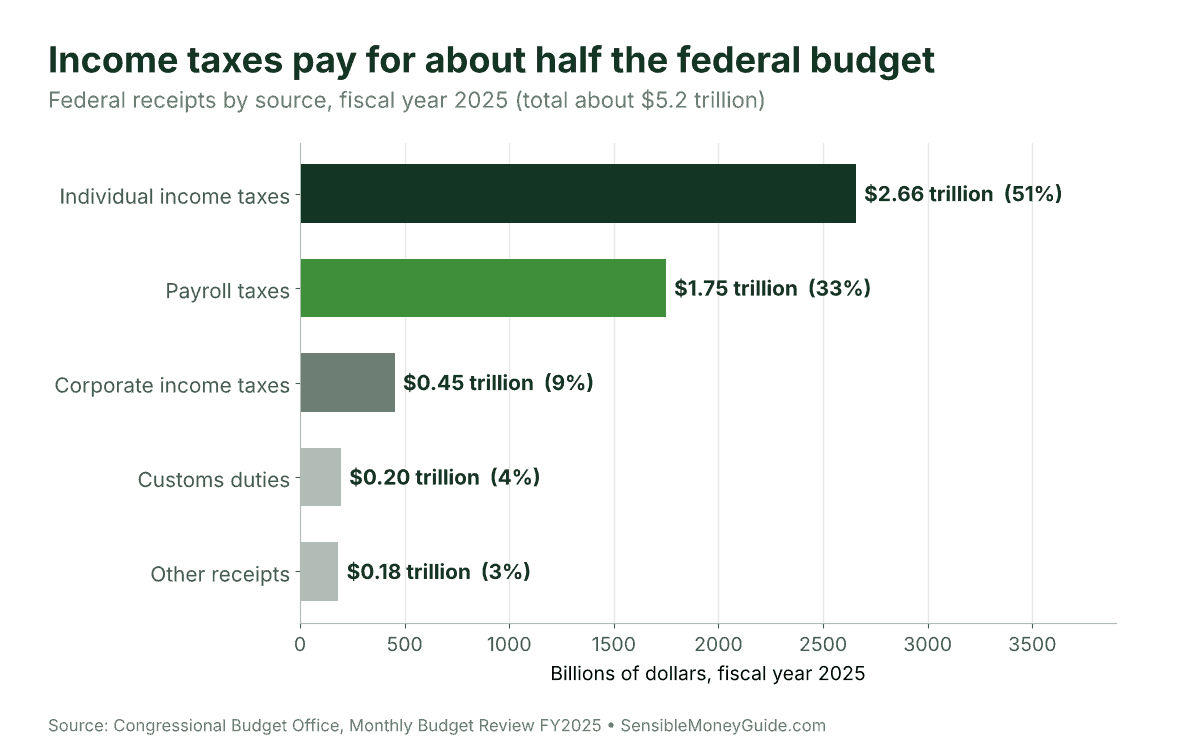
It’s the single biggest way the federal government pays its bills. In the 2025 fiscal year, which ran from October 2024 through September 2025, the government collected about $5.2 trillion. Individual income taxes brought in $2.66 trillion of that, or about half, according to the Congressional Budget Office.
The next biggest piece was payroll taxes, the Social Security and Medicare taxes taken from your check. Those brought in about a third. Corporate taxes, customs duties (including tariffs) and everything else made up the rest.
Even with all that money coming in, the government still spent more than it collected. The CBO reports a deficit of $1.8 trillion for that year. That’s a debate for another day. For your wallet, the point is simpler: income tax is a big deal, and it’s worth understanding.
The system is “pay as you go”
Here’s a part many people miss. You don’t just pay your taxes once a year in April. The IRS expects you to pay most of your tax during the year, as you earn the money. Its own guide puts it this way: you “pay most of your tax during the year, as you receive income” (IRS).
If you have a regular job, your employer handles that for you. They hold back some money from each paycheck and send it to the IRS. That’s called withholding. If you’re self-employed, you send in payments yourself every few months.
Your tax return, the one you file each spring, is really a settling-up form. It compares what you actually owe for the year with what you already paid. If you paid too much, you get a refund. If you paid too little, you owe the difference.
A lot of people owe no federal income tax at all
This surprises people. The Tax Policy Center, a joint project of the Urban Institute and the Brookings Institution, estimated that about 40% of U.S. households would owe no federal income tax for 2025. Most of them earn under $75,000. For many, the standard deduction and credits like the Earned Income Tax Credit and Child Tax Credit wipe out the bill.
That doesn’t mean they paid no tax. The same research notes that many of these households still pay a lot in payroll taxes. And everyone pays sales taxes, gas taxes and often state taxes. So “no income tax” isn’t the same as “no taxes.”

The road from your paycheck to your tax bill
The math on your tax return follows the same path every year. Once you see it, the whole form makes sense. Here’s the path in seven steps.
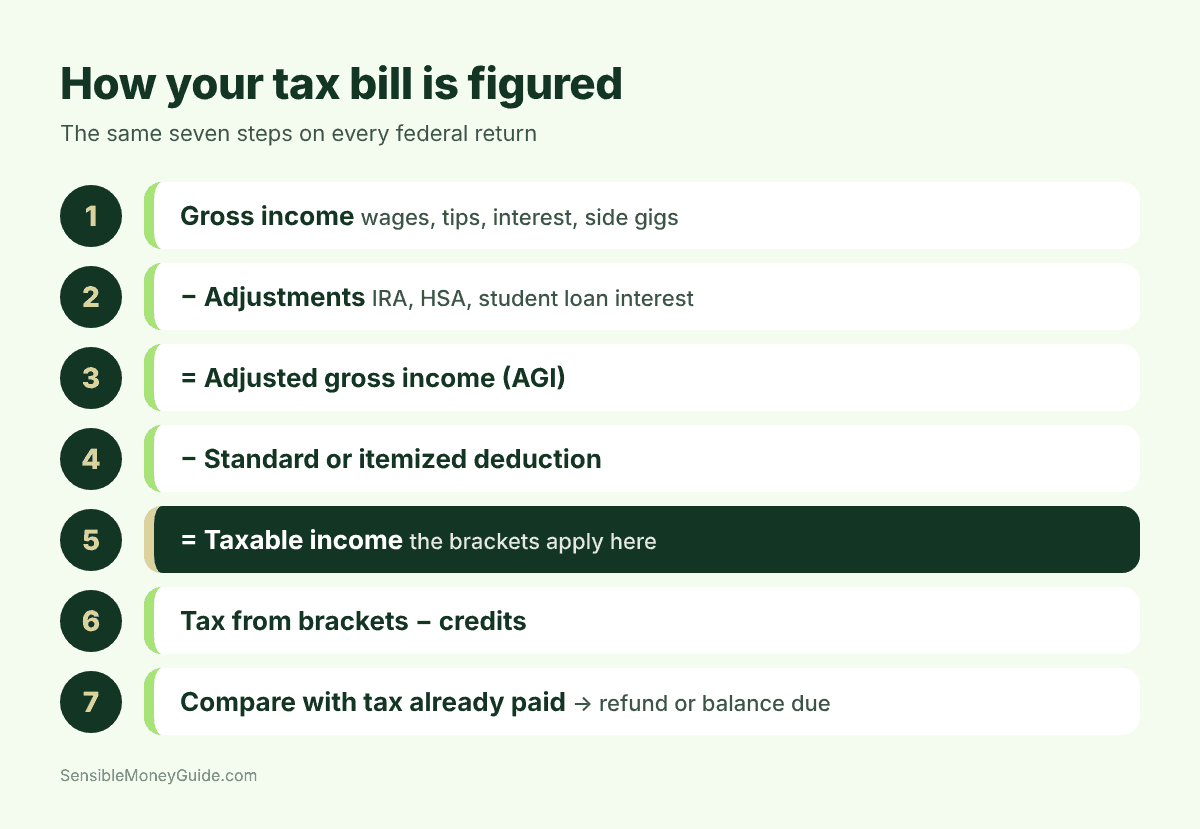
Step 1: Add up your gross income
Gross income means all the taxable money you received during the year, before anything is taken out. For most people, that’s the wages on their W-2 form. It also includes freelance pay, tips, interest, dividends, unemployment benefits and some retirement withdrawals.
Some money isn’t taxed at all. Gifts you receive, most life insurance payouts and child support, for example, generally don’t count as income on your federal return.
Step 2: Subtract “adjustments”
Adjustments are special subtractions you can take before anything else. Common ones include contributions to a traditional IRA, contributions to a health savings account (HSA), some student loan interest and half of the self-employment tax.
Money you put into a traditional 401(k) at work is usually taken out before your W-2 is even printed. So it’s already left out of the wages box. That’s one reason pre-tax retirement saving is such a strong tax tool.
Step 3: Arrive at your AGI
What’s left is your adjusted gross income, or AGI. This number matters more than most people realize. Many tax breaks shrink or vanish once your AGI (or a close cousin of it, called modified AGI) passes a certain level. Your AGI also decides whether you can use the IRS Free File program.
Step 4: Subtract your deduction
Next, you subtract either the standard deduction (a flat amount everyone in your filing status gets) or your itemized deductions (a list of specific expenses, such as mortgage interest and charitable gifts). You pick whichever is bigger. For 2026, the standard deduction is $16,100 for single filers and $32,200 for married couples filing jointly (IRS).
Starting with 2025 returns, there’s a new extra step here, too. Several new deductions, like the ones for tips and overtime, come off at this point whether or not you itemize. We’ll cover those below.
Step 5: Find your taxable income
What’s left after deductions is your taxable income. This is the number the tax brackets apply to. Not your salary. Not your gross income. Your taxable income.
That one fact clears up a lot of confusion. Someone earning $68,000 doesn’t pay tax on $68,000. After the standard deduction, a single filer would pay tax on $51,900.
Step 6: Figure the tax, then subtract credits
You run your taxable income through the brackets to get your tax. Then you subtract any tax credits you qualify for, like the Child Tax Credit. Credits come straight off the tax itself, so they’re worth more than deductions of the same size.
Step 7: Compare with what you already paid
Finally, you compare your total tax with what you’ve already paid through withholding or estimated payments. Paid more than you owe? You get a refund. Paid less? You owe the rest by the filing deadline, which is usually April 15.
Your filing status sets the rules
Before you can do any of this, you need your filing status. It’s the category that decides your brackets and your standard deduction. There are five:
- Single: You’re unmarried on the last day of the year and don’t qualify for another status.
- Married filing jointly: You and your spouse file one return together. This usually gives the lowest tax for couples.
- Married filing separately: Each spouse files alone. It sometimes helps in special cases, but you lose access to several credits.
- Head of household: You’re unmarried and pay more than half the cost of keeping up a home for a qualifying person, such as a child. You get wider brackets and a bigger standard deduction ($24,150 in 2026) than single filers.
- Qualifying surviving spouse: For the two tax years after the year your spouse died, if you haven’t remarried and have a dependent child, you can use the joint brackets. (For the year of death itself, you can usually still file jointly.)
Your status is based on where things stand on December 31. If you get married on New Year’s Eve, the IRS treats you as married for the whole year.
How tax brackets really work
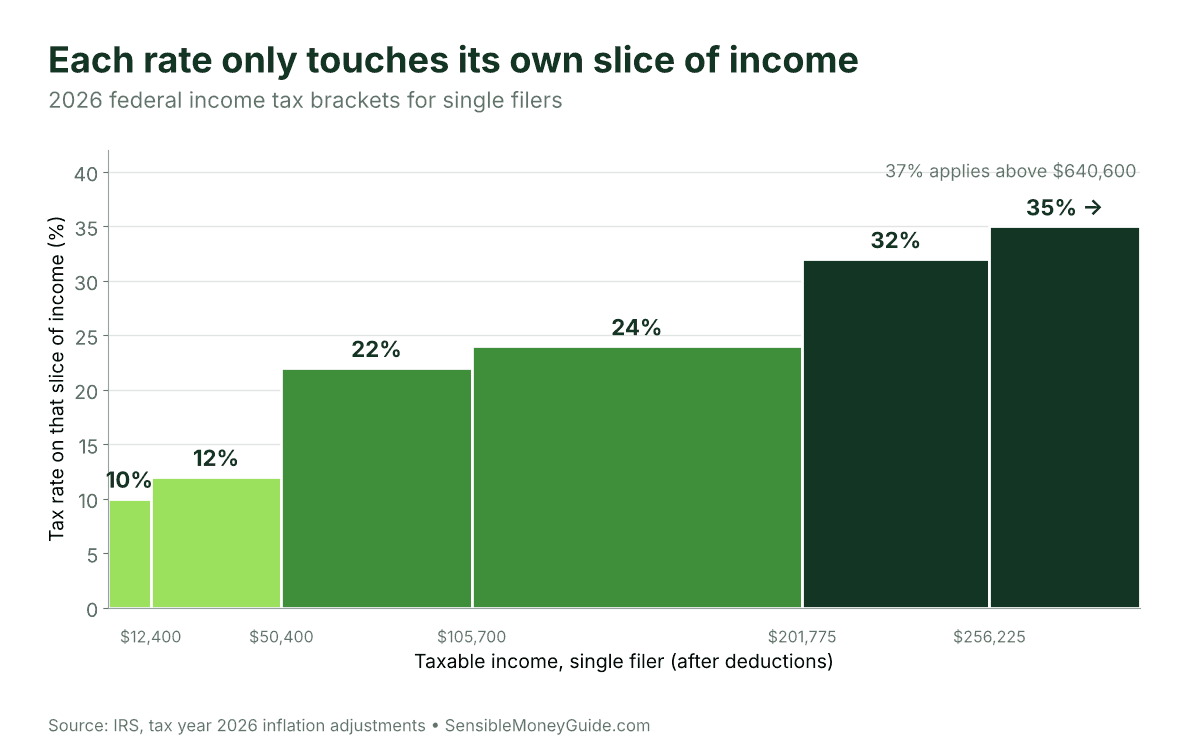
The U.S. has seven federal income tax rates: 10%, 12%, 22%, 24%, 32%, 35% and 37%. Each rate applies to a slice of income called a bracket. The IRS adjusts the dollar ranges every year for inflation, so a cost-of-living raise doesn’t push you into a higher bracket by itself.
Here’s the key idea. You don’t pay one rate on all your income. You pay the 10% rate on the first slice, 12% on the next slice, and so on. As Fidelity puts it, “You don’t pay the same tax rate on every dollar of income” (Fidelity).
Think of it like filling a row of buckets. The first bucket fills up, and anything extra spills into the next one. Each bucket has its own tax rate. Money that lands in the 22% bucket doesn’t change the rate on the money already sitting in the 10% and 12% buckets.
The 2026 federal tax brackets
These are the brackets for income you earn in 2026, which you’ll report on the return you file in early 2027. They come straight from the IRS’s 2026 inflation adjustments.
| Tax rate | Single: taxable income | Married filing jointly: taxable income |
|---|---|---|
| 10% | $0 to $12,400 | $0 to $24,800 |
| 12% | $12,401 to $50,400 | $24,801 to $100,800 |
| 22% | $50,401 to $105,700 | $100,801 to $211,400 |
| 24% | $105,701 to $201,775 | $211,401 to $403,550 |
| 32% | $201,776 to $256,225 | $403,551 to $512,450 |
| 35% | $256,226 to $640,600 | $512,451 to $768,700 |
| 37% | Over $640,600 | Over $768,700 |
Notice that most of the joint brackets are exactly double the single ones. That’s on purpose. It keeps most married couples from paying more tax just because they got married. The one exception is the start of the 37% bracket, which isn’t doubled, so some very high-earning couples can still face a small “marriage penalty.”
Worked example 1: Jordan’s tax bill
Let’s go back to Jordan. She’s single and earns $68,000 a year. She takes the standard deduction and has no other income.
- Gross income: $68,000
- Minus the 2026 standard deduction: $16,100
- Taxable income: $51,900
Now we fill the buckets:
- First $12,400 at 10% = $1,240
- Next $38,000 (from $12,400 up to $50,400) at 12% = $4,560
- Last $1,500 (from $50,400 up to $51,900) at 22% = $330
- Total federal income tax: $6,130
Only $1,500 of Jordan’s income is taxed at 22%. The rest is taxed at 10% or 12%. Her total tax is about 9% of her $68,000 salary.
Marginal rate vs. effective rate
Those two numbers have names, and they’re worth knowing.
- Marginal tax rate: the rate on your last, highest dollar of taxable income. Jordan’s is 22%. This is the rate that matters when you’re deciding about extra income or a new deduction.
- Effective tax rate: your total tax divided by your income. It’s your average rate. Jordan’s is about 9% of her total pay, or about 11.8% if you measure it against her taxable income only.
Different sources measure effective rate slightly differently. Fidelity divides by total income, while NerdWallet divides by taxable income. Either way, your effective rate is always lower than your top bracket. Charles Schwab gives an example of a single filer with $100,000 of taxable income in 2026. That person has a 22% marginal rate but an effective rate of about 16.7% (Schwab).
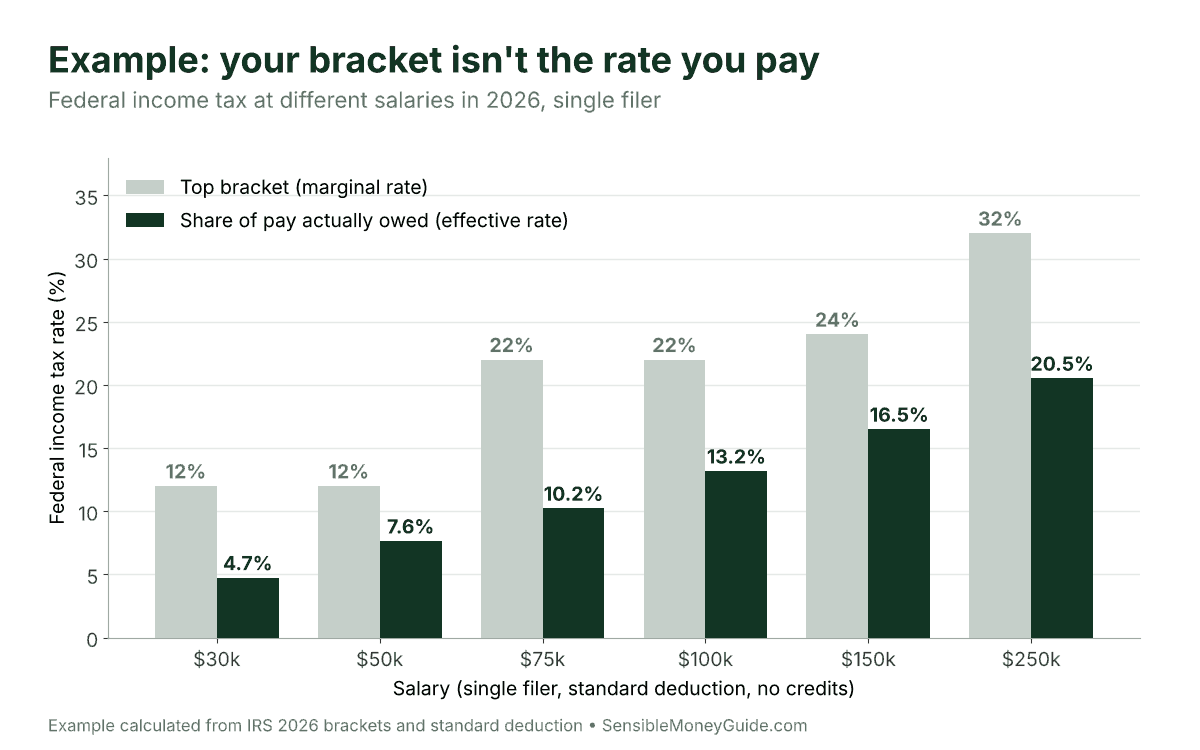
The chart above shows the same pattern at different salaries. A single person earning $100,000 in 2026 is in the 22% bracket, but their federal income tax works out to about 13% of their pay.
Worked example 2: What happens to Jordan’s raise
Jordan’s coworker said her raise could cost her money. Let’s test it with a $1,000 slice of the raise, since she’s already in the 22% bracket.
- Extra federal income tax: $1,000 × 22% = $220
- Extra Social Security and Medicare tax: $1,000 × 7.65% = $76.50
- Jordan keeps: $703.50 of every extra $1,000 (before any state tax)
On the full $4,000 raise, she keeps about $2,814 a year before state taxes. A raise can never lower your take-home pay through the bracket system, because the higher rate only touches the new dollars. The IRS says it plainly: moving up a bracket doesn’t raise the rate on all your income.
Watch out: There is one real exception to “more income is always better.” Some benefits and credits, like the Earned Income Tax Credit or health insurance subsidies, phase out as income rises. In rare cases, losing a benefit can eat up much of a small raise. That’s a benefit cliff, not a tax-bracket problem, and it’s worth checking if you’re near the edge of a program’s income limit.
If you’d like to see the bucket idea animated, this short video from PBS’s Two Cents series explains how tax brackets actually work in a few minutes.
Not all income uses these brackets
Wages, tips, interest and short-term investment gains all use the brackets above. But long-term capital gains (profits on investments you held more than a year) and qualified dividends (most dividends from U.S. stocks you’ve held a while) get their own lower rates: 0%, 15% or 20%, depending on your income (Schwab). That’s one reason patient, long-term investing in something like an index fund can be so tax-friendly.
Deductions: standard vs. itemized
A deduction lowers your taxable income. It doesn’t cut your tax dollar for dollar. Instead, it saves you money at your marginal rate. A $1,000 deduction saves about $220 for someone in the 22% bracket, and about $120 for someone in the 12% bracket (NerdWallet).
Every filer gets to choose: take the standard deduction, or add up your itemized deductions. You use whichever is bigger.
The standard deduction for 2026
| Filing status | 2025 standard deduction | 2026 standard deduction |
|---|---|---|
| Single or married filing separately | $15,750 | $16,100 |
| Married filing jointly | $31,500 | $32,200 |
| Head of household | $23,625 | $24,150 |
Source: IRS.
If you’re 65 or older, or blind, you get an extra amount on top. For 2026 that’s $2,050 if you’re single or head of household, and $1,650 per qualifying spouse if you’re married, according to Kiplinger. Seniors also get a separate new $6,000 deduction, which we’ll cover in a minute.
When itemizing makes sense
Itemized deductions are specific expenses the tax code lets you subtract. The big ones are:
- Mortgage interest on your home
- State and local taxes (often called SALT), such as property taxes and state income tax. The cap on this deduction jumped to $40,400 for 2026, Kiplinger reports.
- Gifts to charity
- Medical bills above 7.5% of your AGI
For most people, the standard deduction wins easily. Kiplinger, citing the IRS, says nearly 90% of filers take it. Itemizing usually only pays off if you have a large mortgage, high state and local taxes, or big charitable gifts.

New for 2026: a charity deduction for non-itemizers
Starting with 2026 returns, people who take the standard deduction can also deduct up to $1,000 in cash gifts to qualified public charities, or $2,000 for married couples filing jointly (Kiplinger). “Cash” includes checks, card payments and payroll giving. Gifts to donor-advised funds don’t count.
There’s a flip side for itemizers. Starting in 2026, only the part of your charitable giving above 0.5% of your AGI counts. With a $100,000 AGI, the first $500 of gifts wouldn’t be deductible.
Pro tip: Keep every donation receipt in one folder or phone album this year, even if you don’t itemize. With the new $1,000 or $2,000 deduction, small gifts you used to ignore can now lower your tax.
Tax credits: the most powerful break
A tax credit cuts your tax bill directly, dollar for dollar. Charles Schwab describes credits as reducing your tax liability “directly, dollar for dollar” (Schwab). A deduction only shrinks the income your tax is figured on.
That makes a big difference. Here’s the same $1,000 used two ways, for someone in the 22% bracket:
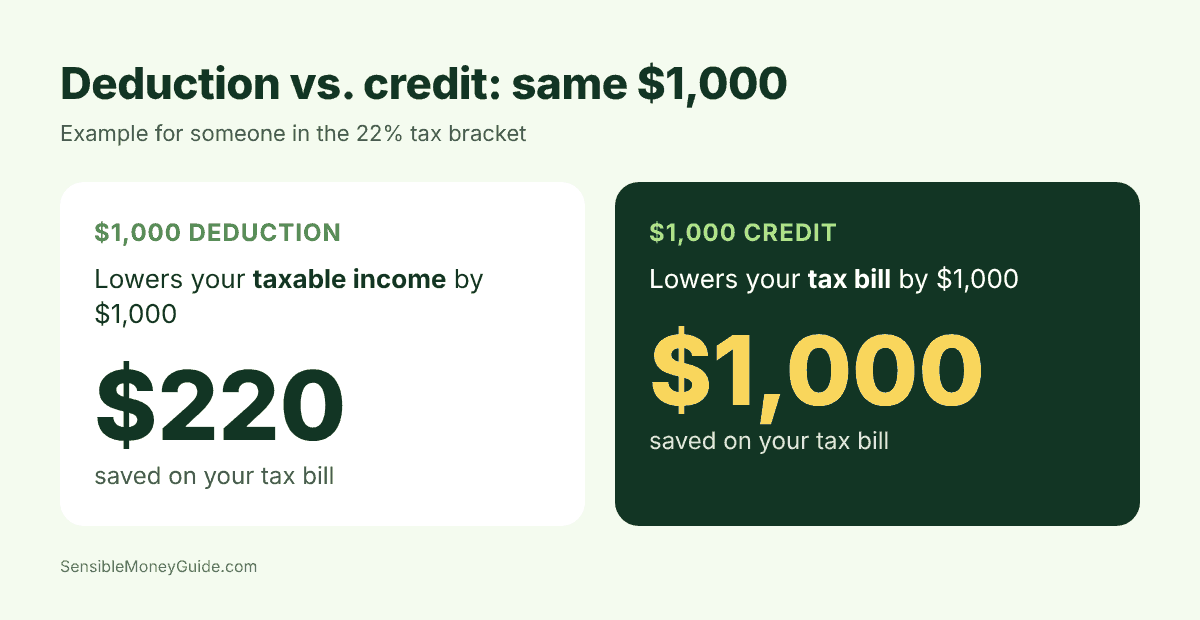
- A $1,000 deduction lowers taxable income by $1,000, which saves $220.
- A $1,000 credit lowers the tax bill by $1,000, which saves $1,000.
So when you hear about a new tax break, the first question to ask is simple. Is it a deduction or a credit?
Refundable vs. nonrefundable credits
Credits come in two flavors.
- Nonrefundable credits can bring your tax down to zero, but no lower. If the credit is bigger than your tax, the extra is lost. The Lifetime Learning Credit and the Saver’s Credit work this way.
- Refundable credits can go below zero. If the credit is bigger than your tax, the IRS sends you the difference as part of your refund. The Earned Income Tax Credit is the best-known example.
Schwab gives a clear example. Say you owe $300 and qualify for a $500 credit. If the credit is nonrefundable, your tax drops to zero and the other $200 disappears. If it’s refundable, your tax drops to zero and you get the $200 back.
The Child Tax Credit
This is the credit most families care about. For both 2025 and 2026, it’s worth up to $2,200 per qualifying child, according to the IRS and its 2026 inflation guidance. Here’s how it works:
- The child must be under 17 at the end of the year.
- You, your spouse if filing jointly, and the child need Social Security numbers that are valid for work.
- The full credit is available if your income is $200,000 or less, or $400,000 or less for joint filers. Above that, it shrinks.
- Up to $1,700 per child is refundable. To get any refundable amount, you need more than $2,500 of earned income, and the refundable part grows as your earnings rise.
Worked example 3: A family of four
Picture a hypothetical married couple, Sam and Priya. They earn $110,000 combined, file jointly and have two kids, ages 6 and 9.
- Gross income: $110,000
- Minus the 2026 joint standard deduction: $32,200
- Taxable income: $77,800
- Tax: 10% of the first $24,800 ($2,480) plus 12% of the next $53,000 ($6,360) = $8,840
- Minus the Child Tax Credit: 2 × $2,200 = $4,400
- Final federal income tax: $4,440
That’s about 4% of their income. The credit cut their bill in half. A deduction of the same $4,400 would have saved them only $528 at their 12% rate.
Other credits worth knowing
- Earned Income Tax Credit (EITC): a refundable credit for low- and moderate-income workers. For 2026, the maximum is $8,231 for families with three or more qualifying children (IRS). Workers without children can qualify for a smaller amount.
- Child and Dependent Care Credit: helps cover daycare or after-school care costs so you can work.
- American Opportunity Tax Credit: for the first four years of college. Part of it is refundable.
- Saver’s Credit: a credit for lower-income workers who put money into a retirement account.
The EITC in particular goes unclaimed by many people who qualify. If your household income is modest, it’s worth checking every year, especially after a change in work or family size.
New tax breaks for 2025 through 2028
The big tax law passed in July 2025, often called the One Big Beautiful Bill Act, added four new deductions for workers and seniors. The IRS now calls these the Working Families Tax Cuts. They run from the 2025 tax year through 2028, so they apply to the return you’ll file in 2027 for this year.
The best part: you can take all four whether you itemize or take the standard deduction (IRS). If you’re married, you have to file jointly to claim them.
| Deduction | Yearly maximum | Starts phasing out above (modified AGI) | Key rule |
|---|---|---|---|
| Qualified tips | $25,000 | $150,000 ($300,000 joint) | Must be in a job where tips are customary |
| Qualified overtime | $12,500 ($25,000 joint) | $150,000 ($300,000 joint) | Covers the extra “half” of time-and-a-half pay |
| Car loan interest | $10,000 | $100,000 ($200,000 joint) | New personal-use vehicle, loan taken out after 2024 |
| Seniors 65+ | $6,000 per person | $75,000 ($150,000 joint) | Must be 65 by the end of the year |
Source: IRS.
“No tax on tips” and “no tax on overtime,” explained
The names sound bigger than the rules. These are deductions, not full exemptions. Your tips and overtime still show up as income. You then subtract the qualifying amount, up to the cap. And they only reduce federal income tax. You still pay Social Security and Medicare tax on that money, and your state may tax it too.
For overtime, the deduction only covers the premium part of your pay. If you normally earn $20 an hour and get $30 an hour for overtime, only the extra $10 an hour counts.
Here’s what that can be worth. A single server in the 12% bracket who receives $8,000 in tips could deduct all of it and save about $960 in federal income tax. If some of those tips push into the 22% bracket, the savings are even bigger.
The car loan interest deduction
Did you buy a new car for personal use with a loan taken out after December 31, 2024? Then you may be able to deduct up to $10,000 of the interest each year. Leases don’t count. Used cars don’t count. And you’ll need the car’s VIN on your return. The IRS adds that the vehicle’s final assembly must be in the United States, so check before you count on this one.
The new senior deduction
If you’re 65 or older by the end of the year, you can deduct an extra $6,000. A married couple who are both 65 or older can deduct $12,000. This is on top of the existing extra standard deduction for seniors. It starts phasing out at $75,000 of modified AGI for single filers and $150,000 for joint filers.

Put it together for a hypothetical retired couple, both 66, filing jointly. Their standard deduction is $32,200, plus $1,650 each for being over 65, plus $6,000 each from the new senior deduction. That’s $47,500 they can earn before owing any federal income tax at all, assuming their income is low enough to get the full senior deduction. (How much of their Social Security counts as income is a separate calculation.)
Payroll taxes: the other tax on your paycheck
Look at your pay stub, and you’ll usually see more than one federal tax. Besides income tax withholding, there’s Social Security and Medicare tax. Together, these are often called FICA or payroll taxes.
For 2026, here’s how they work, according to the Social Security Administration:
- Social Security tax: 6.2% of your wages, up to $184,500 of earnings. Above that, no more Social Security tax for the year.
- Medicare tax: 1.45% of all your wages, with no cap.
- Additional Medicare tax: an extra 0.9% on wages above $200,000 ($250,000 for married couples filing jointly).
- Your employer pays a matching 7.65% on your behalf (but doesn’t match the extra 0.9%).
- Self-employed people pay both halves, for a total of 15.3%. They get to deduct half of it as an adjustment.
Unlike income tax, payroll tax starts with your very first dollar. There’s no standard deduction, and there are no brackets below the cap. That’s why the Tax Policy Center points out that many households who owe no income tax still pay quite a bit in payroll taxes.
For Jordan, at $68,000, payroll tax is about $5,202 a year. That’s close to her $6,130 income tax bill. For a lot of workers, payroll taxes are just as big as income taxes, or bigger.
Withholding, refunds and estimated taxes
Remember that taxes are pay as you go. For most workers, that means withholding. When you start a job, you fill out a Form W-4. It tells your employer how much federal income tax to hold back from each paycheck, based on your filing status, other jobs, dependents and deductions.
The W-4 is not a one-time form. You can hand your employer a new one any time. And you should, after big life changes like a marriage, a new baby, a second job or a house purchase. The IRS suggests checking your withholding once a year with its free Tax Withholding Estimator and again after any of those changes (IRS).
What a refund really means
A refund isn’t a gift or a bonus. It’s your own money coming back because too much was withheld during the year. The IRS generally doesn’t pay you interest while it holds it.
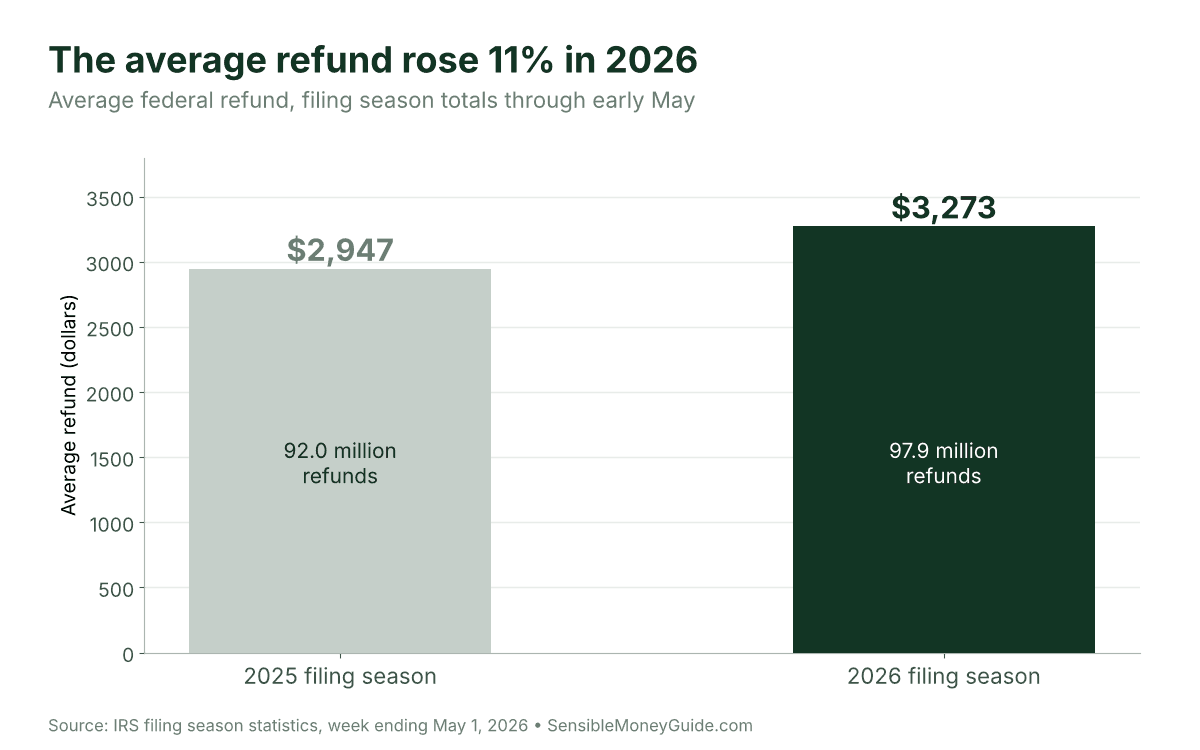
Refunds are common, and they got bigger this year. By the start of May 2026, the IRS had sent about 97.9 million refunds, with an average of $3,273. That’s up 11.1% from $2,947 at the same point in 2025 (IRS filing season statistics). The new deductions, which first applied to 2025 returns, may explain part of that jump.
Is a big refund good or bad? Experts disagree
Ramsey Solutions takes a firm stance: “Getting a big tax refund isn’t a reason to celebrate” (Ramsey Solutions). Their view is that the ideal is to owe nothing and get nothing back, so your money works for you all year instead.
The math backs that up. A $3,273 refund works out to about $126 per paycheck if you’re paid every two weeks. That money could have gone toward a credit card balance or into a high-yield savings account.
Still, many people like getting a refund. For them, it works as forced savings, a once-a-year lump sum that pays for a car repair or builds an emergency fund. If you know you’d spend that extra $126 every two weeks without noticing, a modest refund might serve you better. The middle ground most planners suggest: aim for a small refund, a few hundred dollars, so you’re not surprised by a bill but you’re not lending the government thousands.
Estimated taxes, for side gigs and the self-employed
If no employer is withholding for you, you’re expected to pay as you go yourself. That’s done with quarterly estimated tax payments. Freelancers, gig workers, landlords and people with big investment gains often need to make them.
The payments for 2026 income are due around these dates (IRS):
- April 15, for income earned January through March
- June 15, for April and May
- September 15, for June through August
- January 15 of the next year, for September through December
If a date lands on a weekend or holiday, it moves to the next business day.
How to avoid the underpayment penalty
If you don’t pay enough during the year, the IRS can charge a penalty, which works like interest on the shortfall. According to IRS Topic 306, you generally avoid it if either of these is true:
- You owe less than $1,000 after subtracting your withholding and refundable credits.
- You paid at least 90% of this year’s tax, or 100% of last year’s tax, whichever is smaller.
Higher earners face a slightly stricter version of the last-year rule, so check Form 1040-ES if your AGI is above $150,000.
Pro tip: If you have a side gig and a regular job, you can skip quarterly payments by asking your employer to withhold a bit more. Step 4(c) of the W-4 lets you add a flat extra amount to every paycheck. Withholding counts as if it was paid evenly through the year, even if you add it in December.

Legal ways to lower your tax bill
You can’t control tax rates. But you have more control over your taxable income than you might think. Here are the moves that matter most for everyday people.
Save for retirement with pre-tax money
Money you put into a traditional 401(k), 403(b) or similar workplace plan comes out of your paycheck before income tax. For 2026, you can put in up to $24,500, plus an extra $8,000 if you’re 50 or older. People ages 60 to 63 can add $11,250 instead of $8,000 (IRS).
Here’s what that looks like for Jordan.
Worked example 4: Jordan saves an extra $5,000
Say Jordan bumps her 401(k) contributions by $5,000 this year. Her taxable income drops from $51,900 to $46,900.
- The first $1,500 she removes was taxed at 22%: saves $330
- The next $3,500 was taxed at 12%: saves $420
- Total federal income tax savings: $750
So putting $5,000 into retirement only costs her about $4,250 in take-home pay. (She still pays Social Security and Medicare tax on 401(k) money.) If her employer offers a match, the deal gets even better.
Use IRAs and HSAs
You can also put up to $7,500 into an IRA for 2026, or $8,600 if you’re 50 or older. A traditional IRA may give you a deduction now, depending on your income and if you have a workplace plan. A Roth IRA gives you no deduction now, but qualified withdrawals in retirement are tax-free (Vanguard). Vanguard notes that having both types can give you flexibility, since nobody knows what future tax rates will be. Our guide to Roth vs. traditional IRAs walks through that choice in detail.
If you have a high-deductible health plan, a health savings account (HSA) is one of the best tax deals around. Contributions are deductible, growth is untaxed, and withdrawals for medical costs are tax-free.
Claim everything you’re entitled to
Lots of people overpay because they miss breaks they qualify for. Each year, ask:
- Did I earn tips or overtime? (New deduction.)
- Did I buy a new car with a loan? (New deduction.)
- Am I 65 or older? (Extra standard deduction plus the new $6,000 deduction.)
- Did I pay for child care, college or student loan interest?
- Did I give cash to charity? (New for 2026, even if you don’t itemize.)
- Does my income qualify me for the EITC or the Saver’s Credit?
Think about timing
Because brackets are annual, the year you get income or pay a deductible expense can matter. If you’re close to the top of a bracket, a December 401(k) boost or bunching two years of charitable gifts into one year can tip the scales. If you sell investments, holding them for more than a year usually gets you the lower long-term capital gains rates.
Your step-by-step action plan
Here’s a plan you can start this week and finish before the 2027 filing season. It’s October, so there’s still time to make changes that count for 2026.
- Find last year’s return. Look at your AGI, taxable income, total tax and refund or balance due. That’s your starting point.
- Grab your most recent pay stub. Note how much federal income tax has been withheld so far this year.
- Run the IRS Tax Withholding Estimator. Have your pay stub and last year’s return in hand. It’ll show if you’re on track for a refund or a bill.
- Update your W-4 if needed. If the estimator says you’ll owe, or you’re headed for a huge refund, give your employer a new W-4 now. With about five paychecks left in 2026 for many workers, small changes add up.
- List any new deductions you qualify for. Tips, overtime, car loan interest, the senior deduction and the new charity deduction. Start a folder for the records you’ll need.
- Consider a year-end retirement boost. If your budget allows, raise your 401(k) contribution for your last few paychecks of the year.
- Self-employed? Plan your January 15 payment. Set aside money now for the fourth-quarter estimated payment.
- Pick how you’ll file. In the 2026 filing season, IRS Free File offered free guided tax software to filers with an AGI of $89,000 or less. The IRS usually announces the next season’s limit early in the year. Free File Fillable Forms have no income limit. The IRS’s VITA and TCE programs offer free in-person help from IRS-certified volunteers. Note that the IRS’s own Direct File tool was not offered in the 2026 filing season, and no return date has been set (Nextgov).
- File electronically and choose direct deposit. It’s the fastest, most accurate way to get a refund.
Want to fit taxes into a bigger plan for your money? Our guide on how to make a budget that actually works shows how to plan for a tax bill or put a refund to work.
Common mistakes to avoid
- Setting your W-4 and forgetting it. A marriage, a second job or a new child can throw your withholding off by thousands of dollars.
- Confusing deductions with credits. A $1,000 credit is worth far more than a $1,000 deduction. Don’t trade a credit away to chase a deduction.
- Turning down extra income to “stay in a lower bracket.” You’ll almost always keep most of every extra dollar.
- Forgetting side-gig income. Money from freelance work, ride-share driving or selling things for a profit is taxable, whether or not you get a 1099 form.
- Not saving for taxes on self-employment income. Many planners suggest setting aside 25% to 30% of side-gig profit. Remember that the 15.3% self-employment tax applies on top of income tax.
- Itemizing out of habit. With higher standard deductions, many people who used to itemize now come out ahead with the standard deduction. Compare both every year.
- Missing the new deductions. Tips, overtime, car loan interest and the senior deduction aren’t automatic. You have to claim them on your return.
- Paying for tax prep you don’t need. If your return is simple, free options may do the job.
- Filing late when you owe. If you can’t pay in full, file on time anyway. The penalty for not filing is usually much bigger than the penalty for not paying.
Myths vs. facts
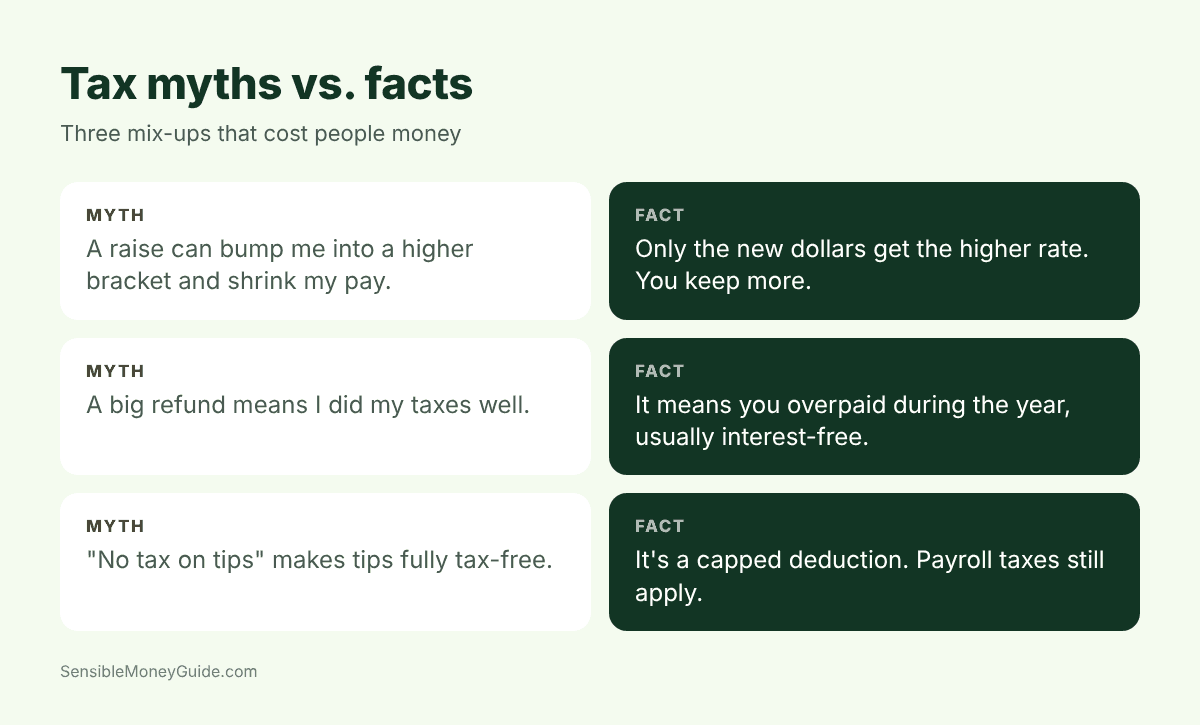
Myth: A raise can push me into a higher bracket and shrink my paycheck.
Fact: Only the dollars above the bracket line get the higher rate. Your take-home pay goes up with every raise.
Myth: A big refund means I’m good at taxes.
Fact: A big refund means you overpaid during the year. Good planning usually means a small refund or a small bill.
Myth: “No tax on tips” means tips are totally tax-free.
Fact: It’s a deduction with a $25,000 cap and income limits. Tips are still subject to Social Security and Medicare tax, and possibly state tax.
Myth: If I file an extension, I get more time to pay.
Fact: An extension gives you more time to file, not to pay. Interest and penalties start on any tax not paid by the April deadline.
Myth: Only rich people need to think about taxes.
Fact: Lower- and middle-income families often have the most to gain, through credits like the EITC and the Child Tax Credit that can put thousands of dollars back in their pockets.
Myth: My effective tax rate equals my bracket.
Fact: Your effective rate is your average, and it’s almost always well below your top bracket. Jordan is in the 22% bracket but pays about 9% of her pay in federal income tax.
Key takeaways
- Your tax is based on taxable income, which is your income minus adjustments and deductions. It’s not based on your salary.
- Tax brackets work like buckets. Each rate only applies to the slice of income inside that bracket, so a raise always leaves you with more money.
- For 2026, the standard deduction is $16,100 for single filers and $32,200 for joint filers, and nearly 90% of filers use it.
- Credits beat deductions. A $1,000 credit cuts your tax by $1,000, while a $1,000 deduction saves you only your marginal rate.
- New deductions for tips, overtime, car loan interest and seniors run from 2025 through 2028, and you can take them without itemizing.
- Payroll taxes (7.65% for most workers) are a separate tax, and for many people they’re as big as income tax.
- A refund is your own money coming back. Check your withholding once a year so you’re not surprised either way.
- Pre-tax retirement savings is one of the simplest ways to lower your bill and build wealth at the same time.
FAQ
What tax bracket am I in?
Subtract your deductions from your income to get your taxable income, then find that number in the bracket table for your filing status. For 2026, a single filer with $40,000 of taxable income is in the 12% bracket, and one with $80,000 is in the 22% bracket. Remember, that’s your marginal rate, not the rate on all your income.
Do I have to file a tax return?
It depends on your income, age and filing status. In general, if your gross income is more than your standard deduction, you need to file. Self-employed people usually must file if they earned $400 or more. Even if you don’t have to file, you should if taxes were withheld or you qualify for refundable credits, since that’s the only way to get that money back.
What’s the difference between a tax deduction and a tax credit?
A deduction lowers the income your tax is figured on. A credit lowers the tax itself, dollar for dollar. At a 22% rate, a $1,000 deduction saves $220, while a $1,000 credit saves $1,000.
Why do I owe taxes this year when I usually get a refund?
The most common reasons are a second job, side-gig income, a change in filing status, losing a credit (often because a child turned 17), or an old W-4 that no longer fits your situation. Run the IRS Tax Withholding Estimator and update your W-4 so it doesn’t happen again.
How long does it take to get a tax refund?
The IRS says it “issues most refunds in less than 21 days” (IRS). Filing electronically and choosing direct deposit is the fastest route. Returns that leave out bank details, or that claim credits like the Additional Child Tax Credit, can take longer. You can track yours with the IRS “Where’s My Refund?” tool about 24 hours after you e-file.
Are tips and overtime really tax-free now?
Not completely. From 2025 through 2028, you can deduct up to $25,000 of qualified tips and up to $12,500 of qualified overtime pay ($25,000 for joint filers), with phase-outs above $150,000 of income ($300,000 joint). You still pay Social Security and Medicare tax on that money, and state rules vary.
When are taxes due?
For most people, the deadline to file and pay is April 15 of the following year. So your 2026 return is due in April 2027. If you need more time to file, you can request an extension, but any tax you owe is still due in April.
Can I file my taxes for free?
Often, yes. In the 2026 filing season, IRS Free File offered free guided software from partner companies to filers with an AGI of $89,000 or less. The limit for 2027 hadn’t been announced as of this writing. Anyone can use Free File Fillable Forms, and free in-person help is available through the IRS’s VITA and TCE programs for people who qualify.
Your next step this week
Set aside 20 minutes, grab your latest pay stub and last year’s tax return, and run the IRS Tax Withholding Estimator. If it shows you’ll owe more than a few hundred dollars, or get back a refund much bigger than you’d like, give your employer an updated W-4 before your next paycheck. That one small step can save you from an April surprise and put more of your money in your hands right now.
Sources
- Internal Revenue Service. IRS releases tax inflation adjustments for tax year 2026, including amendments from the One, Big, Beautiful Bill. October 9, 2025.
- Internal Revenue Service. Federal income tax rates and brackets. Accessed October 2026.
- Internal Revenue Service. Working Families Tax Cuts – Individuals and workers. Accessed October 2026.
- Internal Revenue Service. Revenue Procedure 2025-32 (2026 inflation adjustments). October 2025.
- Internal Revenue Service. Working Families Tax Cuts: Tax deductions for working Americans and seniors. Accessed October 2026.
- Internal Revenue Service. Child Tax Credit. Accessed October 2026.
- Internal Revenue Service. 2026 Filing season statistics, week ending May 1, 2026. May 2026.
- Internal Revenue Service. Taxpayers should check their withholding now to prepare for next year and Tax Withholding Estimator. Accessed October 2026.
- Internal Revenue Service. Pay as you go, so you won’t owe and Topic no. 306, Penalty for underpayment of estimated tax. Accessed October 2026.
- Internal Revenue Service. Free options and resources for preparing and filing taxes in 2026. Accessed October 2026.
- Internal Revenue Service. 401(k) limit increases to $24,500 for 2026, IRA limit increases to $7,500. November 13, 2025.
- Social Security Administration. 2026 Cost-of-Living Adjustment (COLA) Fact Sheet. Accessed October 2026.
- Congressional Budget Office. Monthly Budget Review: Summary for Fiscal Year 2025. November 2025.
- Fidelity Investments. 2025 and 2026 tax brackets and federal income tax rates. March 2, 2026.
- Charles Schwab. What Are Tax Brackets, and How Do They Work? April 13, 2026.
- Charles Schwab. What Is a Tax Credit? November 11, 2025.
- Vanguard. Managing your accounts to lower taxes. Accessed October 2026.
- NerdWallet. How Federal Tax Brackets and Rates Work. Updated July 7, 2026.
- Kiplinger. Standard Deduction 2026: How Much You Can Claim and Whether You Should Itemize. Updated May 30, 2026.
- Kiplinger. 2026 Tax Law: 3 Big Ways Your Charitable Donation Tax Deduction Has Changed. Updated February 21, 2026.
- Ramsey Solutions. What You May Be Missing by Getting a Large Refund. Updated July 7, 2026.
- Tax Policy Center (Urban Institute and Brookings Institution). Who Will Pay No Federal Individual Income Tax in 2025? June 4, 2025.
- Nextgov/FCW. Direct File won’t happen in 2026, IRS tells states. November 4, 2025.
- Internal Revenue Service. Tax return filed: Here are ways to check the status of a tax refund. Tax Tip 2026-33, April 21, 2026.
This article is for educational purposes only and isn’t financial advice. Consider talking with a qualified professional about your situation.



How Federal Income Taxes Work: A Complete Beginner’s Guide

Roth vs. Traditional IRA: How to Choose the Right One

Index Funds Explained: A Complete Beginner’s Guide

How to Pay Off Credit Card Debt: The Complete Guide

How Credit Scores Really Work: A Complete Guide

How to Make a Budget That Actually Works: A Complete Guide

Emergency Fund Guide: How Much You Need and Where to Keep It
How Credit Scores Really Work: A Complete Guide
How to Pay Off Credit Card Debt: The Complete Guide
Index Funds Explained: A Complete Beginner’s Guide
-
 Budgeting6 days ago
How to Make a Budget That Actually Works: A Complete Guide
-
 Saving Strategies5 days ago
Emergency Fund Guide: How Much You Need and Where to Keep It
-
 Credit Management4 days ago
How Credit Scores Really Work: A Complete Guide
-
 Debt Management3 days ago
How to Pay Off Credit Card Debt: The Complete Guide
-
 Investing Basics2 days ago
Index Funds Explained: A Complete Beginner’s Guide
-
 Retirement Planning1 day ago
Roth vs. Traditional IRA: How to Choose the Right One
You must be logged in to post a comment Login