

Debt Management
Debt Consolidation in 2026: Loans, Transfers and Pitfalls
Debt consolidation can cut your interest, but only if the math and your habits line up. Compare loans, 0% transfers and debt management plans for 2026.

The myth: debt consolidation gets you out of debt. It doesn’t. It takes the debts you already have and rolls them into one new loan or card. You still owe every dollar. What can change is the interest rate, the monthly payment and the date you finish.
The truth: consolidation is a tool, and it works best for one kind of person. That’s someone who qualifies for a clearly lower rate, has stopped adding new debt and will keep paying hard until it’s gone. For everyone else, it can make things worse. This guide shows you how to tell which group you’re in, and what to do in each case.
This guide in four numbers
| Number | What it means for you |
|---|---|
| 22.15% | The average interest rate on credit card accounts that were charged interest, second quarter of 2026 (Federal Reserve) |
| 11.86% | The average bank rate on a 24-month personal loan in the same period. That gap is the whole reason consolidation can save money. |
| 3% to 5% | The usual balance transfer fee. On $12,000, that’s $360 to $600 up front. |
| $4,934 | Interest and fees saved in our main example below, by moving $12,000 of card debt to a 0% transfer card instead of paying the cards as-is (both at $400 a month) |
Rates come from the Federal Reserve’s G.19 consumer credit release of September 8, 2026. The savings figure comes from a hypothetical example, worked out step by step later in this guide. Your own numbers will depend on your credit and the offers you get.
What’s in this guide
- What debt consolidation is, and what it isn’t
- The two-part test: will consolidation help you?
- Five ways to consolidate, side by side
- Debt consolidation loans
- Balance transfer credit cards
- Borrowing against your home or your 401(k)
- Credit counseling and debt management plans
- Debt settlement is not consolidation
- What consolidation does to your credit score
- One $12,000 debt, five different paths
- Where the experts disagree
- Your step-by-step plan, with a worksheet
- The short version
- Questions people ask
- Your first move
- Sources
What debt consolidation is, and what it isn’t
Debt consolidation means using one new debt to pay off several old ones. Say you have three credit cards with balances. You take out one loan, use it to pay all three cards down to zero, and from then on you make a single payment to the new lender.
That’s the whole idea. One bill instead of three, ideally at a lower interest rate. The interest rate is the yearly price of borrowing, usually shown as an APR (annual percentage rate). A lower APR means more of each payment goes to the debt itself instead of to interest.
Here’s what consolidation can do for you:
- Lower your interest rate, if you qualify for a better rate than you pay now.
- Give you a fixed end date. A personal loan has a set number of payments. Credit cards don’t, which is why balances can drag on for years.
- Simplify your bills, which makes it harder to miss a payment.
- Possibly help your credit score over time, by lowering how much of your card limits you’re using.
And here’s what it can’t do:
- It can’t shrink what you owe. As Wells Fargo puts it, you’re not eliminating your debt, you’re restructuring it.
- It can’t fix the reason the debt piled up. The Consumer Financial Protection Bureau (CFPB) warns that if you’re spending more than you earn, a consolidation loan may not help unless you also cut spending or raise your income.
- It can’t promise you’ll save money. Fees, a longer payoff term or a rate that jumps later can wipe out the savings.
Three terms that get mixed up
People use “debt relief” for almost anything, and some companies blur the lines on purpose. Keep these three straight:
| Term | What happens to your debt | Who you deal with |
|---|---|---|
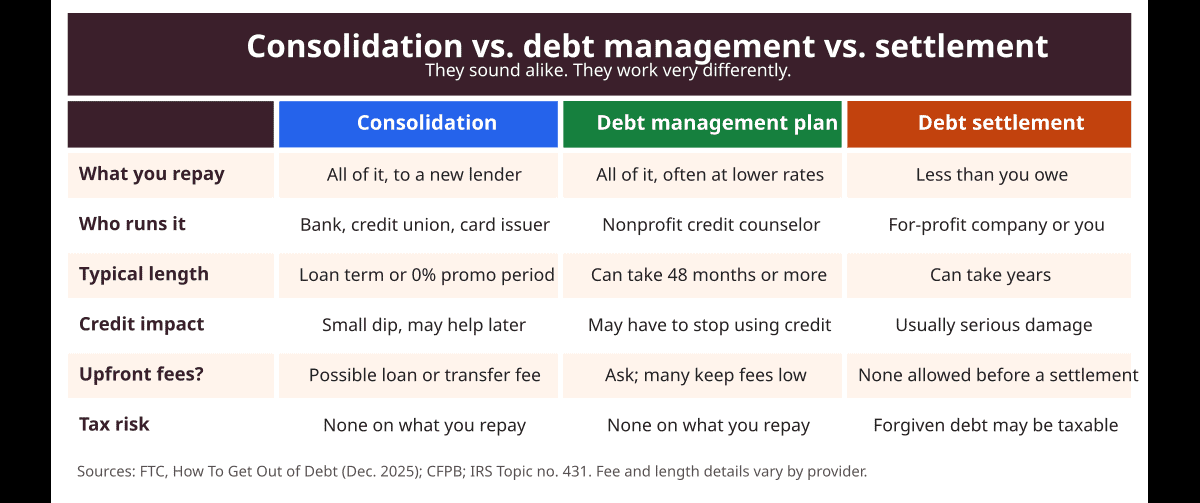
| Debt consolidation | Paid off with a new loan or card. You repay 100% to the new lender. | A bank, credit union, online lender or card issuer |
| Debt management plan | Repaid in full through a payment schedule, often at lower interest rates your creditors agree to | A nonprofit credit counseling agency |
| Debt settlement | Creditors agree to accept less than you owe. Your credit usually takes a big hit, and forgiven debt may be taxed. | A for-profit settlement company, or you on your own |
The CFPB’s consolidation page has a warning worth remembering: some companies that advertise “consolidation” are really debt settlement companies. They may charge fees up front, tell you to stop paying your debts and have you move money into a special account. We’ll come back to that in the settlement section.

What this guide doesn’t cover
Federal student loans have their own government consolidation program with its own rules, and those rules don’t work like a bank loan. This guide focuses on credit cards and other consumer debt, which is where most consolidation decisions happen. If you have federal student loans, check your options with your loan servicer before moving them into any private loan, because private loans don’t carry federal repayment protections.
The two-part test: will consolidation help you?
Before you look at a single offer, run this test. Consolidation tends to help only when you can answer “yes” to both parts.
Part 1: Is the new rate clearly lower, after fees?
This part is math. Credit cards are expensive. In the second quarter of 2026, the average rate on credit card accounts that were actually charged interest was 22.15%, according to the Federal Reserve. The average bank rate on a 24-month personal loan was 11.86%.
That gap has been there for years. The chart below shows it.
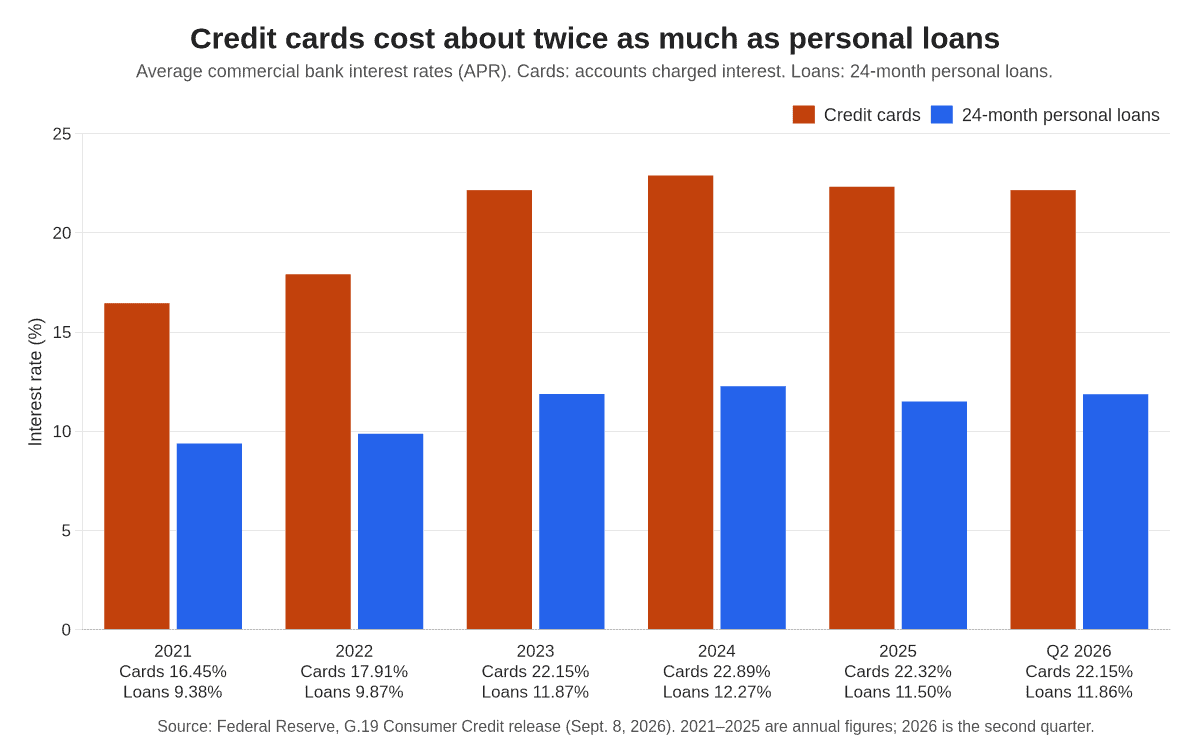
A quick note on what those numbers mean. The Fed’s card figure is the interest people actually paid, divided by their average balances, for accounts that carried a balance. The personal loan figure is an average of the most common rate each bank charged. Neither is the rate you will be offered. That depends mostly on your credit score and income.
A separate survey shows a similar picture. Bankrate, which surveys rates at the 10 largest banks and thrifts in the 10 largest U.S. markets, put the average personal loan APR at 12.55% as of October 21, 2026, for a borrower with a 700 FICO score taking a $5,000, three-year loan. Bankrate says borrowers with excellent credit (740 and up) may see rates near 6%, while people with poor credit (under 580) can face rates as high as 36%.
So if your cards charge around 22% and you qualify for 12%, part 1 passes easily. If your credit has slipped and the best loan you can get is 28%, consolidation with a loan won’t save you anything. You’d be better off with one of the other paths in this guide.
“For millions of American households, credit card debt represents their highest-cost debt by a wide margin.”
Ted Rossman, Senior Industry Analyst at Bankrate, in Bankrate’s 2026 Credit Card Debt Report
Part 2: Have you stopped the leak?
This part is behavior, and it’s harder. After you pay off your cards with a loan, those cards sit there with zero balances and full limits. If spending keeps outrunning income, the balances creep back. Then you have the new loan and new card debt.
The Federal Reserve Bank of New York reported that Americans owed $1.26 trillion on credit cards in the second quarter of 2026, up $21 billion from the quarter before. Debt that large usually builds a little at a time. It doesn’t vanish in one move, either.
Ask yourself three honest questions:
- Over the last three months, has my card debt gone down, stayed flat or gone up?
- Do I know where my money goes each month? (If not, a simple budget is step one.)
- Do I have some cash set aside, so the next car repair doesn’t go on a card? Even a small starter emergency fund helps.
If your balances are still rising, fix that first. Consolidating while the leak is still running is like mopping the floor with the faucet on.
Not sure where you stand? This short video from PBS’s Two Cents walks through whether consolidating makes sense, including the downsides.
The fastest “no” answers
Skip consolidation, at least for now, if any of these are true:
- Your total debt is small enough to pay off quickly from your budget. As a rough rule of thumb, if that’s within about a year, fees may cost more than the interest you’d save.
- The only offers you get have rates near or above what you pay now.
- The lower payment you’re after only comes from stretching the loan out for many more years.
- You can’t afford the new payment without skipping other bills.
- Your debts are so large compared with your income that you couldn’t realistically repay them even at 0%. In that case, talk to a nonprofit credit counselor (covered below) before you sign anything.
Five ways to consolidate, side by side
There are five common ways to roll debts together. They differ a lot in cost, risk and who qualifies. Here’s the quick comparison before we go through each one.
| Option | Typical cost | Who it fits | Biggest risk |
|---|---|---|---|
| Debt consolidation loan (a personal loan) | APR based on your credit, plus a possible origination fee | Fair to excellent credit, steady income | A long term that costs more overall |
| Balance transfer card | 0% intro APR for a set time, plus a 3% to 5% transfer fee | Good to excellent credit, able to pay it off in the promo period | The rate jumps when the promo ends |
| Home equity loan or line of credit | Lower rates, closing costs | Homeowners with equity | Your home secures the debt |
| 401(k) loan | Interest paid back into your own account | People with a plan that allows loans and a very stable job | Lost growth, and fast repayment if you leave your job |
| Debt management plan | Small monthly fee in many cases, with lower rates from creditors | People who can’t qualify for a good loan or card | You may have to stop using credit during the plan |
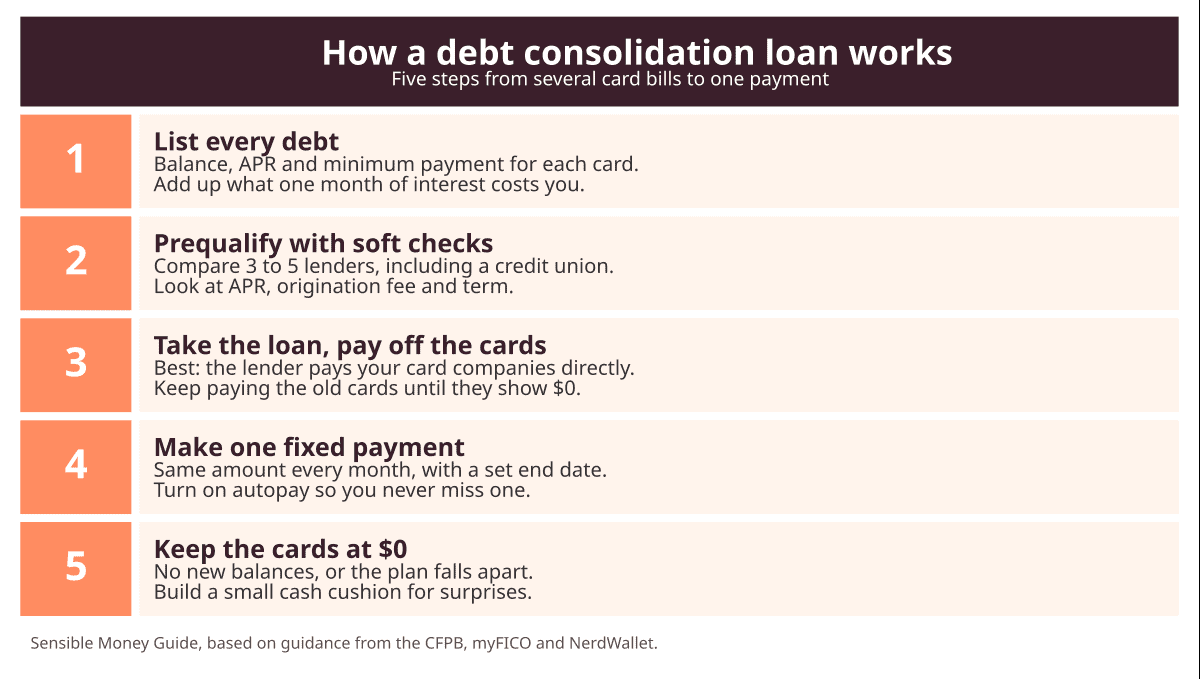
The first two are the most common. They’re also the ones most people mean when they say “consolidation,” so we’ll start there.
Debt consolidation loans
A debt consolidation loan is usually just a personal loan you use to pay off other debts. Banks, credit unions and online lenders offer them. Most are unsecured, meaning you don’t put up a house or car as collateral. You get a fixed rate, a fixed monthly payment and a set number of months to pay it off, often two to five years.
Some lenders will even send the money straight to your card companies. That’s a good feature. It removes the temptation to spend the cash.
The costs to check
- The APR. This is the number to compare, because it includes most fees. Wells Fargo makes a fair point here: there’s no guarantee a personal loan will beat the rates on the debt you already have.
- The origination fee. Some lenders charge a one-time fee taken out of the loan amount. According to Bankrate, it can run as high as 12% of the loan. Some lenders charge none, and Bankrate notes that credit unions typically don’t.
- The term. A longer loan means a smaller payment but more total interest. The CFPB flags this exact trap: a lower monthly payment often means a longer term, which can cost more overall.
- Teaser rates. The CFPB also notes that some low advertised rates are temporary. Read what happens after the first months.
Watch out: an origination fee is usually taken out of the money you receive. If you need $12,000 to pay off your cards and the fee is 5%, a $12,000 loan only puts $11,400 in your hands. You’d need to borrow about $12,632 to end up with $12,000.
Worked example 1: the same loan, two lengths
Here’s a hypothetical example. Teo is a school bus mechanic with $12,000 spread across three credit cards. He’s paying about $400 a month in total. He’s offered a personal loan at 12% APR with a 5% origination fee. To clear all $12,000, he borrows $12,632.
| 3-year loan | 5-year loan | |
|---|---|---|
| Amount borrowed (including 5% fee, rounded) | $12,632 | $12,632 |
| Monthly payment | $419.55 | $280.98 |
| Total paid | $15,104 | $16,859 |
| Cost above the $12,000 he owed (interest plus fee) | $3,104 | $4,859 |
The five-year loan feels easier: about $139 less each month. But it costs Teo $1,755 more and keeps him in debt two extra years. If he can manage the three-year payment, which is close to the $400 he already pays, it’s the better deal.
Compare both with doing nothing. Say Teo keeps paying $400 a month on his cards at their current rates (24.99%, 22.49% and 27.99%), highest rate first. It takes him 46 months and costs $6,326 in interest. The three-year loan cuts that cost roughly in half and finishes ten months sooner.
How to shop for a loan without hurting your score much
Many lenders let you prequalify, which shows you a likely rate using a soft credit check. According to myFICO, soft inquiries don’t affect your FICO scores. A full application triggers a hard inquiry, which for most people takes less than five points off. Prequalify with three to five lenders, including a local credit union, then formally apply only for the best offer.
Pro tip: credit unions can have some of the friendliest rates and fees for members. If you already belong to one, start there.
Balance transfer credit cards
A balance transfer card lets you move debt from other cards onto a new card, usually at a 0% intro APR for a set number of months. During that window, every dollar you pay goes toward the balance. None of it goes to interest.
“A 0% balance transfer credit card is about the best consolidation offer you can get.”
Matt Schulz, chief credit analyst at LendingTree, to ABC News
In the same interview, Schulz added a caution: “It requires some discipline.” A new card with a fresh limit can tempt you to spend. Think of a 0% offer as a deadline, not a gift.
How balance transfers work
- There’s a fee. NerdWallet calls 3% to 5% of the amount moved standard. The CFPB notes that the fee is usually a percentage or a flat amount, whichever is greater.
- The promo ends. When the intro period is over, whatever’s left starts charging the card’s regular rate. Several cards NerdWallet listed as of November 2025 offered 0% for 18 to 21 months (or billing cycles), but offers change, so check current terms.
- You can’t move debt within the same bank. NerdWallet notes you can’t transfer balances between cards from the same issuer.
- It takes time. A transfer can take two weeks or longer. Keep paying the old card until it shows a zero balance.
- The limit may be lower than you hoped. If the new card’s limit is $7,000 and you owe $12,000, you can only move part of it.
Two rules the fine print hides
The CFPB points out two traps. First, if you use the transfer card for new purchases, you may lose the grace period. That means you could pay interest on those purchases until the whole balance, including the transferred part, is paid off. The easy fix: don’t buy anything with that card.
Second, if you’re more than 60 days late on a payment, the card company can raise the rate on all your balances, including the transferred one. One badly missed payment can end your 0% deal. Set up autopay for at least the minimum the day you open the card.

Worked example 2: Teo’s balance transfer
Now say Teo qualifies for a card with 0% for 18 months and a 4% transfer fee, and the full $12,000 fits under his limit. The fee adds $480, so his new balance is $12,480.
- To clear it in 18 months, he needs to pay $693.33 a month. Total cost: just the $480 fee.
- If he keeps paying $400 a month, he’ll have $5,280 left when the promo ends. At a regular rate of 23.99%, that takes 16 more months and $912 in interest. Total cost: $1,392 over 34 months.
Even the slower path beats paying the cards as-is ($6,326) and beats the three-year loan ($3,104). But the faster path is the real win. Divide your transferred balance (fee included) by the number of 0% months. That’s your monthly target.
Is the fee worth it?
Here’s a quick way to check. Take your balance and multiply by your current rate, then divide by 12. That’s roughly one month of interest. At the Fed’s 22.15% average, $12,000 costs about $221.50 a month in interest. A 4% fee is $480, a bit more than two months of interest. With 18 months at 0%, the fee pays for itself many times over. A 5% fee on a short promo you can’t pay off in time is a closer call.
Borrowing against your home or your 401(k)
These two options often come with lower rates than a personal loan. That’s because something valuable backs them: your house or your retirement savings. That’s also exactly why they’re riskier. You’re turning debt that can’t take your house into debt that can, or borrowing from your future self.
Home equity loans and lines of credit
Your home equity is what your home is worth minus what you owe on it. A home equity loan gives you a lump sum with a fixed payment. A home equity line of credit (HELOC) works more like a credit card with a limit, usually with a variable rate.
The CFPB lists the risks plainly:
- If you can’t repay, you could face foreclosure and lose your home.
- Closing costs can run from hundreds to thousands of dollars.
- If your home’s value drops, you could owe more than it’s worth, which makes it harder to sell or refinance.
- Using your equity now leaves less of it for emergencies or home repairs later.
The Federal Trade Commission (FTC) gives the same warning. Some of these loans require you to put up your home as collateral. If you don’t pay, you could lose your home.
One more myth to clear up: the interest is not tax-deductible when you use it to pay off cards. IRS Publication 936 covers 2025 tax returns. It says interest on a loan secured by your home isn’t deductible to the extent the money wasn’t used to buy, build or substantially improve the home. Paying off credit cards doesn’t count.
Watch out: the biggest danger with home equity is what happens next. If you clear your cards with your house and then run the cards back up, you now have card debt and a bigger lien on your home. Only consider this path if you’ve already fixed the spending problem and have a solid emergency fund.
401(k) loans
Many workplace plans let you borrow from your own 401(k). The rules come from the IRS, and your plan can be stricter. According to the IRS:
- You can generally borrow up to half of your vested balance, with a cap of $50,000. (A plan may allow up to $10,000 even if half your balance is less, but it doesn’t have to.)
- You generally must repay within five years, with payments at least every three months. (The five-year limit doesn’t apply if you use the loan to buy your main home.)
- If you miss the required payments, the rest of the loan can be treated as a withdrawal. It becomes taxable income and may also face a 10% early withdrawal tax.
- If you leave your job, your plan may require you to repay the full balance. Whatever you don’t repay is treated as a distribution. You can avoid the tax by putting that amount into an IRA or other eligible plan by your tax return due date, including extensions, for that year.
The interest goes back into your own account, which sounds like a great deal. Fidelity explains the catch: while the money is out of your 401(k), it isn’t invested, so it misses any market gains. Your take-home pay also drops while you repay. And if you lose or leave your job, many plans want the loan repaid quickly, Fidelity says often within 30, 60 or 90 days.
That last point matters most. People who are deep in card debt often have the least job security cushion. A layoff could turn a 401(k) loan into a tax bill at the worst possible time.
When either one might make sense
These aren’t always wrong. A homeowner with lots of equity, a steady job, a clear budget and a fixed-rate home equity loan may save a lot of interest. Someone with a very secure job and a small, short 401(k) loan may come out fine. But try the unsecured options first. If you can’t qualify for a decent personal loan or transfer card, that’s often a sign to talk with a credit counselor, not to put your house on the line.
Credit counseling and debt management plans
If your credit has taken hits and loan offers come back at high rates, a debt management plan (DMP) may be the best “consolidation” you can get. You don’t borrow anything. Instead, a nonprofit credit counseling agency works out lower rates with your card companies, and you make one monthly payment to the agency, which pays your creditors.
Here’s how the FTC describes it:
- A counselor builds a payment schedule with you and your creditors.
- You deposit money each month with the counseling organization, which pays your creditors.
- Your creditors may agree to lower your interest rates or waive certain fees.
- A plan can take 48 months or more to finish.
- You might have to agree not to apply for or use any more credit until the plan is done.
That last rule sounds strict. For many people, it’s the point. It closes the leak while the debt gets paid.

What a good first session looks like
A legitimate counselor starts by looking at your whole budget, not by selling you a plan. The FTC says a good credit counselor will spend time with you, and that reputable organizations should give you free information before you share details about your situation.
“That initial counseling session helps you better understand your financial capacity and where things stand with your debt.”
Bruce McClary, senior vice president of communications at the National Foundation for Credit Counseling, to Money
Fees vary. The FTC notes that many counseling organizations keep fees low, but some charge high fees they may not mention, so ask how much you’ll pay before you enroll. The FTC’s March 2026 consumer alert also points to low-cost counseling through credit unions, universities, community colleges and, for service members, military personal financial managers.
Questions to ask any counseling agency
- Are you a nonprofit, and are your counselors certified?
- What will I pay to set up the plan, and what will I pay each month?
- Which of my creditors usually agree to your plans, and what rates do they offer?
- Will you send me a written plan and regular statements showing each creditor was paid?
- What happens if I miss a payment to you?
Debt settlement is not consolidation
This is where many people get burned. Some ads say “consolidate your debt” when the company actually does debt settlement. In settlement, a company tries to get your creditors to accept less than you owe. It usually tells you to stop paying your cards and save money in a special account until there’s enough to offer a lump sum.
While you wait, the missed payments pile up on your credit report, and late fees and interest keep growing. The FTC calls these programs risky. It says that if a program doesn’t work out, you could wind up owing even more money in late fees and interest. It also says the process can take years.
“Your score is going to almost certainly be in the subprime range.”
Rod Griffin, senior director of consumer education and advocacy at Experian, on credit scores after settling debts through a debt relief program, to Money
The rules that protect you
- No fees before results. The FTC says a debt settlement company can’t collect its fees from you before it settles your debt. Its 2026 alert puts it bluntly: only scammers will tell you to pay them upfront before they settle any of your debts.
- No guarantees. The FTC says anyone who guarantees to settle all your debts or get you fast loan forgiveness is a scammer.
- Ignore cold calls and texts offering fast settlement. Report scams at ReportFraud.ftc.gov.
Worked example 3: the tax bill nobody mentions
Forgiven debt can count as income. The IRS says canceled debt is generally taxable, and the creditor may send you a Form 1099-C. There are exceptions, including debts canceled in bankruptcy and debt canceled while you’re insolvent, but only up to the amount by which your total debts were more than the value of your total assets right before the cancellation. You claim these exclusions on IRS Form 982.
Here’s a hypothetical. Suppose a card company accepts $5,000 to settle a $10,000 balance. The $5,000 that was forgiven may be taxable. If you’re not insolvent and the full $5,000 is taxed in the 12% federal bracket (one of the 2026 tax brackets), that’s about $600 in extra federal tax. In the 22% bracket, it’s about $1,100. State tax may apply too. That’s on top of whatever the settlement company charged and the damage to your credit.
Settlement isn’t always wrong. For someone who truly can’t repay, it may be one of a few hard choices, along with bankruptcy. But it isn’t consolidation, and it shouldn’t be your first stop. Talk with a nonprofit credit counselor first so you understand every option.
What consolidation does to your credit score
Done well, consolidation can help your score over time. Done badly, it can hurt it. Here’s what typically happens, step by step. (If you want the full background, our guide to how credit scores work explains each factor.)
| What happens | Typical effect |
|---|---|
| You apply (hard inquiry) | A small, short-term dip. myFICO says one inquiry takes less than five points off for most people. Inquiries stay on your report for two years but affect FICO scores for only one. |
| A new account opens | Your average account age may drop a little, since the new account is brand new. |
| Your card balances drop to zero | Your credit utilization (the share of your card limits you’re using) falls, which may help your score. Chase notes that paying down card balances with a loan can lower utilization and may improve your score. |
| You pay the new loan or card on time every month | On-time payments build a positive history. Chase notes this may help your score. |
| You miss a payment or run the cards back up | This can undo the gains and then some. |
Should you close the old cards?
Usually not right away, as long as they don’t charge an annual fee you don’t want to pay. Open cards with zero balances keep your total available credit high, which keeps utilization low. If having them open tempts you to spend, try a middle path. Keep them open but put them away, and remove them from online stores and apps. You can use one card for a small bill you pay in full each month.
If you’re on a debt management plan, you may have to agree to stop using credit, and some creditors may close the enrolled accounts. That can lower your score for a while, but finishing the plan and paying every debt in full is what matters most in the long run.
Pro tip: you don’t need to carry a balance or pay interest to build credit. Paying your statement balance in full each month still shows lenders you use credit well. Our guide on building credit covers the habits that matter.
One $12,000 debt, five different paths
Let’s put Teo’s options side by side. Same hypothetical debt, same starting point. The only things that change are the tool he picks and how hard he pays.
| Path | Monthly payment | Months to debt-free | Total interest and fees |
|---|---|---|---|
| A. Keep the three cards, pay highest rate first | $400 | 46 | $6,326 |
| B. 5-year loan at 12%, 5% fee | $280.98 | 60 | $4,859 |
| C. 3-year loan at 12%, 5% fee | $419.55 | 36 | $3,104 |
| D. 0% transfer for 18 months, 4% fee, then 23.99% | $400 | 34 | $1,392 |
| E. Same transfer, paid off before the promo ends | $693.33 | 18 | $480 |
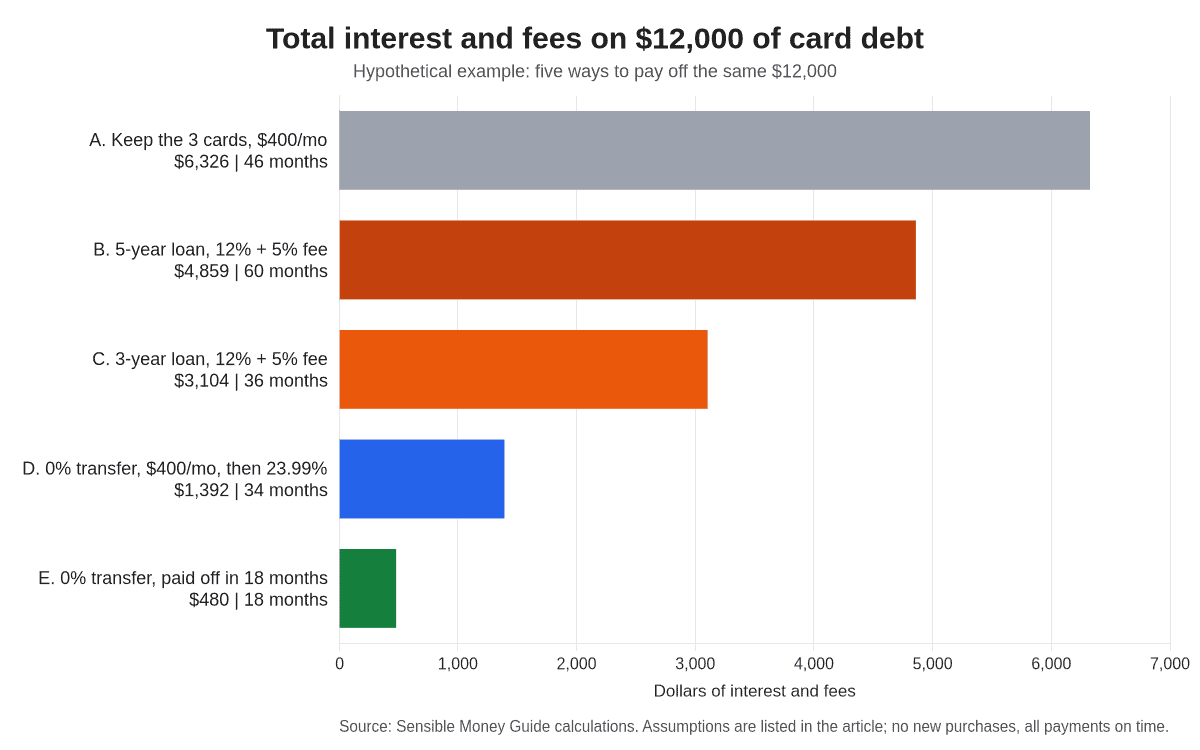
Three lessons jump out:
- The lowest payment is the most expensive consolidation option. Path B has the smallest payment, but it costs the most of the four consolidation paths and keeps Teo in debt the longest: five full years.
- The tool matters less than the payment. Paths D and E use the same card. Paying an extra $293 a month saves $912 and gets Teo out 16 months sooner.
- Every consolidation path here beats Path A, but only because Teo stops adding new charges. If he kept spending on the old cards, none of these numbers would hold.
The next chart shows how fast each balance falls. Notice how Path D drops steadily during the 0% months, then slows once interest kicks back in.
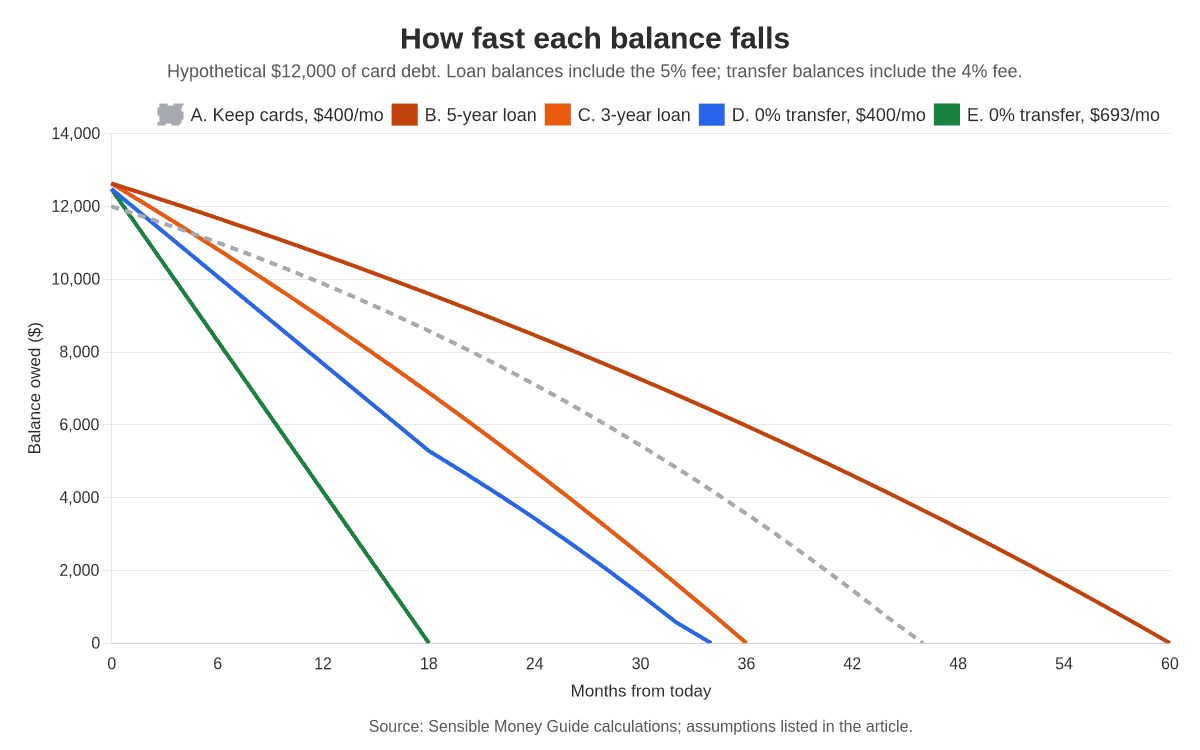
Read this before you trust the numbers. Teo is a made-up example. Here’s what we assumed. He owes $12,000 on three cards: $6,200 at 24.99%, $3,900 at 22.49% and $1,900 at 27.99%. Interest is charged monthly at the yearly rate divided by 12. He makes no new purchases and pays on time. In Path A, all $400 goes to the highest-rate card first, and for simplicity we ignore the minimum payments the other cards would require. Paying those minimums out of the same $400 would add about a month and a few hundred dollars of interest, so Path A’s real cost is likely a bit higher. The loan is 12% APR, with the 5% fee added to the amount borrowed. The transfer card’s limit covers the full $12,000, with a 4% fee and a 23.99% rate after 18 months. Real offers vary with your credit score, income, the lender and the market. Real card minimums and interest math also vary by issuer. Use these figures to compare choices, not as a quote.
Where the experts disagree
Not everyone in personal finance likes consolidation. The two camps are worth hearing, because each is right about something.
View 1: consolidation treats the symptom
Ramsey Solutions, the company behind radio host Dave Ramsey, is the best-known skeptic. Jade Warshaw, a personal finance coach, makes the case in a Ramsey Solutions article. She writes: “Debt consolidation doesn’t help you deal with the root of your money problems—it only puts a band aid on the symptom” (Ramsey Solutions). The Ramsey approach is to stop borrowing, live on a tight budget and pay debts off smallest to largest, known as the debt snowball.
The strongest part of this view is the behavior warning. Plenty of people consolidate, feel relief, and slowly fill the cards back up.
View 2: a lower rate is real money
Many mainstream sources, including banks and credit analysts, treat consolidation as a useful tool when the math works and the spending is under control. Even the CFPB, while listing the risks, explains how consolidating can lower your costs. LendingTree’s Matt Schulz, quoted earlier, calls a 0% balance transfer card about the best consolidation offer you can get. Teo’s example shows why: the same $400 a month gets him out of debt a year sooner and saves him nearly $5,000.
The strongest part of this view is the math. Interest at 22% is a heavy drag on any payoff plan.
Our take
Both are right, in order. Fix the behavior first, then use the math. If you’ve already built a budget and your card balances are falling, a lower rate speeds you up. If they’re still rising, no loan will save you. Either way, a payoff method like the avalanche or snowball still matters after you consolidate. Our guide to paying off credit card debt compares those methods in detail.
Your step-by-step plan, with a worksheet
Step 1: Fill in your debt worksheet
Grab your latest statements. For each debt, write down the balance, the APR and the minimum payment. Then estimate one month of interest: balance times APR, divided by 12.
| Debt | Balance | APR | Minimum payment | One month of interest (balance × APR ÷ 12) |
|---|---|---|---|---|
| Example: store card | $1,900 | 27.99% | $60 | $44.32 |
| Debt 1 | $______ | ____% | $______ | $______ |
| Debt 2 | $______ | ____% | $______ | $______ |
| Debt 3 | $______ | ____% | $______ | $______ |
| Debt 4 | $______ | ____% | $______ | $______ |
| Total | $______ | $______ | $______ |
The total in the last column is roughly what your debt costs you each month right now. Keep that number in front of you while you compare offers. (The $60 minimum in the example row is made up; yours is on your statement.)

Step 2: Set your monthly payoff amount
Look at your budget and pick the most you can steadily pay toward debt each month. That’s the number that will decide how fast you’re done, whichever tool you use.
Step 3: Check your credit
See where your score stands before you shop. Your score drives the rates you’ll be offered. You can get free credit reports from all three bureaus at AnnualCreditReport.com (they don’t include scores). If you spot errors, dispute them with the bureau before you apply.
Step 4: Shop with soft checks
Prequalify for two or three transfer cards and three to five personal loans, including at a credit union. Write each offer down: APR, fee, term or promo length, and monthly payment.
Step 5: Run the decision checklist
Pick an offer only if every line here is true:
- The new rate, after fees, is clearly lower than what I pay now.
- I can afford the monthly payment that clears the debt on time.
- For a transfer card: my target payment (balance plus fee, divided by the 0% months) fits my budget.
- For a loan: I’m choosing the shortest term I can afford, not the lowest payment.
- My card balances haven’t grown in the last three months.
- I’m not putting my home or retirement at risk unless I’ve ruled out the other options.
- Nobody asked me for a fee upfront or told me to stop paying my bills.
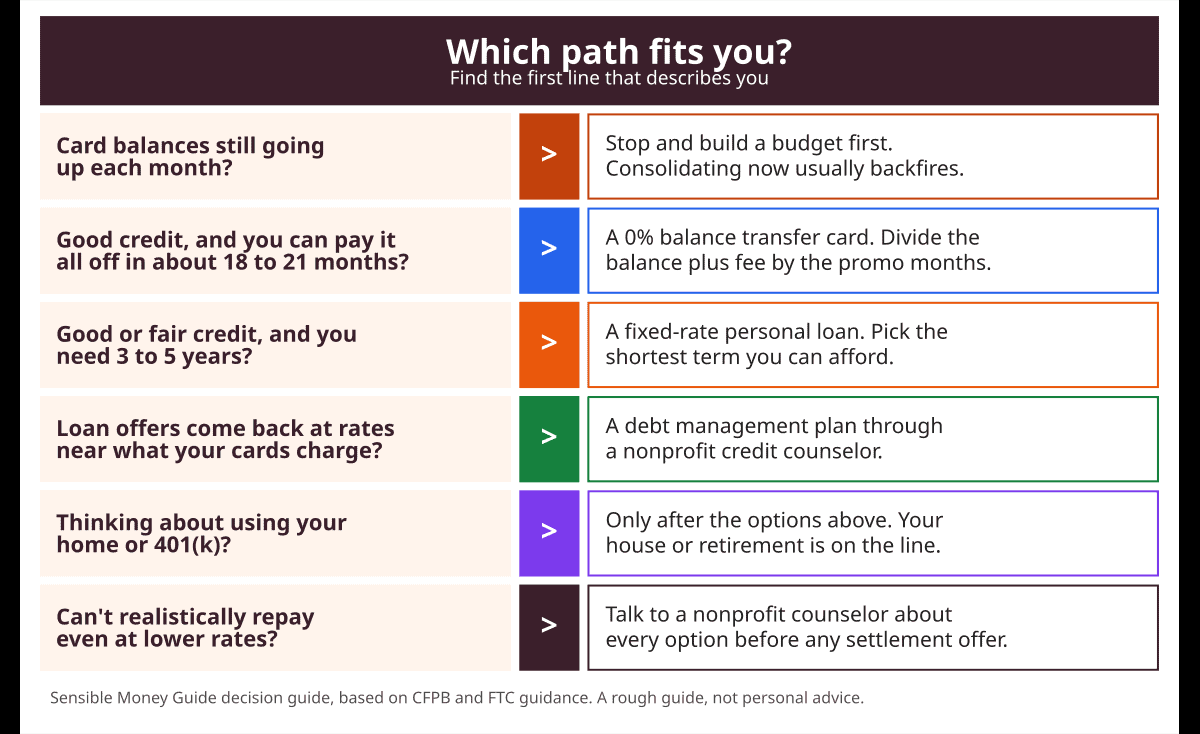
If you can’t check every box, the chart below points you to a better next step.
Step 6: Apply and pay off the old debts the right way
- Apply only for the one offer you chose.
- If the lender pays your creditors directly, let it. If not, pay each card the day the money arrives.
- Keep making payments on the old accounts until each one shows $0. Transfers can take weeks.
- Set up autopay on the new loan or card.
Step 7: Lock the door behind you
- Remove saved card numbers from shopping sites and apps.
- Put your paid-off cards somewhere inconvenient.
- Build a small cash buffer so emergencies don’t go on a card.
- Check your balances once a month. If the cards start creeping back up, stop and fix the budget right away.
The short version
- Debt consolidation combines debts into one new loan or card. It changes the rate and payment, not the amount you owe.
- It helps only if the new rate is clearly lower after fees and you’ve stopped adding new debt.
- Credit cards averaged 22.15% for accounts charged interest in mid-2026, versus 11.86% for 24-month personal loans at banks, per the Federal Reserve.
- A 0% balance transfer can be the cheapest option, if you pay it off before the promo ends and never miss a payment.
- With a loan, pick the shortest term you can afford. Long terms lower the payment but raise the total cost.
- Home equity and 401(k) loans carry serious risks: your home, your retirement and a fast repayment if you lose your job.
- A nonprofit debt management plan is a strong option if your credit won’t get you a good rate.
- Debt settlement is a different thing. It can wreck your credit, may create a tax bill, and should never cost you anything upfront.
Questions people ask
Does debt consolidation hurt your credit?
Usually only a little at first. Applying creates a hard inquiry, which myFICO says costs most people fewer than five points, and a new account may lower your average account age. Over time, lower card balances and on-time payments may help your score, as Chase notes.
What credit score do you need for a debt consolidation loan?
It varies by lender. Bankrate says most lenders look for a score of around 580 at minimum, but the best rates go to people with scores of 740 and up. With fair or poor credit, offers may be too expensive to help, and a debt management plan may be a better fit.
Is a balance transfer better than a personal loan?
If you can pay the full balance off during the 0% period, a transfer is usually cheaper, as Teo’s example shows. If you need three to five years, a fixed-rate loan is often safer, because its rate won’t jump partway through. Many people with large balances can’t get a transfer limit big enough anyway.
Can I consolidate debt with bad credit?
Yes, but be careful. High-rate loans may not save you anything. A nonprofit credit counseling agency can review your situation for free or at low cost. A debt management plan doesn’t depend on getting approved for a new loan. Avoid anyone who charges fees before doing any work.
How long does a debt management plan take?
The FTC says a plan can take 48 months or more to finish. The exact length depends on how much you owe, the rates your creditors agree to and how much you can pay each month.
Is debt consolidation the same as debt settlement?
No. With consolidation, you repay everything you owe, just through a new loan or card. With settlement, creditors accept less than the full amount, which usually damages your credit, and the IRS says forgiven debt is generally taxable.
Should I use my home equity to pay off credit cards?
Only with great care. You’d be turning unsecured card debt into debt backed by your home, which the CFPB warns could lead to foreclosure if you can’t pay. The interest also generally isn’t tax-deductible when the money pays off cards, per IRS Publication 936.
Should I close my credit cards after consolidating?
Often it’s better to leave no-fee cards open with a zero balance, since that keeps your credit utilization low. If you can’t trust yourself with them yet, put them away or remove them from your phone and shopping sites rather than spending on them.
Your first move
Before you look at any offer, fill in the worksheet above with your real numbers. Fifteen minutes with your statements will tell you what your debt costs each month and how much a lower rate could save. If your balances are still rising, spend the next week on your budget instead. Consolidation works best once the leak is fixed.
About this guide
Written and reviewed by Daniel Brienza, founder and editor of Sensible Money Guide (B.S. in Business Administration, University of South Florida). Every rule, limit and number in this guide was checked against the primary sources listed below. Daniel is not a licensed financial advisor; this guide is for general education.
Published October 25, 2026. Figures are current as of that date.
Sources
- Board of Governors of the Federal Reserve System, “Consumer Credit – G.19”, September 8, 2026.
- Consumer Financial Protection Bureau, “What do I need to know about consolidating my credit card debt?”, last reviewed September 2, 2026.
- Federal Trade Commission, “How To Get Out of Debt”, December 2025.
- Federal Trade Commission, “Looking for debt relief? Here’s how to avoid a scam”, March 26, 2026.
- Internal Revenue Service, “Retirement Topics – Loans”, reviewed February 26, 2026.
- Internal Revenue Service, “Publication 936 (2025), Home Mortgage Interest Deduction”, accessed October 2026.
- Internal Revenue Service, “Topic no. 431, Canceled debt – Is it taxable or not?”, reviewed September 24, 2026.
- Federal Reserve Bank of New York, “Household Debt Balances Decreased Slightly; Credit Card Delinquency Transition Rates Remained Steady”, August 11, 2026.
- Chase, “How debt consolidation loans can impact your credit”, October 14, 2025.
- Wells Fargo, “What is debt consolidation and is it a good idea?”, accessed October 2026.
- Fidelity Investments, “The Pros and Cons of 401(k) Loans”, Money Unscripted, July 20, 2026.
- myFICO, “Credit Checks: What are credit inquiries and how do they affect your FICO Score?”, accessed October 2026.
- Bankrate, “What is the average personal loan rate for October 2026?”, updated October 22, 2026.
- NerdWallet, Claire Tsosie, “How to Transfer a Credit Card Balance in 3 Simple Steps”, updated November 7, 2025.
- Ramsey Solutions, Jade Warshaw, “The Truth About Debt Consolidation”, updated February 28, 2025.
- ABC News, Megan Fahrney and Max Zahn, “‘Weight off my shoulders’: Credit card holders seek debt consolidation for lower interest rates”, October 1, 2026 (Matt Schulz, LendingTree).
- Money, Andrea Agostini Ferrer, “How Credit Counseling Can (and Can’t) Help With Your Debt”, March 6, 2025 (Bruce McClary, NFCC).
- Money, Mallika Mitra, “Will Debt Relief Hurt Your Credit Score?”, March 19, 2025 (Rod Griffin, Experian).
- Bankrate, Katie Kelton with Ana Staples, “Bankrate’s 2026 Credit Card Debt Report”, January 12, 2026 (Ted Rossman).
- Two Cents (PBS), “Should You Consolidate Your Debt?”, YouTube, May 11, 2022.
This article is for educational purposes only and isn’t financial advice. Consider talking with a qualified professional about your situation.


Debt Consolidation in 2026: Loans, Transfers and Pitfalls

How to Build Credit From Scratch: Your First-Year Plan

How Does a 401(k) Work? Matching, Taxes and 2026 Limits

How Much Do You Need for a House Down Payment?

How to Lower Your Monthly Bills: Calls, Scripts and Savings

How to Pay Off Credit Card Debt: Avalanche, Snowball and More

How to Make a Budget That Actually Works, Step by Step

How Much Emergency Savings Do You Need? Find Your Number

How Credit Scores Work: FICO Factors and Ways to Improve

You must be logged in to post a comment Login