Retirement Planning
Roth vs. Traditional IRA: How to Choose the Right One
Roth or traditional IRA? Learn the 2026 limits, income rules and real-number math to pick the right IRA for you, or use both. A plain-English guide.


Picture someone like Maria, a 34-year-old nurse. (She’s a made-up example, but you probably know someone just like her.) It’s a Sunday night in January. She’s finally ready to open an IRA, and the bank’s website hits her with a question before she can type a single dollar: “Traditional or Roth?”
She freezes. One option gives her a tax break right now. The other promises tax-free money later. Both sound good. Picking wrong feels like it could cost her thousands of dollars, so she closes the tab and tells herself she’ll figure it out next weekend.
Next weekend turns into next year. That’s the real cost. Not picking the “wrong” IRA, but picking nothing at all while the years of growth slip by.
Here’s the good news. This choice is easier than it looks once you see what’s going on under the hood. And for most people, either answer beats waiting. By the end of this guide, you’ll know which one fits you, why, and exactly what to do this week.
What you’ll learn:
- The one big difference between a Roth and a traditional IRA, in plain English
- The 2026 contribution limits, income limits and deadlines
- Real-number examples that show which account leaves you more money
- A simple set of questions that points you to the right choice
- Why many people end up using both, and how to avoid the mistakes that cost the most
In this guide:
- What an IRA is (and what it isn’t)
- The one big difference: when you pay the tax
- The 2026 rules at a glance
- How a traditional IRA works
- How a Roth IRA works
- The math: which one leaves you more money?
- How to choose: seven questions to ask yourself
- Why many people use both
- Special situations
- Your step-by-step action plan
- Common mistakes to avoid
- Myths vs. facts
- Key takeaways
- Frequently asked questions
What an IRA is (and what it isn’t)
An IRA is an individual retirement account. It’s a special kind of account you open on your own, not through your job, that gets tax breaks for retirement saving. The SEC’s investor education site, Investor.gov, describes IRAs simply as accounts that offer tax advantages for retirement savings, up to a yearly maximum set by the IRS.
Here’s the part that trips people up. An IRA is not an investment. It’s a container. Think of it like a sturdy box with a special tax label on it. What you put inside the box is up to you: index funds, stocks, bonds, CDs or plain cash.
So if you put $7,000 into an IRA and leave it sitting in cash, it won’t grow much. Opening the account is step one. Choosing investments inside it is step two. Lots of people forget step two, and we’ll come back to that in the common mistakes section.
Why IRAs matter more than you might think
If you have a 401(k) at work, you might wonder if you even need an IRA. Plenty of people do. Some don’t have a workplace plan at all. Others want more room to save, better investment choices or a different kind of tax break than their job offers.
And plenty of us are behind. In the Federal Reserve’s latest survey of household finances, only 35% of adults who weren’t yet retired said their retirement savings were on track. Among adults ages 18 to 29, it was just 22%.
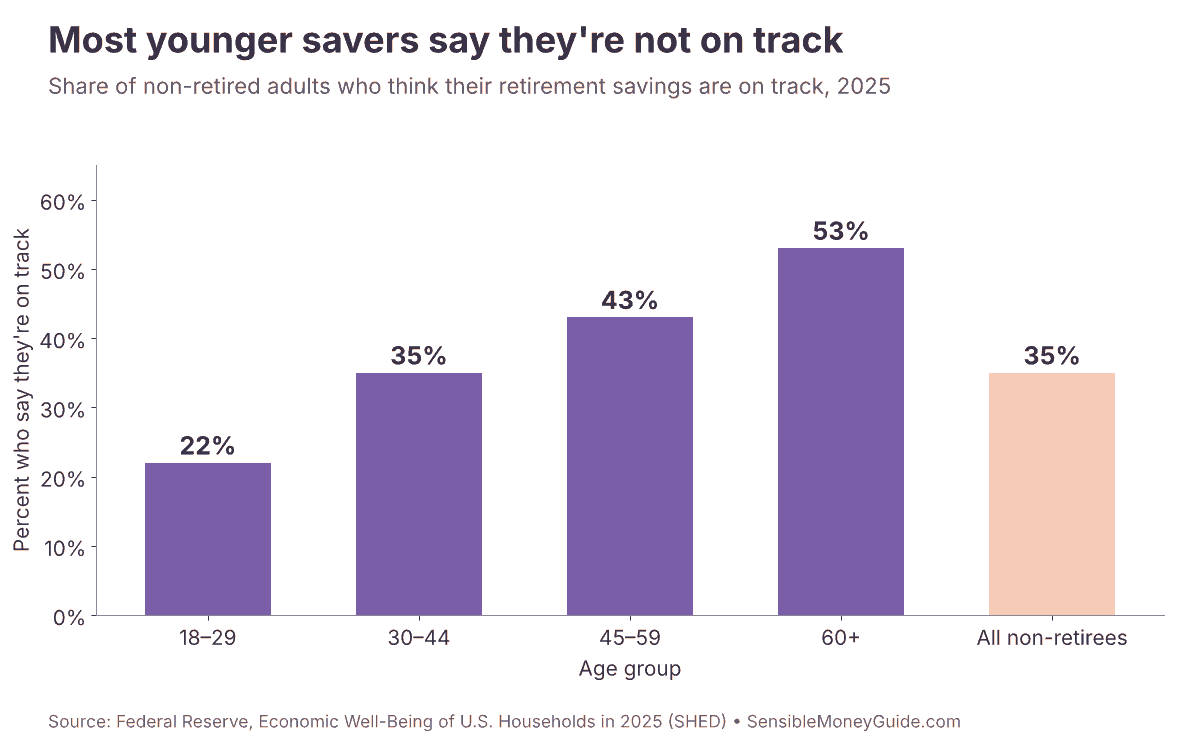
The same survey found that 61% of non-retirees had a tax-preferred retirement account, like a 401(k) or an IRA. That means nearly 4 in 10 didn’t. An IRA is one of the easiest ways to close that gap, because almost anyone with a paycheck can open one in about 15 minutes.
The two main flavors
There are a few types of IRAs, including SEP and SIMPLE IRAs for small businesses. But for most people, the choice comes down to two:
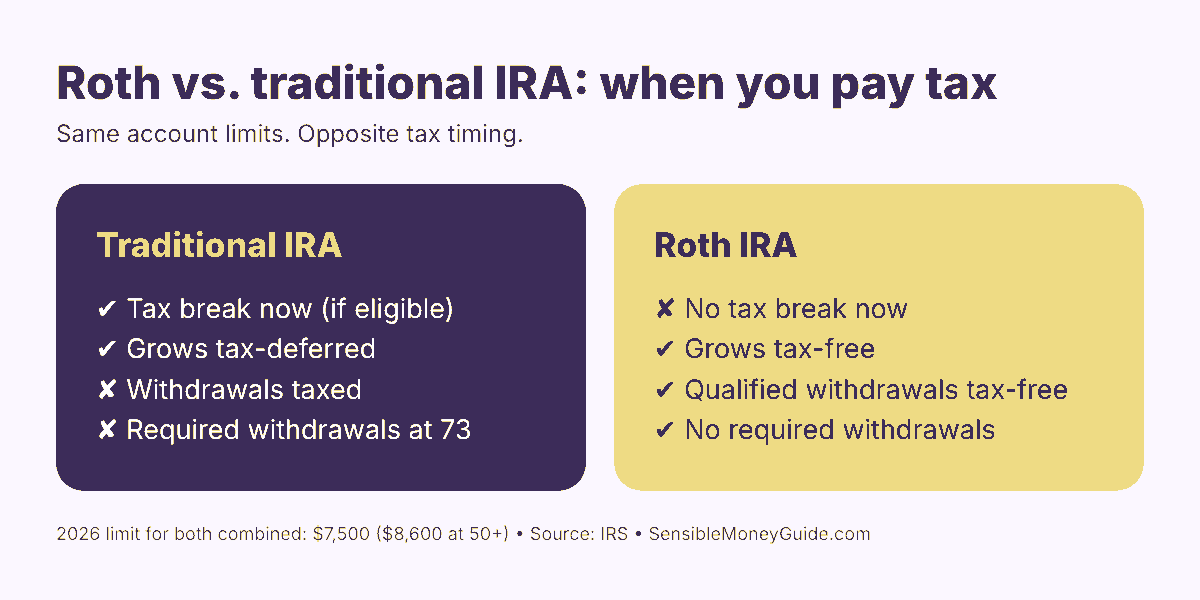
- Traditional IRA: You may get a tax deduction now. You pay income tax when you take the money out in retirement.
- Roth IRA: You get no deduction now. If you follow the rules, the money comes out tax-free in retirement, growth and all.
That’s the heart of it. Everything else in this guide is detail and strategy built on top of that one difference.

The one big difference: when you pay the tax
Every dollar you earn gets taxed eventually. The only question is when. That’s the whole Roth vs. traditional decision in one sentence.
Fidelity describes it the same way: the main difference is when you get your tax advantage.
Traditional: tax break now, tax bill later
With a traditional IRA, your contribution may be tax-deductible. A deduction lowers the income you pay tax on this year. Put in $5,000, and you might pay tax on $5,000 less income. The money then grows tax-deferred, which means you don’t pay tax on gains each year. You pay ordinary income tax on whatever you withdraw in retirement.
Roth: tax bill now, tax-free later
With a Roth IRA, you put in money you’ve already paid tax on. There’s no deduction. But your money grows tax-free, and qualified withdrawals in retirement are tax-free too. Vanguard sums it up this way: “Roth IRAs offer tax-free growth and withdrawals in retirement.”
A qualified withdrawal is one that meets two tests. According to the IRS, you generally need to be at least 59½, and at least five tax years must have passed since your first Roth contribution. We’ll unpack that five-year rule in the Roth section.
A simple way to picture it
Imagine a farmer. She can pay tax on the seeds she plants this spring, or she can pay tax on the whole harvest in the fall. A traditional IRA taxes the harvest. A Roth taxes the seeds.
Taxing the seeds sounds like an obvious win, since the harvest is bigger. But it’s not quite that simple. What really matters is the tax rate on the seeds versus the tax rate on the harvest. If the rates are the same, you end up in the same place either way. We’ll prove that with real numbers in the math section.
The 2026 rules at a glance
Both IRAs share the same yearly limit. For 2026, the IRS raised the IRA contribution limit to $7,500, up from $7,000 in 2025. If you’re 50 or older, you can add a $1,100 catch-up contribution, for a total of $8,600.
That limit covers all your IRAs combined. The IRS is clear that the cap applies to all of your traditional and Roth IRAs together. So you could put $4,000 in a Roth and $3,500 in a traditional IRA, but not $7,500 in each.
You also need earned income, like wages, tips or self-employment income. You can’t contribute more than you earned that year. Investment income, pensions and Social Security don’t count. There’s one handy exception: if you’re married and file jointly, a spouse with little or no income can still contribute based on the working spouse’s pay. That’s often called a spousal IRA.
There’s no age limit anymore, either. Since 2020, you can keep contributing to a traditional IRA at any age, as long as you have earned income.
| 2026 rule | Traditional IRA | Roth IRA |
|---|---|---|
| Yearly limit (under 50) | $7,500 (shared) | $7,500 (shared) |
| Yearly limit (50 and older) | $8,600 (shared) | $8,600 (shared) |
| Tax break | Possible deduction now | Tax-free qualified withdrawals later |
| Income limit to contribute | None | Yes (phases out at higher incomes) |
| Income limit for the deduction | Only if you or your spouse has a workplace plan | Not applicable |
| Required withdrawals | Yes, starting at 73 | None while you’re alive |
| Early withdrawals of contributions | Taxed, plus a 10% penalty in most cases | Tax- and penalty-free anytime |
The deadline is later than you think
You don’t have to rush before December 31. You can make IRA contributions for a given year up until the tax filing deadline the next spring. The IRS gives an example: contributions for 2024 could be made until April 15, 2025. The same pattern means you can put money in for 2026 until the April 2027 tax deadline.
Just tell your bank or brokerage which year the money is for. If you don’t say, it may be counted toward the current year.
Watch out: The IRS usually announces next year’s limits in the fall. Check the IRS site before you contribute for 2027, because the numbers often go up with inflation.
How a traditional IRA works
A traditional IRA is the older of the two. Anyone with earned income can put money in. There’s no income cap on contributing. The catch is whether you get to deduct what you put in.
Who gets the deduction
If neither you nor your spouse has a retirement plan at work, you can deduct your full contribution no matter how much you earn. That’s simple.
If you do have a workplace plan, like a 401(k) or 403(b), the deduction shrinks as your income rises. For 2026, the IRS phase-out ranges are:
- Single, covered by a plan at work: $81,000 to $91,000
- Married filing jointly, and you’re covered: $129,000 to $149,000
- Married filing jointly, you’re not covered but your spouse is: $242,000 to $252,000
- Married filing separately, covered: $0 to $10,000
These ranges use your modified adjusted gross income, or MAGI. That’s roughly your total income minus a few items, with some deductions added back. Below the range, you get the full deduction. Inside it, you get part. Above it, you get none.
You can still contribute even if you can’t deduct it. That’s called a nondeductible contribution, and you report it on IRS Form 8606. It’s mostly useful as a stepping stone for the “backdoor Roth” we’ll cover later.
What the deduction is really worth
A deduction saves you money at your marginal tax rate. That’s the rate on your last, highest dollar of income. It’s not the rate on all your income.
Here are the 2026 federal brackets for a single filer. The standard deduction for a single filer is $16,100, so taxable income starts after that.
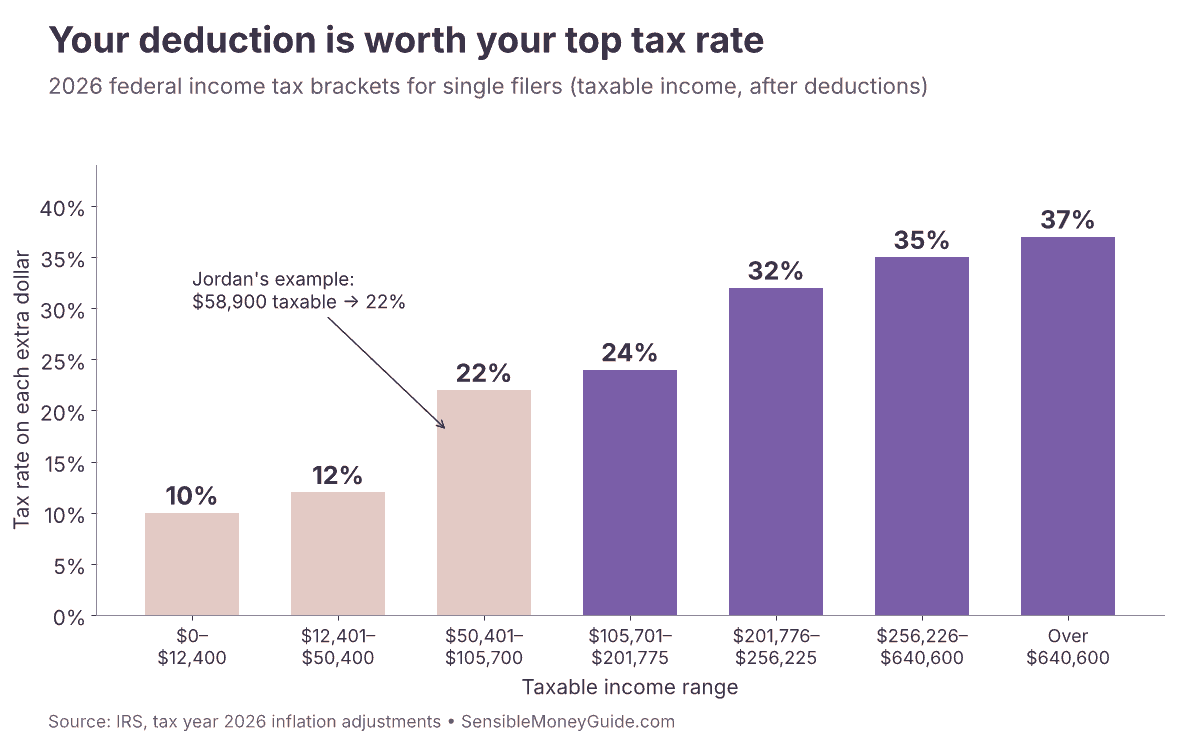
Worked example 1: Jordan’s deduction. Picture Jordan, a single 29-year-old who earns $75,000. (Jordan is a made-up example too.) After the $16,100 standard deduction, Jordan’s taxable income is $58,900. That’s above the $50,400 line, so Jordan’s top bracket is 22%.
If Jordan puts $7,500 in a deductible traditional IRA, taxable income drops to $51,400. That’s still above $50,400, so every one of those dollars came out of the 22% bracket.
- $7,500 x 22% = $1,650 less federal tax
- Jordan’s real out-of-pocket cost: $7,500 minus $1,650 = $5,850
If Jordan earned $60,000 instead, taxable income would be $43,900. That’s already in the 12% bracket, so the same deduction would save only about $900 ($7,500 x 12%). If your income sits near a bracket line, part of your deduction can fall in each bracket. That’s why it helps to know where your income sits.
Many states with an income tax also let you deduct traditional IRA contributions, which can add to your savings. Rules vary, so check your state’s tax agency.
The rules for taking money out
Traditional IRA money is meant to stay put until retirement. If you withdraw before age 59½, you’ll generally owe income tax plus a 10% additional tax, according to the IRS. There are exceptions. The IRS list includes up to $10,000 for a first home and up to $5,000 for a birth or adoption. Qualified higher education costs and certain medical bills are on it too.
Then there’s the other end of the timeline. Traditional IRAs come with required minimum distributions, or RMDs. These are withdrawals the IRS makes you take each year, whether you need the money or not. Under current rules, they start at age 73. NerdWallet notes that the starting age is scheduled to rise to 75 in 2033.
RMDs are taxable income. For some retirees, they can push income high enough to raise taxes on Social Security benefits or Medicare premiums. That’s one reason some people like having Roth money too.

Who a traditional IRA tends to suit
- People in a higher tax bracket now than they expect to be in retirement
- People who need the tax break this year to afford saving at all
- People in their peak earning years who are close to retirement
- People whose income is too high for a Roth and who don’t want to fuss with a backdoor Roth
How a Roth IRA works
The Roth IRA has been around since 1998, and it has a big fan club. The appeal is easy to understand: once your money is inside and you follow the rules, the IRS never taxes it again.
Who can contribute
Unlike a traditional IRA, a Roth has income limits. For 2026, the IRS phase-out ranges are:
- Single or head of household: $153,000 to $168,000
- Married filing jointly: $242,000 to $252,000
- Married filing separately: $0 to $10,000
Below the range, you can contribute the full amount. Inside it, your limit shrinks. Above it, you can’t contribute directly at all.
Worked example 2: a partial Roth contribution. Say you’re single with a MAGI of $160,000. You’re $8,000 below the top of the $15,000-wide phase-out range. Here’s the math:
- $168,000 – $160,000 = $8,000
- $8,000 / $15,000 = 0.533
- 0.533 x $7,500 = $4,000 you can put in a Roth for 2026
You could put the other $3,500 in a traditional IRA, since the $7,500 limit is shared. The IRS has a worksheet for this in Publication 590-A, and it rounds results up to the next $10.
The flexibility nobody talks about enough
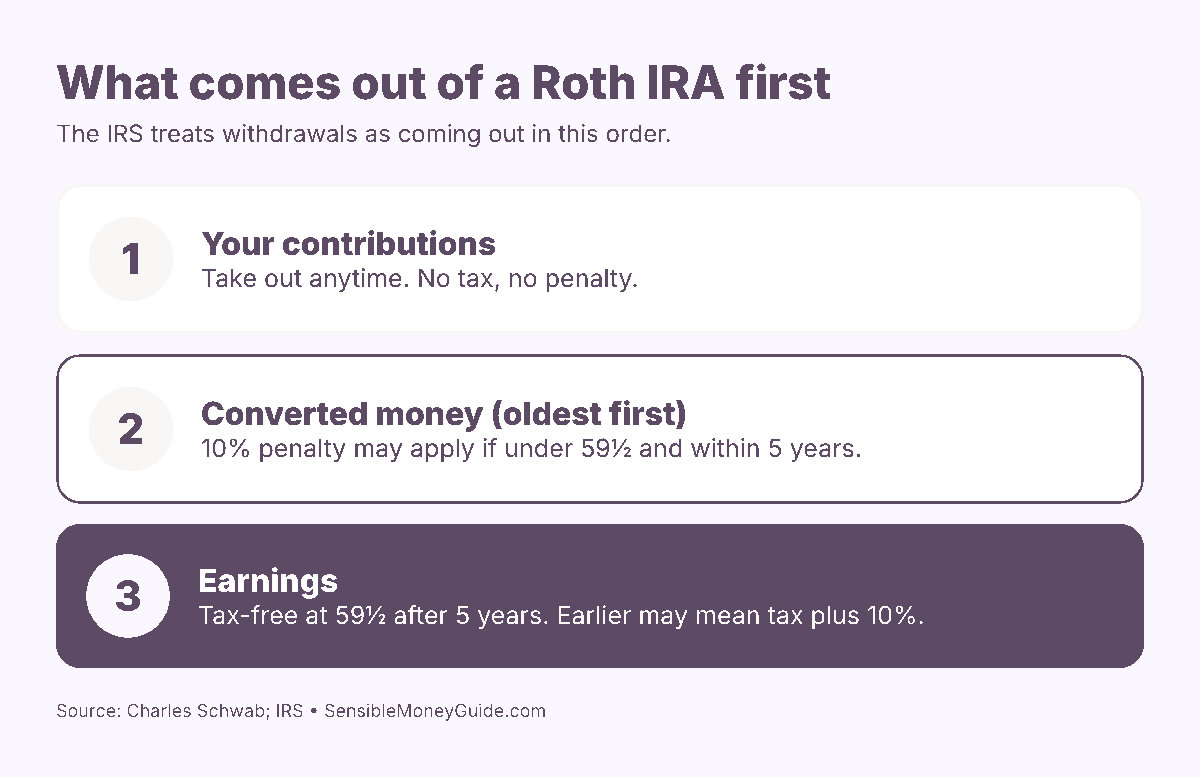
Here’s a Roth feature that matters a lot for real life. You can take out your contributions (the money you put in, not the growth) at any time, for any reason, with no tax and no penalty. Fidelity points out that this kind of anytime access is unique to the Roth.
That’s because the IRS treats Roth withdrawals as coming out in a set order. Charles Schwab explains the order like this:
- Your regular contributions come out first.
- Money you converted from a traditional IRA comes out next, oldest first.
- Earnings come out last.
Worked example 3: tapping a Roth early. Say you’ve put $20,000 into a Roth over several years, and it’s grown to $26,000. You’re 40, and your car dies. You can pull out up to $20,000 with no tax and no penalty, because that’s your own contribution money.
If you took the full $26,000, the $6,000 of earnings would be a different story. At 40, those earnings would generally be taxed as income and hit with the 10% penalty. In the 22% bracket, that’s $1,320 in income tax plus a $600 penalty, or $1,920 in total on $6,000 of growth.
So a Roth can double as a backup emergency fund. That said, it works best as a last resort. Every dollar you pull out loses years of tax-free growth, and you can’t simply put it back later beyond your normal yearly limit. Your first line of defense should still be a real emergency fund.
The five-year rule, made simple
To take earnings out tax-free, you need a qualified distribution. That generally means being 59½ or older and having had a Roth IRA for at least five tax years.
The five-year clock is friendlier than it sounds. Per Schwab, it starts on January 1 of the tax year of your first contribution. If you make a 2026 contribution in April 2027, your clock still starts January 1, 2026. And your first contribution to any Roth IRA starts the clock for all of them.
That’s a great reason to open a Roth sooner rather than later, even with a small amount. Starting the clock early costs you nothing.
Conversions have their own separate five-year clocks, which we’ll touch on in special situations.
No required withdrawals
Roth IRAs have no required minimum distributions while you’re alive. The IRS says that the original owner of a Roth IRA doesn’t have to take distributions regardless of age. Your money can keep growing tax-free as long as you live, and it can pass to your heirs. (Heirs do have their own withdrawal rules.)
Who a Roth IRA tends to suit
- Younger workers early in their careers, who are often in a lower bracket now
- People who expect higher income, or higher tax rates, later
- People who want flexible access to their contributions
- People who’d like to leave tax-free money to their kids
- Savers who can already afford to max out their accounts
The math: which one leaves you more money?
This is where most articles hand-wave. Let’s actually run the numbers. They reveal something surprising.
Worked example 4: same rate now and later
Say you have $5,000 of salary you want to save for retirement. You’re in the 22% bracket. You’ll invest for 30 years, and we’ll assume 6% average yearly growth. (That’s an assumption for illustration, not a promise. Real returns go up and down.) At 6% a year, money grows about 5.74 times in 30 years.
| Step | Traditional IRA | Roth IRA |
|---|---|---|
| Salary set aside | $5,000 | $5,000 |
| Tax paid today (22%) | $0 | $1,100 |
| Amount invested | $5,000 | $3,900 |
| Value after 30 years | $28,717 | $22,400 |
| Tax on withdrawal (22%) | $6,318 | $0 |
| Money you can spend | $22,400 | $22,400 |
They’re the same. That’s not a coincidence. When your tax rate is the same going in and coming out, the math comes out even. Multiplying by 0.78 and then by 5.74 gives the same answer as multiplying by 5.74 and then by 0.78.
So the real question isn’t “Roth or traditional?” It’s “Will my tax rate be higher or lower when I take the money out?”
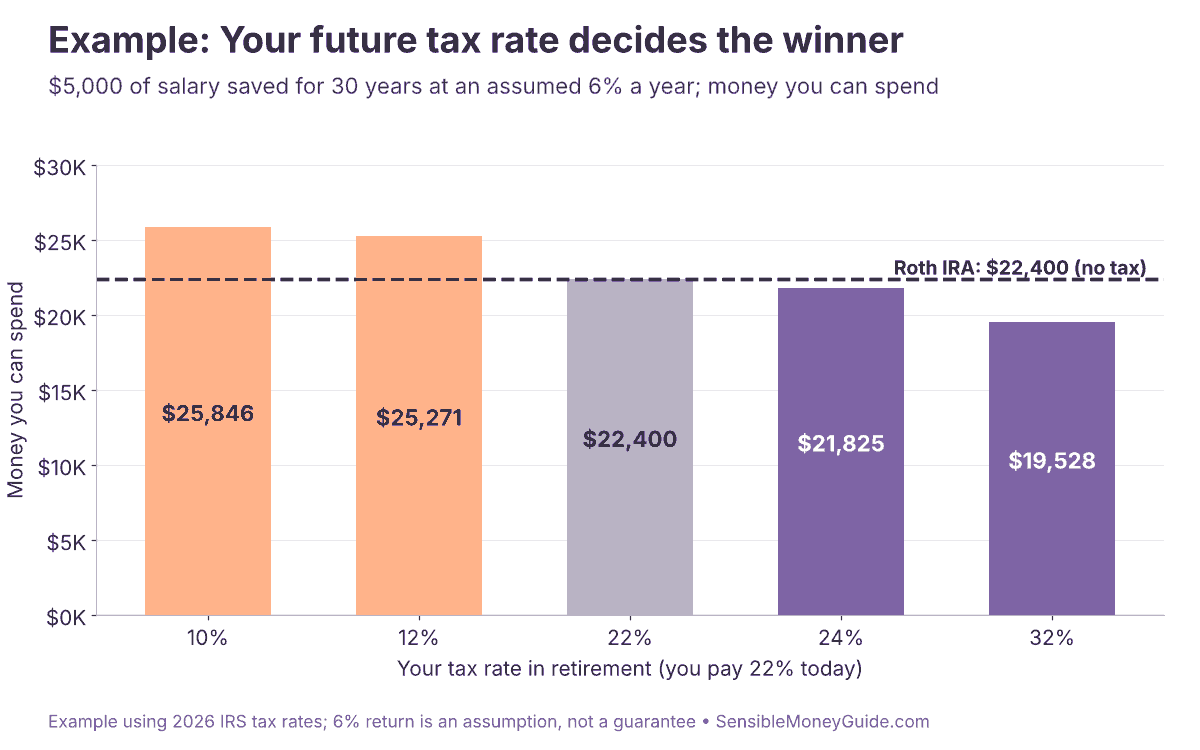
The chart shows what happens to the traditional IRA if your retirement tax rate changes while the Roth stays at $22,400. Retire into the 12% bracket and the traditional IRA wins by about $2,870. Land in the 32% bracket and the Roth wins by about $2,870.
Worked example 5: when you max out
Now the twist. The example above assumes the traditional IRA saver invests the full $5,000 and the Roth saver invests $3,900. But what if you can afford to put the full $7,500 into either account?
A $7,500 Roth contribution is $7,500 of after-tax money. A $7,500 traditional contribution is $7,500 of pre-tax money, and some of it belongs to the IRS. Using the same 6% growth for 30 years:
- Roth: $7,500 grows to about $43,076, all yours, tax-free
- Traditional: $7,500 grows to about $43,076, but after 22% tax you keep about $33,599
The traditional saver gets $1,650 of tax savings up front. To catch up, they’d have to invest that $1,650 in a regular taxable account every single year. Most people don’t. They spend it. Morningstar makes this same point. If you’re maxing out, a Roth lets you shelter more money. A traditional IRA generally needs you to invest the tax savings to keep up.
Pro tip: If you choose a traditional IRA, give your tax savings a job. Set your refund or your lower withholding to flow straight into savings or investments. Otherwise, the Roth quietly wins.
What could change your tax rate later
Nobody knows their future tax rate. But you can make a decent guess by thinking about a few things:
- Your career stage. Early-career workers often earn less now than they will later. A nurse earning $55,000 at 25 may earn $95,000 at 45.
- Your retirement income. Social Security, pensions, RMDs and part-time work all count. Some retirees end up in the same bracket they had while working.
- Your filing status. When a spouse dies, the survivor usually files as single. Single brackets are narrower, so the same income can land in a higher bracket.
- Where you’ll live. Moving from a high-tax state to a no-income-tax state can change the math.
- Future tax laws. Congress changes tax rates. Nobody can predict how.
Suze Orman, a longtime Roth fan, leans on that last point. As she wrote, “who knows where tax rates will be 10, 20, 30 years from now?” To her, that uncertainty is a reason to lock in tax-free income. Others see it differently, as you’ll see in the next section.
Prefer to hear it explained out loud? This NerdWallet video, “Roth vs Traditional IRA Investments: What’s Best For You?”, walks through the same trade-off between paying tax now and paying it later.
How to choose: seven questions to ask yourself
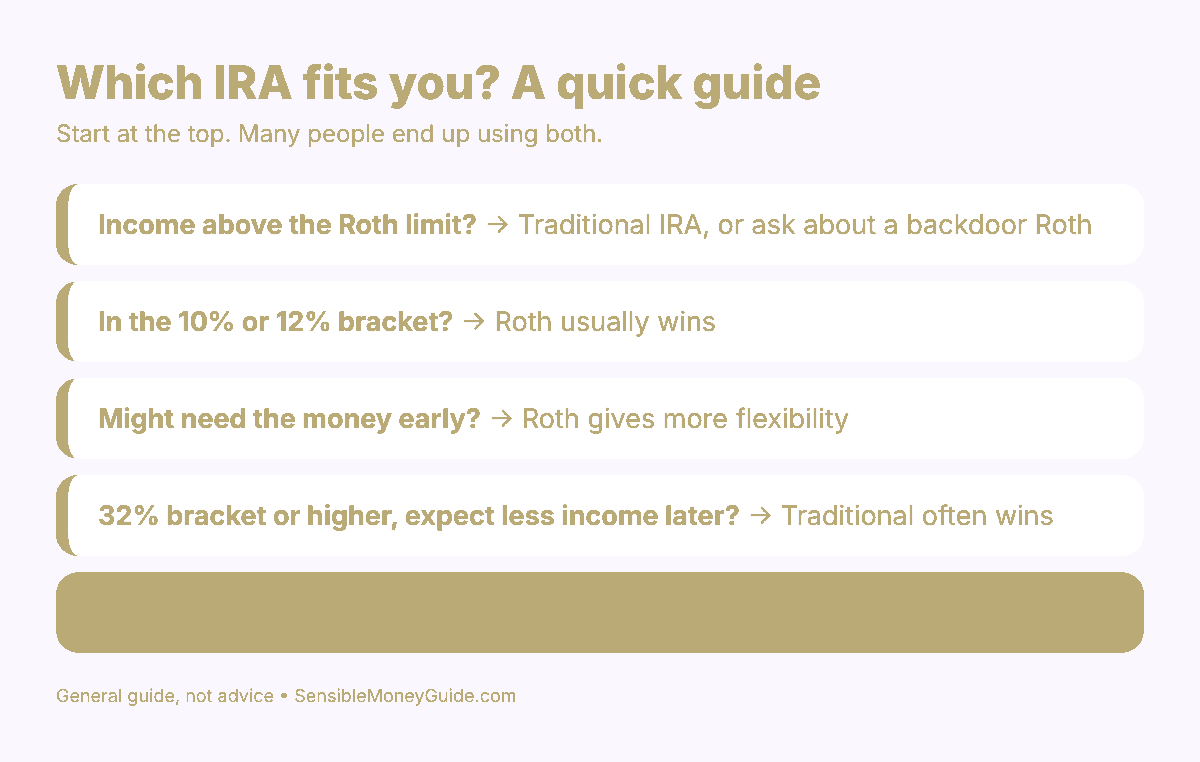
You don’t need a crystal ball. You need honest answers to a handful of questions. Work through them in order. The first ones can make the decision for you.
1. Are you even eligible?
Start here. NerdWallet calls eligibility what may be the biggest factor of all. If your income is above the Roth limit, a direct Roth contribution is off the table. If you have a workplace plan and your income is above the deduction range, a traditional IRA gives you no deduction. Sometimes the rules pick for you.
2. Are you getting your full 401(k) match?
If your employer matches your 401(k) contributions, grab that first. A match is free money, often 50 cents or a dollar for every dollar you put in, up to a limit. No IRA tax break comes close to that. Once you’ve captured the full match, an IRA is a great next stop.
3. What’s your tax bracket today?
Look at last year’s tax return or use the 2026 brackets above. If you’re in the 10% or 12% bracket, the Roth usually looks attractive. Your tax break from a deduction would be small, and you’d be paying tax at a low rate now. If you’re in the 32% bracket or above, the traditional deduction looks more valuable.
4. What do you expect in retirement?
Think about the income you’ll likely have later: Social Security, any pension, required withdrawals and part-time work. If you expect a big drop in income, traditional has an edge. If you expect a similar or higher income, Roth has the edge. Vanguard notes that a Roth may suit people who expect a higher bracket in retirement. It may also suit younger investors, who have more years of tax-free growth ahead.
5. Might you need the money before 59½?
Life happens. If there’s a real chance you’ll need to tap this money early, the Roth’s anytime access to contributions is a big plus.
6. Can you afford to max it out?
If you can put the full $7,500 in either way, remember worked example 5. The Roth shelters more money from tax over time.
7. Do you need the tax break to save at all?
This one is about real life, not spreadsheets. If the only way you can afford to save $3,000 this year is with the deduction’s help, a traditional IRA is a fine answer. Saving something beats saving nothing.
Where the experts disagree
Smart people land in different places on this question, and it’s worth knowing why.
The Roth-first camp. Ramsey Solutions recommends the Roth for most people and says that “the Roth IRA simply can’t be beat when it comes to building wealth.” Its suggested order is to invest 15% of your income for retirement: first up to your 401(k) match, then a Roth IRA, then more in the 401(k). Suze Orman also leans strongly toward Roth accounts, mainly because nobody knows future tax rates.
The “it depends on your rate” camp. Many planners treat this as a math problem with no default answer. In the Morningstar piece mentioned earlier, researcher David Blanchett points out that a traditional deduction saves you tax at your top rate, while retirement withdrawals often fill up the lower brackets first. That means a traditional account can come out ahead more often than a simple same-rate comparison suggests.
The middle ground. Fidelity, Vanguard and NerdWallet all frame it around your expected tax rate now versus later. NerdWallet notes that many advisors suggest a Roth, or a split, if you’re far from retirement and can’t decide.
Here’s how to think about it. The Roth fans are right that a Roth is simple and predictable. The math camp is right that a high earner nearing retirement may do better with the deduction. Neither side is wrong. They’re answering for different people.
Why many people use both
You don’t have to pick a team forever. You can split your contributions in the same year, as long as the total stays within $7,500 (or $8,600 at 50 and up). Fidelity confirms you can contribute to both in the same year under one combined limit. You can also change your mind next year.
Holding both kinds of money is called tax diversification. It works a lot like diversifying your investments. Instead of betting everything on one future tax rate, you spread your bets.
Why it helps in retirement
In retirement, having two buckets gives you control. Say you need $60,000 one year. You could take some from your traditional IRA to fill up the low tax brackets, then take the rest from your Roth tax-free. In a year with big medical bills, you might lean more on the Roth to keep your taxable income down.
J.P. Morgan Asset Management’s 2026 Guide to Retirement makes this point too. It notes that holding savings in both traditional and Roth accounts gives you more flexibility over your tax bill in retirement.
Don’t forget your workplace plan
Your 401(k) counts in this picture. Many employers now offer both a traditional 401(k) and a Roth 401(k). If your 401(k) money is all traditional, putting your IRA money in a Roth is an easy way to diversify. If your 401(k) is all Roth, a traditional IRA could balance things out, if you qualify for the deduction.
The 401(k) has much higher limits. For 2026, the IRS set the 401(k) limit at $24,500, plus an $8,000 catch-up at 50 and up. Workers ages 60 to 63 get an even higher catch-up of $11,250.
How many people use each type
Roth IRAs have been catching up. According to the Investment Company Institute’s 2026 IRA research report, 44% of U.S. households owned some kind of IRA in mid-2025. About 32.6% owned a traditional IRA and 27.8% owned a Roth, and many owned both.
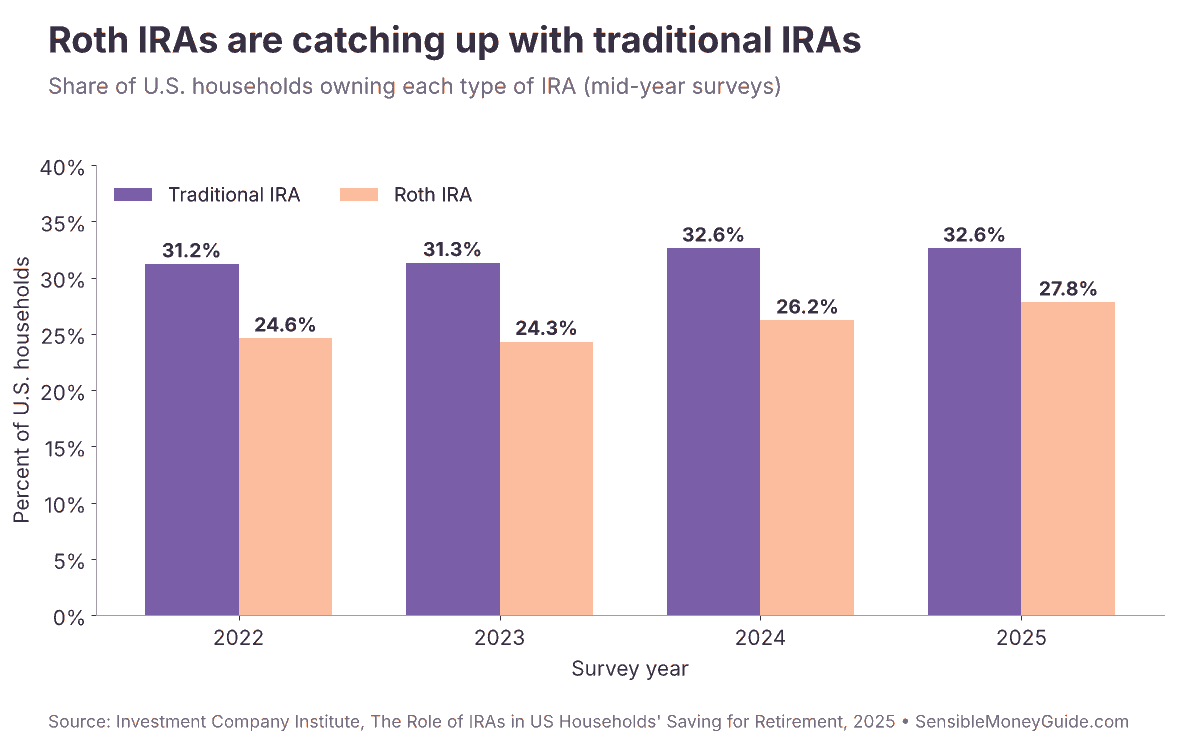
The same report found that Roth owners were more likely to keep contributing. In tax year 2024, 42% of households with a Roth IRA added money, compared with 23% of households with a traditional IRA. Part of that gap reflects retirees and rollovers: many traditional IRA owners are retired, and many traditional IRAs hold money rolled over from old 401(k)s.
Special situations
The basic advice covers most people. But a few situations deserve their own playbook.
Your income is too high for a Roth
If you earn above the Roth limits, there’s a well-known workaround called the backdoor Roth. You make a nondeductible contribution to a traditional IRA, then convert it to a Roth. Because there’s no income limit on conversions, this gets money into a Roth legally.
There’s a big catch, though. If you already have other pre-tax money in any traditional, SEP or SIMPLE IRA, the IRS doesn’t let you convert just the after-tax dollars. It looks at all your IRA balances together, and part of your conversion becomes taxable. This is often called the pro-rata rule, and it’s handled on Form 8606. If you have old pre-tax IRA money, talk to a tax pro before you try this.
Your income is modest
If money is tight, you may qualify for extra help. The Saver’s Credit can cut your tax bill by 50%, 20% or 10% of up to $2,000 you contribute ($4,000 for married couples filing jointly). Both traditional and Roth IRA contributions count. You must be 18 or older, not a full-time student and not claimed as someone’s dependent.
For 2026, the income cutoff is $40,250 for single filers, $60,375 for heads of household and $80,500 for married couples filing jointly. The lower your income, the bigger the credit rate.
Starting with contributions for 2027, there’s also a new federal Saver’s Match. The IRS says it can deposit up to 50% of your contributions, up to $1,000 per person, straight into your retirement account. The full match goes to single filers with income up to $20,500 and joint filers up to $41,000, with smaller matches above that. Contributions to either a traditional or a Roth IRA can count toward it, but the match itself goes into a non-Roth retirement account you choose.
If you’re in a low bracket, the Roth often makes the most sense, since your tax break from a deduction would be small anyway.
You’re self-employed or have a non-working spouse
Self-employment income counts as earned income, so you can open an IRA. You also have bigger options, like a SEP IRA or a solo 401(k), that may let you save far more. If you’re married and one of you stays home, the working spouse’s income can fund an IRA for both of you, as long as you file jointly and your combined contributions don’t exceed your joint taxable pay.

You’re close to retirement
If you’re in your 50s or early 60s and in your peak earning years, the traditional deduction may be worth more. But don’t ignore the Roth. A Roth has no required withdrawals, which gives you more control over your taxes later. It can also be a tax-free gift to heirs.
Some people also do Roth conversions, moving money from a traditional IRA into a Roth and paying the tax now. This often makes sense in low-income years, like the gap between retiring and starting Social Security or RMDs. J.P. Morgan’s guide notes that well-timed conversions can help manage taxes and Medicare premiums in retirement.
Two cautions. First, the tax on a conversion is due for the year you convert, so you need cash on hand to pay it. Second, each conversion has its own five-year clock. Per Schwab, if you’re under 59½ and withdraw converted money before five years pass, you may owe the 10% penalty.
You plan to retire early
Early retirees love Roth IRAs for their access to contributions. Some build a “Roth conversion ladder,” converting a slice of traditional money each year and waiting five years to withdraw each slice penalty-free. It takes planning, but it can bridge the years before 59½.
Your step-by-step action plan
Reading about IRAs doesn’t grow your money. Opening one does. Here’s the whole process, start to finish.
- Cover the basics first. Have at least a starter emergency fund, and get any high-interest credit card debt under control. A card charging 24% interest will outrun almost any investment. Our guide on paying off credit card debt can help.
- Grab your full 401(k) match, if your job offers one.
- Find your numbers. Pull up last year’s tax return. Note your filing status, your adjusted gross income and your top tax bracket. Check whether you or your spouse has a retirement plan at work.
- Check your eligibility. Compare your income with the 2026 Roth range and, if you have a workplace plan, the traditional deduction range.
- Pick your account using the seven questions. If you’re still unsure, a Roth or a 50/50 split is a reasonable default for many younger savers.
- Choose a provider. Look for a well-known brokerage with no account fees, no minimums and a wide choice of low-cost funds. Vanguard, Fidelity and Charles Schwab are popular examples, but many good options exist.
- Open the account. It usually takes 10 to 15 minutes online. Have your Social Security number, your bank account and your routing number handy.
- Fund it. Make a first deposit, even a small one. If it’s for last year and the tax deadline hasn’t passed, tell the provider which year it counts toward.
- Invest the money. This is the step people skip. Pick a simple, diversified option, like a target-date fund or a broad index fund.
- Automate it. Set up a monthly transfer. To max out $7,500 in 2026, that’s $625 a month. Even $100 a month is $1,200 a year.
- Review once a year. Each January, check the new limits, your income and whether your Roth vs. traditional mix still fits.

If finding money to save feels impossible, start with your spending plan. Our step-by-step guide to making a budget that works can help you free up $50 or $100 a month to get started.
Want to see how small, steady contributions add up? Try the free compound interest calculator on the SEC’s Investor.gov. For a rough idea, $7,500 a year for 30 years at 6%, deposited at the start of each year, grows to about $628,500. At $3,000 a year, it’s about $251,400.
Common mistakes to avoid
Most IRA mistakes aren’t about picking the wrong type. They’re about the small details. These are the ones that cost people the most.
Leaving the money in cash
Many brokerages park new deposits in a cash or money market fund until you choose an investment. If you never choose, your “retirement savings” may barely grow for years. Log in after your deposit lands and make sure it’s actually invested.
Waiting for the perfect answer
Remember Maria from the opening? The worst result isn’t choosing the “wrong” IRA. It’s choosing nothing. The math shows that the gap between a well-chosen and a so-so choice is often a few thousand dollars over decades. The gap between saving and not saving is far bigger.
Putting in too much
If you contribute more than the limit, or more than you earned, or put money in a Roth when your income is too high, the extra is an excess contribution. The IRS charges a 6% tax each year on excess money that stays in the account. You can avoid it by pulling the excess (and its earnings) out by your tax filing deadline, including extensions.
Ignoring the deduction rules
Some people put money in a traditional IRA, expecting a deduction, and then learn their workplace plan and income wiped it out. Check the phase-out ranges before you contribute.
Treating the Roth like a checking account
Yes, you can pull out contributions anytime. But money you take out can’t simply be put back later on top of your normal limit. Keep a separate emergency fund so your Roth can do its real job.
Forgetting the five-year clock
If you open your first Roth at 58, you can’t take tax-free earnings at 59½. Your five-year clock wouldn’t run out until around 63. Opening even a small Roth early starts the clock.
Missing RMDs
Once you hit RMD age with a traditional IRA, missing a required withdrawal can mean a hefty IRS penalty. Many providers will calculate your RMD and even send it automatically if you ask.
Assuming the decision is permanent
It isn’t. You can switch which type you fund each year. You can convert traditional money to a Roth later. Make the best choice you can today, and revisit it as your life changes.
Myths vs. facts
A lot of IRA advice floats around online. Here’s what holds up and what doesn’t.
Myth: A Roth is always better because the withdrawals are tax-free.
Fact: A Roth wins when your tax rate later is higher than it is now. If your rate drops a lot in retirement, a traditional IRA can leave you with more, as long as you use the tax savings well.
Myth: You can’t have a Roth IRA if you have a 401(k).
Fact: You can have both. A workplace plan affects the traditional IRA deduction, not your ability to contribute to a Roth. Roth eligibility depends on your earned income, your income level and your filing status.
Myth: You need a lot of money to open an IRA.
Fact: Many big brokerages let you open an IRA with no minimum. You can start with $25 or $50 and add more over time.
Myth: Your money is locked up until 59½.
Fact: Roth contributions can come out anytime, tax- and penalty-free. Both IRA types also have exceptions to the early withdrawal penalty, like up to $10,000 for a first home.
Myth: You have to choose one type forever.
Fact: You can split contributions in the same year, switch types year to year, and convert traditional money to a Roth later.
Myth: Retired people can’t contribute.
Fact: There’s no age limit. If you have earned income from a part-time job, you can still contribute at 75.
Myth: You’ll definitely be in a lower bracket in retirement.
Fact: Many retirees are, but not all. Social Security, pensions and RMDs add up. And a surviving spouse who files as single often faces narrower brackets on similar income.
Key takeaways
- The core difference is timing: traditional IRAs give you a possible tax break now, and Roth IRAs give you tax-free qualified withdrawals later.
- For 2026, you can put up to $7,500 total across all your IRAs, or $8,600 if you’re 50 or older, until the April 2027 tax deadline.
- If your tax rate is the same now and later, both accounts leave you the same money. The better choice depends on whether your rate rises or falls.
- Roths tend to suit younger workers, people in low brackets and anyone who can max out their account. Traditional IRAs tend to suit high earners who expect lower income later.
- Roth contributions can be withdrawn anytime without tax or penalty, and Roth IRAs have no required withdrawals during your lifetime.
- You don’t have to choose just one. Splitting between both builds tax diversification and more control in retirement.
- Get your full 401(k) match first, and always invest the money once it’s in the IRA.
- Starting matters more than choosing perfectly.
Frequently asked questions
Can I contribute to both a Roth IRA and a traditional IRA in the same year?
Yes. You can split your money between them however you like. The catch is that your combined total can’t go over the yearly limit, which is $7,500 for 2026, or $8,600 if you’re 50 or older.
Can I have a Roth IRA and a 401(k) at the same time?
Yes. Having a 401(k) doesn’t limit your Roth IRA at all. Your Roth eligibility depends on your earned income, your income level and your filing status. A workplace plan only matters for whether you can deduct traditional IRA contributions.
What happens if my income ends up too high for the Roth I already funded?
You’ll need to fix it to avoid a 6% yearly excise tax. You can usually ask your provider to “recharacterize” the contribution as a traditional IRA contribution, or withdraw the excess plus its earnings by your tax deadline. Call your provider before the deadline and ask for help.
How much should I put in my IRA?
As much as you comfortably can, up to the limit. Many planners suggest saving 10% to 15% of your income for retirement across all accounts, including your 401(k). If that’s out of reach, start with any amount and raise it a little each year.
Is a Roth IRA a good idea for teenagers or college students?
Often, yes, if they have earned income from a job. Young workers are usually in a very low tax bracket, so paying tax now costs little. And the money has decades to grow tax-free. Their contribution can’t be more than what they earned that year.
What investments should I put in my IRA?
For most people, a simple, low-cost, diversified fund works well. A target-date fund picks a mix of stocks and bonds based on the year you plan to retire. A broad stock index fund is another popular choice. The key is to pick something rather than leave the money in cash.
Can I convert my traditional IRA to a Roth?
Yes, anyone can convert, at any income level. You’ll owe income tax on the pre-tax amount you convert, for the year you convert it. Conversions can make sense in low-income years, but they’re a bigger decision, so run the numbers or talk with a tax pro first.
Where do I open an IRA?
Most people open one at a brokerage, a robo-advisor or a bank. Look for no account fees, low-cost funds and an easy website or app. You can open an IRA at a different company from your 401(k).
Your next step this week
Set a 20-minute appointment with yourself this week. Pull up last year’s tax return, find your income and tax bracket, and use the seven questions to pick Roth, traditional or a split. Then open the account and set up an automatic deposit, even if it’s just $50 a month. You can always raise it later. The important thing is that your money starts working for you this week instead of “someday.”
Sources
- Internal Revenue Service. 401(k) limit increases to $24,500 for 2026, IRA limit increases to $7,500. November 13, 2025.
- Internal Revenue Service. IRS releases tax inflation adjustments for tax year 2026. Accessed October 2026.
- Internal Revenue Service. Retirement topics: IRA contribution limits. Accessed October 2026.
- Internal Revenue Service. Topic no. 451, Individual retirement arrangements (IRAs). Accessed October 2026.
- Internal Revenue Service. Topic no. 557, Additional tax on early distributions from traditional and Roth IRAs. Accessed October 2026.
- Internal Revenue Service. Publication 590-A, Contributions to Individual Retirement Arrangements and Publication 590-B, Distributions from Individual Retirement Arrangements. Accessed October 2026.
- Internal Revenue Service. IRA year-end reminders. Accessed October 2026.
- Internal Revenue Service. Retirement Savings Contributions Credit (Saver’s Credit) and Saver’s Match. Accessed October 2026.
- Internal Revenue Service. About Form 8606, Nondeductible IRAs. Accessed October 2026.
- Board of Governors of the Federal Reserve System. Economic Well-Being of U.S. Households in 2025: Savings and Investments. May 2026.
- U.S. Securities and Exchange Commission, Investor.gov. Individual Retirement Account (IRA) and Compound Interest Calculator. Accessed October 2026.
- Vanguard. Roth IRA vs. traditional IRA. Accessed October 2026.
- Fidelity Investments. Roth IRA vs. traditional IRA: What’s the difference? October 2, 2026.
- Charles Schwab. What to Know About the Five-Year Rule for Roths. May 26, 2026.
- Charles Schwab. Roth IRA Withdrawal Rules. Accessed October 2026.
- J.P. Morgan Asset Management. J.P. Morgan Asset Management Releases 2026 Guide to Retirement. February 26, 2026.
- Morningstar. All Things (and Tax Rates) Being Equal, Is a Roth Better? Accessed October 2026.
- Investment Company Institute. The Role of IRAs in US Households’ Saving for Retirement, 2025. June 2026.
- NerdWallet. Roth vs. Traditional IRA: Which Is Right For You? February 20, 2026.
- Ramsey Solutions. Roth IRA vs. Traditional IRA: Which Is Right for You? Updated February 26, 2026.
- Suze Orman. Why You Should Seriously Consider a Roth 401(k). Accessed October 2026.
This article is for educational purposes only and isn’t financial advice. Consider talking with a qualified professional about your situation.



Roth vs. Traditional IRA: How to Choose the Right One

Index Funds Explained: A Complete Beginner’s Guide

How to Pay Off Credit Card Debt: The Complete Guide

How Credit Scores Really Work: A Complete Guide

Emergency Fund Guide: How Much You Need and Where to Keep It

How to Make a Budget That Actually Works: A Complete Guide
Emergency Fund Guide: How Much You Need and Where to Keep It
How Credit Scores Really Work: A Complete Guide
How to Pay Off Credit Card Debt: The Complete Guide
Index Funds Explained: A Complete Beginner’s Guide
-
 Budgeting5 days ago
How to Make a Budget That Actually Works: A Complete Guide
-
 Saving Strategies4 days ago
Emergency Fund Guide: How Much You Need and Where to Keep It
-
 Credit Management3 days ago
How Credit Scores Really Work: A Complete Guide
-
 Debt Management2 days ago
How to Pay Off Credit Card Debt: The Complete Guide
-
 Investing Basics1 day ago
Index Funds Explained: A Complete Beginner’s Guide
You must be logged in to post a comment Login