


Saving Strategies
HSA Rules for 2026 and 2027: Limits, Taxes and Smart Uses
HSA rules for 2026 and 2027: limits, who qualifies, the triple tax break, worked examples, and how to choose between an HSA plan and a traditional plan.

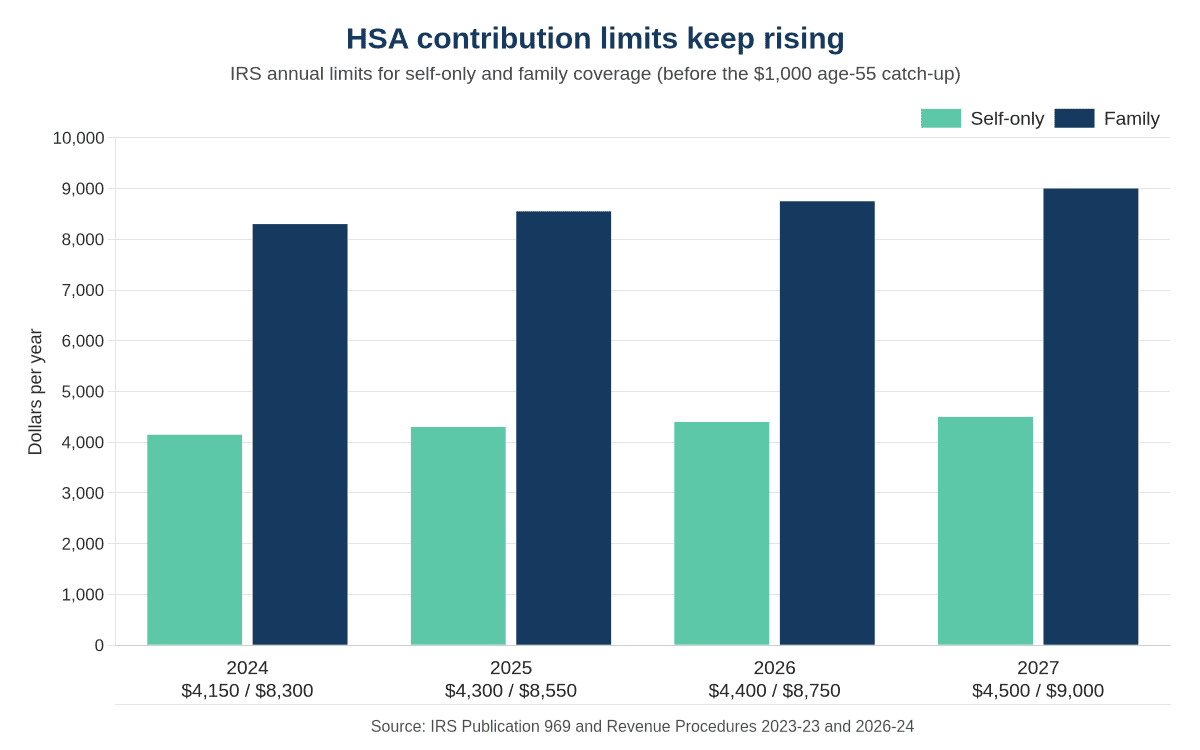
A health savings account (HSA) is a savings account for medical bills that comes with three tax breaks at once. Money goes in before federal income tax, grows without tax, and comes out tax-free when you spend it on qualified medical care. To put money in, you need an HSA-eligible health plan, usually a high-deductible plan. For 2026 you can save up to $4,400 with self-only coverage or $8,750 with family coverage. Those limits rise to $4,500 and $9,000 in 2027, according to the IRS and Revenue Procedure 2026-24.
Open enrollment season is here, so this is the week to decide if an HSA fits you. Start with the five-line check below. Fill in your own numbers, then use the rest of this guide to act on them.
Your five-minute HSA check
Grab your plan options from your employer or the Marketplace and fill in the right-hand column. It takes a few minutes, and it tells you which sections of this guide matter most to you.
| Question | Where to find it | Your answer |
|---|---|---|
| 1. Is one of your plan choices labeled “HSA-eligible” or “HSA-qualified”? | Plan summary or benefits portal | Yes / No |
| 2. Yearly premium difference: (regular plan premium − HSA-eligible plan premium) × 12 | Premium lines in the plan comparison | $______ |
| 3. Will your employer put money into your HSA? How much? | Benefits guide (“employer HSA contribution” or “seed”) | $______ |
| 4. Out-of-pocket max gap: HSA plan out-of-pocket maximum − regular plan out-of-pocket maximum | Summary of Benefits and Coverage | $______ |
| 5. Could you pay the HSA plan’s full out-of-pocket maximum if you had a bad year? | Your savings balance | Yes / Not yet |
How to read it: Add lines 2 and 3. If that total is bigger than line 4, the HSA plan costs you less even in a worst-case year. Even if it’s smaller, the HSA plan can still win in light and middle years, so run the three-year comparison in the section on choosing a plan. If line 5 is “Not yet,” an HSA can still work, but build that cushion first. The section on choosing a plan also walks through a full example.
What’s in this guide
- What an HSA is, in plain English
- Who can contribute (and the new 2026 rules)
- 2026 and 2027 contribution limits
- The three tax breaks, with real numbers
- What you can pay for
- High-deductible plan or traditional plan?
- Spend it now or invest it for later?
- Picking an HSA provider and investments
- HSAs at 65 and beyond
- Nine HSA mistakes that cost real money
- Your seven-step HSA plan
- HSA questions people ask most
What an HSA is, in plain English
Think of an HSA as a personal bank account with a single job: paying for health care. HealthCare.gov defines it as an account that “lets you set aside money on a pre-tax basis to pay for qualified medical expenses” (HealthCare.gov). “Pre-tax” means the money skips federal income tax on the way in.
A few features make HSAs different from almost any other account:
- It’s yours. The account belongs to you, not your employer. If you change jobs, retire or switch health plans, the money stays with you.
- Nothing expires. You don’t have to spend the balance each year. Unused money simply carries over to next year, and the year after that (IRS Publication 969).
- It can be invested. Most HSA providers let you move money beyond a cash cushion into mutual funds or other investments, so it can grow over decades.
- Anyone can add money. You, your employer, or even a relative can contribute, as long as the total stays under your yearly limit.
Still, HSAs are often confused with flexible spending accounts (FSAs). An FSA is owned by your employer’s plan, usually has a “use it or lose it” deadline, and can’t be invested. An HSA has no deadline and moves with you. If your employer offers both, the HSA is the one built for the long haul.
The two pieces you need
Every HSA comes as a pair. Piece one is the health plan, which must be HSA-eligible. Then piece two is the account itself, held at a bank, credit union or investment firm. Your employer may pick the account provider for payroll deposits, but you can usually move the money to a provider you like better later on.
A high-deductible health plan (HDHP) is the classic HSA-eligible plan. The “deductible” is what you pay for covered care each year before the plan starts sharing costs. HDHPs have higher deductibles than many plans, but they usually have lower monthly premiums. Preventive care, such as yearly checkups and many screenings, is generally covered before you meet the deductible.

Who can contribute (and the new 2026 rules)
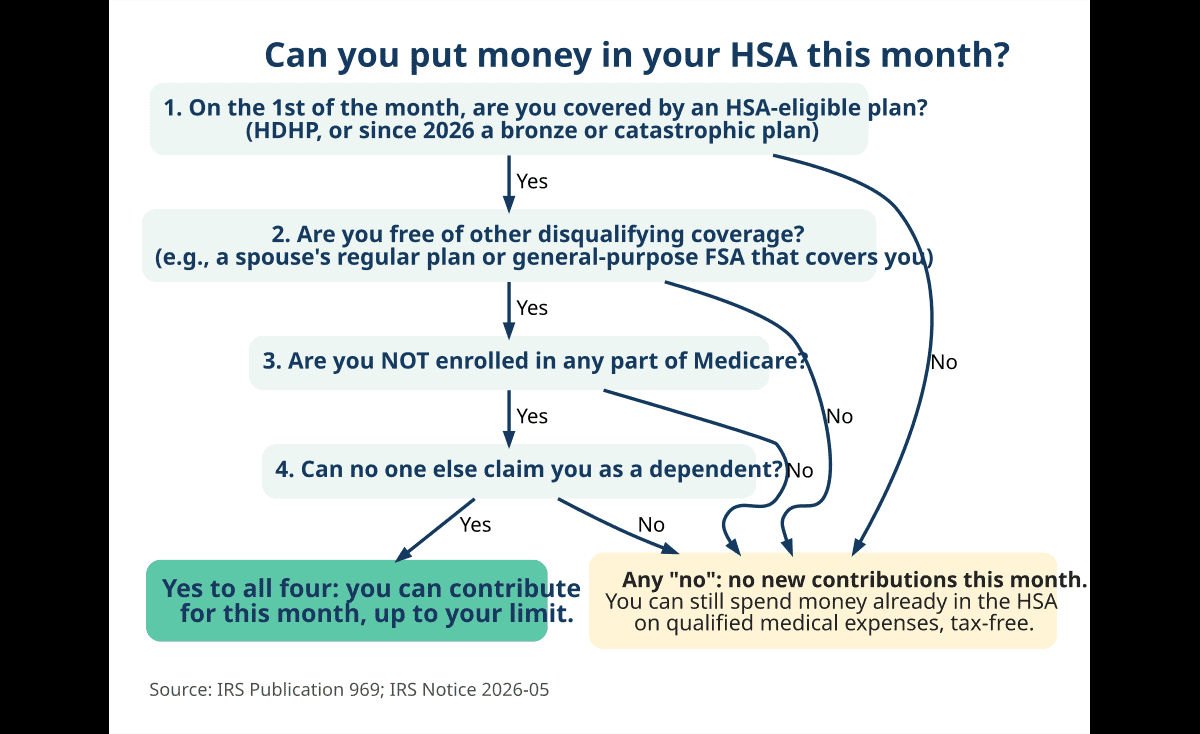
You can put money into an HSA for any month when all four of these are true, per IRS Publication 969:
- You’re covered by an HSA-eligible health plan on the first day of the month.
- You have no other health coverage that isn’t allowed. A spouse’s regular low-deductible plan that covers you, or a general-purpose health FSA, usually counts as other coverage. But dental, vision and some specific coverage are allowed.
- You’re not enrolled in Medicare.
- Nobody can claim you as a dependent on their tax return.
Notice what’s missing from that list: income. There’s no income cap on HSAs, which is different from Roth IRAs. You also don’t need earned income from a job, so an eligible early retiree can still contribute.
What makes a plan “high deductible”
The IRS sets a minimum deductible and a maximum out-of-pocket amount each year. The out-of-pocket maximum is the most you’d pay for covered, in-network care in a year, counting the deductible, copays and coinsurance, but not premiums.
| HDHP rule | 2026 self-only | 2026 family | 2027 self-only | 2027 family |
|---|---|---|---|---|
| Minimum deductible | $1,700 | $3,400 | $1,750 | $3,500 |
| Maximum out-of-pocket | $8,500 | $17,000 | $8,700 | $17,400 |
Sources: IRS Publication 969 (2026 figures) and Rev. Proc. 2026-24 (2027 figures). You don’t have to check these yourself. Plans that qualify are usually labeled “HSA-eligible” or “HSA-qualified.”
Three changes that took effect for 2026
A 2025 federal tax law widened who can use an HSA. The IRS explained the changes in a December 9, 2025, news release and Notice 2026-05:
- Bronze and catastrophic plans now count. Starting January 1, 2026, bronze and catastrophic plans available through a health insurance Exchange are treated as HSA-compatible, even if they don’t meet the usual HDHP definition. The IRS says the plans don’t have to be bought through an Exchange to qualify. This matters especially for self-employed people and others who buy their own insurance.
- Telehealth before the deductible is allowed for good. A plan can cover telehealth and other remote care before you meet the deductible, and you stay HSA-eligible. This is now permanent for plan years beginning on or after January 1, 2025.
- Direct primary care works with an HSA. Starting in 2026, if you’re otherwise eligible and pay a flat monthly fee to a primary care practice (called direct primary care), you can still contribute. You can also pay those periodic fees from your HSA tax-free. The monthly fees can’t exceed $150 for one person or $300 for an arrangement covering more than one person. That cap took effect in 2026 and stays the same for 2027, per Rev. Proc. 2026-24.
Watch out: A spouse’s general-purpose health FSA can knock you out of HSA eligibility, because it can pay your medical bills too. If your spouse signs up for an FSA at work, ask whether it’s a “limited-purpose” FSA (limited to dental, vision and preventive care) or a “post-deductible” FSA. Either is generally compatible with an HSA.
2026 and 2027 contribution limits
The IRS raises HSA limits most years to keep up with inflation. Here’s what you can put in, counting money from every source:
| Coverage type | 2026 limit | 2027 limit | Extra if 55 or older |
|---|---|---|---|
| Self-only HSA-eligible plan | $4,400 | $4,500 | +$1,000 |
| Family HSA-eligible plan | $8,750 | $9,000 | +$1,000 per eligible spouse, in each spouse’s own HSA |
Sources: IRS Publication 969 and Rev. Proc. 2026-24. The $1,000 catch-up applies if you’re 55 or older by the end of the tax year, and it isn’t adjusted for inflation.
Five rules hiding inside that table
1. Employer money counts. If your employer puts $750 into your HSA, you can add only the rest. With self-only coverage in 2026, that’s $4,400 − $750 = $3,650. This includes money you send through payroll, which the IRS also treats as an employer contribution.
2. Married couples share the family limit. Each spouse must have their own HSA, because joint HSAs aren’t allowed. If either spouse has family coverage, the two of you share one family limit, split equally unless you agree on a different split (IRS). So in 2026, an even split is $4,375 each.
3. Each catch-up goes in that spouse’s own account. If both spouses are 55 or older and eligible, each can add $1,000, but each catch-up must go into that spouse’s own HSA. So a couple where only one spouse has an HSA leaves the other catch-up on the table.
HSA rules for part-year coverage and deadlines
4. Part-year coverage usually means a part-year limit. Normally your limit is based on the months you were eligible. The exception is the “last-month rule.” If you’re eligible on December 1, you can contribute the full year’s amount. The catch is a testing period: you must stay eligible through the end of the following year. If you don’t, the extra money becomes taxable income plus a 10% additional tax.
Here’s a hypothetical example. Wendell, a 34-year-old warehouse supervisor, switches to an HSA-eligible plan on December 1, 2026, and contributes the full $4,400 for 2026. If he drops the plan in June 2027, he fails the testing period. Based on one eligible month, his limit would have been about $367 ($4,400 ÷ 12). The other $4,033 counts as income on his 2027 return, and he owes a 10% additional tax of about $403 on top of regular income tax.
5. You have until the tax deadline. You can make contributions for a tax year until that year’s filing deadline. For 2026, that’s April 15, 2027. Put in too much by mistake? Pull out the extra money and what it earned by your filing deadline, including extensions. Otherwise you owe a 6% excise tax for each year it stays in (IRS Publication 969).
Worked example: a married couple with family coverage
Here’s a hypothetical couple. Ines, 56, is a school librarian, and Paul, 52, is a self-employed carpenter. They’re both covered by Ines’s family HSA-eligible plan for all of 2026, and neither has other coverage. Ines’s employer puts $1,000 into her HSA.
| Step | Ines (56) | Paul (52) |
|---|---|---|
| Share of the $8,750 family limit (equal split) | $4,375 | $4,375 |
| Catch-up for being 55 or older | +$1,000 | $0 (not 55 yet) |
| Minus employer money already in that account | −$1,000 | $0 |
| What each can still contribute for 2026 | $4,375 | $4,375 |
Together, $9,750 can go into their two HSAs for 2026, counting the employer’s $1,000. They could also agree on a different split of the $8,750, such as putting more in Paul’s account. The catch-up, though, can only go into Ines’s account. Paul already has his own HSA, so he can add his own catch-up there once he turns 55.
How much should you put in?
Of course, the limit is a ceiling, not a target you have to hit. Think of your HSA contribution in three levels, and climb as your budget allows:
- Cover what you expect to spend. Add up last year’s copays, prescriptions, dental and vision costs. Contributing at least that much means you pay those bills with pre-tax money instead of after-tax money.
- Build up to your deductible. Over a year or two, try to get your HSA balance up to your plan’s deductible. Then a surprise bill is covered without touching your other savings.
- Max it out. Once your emergency savings are solid and you’re getting any 401(k) match at work, aim for the full limit. Every extra dollar can be invested for later health costs.
Even level one helps. Moving $1,000 of yearly medical spending into a payroll HSA saves about $297 in federal income, Social Security and Medicare taxes for someone in the 22% bracket. That’s money you’d spend anyway, just with a discount.
Pro tip: Turning 55 any time in 2026? You qualify for the full $1,000 catch-up for 2026, even with a December 31 birthday. You just need to be HSA-eligible all year (or qualify under the last-month rule). Add it to your payroll election now so it’s spread across your paychecks.
The three tax breaks, with real numbers
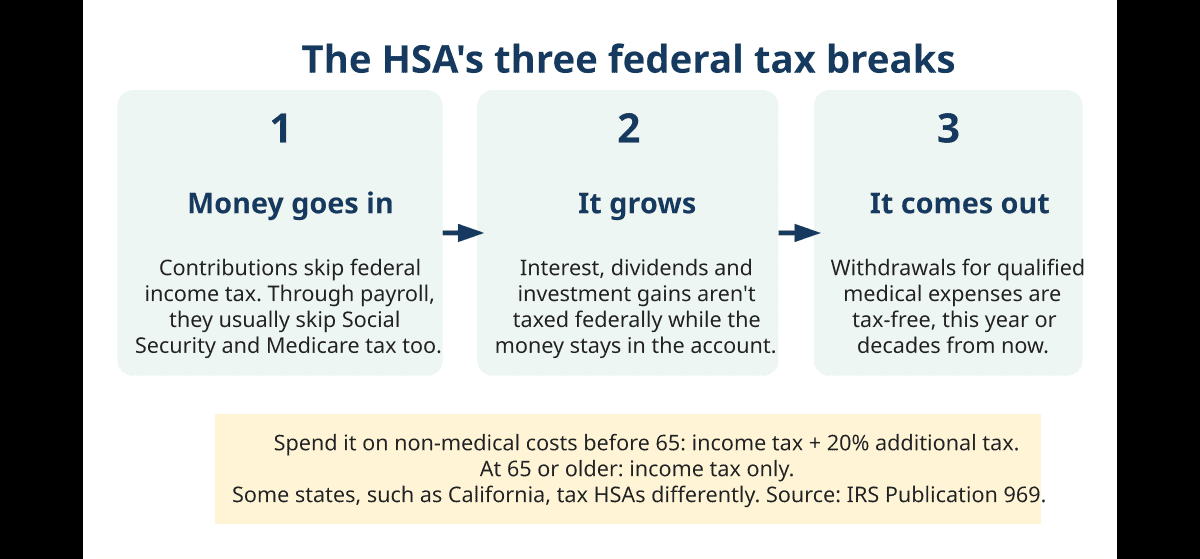
People call the HSA “triple tax-advantaged” because it gets a break at every stage. Fidelity describes it the same way: pre-tax contributions, tax-free growth and tax-free withdrawals for qualified medical expenses at the federal level (Fidelity).
Here’s how each break works:
- Going in: Contributions through payroll come out before federal income tax. If you contribute on your own, you deduct them on your tax return using Form 8889, even if you don’t itemize.
- While it grows: Interest, dividends and investment gains aren’t taxed by the federal government while they stay in the account.
- Coming out: Money you spend on qualified medical expenses is tax-free.
There’s a fourth, quieter break for workers. When you contribute through your employer’s payroll (a “cafeteria plan”), the money generally also skips Social Security and Medicare taxes. IRS Publication 15-B lists HSA contributions as “exempt for qualified individuals up to the HSA contribution limits” in its table of employment taxes (IRS Publication 15-B). For most workers, those two taxes add up to 7.65% of pay. A 401(k) doesn’t get this extra break. Contributions you make on your own, outside payroll, don’t get it either.
Worked example: what $4,400 really costs you
Let’s say you’re single, in the 22% federal tax bracket, and you put the full 2026 limit of $4,400 into your HSA through payroll. (Not sure of your bracket? Our guide to how federal income taxes work explains it.)
| Item | Math | Amount |
|---|---|---|
| Federal income tax you don’t pay | $4,400 × 22% | $968.00 |
| Social Security and Medicare tax you don’t pay | $4,400 × 7.65% | $336.60 |
| Total federal tax savings | $1,304.60 | |
| Real cost to your take-home pay | $4,400 − $1,304.60 | $3,095.40 |
In other words, you put $4,400 toward health care, and in this example your paychecks shrink by only about $3,095 over the year. Many states add a state tax break on top. Your exact savings depend on your bracket and on whether your earnings are above the Social Security wage cap.
What if you’re in a lower bracket? At 12%, the same $4,400 saves $528 in federal income tax plus $336.60 in Social Security and Medicare tax, or $864.60 in total. The payroll tax savings stay the same, which is why HSAs can be a good deal even for people who don’t pay much income tax.
Watch out for state taxes: Not every state follows the federal rules. California, for example, does not let you deduct HSA contributions and adds employer HSA contributions back to your state income. It also taxes HSA interest and earnings “in the year earned,” according to the California Franchise Tax Board. If you live in a state with its own income tax, check your state tax agency’s rules before you count on a state break.
What you can pay for with an HSA
Qualified medical expenses are costs for medical care as the tax code defines it, for you, your spouse and your dependents. That covers far more than doctor visits. Common examples include:
- Deductibles, copays and coinsurance for doctor, hospital and urgent care visits
- Prescription drugs, plus over-the-counter medicines like pain relievers and allergy pills, which no longer need a prescription (IRS)
- Menstrual care products (IRS)
- Dental care such as cleanings, fillings and braces
- Vision care, including eye exams, glasses and contact lenses
- Mental health care, such as therapy visits
- Lab work, X-rays, physical therapy and hearing aids
- Direct primary care membership fees, starting in 2026, within the IRS limits
Two rules trip people up. First, the expense has to happen after you open the HSA. A bill from before the account existed doesn’t qualify, even if you pay it later. Second, health insurance premiums usually don’t qualify. The exceptions are long-term care insurance (up to age-based limits), COBRA continuation coverage, and health coverage while you’re receiving unemployment benefits. Once you’re 65, Medicare premiums and other health coverage also count, except Medigap policies (IRS Publication 969).
Keep your receipts. The IRS says your records must show three things:
- Each withdrawal paid for a qualified medical expense.
- The expense wasn’t paid or reimbursed from another source.
- You didn’t also deduct it on your tax return.
You don’t send these records with your tax return, but you’ll need them if the IRS asks.
What happens if you spend it on something else
Before age 65, money you take out for non-medical costs gets hit twice: it’s added to your taxable income, and you owe an additional 20% tax. Starting at 65, or if you become disabled, the 20% penalty goes away, though you still owe regular income tax on non-medical withdrawals (IRS Publication 969).
Example: at age 50, in the 22% bracket, you pull out $2,000 for a vacation. You’d owe $440 in income tax plus a $400 penalty, for a total of $840. That’s 42% of the withdrawal gone. But the same $2,000 spent on a crown at the dentist costs you $0 in tax.
High-deductible plan or traditional plan? Run the numbers
An HSA only helps if the health plan behind it makes sense for you. The right way to compare plans is to add up the full year. Take the premiums, add what you’d pay out of pocket for care, and subtract any money your employer puts in your HSA. NerdWallet suggests comparing plans on five things: the monthly premium, the deductible, copays and coinsurance, the out-of-pocket maximum, and any employer HSA contribution (NerdWallet).
Side-by-side: one worker, three kinds of years
Here’s a hypothetical comparison for one person choosing between two employer plans. These are made-up but realistic numbers. Your plans will be different, so swap in your own.
- Traditional plan (PPO): $120 a month in premiums, $1,000 deductible, then 20% coinsurance, $4,000 out-of-pocket maximum.
- HSA-eligible plan (HDHP): $70 a month in premiums, $2,500 deductible, then 20% coinsurance, $5,500 out-of-pocket maximum, and the employer adds $750 to the HSA.
| Kind of year | Traditional plan: premiums + care | HSA plan: premiums + care − employer HSA money | Cheaper plan |
|---|---|---|---|
| Light year: $600 of care (checkup is free; a few visits and a prescription) | $1,440 + $600 = $2,040 | $840 + $600 − $750 = $690 | HSA plan, by $1,350 |
| Middle year: $3,000 of care | $1,440 + $1,400 = $2,840 | $840 + $2,600 − $750 = $2,690 | HSA plan, by $150 |
| Heavy year: $25,000 of care (a surgery) | $1,440 + $4,000 = $5,440 | $840 + $5,500 − $750 = $5,590 | Traditional plan, by $150 |
How the care costs were figured: in the middle year, the traditional plan’s bill is the $1,000 deductible plus 20% of the remaining $2,000 ($400). The HSA plan’s bill is the $2,500 deductible plus 20% of the remaining $500 ($100). In the heavy year, both plans hit their out-of-pocket maximums.
This example doesn’t count the tax savings on money you add to the HSA yourself, which would tilt things further toward the HSA plan. It also assumes you stay in network. The big lesson: in this example, the HSA plan wins two years out of three and loses by only $150 in a very bad year. But that only holds if you could come up with up to $5,500 in a bad year. That’s why line 5 of the quick check matters.
Read this before you trust the numbers: The plan example uses made-up premiums and deductibles, assumes all care is in network, and treats coinsurance as a flat 20% after the deductible. Real plans have copays, separate drug tiers and different networks. The investment examples below assume steady returns and deposits made once at the end of each year. Markets don’t move in a straight line, and fees lower returns. Use the method, not the exact results.
Who usually does well with an HSA plan
- People who are generally healthy and don’t expect big medical bills
- People who could pay the deductible within about a month if a surprise bill arrived
- Workers whose employer adds a generous HSA contribution
- Savers who’d like a tax-advantaged place to build money for later medical costs
Who might be better off with a lower deductible
NerdWallet points to these groups:
- People who are pregnant or planning to be, and families with small children
- People with chronic conditions who see doctors often
- People who take several prescriptions or one very expensive drug
- Anyone who simply can’t afford a high deductible
Even then, run the numbers. A low-premium HSA plan with a big employer contribution can sometimes beat a traditional plan, even for someone with ongoing care needs.
Schwab sums up the trade-off well. It says an HSA “can be a very good deal, especially for someone in their 20s and 30s who’s just starting out.” But the benefit applies “provided you can cover the higher deductible” (Charles Schwab).
Pro tip: If you pick the HSA plan, set aside part of what you save on premiums each month. If your HSA balance reaches your deductible, a surprise bill won’t touch your emergency fund.

Spend it now or invest it for later?
Here’s where HSA strategy splits into two camps. Some people use the HSA as a checking account for this year’s medical bills. Others instead leave the money invested for decades and treat it as a retirement account for health care. Both are legitimate. What’s right for you depends on your cash flow, your health costs and how much you’re already saving for retirement.
What the experts say: two views worth hearing
The bullish view says an HSA is one of the best retirement savings tools there is. No other account gets a tax break on the way in and on the way out for the same dollars. Some planners go further and stop thinking of it as a medical account at all:
“I almost don’t think of them as health savings accounts, but profoundly tax-beneficial retirement accounts,”
Andy Baxley, certified financial planner at The Planning Center (title as of 2022), to CNBC, May 2022
The cautious view points out that the accounts don’t help much if people can’t afford to put money in them. A 2020 University of Michigan survey of more than 1,600 people in high-deductible plans found that about one-third of those who could benefit from an HSA hadn’t opened one. Half of those who had opened one had put nothing in during the past year (University of Michigan IHPI). The researcher who led the study put it this way:
“These findings are concerning, given that nearly half of Americans with private insurance now have high-deductible plans,”
Jeffrey Kullgren, M.D., M.S., MPH, then an assistant professor of internal medicine at the University of Michigan Medical School, in a University of Michigan IHPI news release, August 2020
Both views can be true at once. If your budget is tight, the HSA’s first job is to make your deductible less scary. Once you can handle a bad year from savings, the long-term investing strategy starts to make sense.
How people actually use their HSAs
Most accounts are still small and sit in cash. The Employee Benefit Research Institute (EBRI) tracks millions of HSAs. In its August 2026 report, the average balance reached a record $5,532 at the end of 2024, up from $4,747 a year earlier. But only 18% of account holders invested any of their money (EBRI).
“What stands out from this long-term analysis is that people use their HSAs differently the longer they have their accounts,”
Paul Fronstin, director of health benefits research at the Employee Benefit Research Institute (EBRI), to SHRM, August 2026
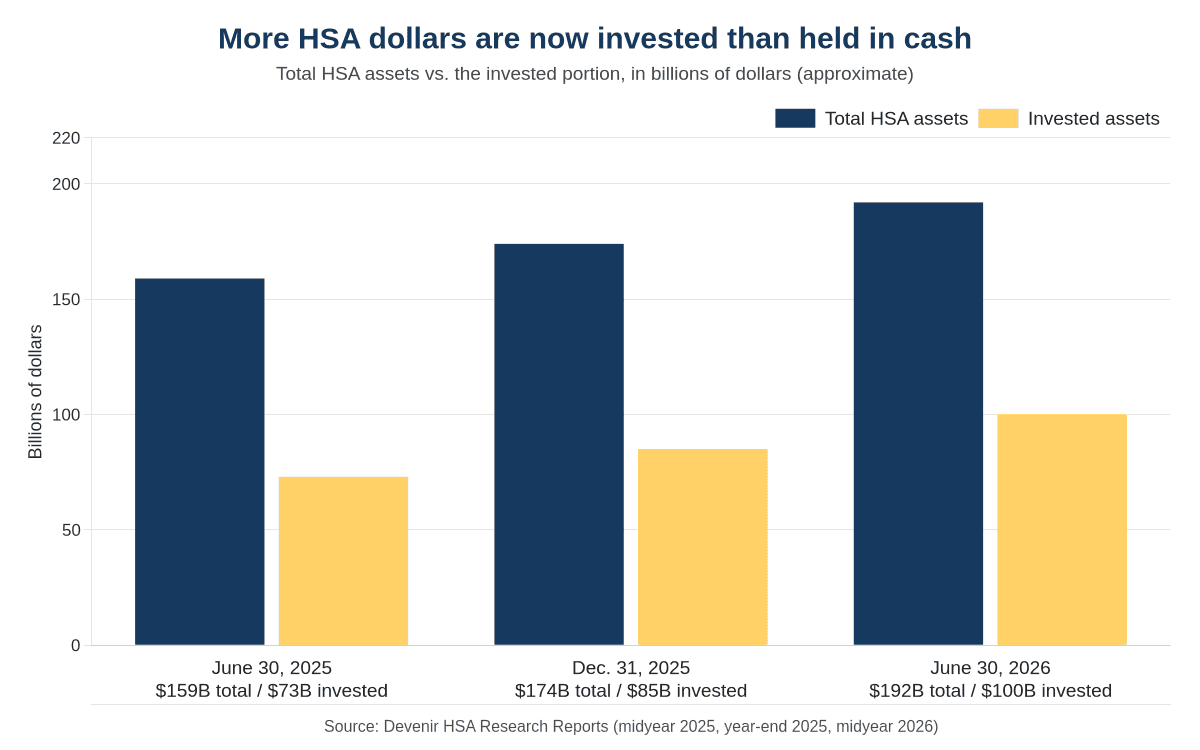
The money in the overall market tells a slightly different story, because a smaller group of long-time savers holds big invested balances. Devenir, a research firm that surveys HSA providers, found that HSAs held about $192 billion across 42.6 million accounts as of June 30, 2026. For the first time, more than half of those dollars (52%) were invested rather than sitting in cash (InvestmentNews, reporting Devenir’s midyear 2026 data).
Worked example: the cost of leaving it in cash
Let’s say you add $3,000 at the end of each year for 25 years and never take any out. Here’s how two choices compare. These are hypothetical, steady returns. Of course, real investments go up and down, and you can lose money.
| Where the money sits | Assumed yearly return | Total you put in | Balance after 25 years |
|---|---|---|---|
| Cash in the HSA | 0.5% | $75,000 | $79,677 |
| Invested in a diversified fund | 6% | $75,000 | $164,594 |
The difference, about $85,000, comes from growth that’s never taxed federally if you spend it on medical care. That’s the case for investing the part of your HSA you won’t need soon.
The “shoebox” strategy: pay now, reimburse yourself later
The IRS says “there is no time limit on when the distribution must occur” (IRS Notice 2004-50). The expense just has to happen after you opened the HSA, and you need records to prove it (IRS Publication 969). That opens up a clever move. If you can afford it, pay small medical bills from your regular checking account, save the receipts, and leave the HSA money invested. Years later, you can withdraw tax-free for those old receipts.
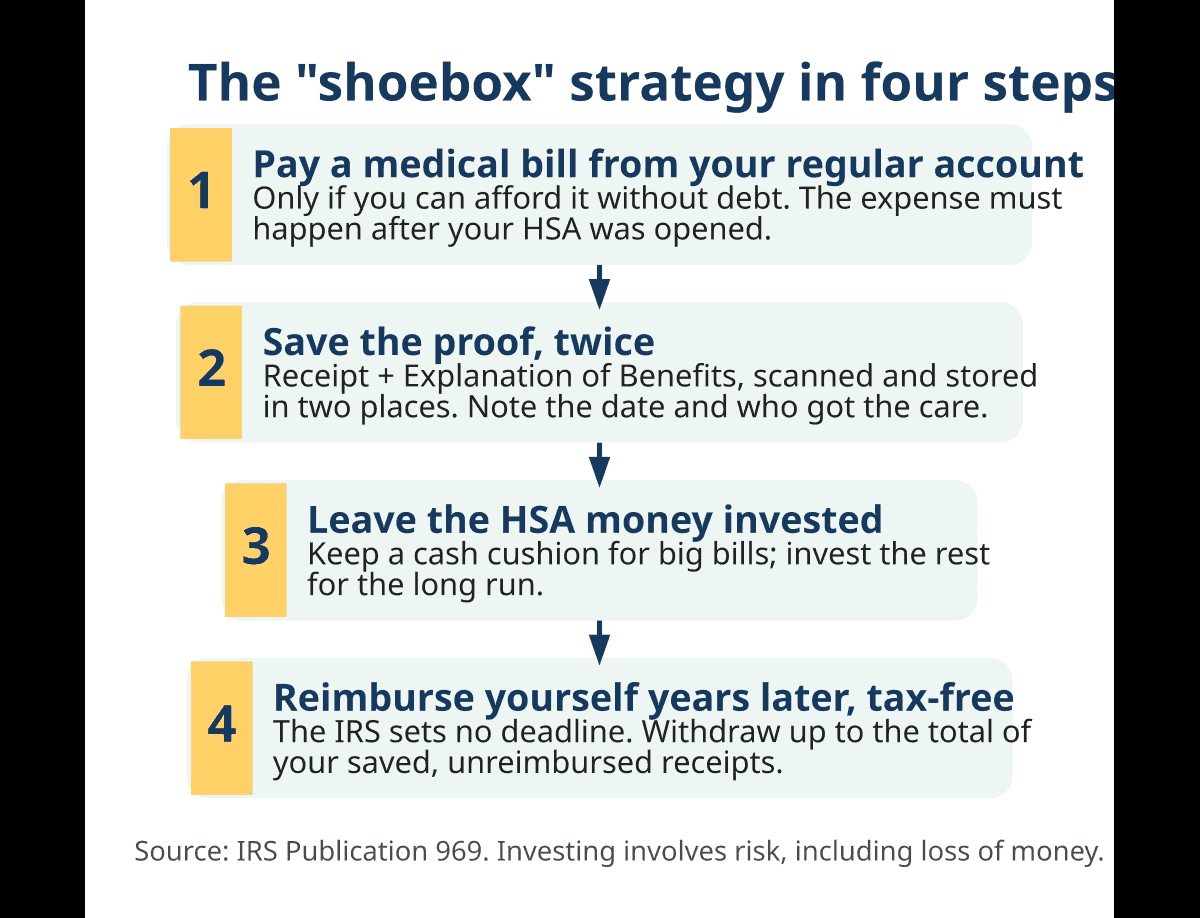
Here’s a hypothetical example. In 2026, you pay a $1,200 dental bill with your debit card instead of your HSA. You leave that $1,200 invested. If it grows at an assumed 6% a year for 20 years, it becomes about $3,849. In 2046, you can pull out $1,200 tax-free using your 2026 receipt, and the other $2,649 of growth stays invested for future medical bills.
Watch out: This only works if you keep good records. Scan each receipt and Explanation of Benefits, and note the date and who got the care. Store them in two places, such as a cloud folder and an email to yourself. Faded paper receipts from 2026 won’t help you in 2046.
Picking an HSA provider and investments
If you get your HSA through work, your employer picks the provider that receives payroll deposits. You’re not stuck there forever, though. You can usually move money to another HSA provider with a direct trustee-to-trustee transfer. If you take the money out yourself and redeposit it, that’s a rollover. It must happen within 60 days, and you get only one per 12 months (IRS Publication 969).
Many people keep the workplace HSA for new payroll deposits, so they keep the payroll tax break. Then they move money once or twice a year to a provider with better investments or lower fees.
What to compare
| Feature | What to look for | Why it matters |
|---|---|---|
| Monthly account fee | $0, or waived above a small balance | A $3 monthly fee is $36 a year, which eats into a small balance fast |
| Cash minimum before investing | Low or none | Some providers have minimum balance or minimum investment requirements before you can invest (NerdWallet; Charles Schwab) |
| Investment choices | Low-cost index funds or a target-date fund | Fund expense ratios add up over decades |
| Interest on cash | Competitive rate on the cash portion | Your spending money should still earn something |
| Tools | Receipt upload, debit card, easy online reimbursements | Makes the shoebox strategy painless |
Should you move your HSA?
Moving makes sense if your current account charges a monthly fee you can’t avoid, offers only high-cost funds, or requires a big cash balance before you can invest. It may not be worth the effort if your balance is small and you spend most of it each year. Before you move, check two things: whether the old provider charges a closing or transfer fee, and whether you’ll lose access to an employer-paid fee waiver. If you leave a job, your old HSA stays yours, but the employer may stop paying its fees.
How to invest the money
Treat your HSA like a layered account. Keep enough in cash to cover a year’s expected medical costs, or your deductible if you’d use the HSA for a bad year. Invest the rest based on when you’ll need it. Money you don’t expect to touch for 15 or 20 years can go into a broad, low-cost stock index fund or a mix of stock and bond funds. If index funds are new to you, our guide to index funds explained covers how they work.
One more thing: your HSA investments are part of your whole retirement picture. If your 401(k) is already in a broad stock fund, you don’t need a different fund in your HSA just to feel diversified. You can hold the same kind of fund, or use the HSA for the bond part of your mix.
For a short overview, this video from Fidelity Investments answers five common questions about HSAs, including who qualifies and how an HSA can help with health costs in retirement. It was published in October 2025, so any dollar figures in it may be out of date.
HSAs at 65 and beyond
Health care is one of the biggest bills in retirement. Fidelity estimates that a single 65-year-old retiring in 2026 can expect to spend an average of $185,500 on health care and medical expenses in retirement. That’s up 7.5% from a year earlier (Fidelity). That figure covers Medicare premiums, copays and out-of-pocket prescription costs. But it doesn’t include long-term care, which can cost far more.
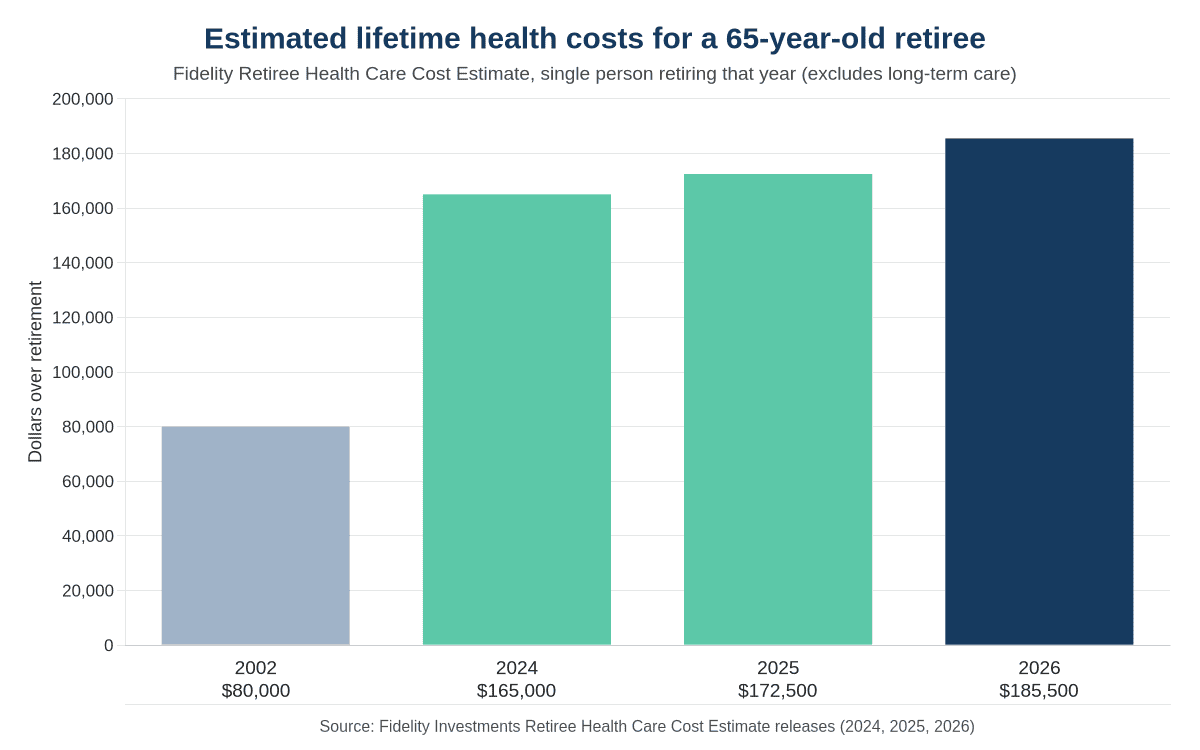
Fidelity’s first estimate, in 2002, was $80,000 (Fidelity). The number has more than doubled since then. An HSA built up during your working years is one of the few ways to pay those costs with money that was never taxed.
What changes at 65
- The 20% penalty ends. Starting at 65, you can take money out for anything. Still, non-medical withdrawals are taxed as income, a lot like a traditional IRA. Medical withdrawals stay tax-free.
- More premiums qualify. At 65 and older, you can use your HSA for Medicare premiums and other health coverage premiums. Medigap (Medicare Supplement) premiums are the exception and don’t qualify. A spouse’s Medicare premiums generally count only once you, the account holder, are 65 (IRS Publication 969).
- There are no required withdrawals. The IRS says you don’t have to take money out of an HSA each year. Unlike a traditional IRA or 401(k), an HSA has no required minimum distributions during your lifetime. (Our guides on the 401(k) and Roth vs. traditional IRAs cover those accounts’ rules.)
A sample retirement drawdown
Here’s a hypothetical. Suppose you reach 65 with $60,000 in your HSA and spend $3,000 a year from it on Medicare premiums, copays, glasses and dental work. Without any further growth, the money would last 20 years. If the invested part keeps growing, it would last longer. Either way, every one of those dollars came out without federal income tax. Pay the medical bills from the HSA, and let your 401(k) or IRA cover everyday living costs.
The Medicare timing trap
Once you’re enrolled in Medicare, you can’t contribute to an HSA anymore. Your limit is zero starting the first month you’re enrolled (IRS Publication 969). You can still spend the money you already have.
The trap is a backdating rule. If you sign up for Medicare Part A after you turn 65, Medicare.gov says “Your Part A coverage starts 6 months back from when you sign up or when you apply for benefits from Social Security.” It can’t start earlier than the month you turned 65 (Medicare.gov). Any HSA contributions you made during those backdated months become excess contributions.
Here’s the practical fix if you’re working past 65 and plan to sign up for Medicare later. Stop HSA contributions six months before you apply for Medicare, but not before the month you turn 65. The same goes for Social Security retirement benefits. The Social Security Administration says that if you’re 65 or older and receive Social Security benefits, “you will be automatically enrolled in Part A” (SSA). If you’re unsure, talk with your benefits office before you file.
What happens to an HSA when you die
Name a beneficiary. If your spouse is the beneficiary, the account simply becomes your spouse’s HSA, with the same tax breaks. But if anyone else inherits it, the account stops being an HSA, and its value becomes taxable income to that person in the year you die (IRS Publication 969). If your estate is the beneficiary, the value goes on your final tax return. That’s one more reason to spend down an HSA during retirement rather than treat it as an inheritance for children.

Nine HSA mistakes that cost real money
- Contributing while not eligible. Adding money after you leave an HSA-eligible plan, enroll in Medicare, or join a spouse’s regular plan or general-purpose FSA creates excess contributions. Those carry a 6% tax each year until you fix them.
- Forgetting employer money counts toward the limit. Your contributions plus your employer’s can’t exceed the limit. Check your pay stubs in the fall.
- Leaving everything in cash for decades. Cash is right for near-term bills. For money you won’t touch for 10 years or more, cash can quietly cost you tens of thousands of dollars of growth.
- Losing the receipts. No records, no proof. The shoebox strategy falls apart without them.
- Paying for things that don’t qualify. Regular health insurance premiums (before 65), gym memberships and general wellness items usually don’t qualify. Look it up before you swipe the HSA card.
- Contributing outside payroll when payroll is available. Contributions through your employer skip Social Security and Medicare taxes. But contributions from your own bank account don’t.
- Missing the catch-up. At 55, you can add $1,000 more. Married couples where both spouses are 55 or older need two separate HSAs to get both catch-ups.
- Getting tripped up by the last-month rule. Contributing a full year after joining a plan late in the year is fine, but only if you stay eligible through the next year.
- Choosing an HSA plan you can’t afford to use. If a $2,500 deductible would push you onto a credit card, delaying care or going into debt can cost more than any tax break saves.
Pro tip: If you contributed too much, ask your HSA provider for a “removal of excess contribution” before your tax filing deadline. Pull out the earnings on that money too, and report them as income.
Your seven-step HSA plan
- Do the five-line quick check at the top of this guide with your actual plan options during open enrollment.
- Price three kinds of years. Use the side-by-side method: a light year, a middle year and a bad year. Pick the plan that you can afford in the bad year and that costs less in the years you’re most likely to have.
- Set your payroll contribution. At a minimum, contribute enough to cover your expected medical costs. If you can, aim for the full limit, minus what your employer adds. For 2026 self-only coverage with a $750 employer deposit, that’s $3,650, or about $140 per paycheck if you’re paid every two weeks.
- Build your HSA cash cushion. Keep enough in cash to cover your deductible, or at least next year’s expected costs.
- Invest the rest. Pick a low-cost, diversified fund for money you won’t need for years. Turn on automatic investing if your provider offers it.
- Set up a receipt system. One folder, two copies, labeled by year. Save every Explanation of Benefits along with receipts.
- Name a beneficiary and calendar the big dates. Your spouse is usually the best choice. Put two reminders on your calendar: April 15 (the contribution deadline for the prior year) and six months before you plan to sign up for Medicare.

The short version
- An HSA gives you three federal tax breaks: money goes in tax-free, grows tax-free, and comes out tax-free for qualified medical care.
- For 2026 the limits are $4,400 (self-only) and $8,750 (family). For 2027 they’re $4,500 and $9,000. People 55 and older can add $1,000.
- You must be covered by an HSA-eligible plan, have no disqualifying coverage, not be on Medicare, and not be someone’s dependent.
- Since January 1, 2026, bronze and catastrophic plans count as HSA-compatible, and direct primary care with fees within the IRS cap no longer blocks you.
- Contributing through payroll also saves Social Security and Medicare taxes, which is 7.65% for most workers.
- Compare plans by total yearly cost in a light, middle and bad year, and pick the HSA plan only if you could handle its out-of-pocket maximum.
- Keep a cash cushion for near-term bills, invest the rest, and save receipts so you can reimburse yourself years later.
- If you enroll in Medicare after 65, stop contributing six months before you sign up for Medicare or apply for Social Security, but not before the month you turn 65.
HSA questions people ask most
Can I have an HSA if my employer doesn’t offer one?
Yes. If you have an HSA-eligible health plan, including one you buy yourself, you can open an HSA on your own at a bank, credit union or brokerage. You’ll contribute from your bank account and take the deduction on your tax return using Form 8889. You just won’t get the Social Security and Medicare tax savings that payroll contributions get.
What happens to my HSA if I leave my job?
Your HSA stays yours. The account and all the money in it belong to you. You can keep it where it is, move it to another provider, and keep spending it on qualified expenses. You can only add new money for months when you’re covered by an HSA-eligible plan.
Is an HSA better than a 401(k)?
They do different jobs, and many people use both. A common order is to first contribute enough to your 401(k) to get any employer match, then fund the HSA, then go back to the 401(k) or an IRA. The HSA’s edge is that the same dollars can go in before federal tax and come out tax-free for medical costs. No 401(k) or IRA gets both of those breaks.
Can I use my HSA for my spouse or kids?
Yes. You can pay qualified medical expenses for yourself, your spouse and your tax dependents from your HSA, even if they’re not on your health plan. An adult child under 26 who’s on your health plan but isn’t your tax dependent doesn’t count.
Can I move money from an IRA into an HSA?
Once in your lifetime, you can move money from a traditional or Roth IRA into your HSA. It’s called a “qualified HSA funding distribution,” and it’s capped at that year’s contribution limit (IRS Publication 969). It counts toward your yearly HSA limit, and you have to stay HSA-eligible for a 12-month testing period afterward. It can’t come from an ongoing SEP or SIMPLE IRA.
Do I have to file anything with my taxes?
Yes. If you or your employer put money in, or you took money out, you file Form 8889 with your federal return. Your HSA provider will send you Form 5498-SA (contributions) and Form 1099-SA (withdrawals) to help.
Are HSA withdrawals reported to the IRS?
Yes. Your provider reports withdrawals on Form 1099-SA. You show on Form 8889 how much went to qualified medical expenses. That’s why receipts matter.
What if I’m self-employed?
You can still use an HSA if your health plan qualifies. If you buy your own coverage, the 2026 change that makes bronze and catastrophic plans HSA-compatible gives you more options. You’ll deduct your contributions on your tax return, but because you’re not contributing through an employer’s cafeteria plan, you won’t get the payroll tax break.
Your first move
Before your open enrollment window closes, fill in the five-line quick check at the top of this guide with your real plan options. Then price a bad year for each plan. If the HSA plan comes out ahead and you could cover its out-of-pocket maximum, it’s likely the better choice. Set a payroll contribution that at least covers your expected medical costs for 2027.
About this guide
Published by Daniel Brienza, founder and editor of Sensible Money Guide (B.S. in Business Administration, University of South Florida). This guide was researched and drafted with the help of AI tools, then fact-checked against the primary sources listed below before publishing. Daniel is not a licensed financial advisor; this guide is for general education.
Published October 27, 2026. Figures are current as of that date.
Sources
Government and official sources
- Internal Revenue Service, Publication 969 (2025), Health Savings Accounts and Other Tax-Favored Health Plans, accessed October 2026.
- Internal Revenue Service, Revenue Procedure 2026-24 (2027 HSA and HDHP amounts), 2026.
- Internal Revenue Service, Revenue Procedure 2023-23 (2024 HSA amounts), 2023.
- Internal Revenue Service, Treasury, IRS provide guidance on new tax benefits for health savings account participants (IR-2025-119), December 9, 2025.
- Internal Revenue Service, IRS outlines changes to health care spending available under CARES Act, 2020; accessed October 2026.
- Internal Revenue Service, Publication 15-B (2026), Employer’s Tax Guide to Fringe Benefits, accessed October 2026.
- Internal Revenue Service, Notice 2026-05 (expanded HSA eligibility), December 2025.
- Internal Revenue Service, Notice 2004-50, Health Savings Accounts: additional questions and answers, 2004.
- Social Security Administration, When to sign up for Medicare, accessed October 2026.
- Medicare.gov (Centers for Medicare & Medicaid Services), When does Medicare coverage start?, accessed October 2026.
- HealthCare.gov, Health Savings Account (HSA) glossary entry, accessed October 2026.
- California Franchise Tax Board, 2024 Instructions for Schedule CA (540), California Adjustments, accessed October 2026.
Banks, investment firms and research
- Fidelity Investments, Fidelity Investments Shares 25th Annual Retiree Health Care Cost Estimate, July 21, 2026.
- Fidelity Investments, Fidelity Investments Releases 2025 Retiree Health Care Cost Estimate, July 30, 2025.
- Fidelity Investments via Business Wire, Fidelity Investments Releases 2024 Retiree Health Care Cost Estimate, August 8, 2024.
- Charles Schwab (Patrick Means), What Is an HSA? A Guide to Health Savings Accounts, November 4, 2025.
- Devenir, 2025 Year-End Devenir HSA Research Report, 2026.
- Devenir, 2025 Midyear Devenir HSA Research Report, October 9, 2025.
- Employee Benefit Research Institute (EBRI), Trends in Health Savings Account Balances, Contributions, Distributions, and Investments, 2011–2024, August 13, 2026.
- University of Michigan Institute for Healthcare Policy and Innovation, People with high-deductible health plans aren’t using health savings account option as intended, August 14, 2020.
- Fidelity Investments (YouTube), Health Savings Accounts (HSAs) Explained | 5 Questions With Fidelity, October 2025.
News and personal finance media
- InvestmentNews, HSA investment assets top $100 billion as investing overtakes cash, October 2026.
- SHRM (Kathryn Mayer), HSA Balances Hit Record — But One Thing Is Falling Short, August 25, 2026.
- CNBC, Here’s the best way to use a health savings account, which offers a triple-tax advantage, May 25, 2022.
- NerdWallet (Lacie Glover and Kate Ashford), Should You Choose a High-Deductible Health Plan?, updated November 23, 2025.
- NerdWallet (Alana Benson), How To Invest With Your HSA — And Why You Should, updated September 26, 2025.
This article is for educational purposes only and isn’t financial advice. Consider talking with a qualified professional about your situation.


HSA Rules for 2026 and 2027: Limits, Taxes and Smart Uses

Asset Allocation by Age: How to Mix Stocks, Bonds and Cash

Debt Consolidation in 2026: Loans, Transfers and Pitfalls

How to Build Credit From Scratch: Your First-Year Plan

How Does a 401(k) Work? Matching, Taxes and 2026 Limits

How to Pay Off Credit Card Debt: Avalanche, Snowball and More

How to Make a Budget That Actually Works, Step by Step

How Much Emergency Savings Do You Need? Find Your Number

How Credit Scores Work: FICO Factors and Ways to Improve

You must be logged in to post a comment Login