

Budgeting
Sinking Funds: How to Save for Irregular Expenses
Sinking funds turn lumpy bills like car insurance, gifts and vet visits into one monthly amount. Use our worksheet, real cost data and catch-up math.

Sinking funds are small savings pots you fill a little each month for known bills that don’t come monthly. Think car insurance, holiday gifts, vet visits or property taxes. Add up what those bills cost in a year, divide by 12, and move that amount into savings every payday. When the bill arrives, the cash is waiting, so you’re less likely to need a credit card or your emergency fund.
Here’s how a sinking fund compares with the two other places your money goes.
| Pot | What it pays for | Examples | How you fill it |
|---|---|---|---|
| Monthly budget | Bills that hit every month for about the same amount | Rent, phone, groceries, streaming | Each paycheck, spent the same month |
| Sinking fund | Known costs that come a few times a year or less | Car insurance, registration, gifts, school costs, vet checkups | A set amount each month, saved until the bill comes |
| Emergency fund | True surprises you can’t plan around | Job loss, a big medical bill, a burst pipe | Built once, then refilled after you use it |
This guide shows what irregular costs really add up to for U.S. households, gives you a worksheet to find your own monthly number, and walks through setup, catch-up math and the mistakes that drain these funds.
What’s in this guide
- What a sinking fund is (and isn’t)
- What irregular costs really add up to
- Which costs belong in a sinking fund?
- Find your number: the sinking fund worksheet
- Starting late? The catch-up formula
- What skipping it costs: a sinking fund vs. a credit card
- Where to keep your sinking funds
- One account or many? What the experts say
- Homeowners: escrow is a sinking fund you may already have
- When you’re in debt or your income swings
- Set it up this week: a 6-step plan
- Mistakes that drain sinking funds
- Questions people ask
What a sinking fund is (and isn’t)
A sinking fund is money you set aside on a schedule for one specific, expected expense. The name comes from corporate finance, where a company puts money aside over time to pay off (“sink”) a bond. In personal finance, the idea is the same: you pay for a big bill in small pieces before it’s due instead of after.
“A sinking fund is designed to handle anticipated, non-regular expenses without disrupting your usual financial flow.”
Jeff Rose, then a CFP and founder of GoodFinancialCents.com, to GOBankingRates (2023)
That makes it different from an emergency fund. A Ramsey Solutions guide sums up the split as known costs versus unknown ones. A sinking fund covers the bills you can see on the calendar. An emergency fund covers the shocks you can’t.
It’s also different from general savings. A general savings account has no job assigned to it. Each sinking fund has a name, a target amount and a due date, so you know exactly when the money will leave.
Why it works
Most budgets break on the months that aren’t “normal.” A monthly budget handles rent and groceries well. It falls apart in the month the car insurance renews, two birthdays land and the dog needs shots. Sinking funds smooth those spikes into one steady monthly line.

What irregular costs really add up to
Federal survey data shows the real scale. In the Bureau of Labor Statistics’ Consumer Expenditure Survey (data via FRED), the average U.S. household spent these amounts in 2024 on five costs that often arrive in lumps:
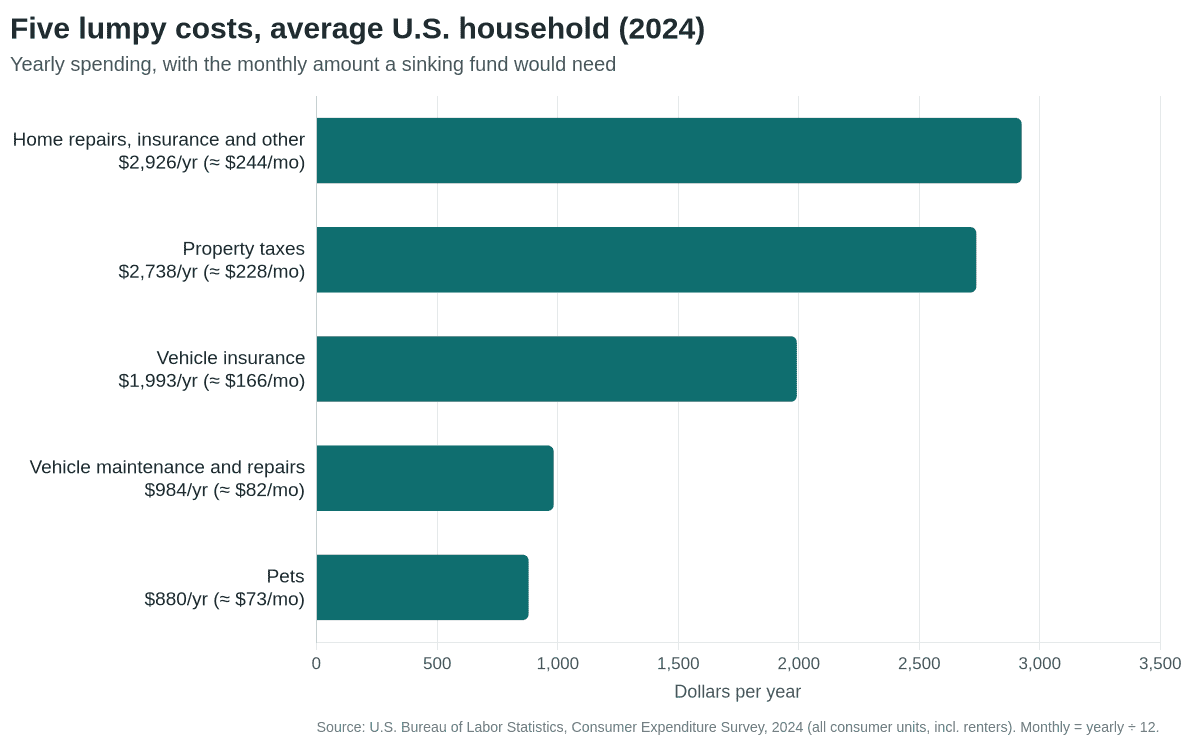
Together, those five lines come to $9,521 a year, or about $793 a month. That’s an average across all households. It includes renters who pay no property tax and people with no car or pet, so your number could be much higher or lower. The point is the size: on average, irregular bills add up to hundreds of dollars a month.
Spending keeps climbing, too. BLS’s 2025 Consumer Expenditures release, published October 29, 2026, puts average household spending at $81,905, up 4.3% from 2024. BLS’s Consumer expenditures in 2024 report found that vehicle insurance spending rose 12.3% from 2023 to 2024. A target you set two years ago may already be too low.
Big “surprises” are often predictable
The Federal Reserve’s Economic Well-Being of U.S. Households in 2025 report found that 59% of adults had at least one major unexpected expense in the prior 12 months. The most common ones were car repairs, home or appliance repairs and medical bills.
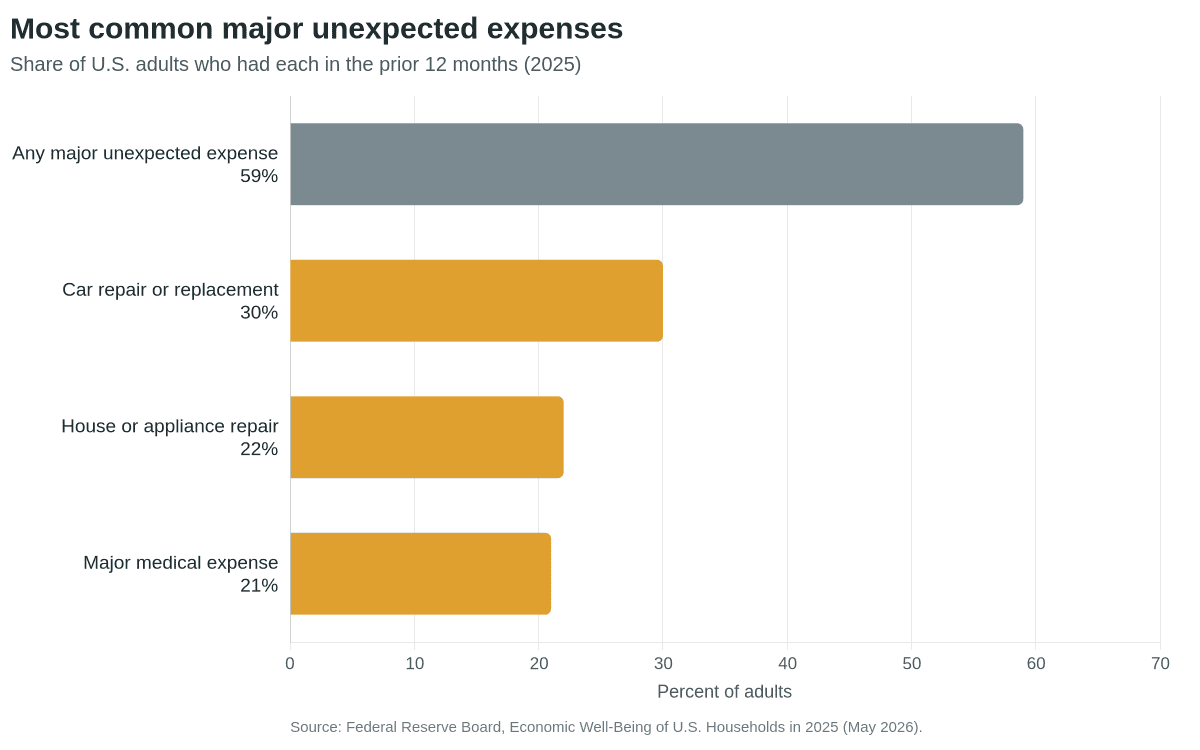
For people who knew the amount, the typical (median) cost of each of those three was between $1,000 and $1,999. Any single repair may be a surprise. But over a few years, the fact that your car or furnace will need work is not. Dave Ramsey said the same in a 2022 “Dave Says” column: when you know something’s coming, it isn’t an emergency fund situation. Plan for routine car and home upkeep with a sinking fund and keep the emergency fund for the truly rare stuff.
Your car alone needs a fund
AAA’s Your Driving Costs 2025 study shows how much of car ownership comes in lumps. For an average new vehicle, AAA estimated full-coverage insurance at $1,694 a year for a driver with a clean record, and license, registration and taxes at $813 a year. Maintenance, repairs and tires came to 11.04 cents a mile.
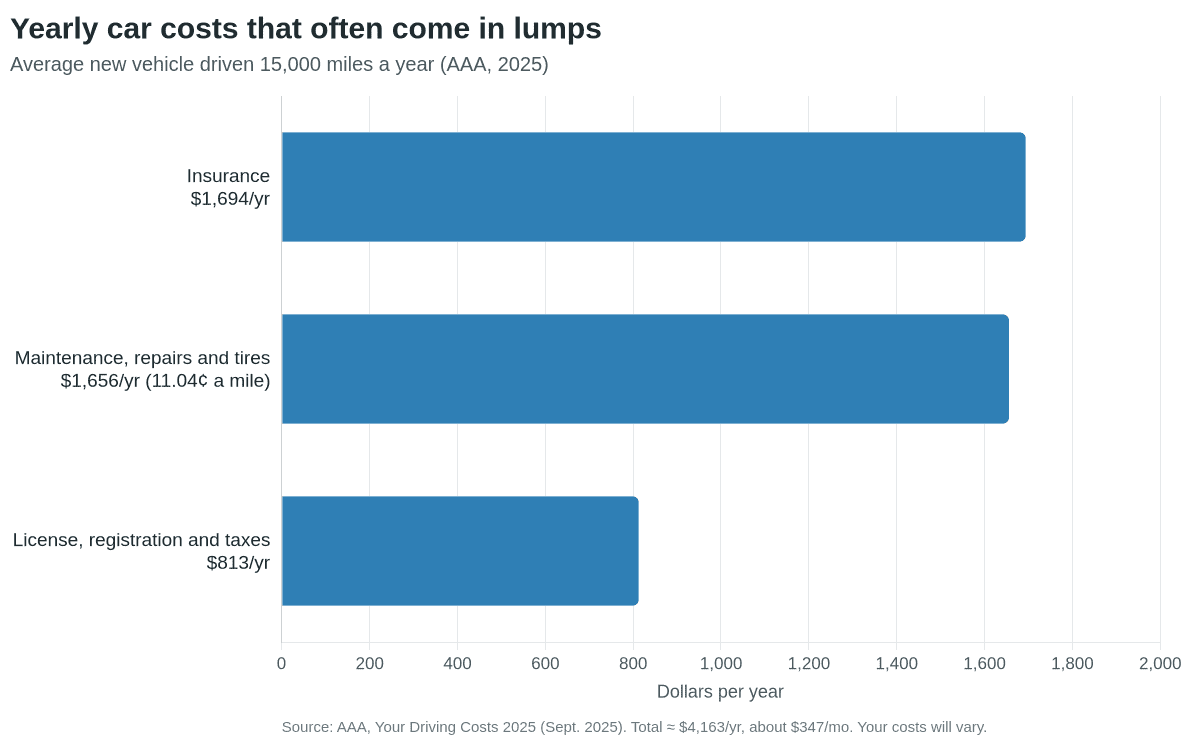
At 15,000 miles a year, those three items come to about $4,163, or roughly $347 a month. Some people pay insurance monthly, and older cars cost more to fix. Treat this as a starting point, not your bill.
Which costs belong in a sinking fund?
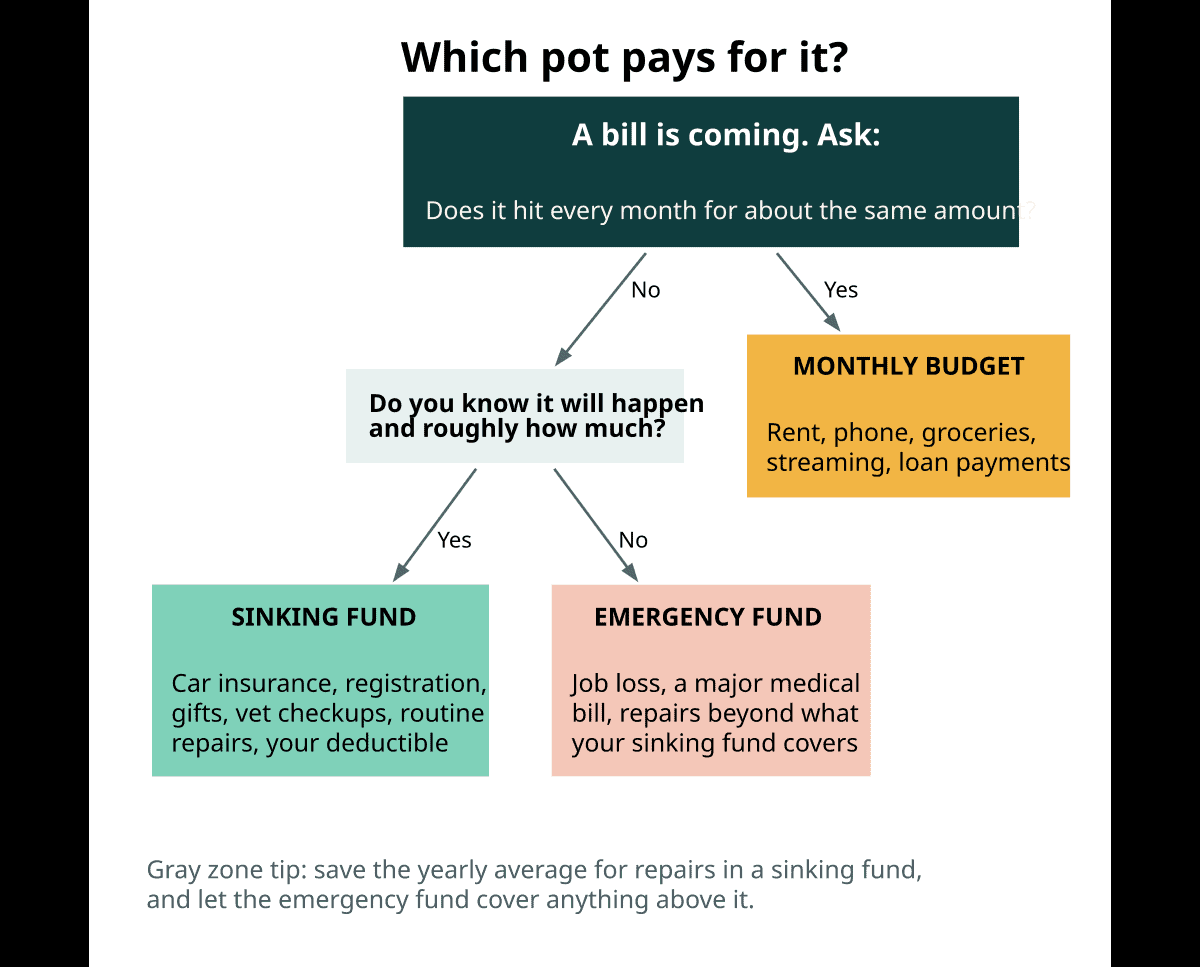
Use one simple test. A cost you know is coming, with an amount you can roughly guess, belongs in a sinking fund. Something rare, huge and hard to predict belongs to your emergency fund. And a bill that’s the same every month belongs in your regular budget.
Common sinking fund categories
- Car: insurance paid every 6 or 12 months, registration and inspection, oil changes, tires, brakes, a down payment on the next car.
- Home: property taxes and homeowners insurance (if not in escrow), HOA dues, routine repairs, appliance replacement, renters insurance paid yearly.
- Health: your plan’s deductible, dental work, glasses or contacts, copays for a planned procedure.
- Family and pets: back-to-school costs, sports fees, summer camp, vet checkups, pet boarding.
- Celebrations: holidays, birthdays, weddings you’re attending, travel.
- Annual bills: memberships, software and streaming plans paid yearly, professional license fees.
- Taxes: quarterly estimated taxes if you’re self-employed, or a balance you expect to owe.
- Tech: replacing a phone or laptop every few years.
The gray zone: repairs and deductibles
Car repairs and health deductibles sit in between. You can’t know the date, but you know they’ll happen. A sensible split is to put the yearly average in a sinking fund. For car repairs, the BLS average was $984 in 2024, averaged across all households, including those without a car. Then let the emergency fund cover anything beyond it. That way a typical year shouldn’t touch your emergency money.

Find your number: the sinking fund worksheet
The math has one rule. For each cost, divide what’s still needed by the number of months until it’s due.
Monthly amount = (cost − amount already saved) ÷ months until due
Once you’re caught up, a bill that repeats every year settles at its yearly cost divided by 12. Copy this table into a notebook or spreadsheet and fill it in:
| Expense | Cost per year | Months until next bill | Monthly amount |
|---|---|---|---|
| Car insurance | $______ | ____ | $______ |
| Car upkeep and repairs | $______ | 12 | $______ |
| Registration and inspection | $______ | ____ | $______ |
| Holidays and birthdays | $______ | ____ | $______ |
| Medical and dental | $______ | 12 | $______ |
| Pets | $______ | 12 | $______ |
| Home or renters costs | $______ | ____ | $______ |
| Annual subscriptions | $______ | ____ | $______ |
| Total | $______ | $______ |
Where to find the numbers
Don’t guess from memory. Pull the last 12 months of bank and credit card statements and look for anything that didn’t happen every month. The CFPB’s annual planning tool prompts you the same way. It asks about bills you pay yearly, twice a year or quarterly, such as insurance premiums, estimated taxes and property and vehicle taxes.
Worked example 1: a full household list
Here’s a hypothetical household that rents and owns one car. The yearly amounts are assumptions for illustration, not averages.
| Expense | Cost per year | Monthly amount |
|---|---|---|
| Car insurance (two 6-month bills of $850) | $1,700 | $141.67 |
| Car maintenance and repairs | $1,000 | $83.33 |
| Registration and inspection | $150 | $12.50 |
| Holidays and gifts | $900 | $75.00 |
| Pet care and vet visits | $600 | $50.00 |
| Medical deductible and copays | $1,200 | $100.00 |
| Clothing and school supplies | $600 | $50.00 |
| Annual subscriptions and memberships | $240 | $20.00 |
| Total | $6,390 | $532.50 |
So this household needs to set aside $532.50 a month, or about $266 per paycheck if they’re paid twice a month. That can look like a lot. But these costs were already happening. The only change is that they now show up in the budget every month instead of landing on a credit card.
Read this before you trust the numbers: every dollar figure in the worked examples is a hypothetical assumption. We chose amounts near the federal averages above. Your insurance quote, car age, location and family size will change the results. Interest is left out of the savings math because it’s small over a year; we look at it separately below.
Starting late? The catch-up formula
Most people start a sinking fund when a bill is already close. That’s fine. You pay more per month until the first bill, then drop to the steady amount.
Worked example 2: insurance due in four months
Say the same hypothetical household’s $850 car insurance bill is due in 4 months and the fund is at $0.
- Catch-up phase: $850 ÷ 4 = $212.50 a month for the next 4 months.
- Steady phase: after that bill is paid, the next $850 is due 6 months later, so $850 ÷ 6 = $141.67 a month.
- With a head start: say they add $280 from a tax refund today. The catch-up amount falls to ($850 − $280) ÷ 4 = $142.50 a month, close to the steady amount.
If the catch-up number is more than your budget can handle, fund the nearest bill first and start the others at their steady amounts. By next year, everything should be on schedule.
What skipping it costs: a sinking fund vs. a credit card
Without a sinking fund, a “surprise” bill usually goes on a card. In the Fed’s G.19 consumer credit release of October 7, 2026, card accounts that were charged interest paid an average rate of 22.15%. That figure is for the second quarter of 2026.

Worked example 3: a $1,500 car repair
| Save first | Put it on a card | |
|---|---|---|
| Monthly amount | $125 saved for 12 months | $100 payment until paid off |
| Time | 12 months before the repair | 18 months after the repair |
| Interest | You earn a little (see below) | About $272.58 paid |
| Total cost of the repair | $1,500 | About $1,772.58 |
The card math assumes a 22.15% annual rate (the G.19 average above), monthly compounding, no new charges and no fees. Your card’s rate may be higher or lower. The point holds either way: saving ahead lets you pay for the repair once, not plus interest.
Holiday shopping shows the same pattern. NerdWallet’s 2025 Holiday Spending Report found that 31% of 2024 holiday shoppers who used credit cards for gifts still hadn’t paid off the balances nearly a year later, as NerdWallet reported in January 2026.
“When the holidays come around, you have the money available to buy all your gifts without digging into credit cards or any other form of high interest debt.”
Filip Telibasa, CFP, owner and planner at Benzina Wealth, to GOBankingRates (2024)
In 2025, shoppers planned to spend $890.49 per person on holiday gifts, food, decorations and other seasonal items. That’s from the National Retail Federation’s October 2025 holiday survey release. Spread over 12 months, that’s about $74 a month. Even if you wait until January, after this year’s bills are paid, next year’s holiday fund needs only about $81 a month over 11 months.

If you’re already carrying card debt from past bills, our guide to paying off credit card debt walks through the avalanche and snowball methods.
Where to keep your sinking funds
A sinking fund needs three things: safety, quick access and some distance from checking. That way you don’t spend it by accident. For most people, that points to a savings account at an FDIC-insured bank or an NCUA-insured credit union.
Checking, savings or something else?
| Option | Good for | Watch out for |
|---|---|---|
| Checking account | A bill due within a few weeks | Easy to spend by mistake; usually little or no interest |
| High-yield savings account | Most sinking funds | Rates change; check for fees and minimums |
| Money market account | Larger balances | Some require a minimum balance |
| Certificate of deposit (CD) | A big cost with a fixed date a year or more away | Early-withdrawal penalties |
Experian suggests not keeping the money in checking because it’s easier to spend. Capital One suggests a separate savings account, while noting checking can work for purchases you’ll make very soon.
Worked example 4: how much interest is at stake
The FDIC’s national average rate on savings accounts was 0.38% for October 2026 (FDIC data via FRED). Many online banks pay far more, but rates change often, so check current offers yourself. Say a sinking fund averages a $3,000 balance over a year:
- At the 0.38% national average: about $11.40 in interest.
- At a hypothetical 4.00% high-yield rate: about $120 in interest.
That interest is taxable. The IRS says in Topic 403 that interest on bank and money market accounts is taxable. You should get a Form 1099-INT if you earn $10 or more. Either way, you must report all of it. In the 4.00% example, a person in the 22% federal bracket for 2026 would owe about $26.40 of federal tax on the $120.
Is it insured?
Yes, at an insured bank, up to the limit. The FDIC says “the standard insurance amount is $250,000 per depositor, per insured bank, for each account ownership category.” Buckets and extra accounts you own alone at the same bank are added together. They don’t each get their own $250,000. For most sinking funds, that’s far more room than you’ll need.
One account or many? What the experts say
This is where advice splits. Some people like a separate account for each goal so the money is clearly walled off. Others prefer one savings account with named “buckets” or a simple spreadsheet to track each fund.
“Generally, you will typically earn less interest on several smaller accounts than one big one.”
Steve Goodman, then managing director and head of product for consumer banking at JPMorgan Chase, to GOBankingRates (2023)
“With a bucket system, you can have one high-yield savings account but set aside separate buckets for emergency savings, travel, home ownership and the like.”
Jay Zigmont, Ph.D., CFP, founder of Childfree Wealth, to GOBankingRates (2023)
On the other side, Capital One’s explainer suggests a savings account separate from your general savings. CNBC Select notes many online banks let you open several accounts and nickname each one, though it says one big account works too. Banks have blurred the line. Ally, for example, lets customers create up to 30 savings buckets within one account. And Empower warns that having too many separate accounts can backfire.
| Setup | Best if you… | Downside |
|---|---|---|
| One savings account + a spreadsheet | Like simple and don’t mind tracking | Easy to lose track of which dollars belong to which bill |
| One account with built-in buckets | Want labels without extra accounts | Only some banks offer buckets |
| Separate accounts per goal | Need hard walls to avoid “borrowing” | More logins and statements; small balances may earn less |
There’s no single right answer. A practical middle path: use one high-yield savings account with buckets or a tracking sheet. Add a separate account only for a fund you’re tempted to raid.
Homeowners: escrow is a sinking fund you may already have
If your mortgage has an escrow account, your lender already runs a sinking fund for you. The CFPB explains that an escrow account is set up by your lender to pay certain property costs, such as property taxes and homeowners insurance. A slice of each monthly payment goes into it, and the servicer pays the bills when they’re due.
The federal rules work like a sinking fund too. Under Regulation X, section 1024.17, servicers must review the account each year. The cushion they hold can’t be more than one-sixth of the year’s expected bills. If a shortage is at least one month’s escrow payment and they ask you to repay it, they must spread it over at least 12 months.
Worked example 5: escrow math
A hypothetical home has $3,600 in yearly property taxes and $2,400 in yearly homeowners insurance, for $6,000 total. The escrow share of each mortgage payment is $6,000 ÷ 12 = $500. The largest cushion the servicer may hold is one-sixth of $6,000, or $1,000.
No escrow? Then you need your own property tax and insurance fund. The 2024 BLS average for property taxes alone was $2,738, about $228 a month. That average includes renters who pay none, so homeowners typically pay more. If you’re still saving to buy, our guide to saving for a down payment covers the upfront side.
When you’re in debt or your income swings
If you’re paying off high-interest debt
Experts don’t fully agree here. Ramsey’s view is that known costs like car repairs aren’t emergencies and should be planned for. But saving for fun goals while paying off debt isn’t what Ramsey teaches. Others, like DollarSprout, argue it’s worth keeping sinking funds going during debt payoff, since the alternative is new card debt.
A reasonable middle ground: keep funding the necessary sinking funds. Those are the costs you’d otherwise put on a card, like insurance, registration, car upkeep and deductibles. Pause or shrink the “nice to have” funds, like travel, until the high-interest debt is gone. Each dollar of avoided new card debt is a dollar you don’t pay 20%-plus interest on.
If your income is irregular
Freelancers, gig workers and commissioned salespeople have two problems at once: lumpy bills and lumpy paychecks. Try this:
- Build your monthly budget, including the sinking fund total, around a lean month’s income, not an average one.
- In good months, fill the sinking funds first, starting with the bill that’s due soonest.
- Treat taxes as their own fund. For the 2026 tax year, IRS Form 1040-ES lists due dates of April 15, June 15 and September 15, 2026, and January 15, 2027.
That last date has an exception. You can skip the January 15, 2027 payment if you file your 2026 return by February 1, 2027, and pay the whole balance with it.
Set it up this week: a 6-step plan
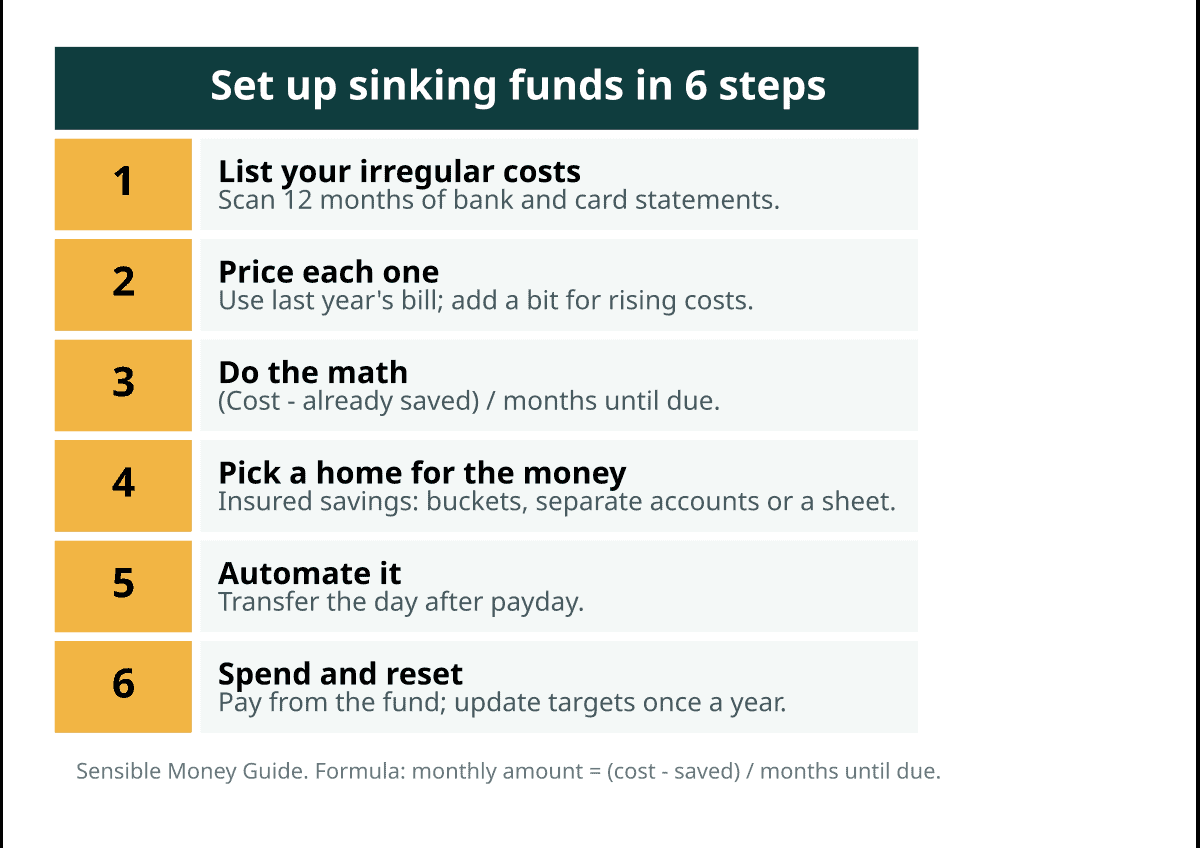
- List your irregular costs. Use 12 months of statements and the categories above.
- Price each one. Use last year’s actual bill, and raise it a bit for costs that have been climbing, like insurance.
- Do the math. Use the worksheet: (cost − saved) ÷ months until due.
- Pick a home for the money. A savings account with buckets, separate accounts, or one account plus a tracking sheet.
- Automate it. Schedule a transfer for the day after payday, so the money moves before you can spend it.
- Spend from the fund and reset. When a bill arrives, pay it from its fund. Once a year, update each target to match the newest bill.
This video from PBS’s Two Cents is hosted by a CFP and an Accredited Financial Counselor. It covers how to build a budget that goes beyond a basic list of income and expenses. It was posted in May 2025.
Need room in your budget for the monthly transfer to your sinking funds? Our guide to lowering your monthly bills has call scripts that can free up cash.
Mistakes that drain sinking funds
- Too many tiny funds. Twenty funds of $15 each are hard to track. Group small, similar costs, like “annual subscriptions.”
- Using last year’s price forever. Insurance and repair costs rise. Recheck every target once a year.
- Mixing it with the emergency fund. If holiday money and job-loss money share one balance with no tracking, one will eat the other.
- Raiding one fund for another without a plan. Borrowing from the vacation fund for a car repair is fine. Just write it down and raise contributions until it’s paid back.
- Forgetting leftovers. If a bill comes in low, roll the extra into next year’s fund for that cost. Or move it to a fund that’s behind.
- Skipping the “boring” bills. Registration, license renewals and once-a-year fees are small, which is why they get forgotten until they’re late.
- Keeping it in checking by default. Money you can see in checking tends to get spent.
The short version
- A sinking fund is money saved monthly for a known, non-monthly bill. An emergency fund is for real surprises.
- The formula: (cost − already saved) ÷ months until due. Bills that repeat yearly settle at cost ÷ 12.
- Five common lumpy costs averaged $9,521 per U.S. household in 2024, about $793 a month (BLS).
- In the Fed’s 2025 survey, 59% of adults had a major unexpected expense, most often a car or home repair.
- Putting a $1,500 repair on a 22.15% card at $100 a month costs about $273 in interest and takes 18 months.
- Keep the money in an insured savings account, labeled by goal, and automate the transfer.
- Interest you earn is taxable, and buckets at one bank share the same FDIC limit.
- Recheck every target yearly; costs like insurance keep rising.
Questions people ask about sinking funds
What is a sinking fund in simple terms?
It’s a savings pot for one planned expense. You put in a little each month so the full amount is ready when the bill comes. The term also describes money companies set aside to repay bonds, but in household budgeting it means saving ahead for known costs.
How is a sinking fund different from an emergency fund?
A sinking fund pays for things you know are coming, like insurance renewals and holidays. An emergency fund pays for things you can’t plan, like job loss or a major medical bill. Keeping them apart stops planned costs from draining your safety net.
How many sinking funds should I have?
There’s no set number. A simple start is one fund per major category, such as car, home, medical, gifts and annual bills. If tracking feels like a chore, combine small categories.
Should sinking funds be in a high-yield savings account?
For most people, yes. A high-yield savings account at an insured bank keeps the money safe and reachable while earning some interest. A bill due within a few weeks can sit in checking, and a large cost more than a year away might suit a CD.
Is the interest on a sinking fund taxed?
Yes. The IRS treats interest on bank accounts as taxable income. You should receive a Form 1099-INT if you earn $10 or more from a bank, but you must report all interest either way.
What do I do with money left over in a sinking fund?
Roll it into next year’s fund for the same expense, which lowers next year’s monthly amount. Or move it to a fund that’s behind. If a category keeps ending with extra, lower its monthly amount.
Should I build sinking funds before paying off debt?
Fund the necessary ones (insurance, registration, car upkeep, medical costs) so those bills don’t end up on a card. Some experts, including Dave Ramsey, suggest pausing optional ones, like travel, until high-interest debt is paid off.
Is a sinking fund the same as an escrow account?
They work the same way, but an escrow account is run by your mortgage servicer and only covers items like property taxes and insurance. You manage your own sinking funds and choose what they cover.
Your one move for this week
Open last year’s bank and card statements and write down every charge that didn’t happen monthly. Total it, divide by 12, and set up one automatic transfer for that amount the day after your next payday. You can split it into labeled funds later; the habit matters more than the setup.
About this guide
Published by Daniel Brienza, founder and editor of Sensible Money Guide (B.S. in Business Administration, University of South Florida). This guide was researched and drafted with the help of AI tools, fact-checked against the primary sources listed below, and reviewed and edited by Daniel before publishing. Daniel is not a licensed financial advisor; this guide is for general education.
Written October 30, 2026. Facts and figures are based on data available on that date.
Sources
Government and official sources
- U.S. Bureau of Labor Statistics, Consumer expenditures in 2024 (accessed October 2026)
- U.S. Bureau of Labor Statistics, Consumer Expenditures – 2025 (news release) (October 29, 2026)
- Federal Reserve Bank of St. Louis (FRED), BLS Consumer Expenditure Survey series, Expenditures: Property Taxes, All Consumer Units (accessed October 2026; related series: vehicle insurance, vehicle maintenance and repairs, owned-home maintenance, repairs, insurance and other, pets)
- Board of Governors of the Federal Reserve System, Economic Well-Being of U.S. Households in 2025 (May 2026)
- Board of Governors of the Federal Reserve System, G.19 Consumer Credit (October 7, 2026)
- Federal Deposit Insurance Corporation, Deposit Insurance (accessed October 2026)
- Federal Deposit Insurance Corporation, Understanding Deposit Insurance (accessed October 2026)
- FDIC data via FRED, National Rate: Savings (SNDR) (October 2026 data)
- Internal Revenue Service, Topic no. 403, Interest received (reviewed October 7, 2026)
- Internal Revenue Service, 2026 Form 1040-ES, Estimated Tax for Individuals (accessed October 2026)
- Consumer Financial Protection Bureau, What is an escrow or impound account? (accessed October 2026)
- Consumer Financial Protection Bureau, Regulation X, § 1024.17 Escrow accounts (accessed October 2026)
- Consumer Financial Protection Bureau, Your Money, Your Goals: Annual planning tool (accessed October 2026)
Banks, firms and research groups
- AAA, Your Driving Costs 2025 (fact sheet) (September 2025)
- National Retail Federation, Consumers to Spend Second-Highest Amount on Record, According to NRF Holiday Survey (October 16, 2025)
- Capital One, What is a sinking fund? (October 8, 2026)
- Ally Bank, Buckets and boosters: Smart resources to help you save (updated March 2026)
- Empower, What is a sinking fund? How to budget without touching emergency funds (April 23, 2026)
- Experian, What’s the Difference Between a Sinking Fund and an Emergency Fund? (December 8, 2025)
News and personal finance media
- NerdWallet, Big Expenses Ruining Your Budget? Try a Sinking Fund. (January 22, 2026)
- CNBC Select, What are sinking funds and should you have them? (accessed October 2026)
- Ramsey Solutions, What Is a Sinking Fund and How Do You Create One? (updated March 20, 2025)
- KTAR News (Dave Says column), Dave Ramsey says: Contribute to ‘sinking fund’ for emergency use (January 4, 2022)
- East Idaho News (Dave Says column), Should we save for fun while still paying off debt? (January 22, 2026)
- DollarSprout, What Is a Sinking Fund? Definition, Categories & Examples (updated April 1, 2025)
- GOBankingRates, Here’s How Much Cash To Keep in a Sinking Fund, According to Experts (October 24, 2023)
- GOBankingRates, 4 ‘Sinking Fund’ Strategies to Keep You Prepared for the Holidays (December 13, 2024)
- GOBankingRates via Yahoo Finance, 35% of Americans Have More Than One Savings Account, But How Many Do Experts Say You Really Need? (October 2, 2023)
- Two Cents (PBS), You Aren’t Using These Sneaky Budget Tricks (video) (May 28, 2025)
This article is for educational purposes only and isn’t financial advice. Consider talking with a qualified professional about your situation.


Beneficiary Designations: How to Name, Check and Update Them

Term Life Insurance: How Much You Need and What It Costs

How to Start Investing: Accounts, First Buys and Real Risks

Student Loan Repayment Plans: RAP vs. IBR vs. Standard

When to Claim Social Security: Ages, Math and Trade-Offs

Credit Report Errors: How to Find, Dispute and Fix Them
Beneficiary Designations: How to Name, Check and Update Them
When to Claim Social Security: Ages, Math and Trade-Offs
Student Loan Repayment Plans: RAP vs. IBR vs. Standard
You must be logged in to post a comment Login