


Retirement Planning
How Does a 401(k) Work? Matching, Taxes and 2026 Limits
How a 401(k) works in plain English: 2026 limits, the employer match, Roth vs. traditional, picking funds, fees, rollovers and withdrawal rules.

Short on time? Here’s how a 401(k) works in one minute. The rest of this guide fills in the details, the math and the fine print.
A 401(k) in 60 seconds
- It’s a retirement account you get through work. Money comes straight out of your paycheck and goes into investments you choose from a short menu.
- Taxes: a traditional 401(k) lowers your taxable income now and is taxed when you withdraw. A Roth 401(k) is taxed now, and qualified withdrawals later are tax-free.
- The match is free money. If your employer matches, contribute at least enough to get every dollar of it before anything else.
- 2026 limit: $24,500 from your paycheck, plus an $8,000 catch-up at 50 and up, or $11,250 at ages 60 to 63.
- Hands off until 59½. Early withdrawals usually mean income tax plus a 10% penalty, with some exceptions.
- Simple investing works. A low-cost target-date fund is a reasonable one-fund choice for most beginners.
| Your situation | A sensible first move |
|---|---|
| Just enrolled, money is tight | Contribute enough to get the full match, then raise it 1% a year |
| Already getting the full match | Work toward saving 15% of pay in total, counting the match |
| Early in your career, lower tax bracket | Consider the Roth 401(k) option if your plan has one |
| Changing jobs | Roll the old account over directly; never cash it out |
| Age 50 or older | Use catch-up contributions if your budget allows |
In this guide:
- What a 401(k) is (and why it exists)
- How money gets into your 401(k)
- The 2026 contribution limits
- The employer match: the best deal in personal finance
- Vesting: when the match is really yours
- Traditional vs. Roth 401(k)
- How to choose your investments
- Fees: the quiet cost you should check
- How much should you save?
- What happens when you change jobs
- Taking money out: withdrawals, loans and penalties
- Your step-by-step 401(k) action plan
- Common 401(k) mistakes
- What people get wrong about 401(k)s
- The short version
- Frequently asked questions
What a 401(k) is (and why it exists)
A 401(k) is a retirement savings account that your employer sets up for you. The odd name comes from the section of the tax code that created it. You put money in straight from your paycheck. That money gets invested, and it grows over the years until you retire.
The big draw is taxes. The government gives you a tax break to save in a 401(k), because it wants people to have money of their own in old age. With a traditional 401(k), you skip income tax on the money now and pay it later when you take it out. With a Roth 401(k), you pay the tax now and take the money out tax-free later. We’ll compare the two in detail below.
A 401(k) is a type of defined contribution plan. That means the amount going in is set, but the amount you end up with is not. It depends on how much you save, how your investments do and how long you leave the money alone. That’s different from an old-style pension, where the employer promises a set monthly check for life and carries the risk.
Today, the 401(k) has mostly replaced the pension at private companies. In March 2026, 72% of private industry workers had access to a retirement plan through work, according to the Bureau of Labor Statistics. And 70% could use a defined contribution plan like a 401(k). But only 52% took part in any plan, and 49% in a defined contribution plan. That gap is a lot of people leaving help on the table.
401(k) cousins: 403(b), 457(b) and the TSP
If you work for a school, hospital or nonprofit, you may have a 403(b) instead. State and local government workers often get a 457(b). Federal workers and the military have the Thrift Savings Plan (TSP). These plans work in mostly the same way, and almost everything in this guide applies to them too. But there is one big difference in how their limits stack up.
| Plan | 2026 employee limit | Shares that limit with… |
|---|---|---|
| 401(k) | $24,500 | 403(b) and TSP (one combined limit across all of them) |
| 403(b) | $24,500 | 401(k) and TSP |
| TSP | $24,500 | 401(k) and 403(b) |
| 457(b) | $24,500 | Nothing. The 457(b) has its own separate limit |
Good news for teachers, nurses and public workers: the IRS says the 457(b) has a separate limit. If your job offers both a 403(b) and a 457(b), you may be able to put up to $24,500 into each in 2026, or $49,000 in total, before catch-up contributions. Check your plan documents, since each plan sets its own rules.
For a quick visual walk-through of the basics, this short lesson from Khan Academy shows how money flows into a 401(k) and how the tax break works.
How money gets into your 401(k)
Money gets into a 401(k) in two main ways: from you and from your employer.
Your contributions (elective deferrals)
You choose a percentage of each paycheck to put in, like 6%. The IRS calls this an elective deferral, which just means you elected to defer, or set aside, part of your pay. Your employer takes it out before the money hits your bank account and sends it to your 401(k). You never see it, so you don’t miss it as much.
That automatic setup is the secret sauce. You don’t have to remember to save. It just happens, every payday, for decades.
Your employer’s contributions
Many employers add money too. The most common way is a match, where they put in a certain amount for each dollar you contribute. Some employers also make a flat contribution for everyone, called a nonelective or profit-sharing contribution, even if you don’t save a cent yourself.
Employers don’t have to match. NerdWallet notes that matching isn’t required for a standard 401(k). But most large plans do offer something, and it’s worth finding out exactly what yours is.
Automatic enrollment
More and more plans now sign you up automatically. This is called automatic enrollment. Unless you opt out, a set percentage of your pay starts going in, usually into a target-date fund. In Vanguard’s How America Saves 2026 report, 61% of its plans used automatic enrollment in 2025.
It works. Vanguard found that 94% of workers in plans with automatic enrollment were taking part, compared with 64% in plans where workers had to sign up on their own. A 2022 law called SECURE 2.0 pushes this further. Starting in 2025, many 401(k) plans set up after late 2022 must automatically enroll new workers, with the savings rate rising each year, according to NerdWallet.
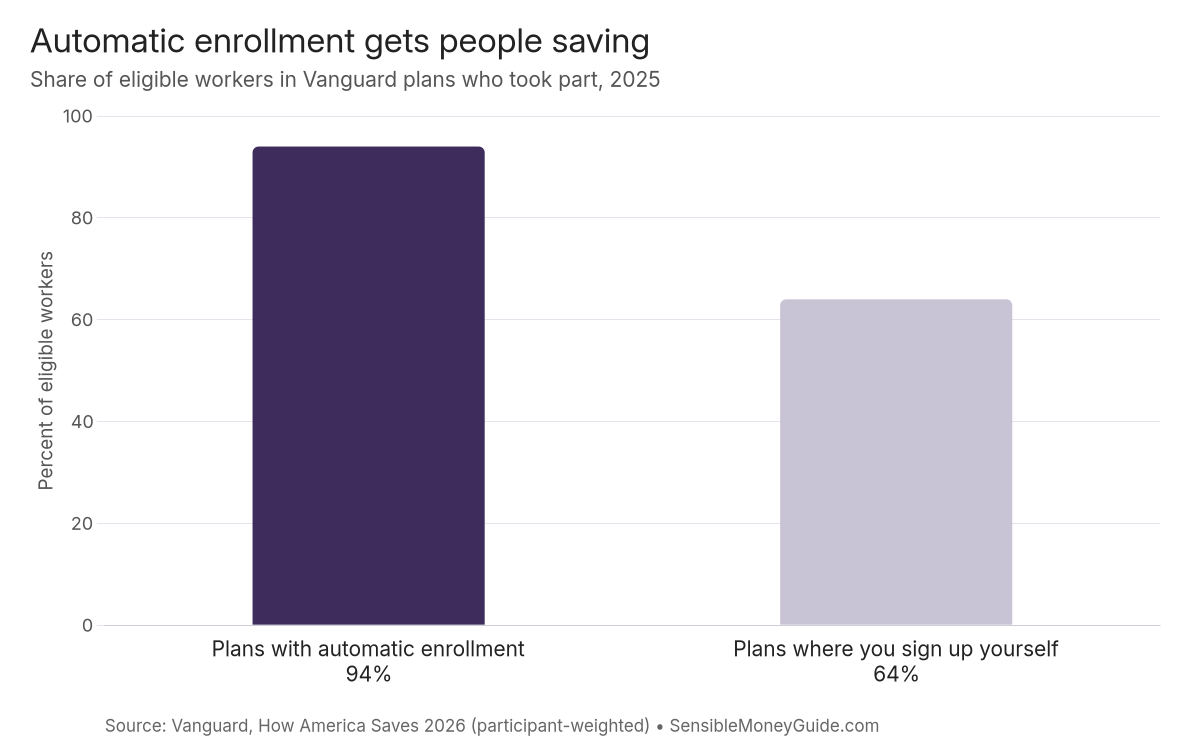
One catch: the default rate is often low. Vanguard found 32% of plans with automatic enrollment started workers at just 3% of pay. If you were signed up automatically, log in and check your rate. You may be saving less than you need, and you may not be getting the full match.
Watch out: Being enrolled automatically doesn’t mean your settings are right for you. Check your savings rate and your investment choice within your first month.
The 2026 contribution limits
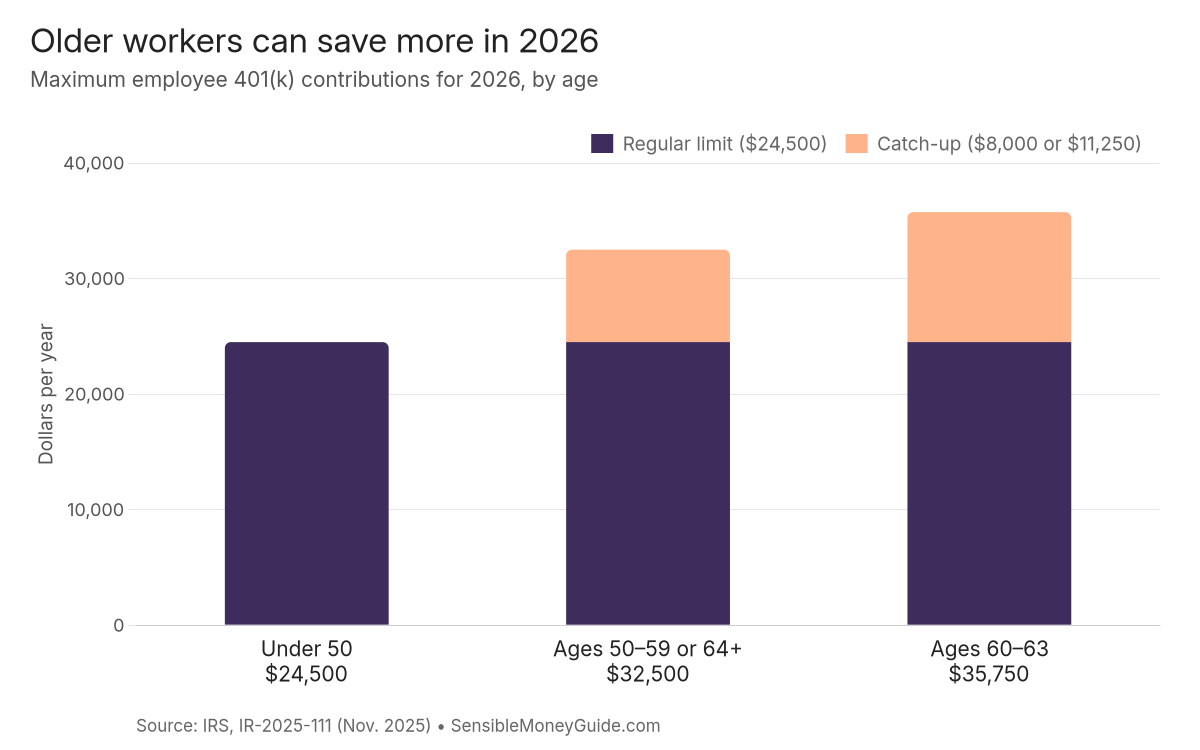
The IRS caps how much you can put into a 401(k) each year. These limits usually rise a bit each year with inflation. Here are the numbers for 2026, from the IRS announcement in November 2025:
- Under age 50: up to $24,500 of your own money (up from $23,500 in 2025).
- Age 50 or older: an extra $8,000 catch-up contribution, for a total of $32,500.
- Ages 60, 61, 62 or 63: a bigger catch-up of $11,250 instead of $8,000, for a total of $35,750.
A catch-up contribution is extra money that older workers are allowed to add. It helps people who started late or want to boost savings right before retirement. The special catch-up for ages 60 to 63 is new under the SECURE 2.0 law. It began in 2025, according to the IRS. Once you turn 64, you go back to the regular $8,000 catch-up.
The total limit, including your employer
There’s also a cap on everything going into your account from all sources, including the match. For 2026, that limit is $72,000 (or 100% of your pay, if less), per the IRS limits table. Catch-up money goes on top of that. Most people never get close, so you don’t need to worry about it unless you earn a lot and your employer is very generous.
A new rule for higher earners
Starting in 2026, there’s a twist for people age 50 and up who earn more. If you earned more than $150,000 from your employer last year, your catch-up contributions must go in as Roth money, per the IRS. That means you pay tax on them now. Your regular contributions up to $24,500 can still be traditional. If your plan has no Roth option, you may not be able to make catch-up contributions at all, so check with your plan.
Do you have to max out? Not at all. Only 14% of workers in Vanguard plans saved the maximum in 2025. The limit is a ceiling, not a goal. We’ll talk about how much to aim for later.
The employer match: the best deal in personal finance
If your employer offers a match, it’s the closest thing to free money you’ll find. Your employer adds a set amount to your account for every dollar you put in, up to a limit. It’s part of your pay. If you don’t contribute, you don’t get it.
How match formulas work
Match formulas can look like a riddle, so let’s decode one. A very common setup is “50% of the first 6% of pay.” In fact, it was the single most common formula among Vanguard plans, used by 12% of plans that offer a match, according to How America Saves 2026.
Here’s what it means. For every dollar you put in, up to 6% of your pay, your employer adds 50 cents. If you put in 6%, your employer adds 3%. If you put in more than 6%, the match stops growing. Other plans use “100% of the first 3%” or “100% of the first 4%, then 50% of the next 2%.” Your plan’s Summary Plan Description, a booklet that explains the rules, will spell out yours.
Worked example: what skipping the match really costs
Let’s say you earn $50,000 a year and your plan matches 50% of the first 6%.
- If you put in 6%, that’s $3,000 a year from you. Your employer adds $1,500.
- If you put in only 3%, that’s $1,500 from you. Your employer adds just $750.
Saving 3% instead of 6% leaves $750 a year on the table. That might not sound huge. But if you invested that $750 every year for 30 years and earned 6% a year, it would grow to about $59,000. That’s the real price of the “I’ll figure it out later” pile.
Here’s another way to see it. When you get a 50% match, you earn a 50% return on that money the day it goes in, before any investment growth. You won’t find that anywhere else.
Most money experts agree on this point, even ones who disagree on almost everything else. NerdWallet says it’s a good rule of thumb to contribute enough to get your employer match. Ramsey Solutions also calls the match free money and says to contribute enough to get it. Still, Ramsey’s broader plan says to wait until you’re out of consumer debt to start investing. We’ll come back to that disagreement.

Pro tip: Some employers match per paycheck. If you max out early in the year, you could miss the match on later paychecks. If you plan to hit the limit, ask HR whether your plan has a “true-up” that fixes this.
Vesting: when the match is really yours
Here’s a detail that trips up a lot of people. The money you put in is always 100% yours. The money your employer puts in may not be, at least not right away.
Vesting means ownership. Your employer’s contributions can come with a vesting schedule that says how long you must work there before you fully own them. If you leave before you’re fully vested, you may lose some or all of the employer money.
The IRS explains the two main types of schedules:
- Cliff vesting: you own nothing of the employer money, then all of it at once. Under the IRS rules, this can’t take longer than 3 years.
- Graded vesting: you own a bit more each year. The longest standard schedule takes 6 years: 20% after year 2, then 20% more each year until you hit 100% after year 6.
Some plans vest you immediately. Others use a shorter schedule than the maximum. Kiplinger notes that vesting schedules commonly run three to five years.
Worked example: leaving a job too soon
Say your employer has put $6,000 into your account over two and a half years, and your plan uses a 3-year cliff. If you quit now, you walk away with your own money and its growth, but the $6,000 from your employer could disappear. If you stay six more months, you keep all of it.
That doesn’t mean you should stay in a bad job for a match. But if you’re close to a vesting date, it’s worth knowing. Check your annual benefits statement or your plan’s website for your vested balance.
Traditional vs. Roth 401(k)
Most plans now offer two flavors. Vanguard found that 98% of its plans offered a Roth option in 2025, but only 18% of workers in those plans used it. Many people simply don’t know what the difference is. Here’s the short version from the SEC’s Investor.gov:
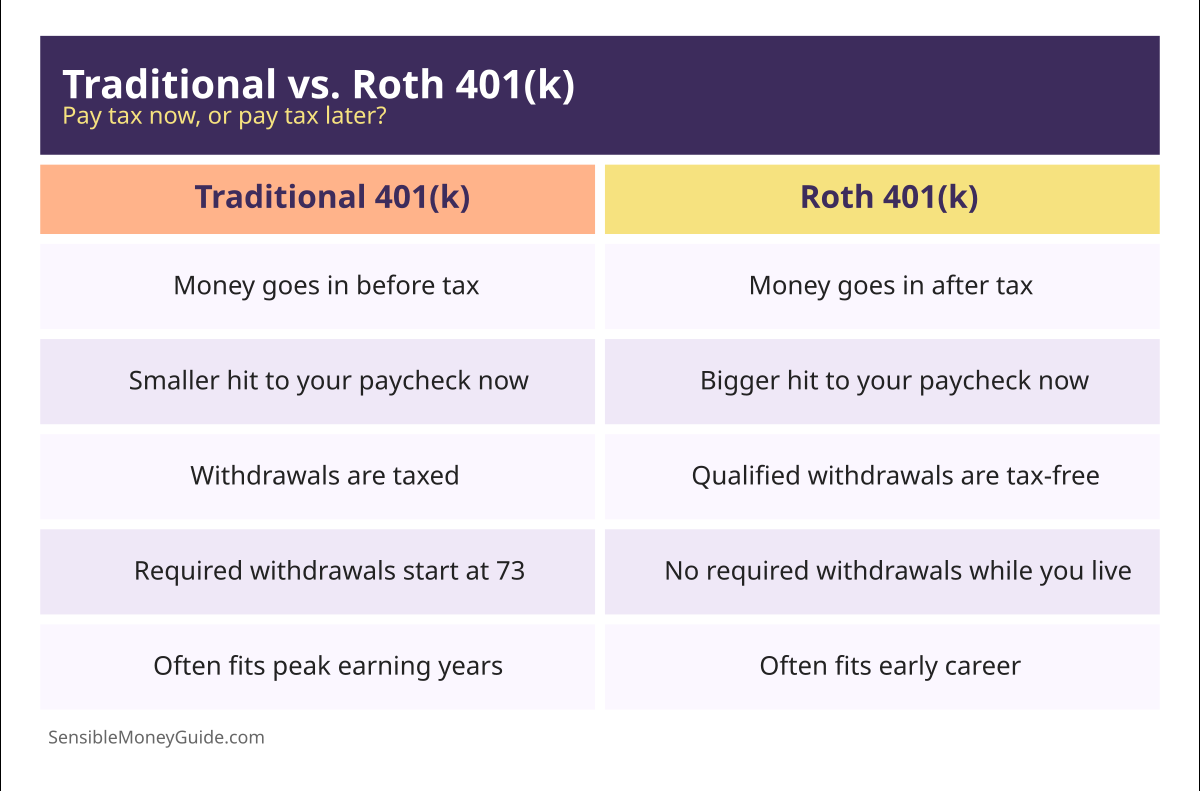
- Traditional 401(k): your contributions go in before income tax. That lowers your taxable income now. You pay income tax on the money, including the growth, when you take it out in retirement.
- Roth 401(k): your contributions go in after tax. You get no tax break today. But your money grows tax-free, and withdrawals in retirement are generally tax-free too.
To get Roth money out tax-free, the withdrawal needs to be “qualified.” Per the IRS, that means two things. First, at least five years have passed since the year of your first Roth contribution to the plan. Second, you’re 59½ or older, you’re disabled, or the money goes to your heirs after your death.
The core question is simple: do you want to pay tax now or later? It’s a bet on whether your tax rate will be higher now or in retirement.
Worked example: how each one hits your paycheck
Let’s say you put $200 from each paycheck into your 401(k) and you’re in the 22% federal tax bracket.
- Traditional: the $200 comes out before federal income tax. Your take-home pay drops by only about $156, because you also save about $44 in federal income tax. (Social Security and Medicare taxes still apply either way.)
- Roth: the $200 comes out after tax. Your take-home pay drops by the full $200.
So the traditional option feels cheaper today. The Roth costs more today but can pay you back later with tax-free income.
How to choose
Here’s a fair rule of thumb that many planners use:
- Lean Roth if you’re early in your career, your income is fairly low, or you expect to earn a lot more later. Your tax rate today is probably as low as it will ever be.
- Lean traditional if you’re in your peak earning years, in a high tax bracket now, or expect a smaller income in retirement.
- Split it if you’re not sure. Investor.gov notes you can divide your contributions between the two. Having some money in each gives you choices about which to tap in retirement.
Not everyone agrees on this. Ramsey Solutions takes a firm stand. If you can choose, its advice is to “go with the Roth every time,” because tax-free withdrawals stretch your savings, per its guide on maxing out a 401(k). Many other planners say it depends on your tax bracket now versus later. If you’re a high earner today, the upfront tax break of a traditional 401(k) can be worth more. Both sides have a point. The good news is that either one beats not saving at all.
A few more facts to keep in mind. In most plans, your employer’s match goes into the pre-tax side even if you choose Roth, so you’ll end up with some of each. Some plans now let you take the match as Roth instead. Also, Roth money in a 401(k) no longer has required minimum distributions while you’re alive, per the IRS. For a deeper look at the same choice in an IRA, see our guide to Roth vs. traditional IRAs.

How to choose your investments
Putting money into a 401(k) is only half the job. You also have to pick what it’s invested in. If you skip this step, your money might sit in a low-earning cash fund for years. (Most plans with automatic enrollment avoid this by using a target-date fund as the default, but check.)
Most plans offer a menu of 10 to 30 funds. Each fund is a basket of many investments. Here are the main types you’ll see:
- Stock funds: own small pieces of many companies. They grow the most over long periods but bounce around a lot along the way.
- Bond funds: lend money to governments and companies for interest. They’re steadier, but they grow more slowly.
- Stable value or money market funds: very safe, very slow. Good for money you’ll need soon, not for a 30-year goal.
- Target-date funds: an all-in-one mix that changes as you age. More on these next.
Target-date funds: the simple choice
A target-date fund has a year in its name, like “2055.” You pick the one closest to the year you expect to retire. The fund holds a mix of stocks and bonds. It starts out heavy in stocks and slowly shifts toward bonds as that year gets closer, according to the SEC’s Investor.gov.
That shift is called the glide path. It means you take more risk when you’re young and have time to recover, and less risk when you’re close to needing the money. The fund rebalances for you, so you don’t have to.
These funds have become the default for most savers. Vanguard found that 96% of its plans offered target-date funds in 2025, and 84% of workers in those plans used them. And 73% of target-date investors held just one target-date fund for their whole account, which is how these funds are meant to be used.
Two cautions. First, don’t mix a target-date fund with a bunch of other funds unless you know why. That can throw off the balance it’s built to manage. Second, the date isn’t a promise. Target-date funds can lose money, including near the target year. Investor.gov advises thinking carefully, both before and after you invest, about whether a target-date fund is right for you. It’s smart to look at the fund’s mix and its fees while you’re at it.
Building your own mix with index funds
If you’d rather choose, look for low-cost index funds. These are funds that simply track a whole market, like the S&P 500 or the total U.S. stock market. They tend to have very low fees. A simple mix might be a U.S. stock index fund, an international stock index fund and a bond index fund. Our guide to index funds covers how they work.
How much in stocks versus bonds? It depends on your age, how you’d feel during a market drop and when you’ll need the money. A younger worker with decades to go often holds mostly stocks. Someone a few years from retirement usually holds more bonds. If you’re not sure, a target-date fund makes that choice for you.
Don’t overload on your employer’s stock
Some plans let you buy shares of the company you work for. Be careful. If the company struggles, you could lose your job and your savings at the same time. Many planners suggest keeping company stock to a small slice of your account, if any.
Fees: the quiet cost you should check
Every 401(k) has costs. You don’t get a bill, so it’s easy to ignore them. They come out of your account or your fund’s returns, quietly, every year. But small fees add up to big money over a career.
The U.S. Department of Labor’s guide, A Look at 401(k) Plan Fees, sorts them into three groups:
- Plan administration fees: the cost of running the plan, like record keeping, legal help and customer service.
- Investment fees: what each fund charges to manage your money. This is usually the biggest cost. It shows up as the fund’s expense ratio, a yearly fee shown as a percent of what you have invested.
- Individual service fees: charges for things you choose, like taking a loan.
How much do fees matter?
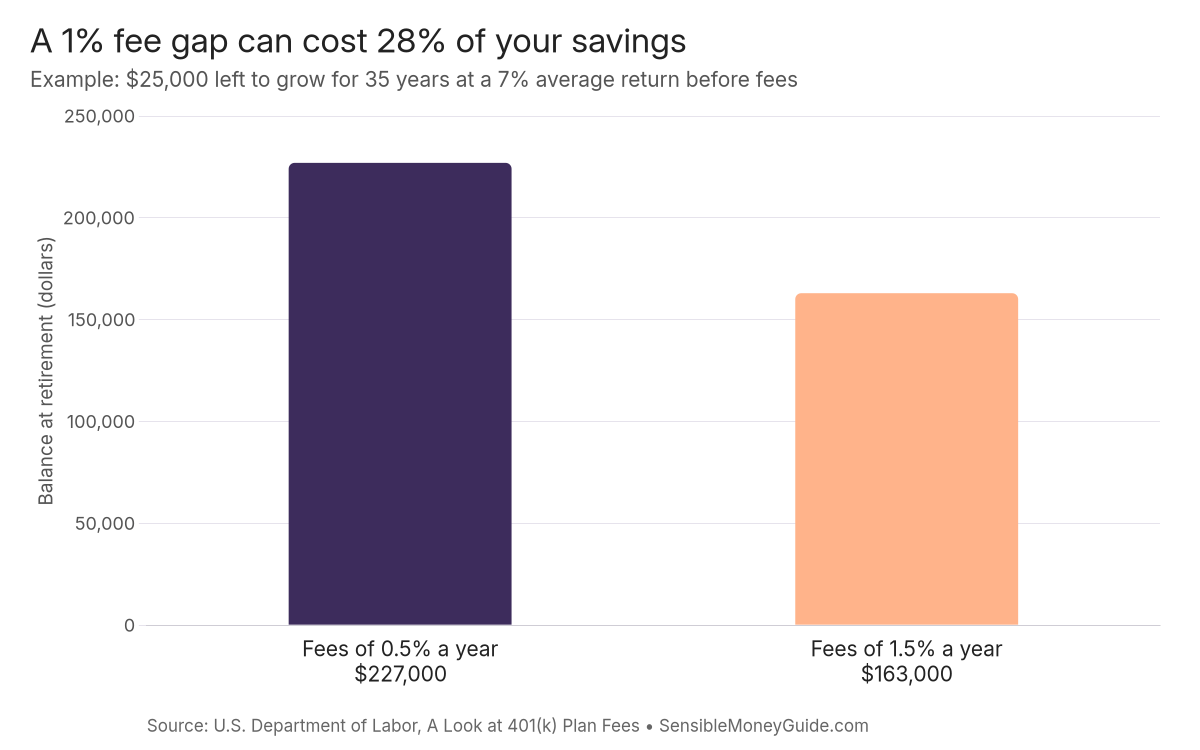
The Labor Department gives a clear example. Picture a worker with 35 years until retirement and a $25,000 balance. Assume returns average 7% a year and no more money goes in.
- If fees eat 0.5% a year, the account grows to about $227,000.
- If fees eat 1.5% a year, it grows to only about $163,000.
That one percentage point cuts the final balance by 28%. Same worker, same savings, same market. The only difference is cost.
How to check your fees
Your plan must give you fee information at least once a year. It lists each fund’s expense ratio and any plan-wide charges. You can usually find it on your plan’s website, often under “documents” or “fees.” Look at the expense ratio for each fund you own.
As a rough guide, broad index funds often charge well under 0.25% a year. Some actively managed funds charge 0.75% or more. If your plan offers both, and the cheaper fund does the same job, the cheaper one often wins over time.
You can’t control what your plan offers. But you can control which funds you pick from its menu. And if your plan’s choices are all expensive, it still usually makes sense to get the match. The match often outweighs high fees.
How much should you save?
There’s no single right number. But there are good targets, and the experts are fairly close to each other.
Fidelity suggests saving at least 15% of your pay each year, including any employer match. Ramsey Solutions also says 15% of gross income, though only after you’re debt-free except for your house and have a fully funded emergency fund. NerdWallet points to a range of 10% to 15%.
How are people doing? In Fidelity’s Q2 2026 Retirement Analysis, the average 401(k) savings rate hit 14.4%. That’s 9.6% from workers and 4.8% from employers. In Vanguard plans, the average total rate was 12.1% in 2025.
Milestones by age
Fidelity also offers savings milestones as a multiple of your salary. If you earn $60,000, “1x” means $60,000 saved.
| By age | Fidelity’s target | Example on a $60,000 salary |
|---|---|---|
| 30 | 1x your salary | $60,000 |
| 40 | 3x your salary | $180,000 |
| 50 | 6x your salary | $360,000 |
| 60 | 8x your salary | $480,000 |
| 67 | 10x your salary | $600,000 |
These targets assume you start saving 15% at age 25 and retire at 67. Fidelity calls them aspirational, and they’re not a pass-or-fail test. If you’re behind, you’re in good company. The point is to know where you stand and to nudge your rate up.
Are people on track?
Many people worry that they’re not. In the Federal Reserve’s survey of household finances, Economic Well-Being of U.S. Households in 2025, only 35% of adults who weren’t yet retired thought their retirement savings were on track. Confidence grew with age, from 22% of adults ages 18 to 29 to 53% of those 60 and older.
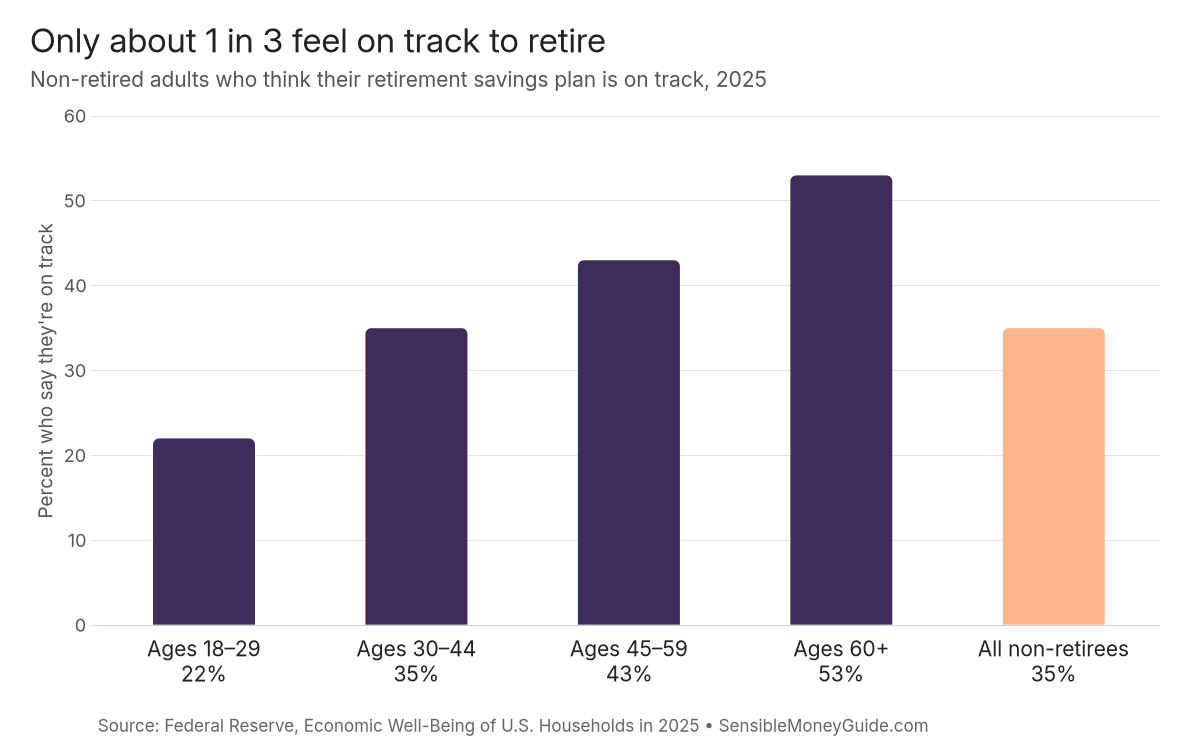
The same survey found that only 47% of adults felt mostly or very comfortable choosing and managing their investments. If that’s you, it’s one more reason a target-date fund can be a helpful default.
Fidelity’s latest numbers suggest more people are taking this seriously. In the second quarter of 2026, the average 401(k) savings rate at Fidelity, counting employer money, hit 14.4%, and the average balance reached $155,800.
“Workers continue to prioritize their financial future, saving at record levels and taking advantage of valuable benefits such as employer matching contributions.”
Sharon Brovelli, President of Workplace Investing at Fidelity Investments, in Fidelity’s Q2 2026 Retirement Analysis
An average isn’t a target, though. Balances skew high because of a smaller number of large, long-held accounts. Compare yourself to your own goal, not to the average.
Worked example: why starting early matters so much
Let’s say three people each save $300 a month in a 401(k) until age 67, and their money earns 6% a year. (That’s a made-up rate for illustration. Real returns go up and down and aren’t guaranteed.)
| Starts at age | Total put in | Balance at 67 |
|---|---|---|
| 25 | $151,200 | About $681,000 |
| 35 | $115,200 | About $347,000 |
| 45 | $79,200 | About $164,000 |
The person who starts at 25 puts in only about a third more money than the person who starts at 35. But they end up with nearly twice as much. That’s compound growth: your earnings start earning their own returns, and time does most of the heavy lifting.
If you’re starting late, don’t let this table discourage you. It just means your savings rate needs to work harder. That’s exactly what catch-up contributions are for.
The “step-up” trick
If 15% feels impossible, start where you can and raise it 1% each year. Many plans offer an automatic increase feature that does this for you. A good time to bump it up is right after a raise, when you won’t feel the change in your take-home pay.
If you’re paying off high-interest credit cards, it’s reasonable to save just enough for the match while you attack that debt, then raise your rate once it’s gone. Our guide to paying off credit card debt can help you plan that.
A tax credit many people miss
If your income is modest, you may get a tax credit just for saving. The Saver’s Credit can be worth 50%, 20% or 10% of up to $2,000 you put into a retirement account ($4,000 for married couples filing jointly), per the IRS. That’s a credit of up to $1,000, or $2,000 for couples.
The credit rate drops from 50% to 20% to 10% as your income rises. For 2026, you can’t claim it at all if your adjusted gross income is above $40,250 for single filers, $60,375 for heads of household or $80,500 for married couples filing jointly, per the IRS. You must be 18 or older, not a full-time student and not claimed as a dependent.
What happens when you change jobs
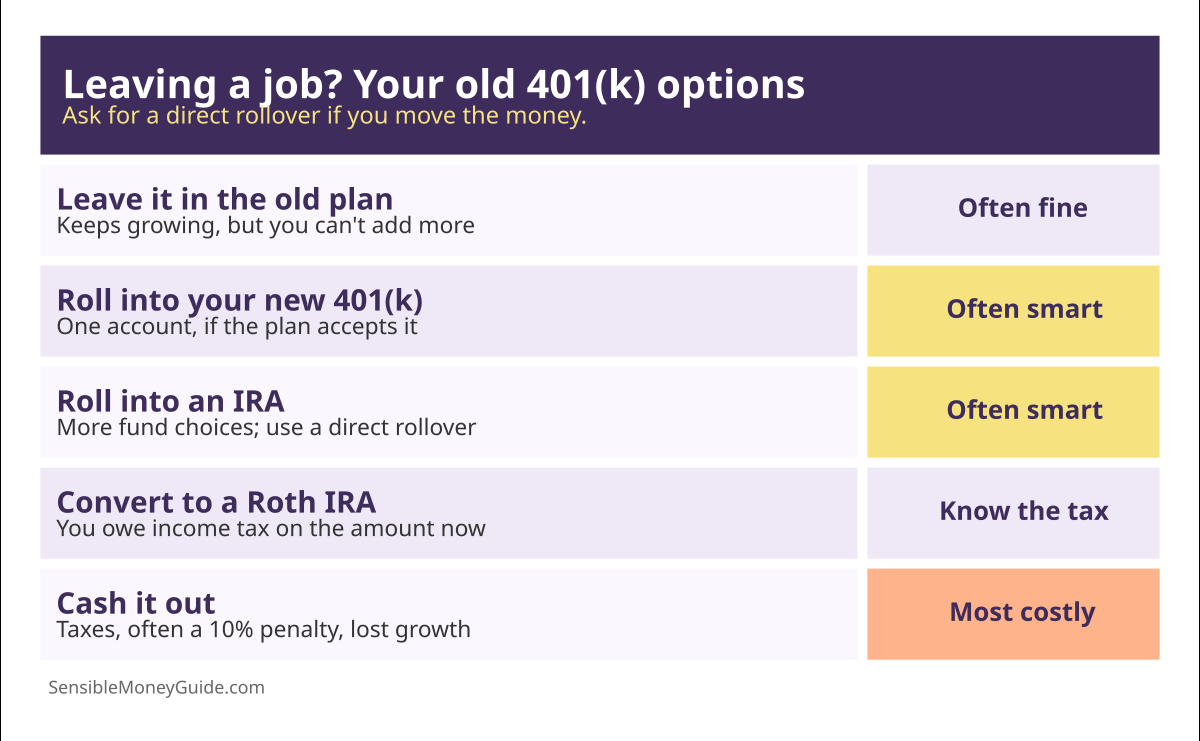
Your 401(k) is yours to keep when you leave a job. (The unvested part of any employer money may not be, as we covered above.) But you do need to decide what to do with it. Charles Schwab lays out five choices:
- Leave it in your old plan. Your money keeps growing tax-deferred. But you can’t add more, and it’s one more account to track.
- Roll it into your new employer’s 401(k). This keeps things in one place, if the new plan accepts rollovers.
- Roll it into a traditional IRA. An IRA is a retirement account you open yourself. It often has more investment choices.
- Convert it to a Roth IRA. You’ll owe income tax on the amount you convert, but qualified withdrawals later are tax-free.
- Cash it out. This is usually the most expensive choice, as you’ll see below.
Do a direct rollover
If you move the money, ask for a direct rollover. That means the old plan sends the money straight to the new plan or IRA. The IRS says no tax is withheld on a direct rollover.
If the plan sends a check to you instead, it generally must withhold 20% for taxes. You then have 60 days to deposit the money into another retirement account. To avoid tax on the full amount, you’d have to make up the 20% from your own pocket. If you can’t, the missing part counts as a withdrawal. It may be taxed, plus a 10% penalty if you’re under 59½.
Don’t forget old accounts
Old 401(k)s are easy to lose track of. Kiplinger cites research estimating about 31.9 million forgotten 401(k) accounts holding roughly $2.1 trillion as of 2025. Keep a simple list of every plan you’ve had, with the website and your login.
Reset your savings rate at the new job
Kiplinger also points to Vanguard research: 64% of job switchers got a raise, but 55% ended up saving less. Why? Many accept the new plan’s lower default rate instead of matching their old one. When you start a new job, set your rate at least as high as it was before.

Taking money out: withdrawals, loans and penalties
A 401(k) is built for retirement, so the rules make it costly to take money out early. That’s on purpose. It helps you leave the money alone.
The age 59½ rule
If you take money out before age 59½, you’ll generally owe a 10% additional tax on top of regular income tax, according to the IRS. People often call this the early withdrawal penalty.
There are exceptions. The IRS list for workplace plans includes:
- Leaving your job in or after the year you turn 55 (often called the “rule of 55”)
- Total and permanent disability, or a terminal illness
- Medical bills above 7.5% of your adjusted gross income
- Up to $5,000 for the birth or adoption of a child
- Payments to an ex-spouse under a court order called a QDRO
- Victims of domestic abuse, and losses from a federally declared disaster
Even when the 10% penalty doesn’t apply, you still usually owe regular income tax on traditional 401(k) money.
Worked example: the true cost of cashing out
Say you’re 35, you leave a job and cash out a $20,000 traditional 401(k). You’re in the 22% federal tax bracket.
- 10% early withdrawal penalty: $2,000
- Federal income tax at 22%: $4,400
- What you keep: about $13,600, before any state tax
You lose about $6,400, or nearly a third. Worse, you lose all the future growth. Left alone at 6% a year, that $20,000 could grow to roughly $205,000 by age 75. Cashing out small accounts when changing jobs is one of the most expensive habits in personal finance.
Hardship withdrawals
Many plans allow a hardship withdrawal for a serious, immediate need, like avoiding eviction or paying certain medical bills. The money is still usually taxed, and the 10% penalty may apply. Vanguard found that 6% of workers took a hardship withdrawal in 2025, up from 5% in 2024. The median amount was $1,900.
The $1,000 emergency withdrawal
Under SECURE 2.0, plans can choose to let you take an emergency withdrawal for personal or family emergencies. Per IRS Notice 2024-55, you can take one per calendar year, up to $1,000 (or less if your vested balance is small). It’s taxed as income but skips the 10% penalty. You can pay it back within three years. If you don’t repay it, you generally can’t take another one for the next three calendar years, unless your new contributions since then at least equal the unpaid amount. Check whether your plan offers it.
401(k) loans
Many plans let you borrow from yourself. Per the IRS:
- You can generally borrow up to half of your vested balance, with a cap of $50,000.
- You usually must repay within five years, unless the loan is for buying your main home.
- Payments must be made at least every three months. Most plans take them from your paycheck.
The big risk: if you don’t repay on time, the unpaid amount is treated as a withdrawal. It gets taxed, and the 10% penalty may apply. Also, while the money is out of your account, it isn’t growing in the market. In Vanguard plans, 13% of workers had a loan in 2025, with an average balance of about $11,000.
A 401(k) loan can be better than a payday loan or a high-rate credit card. But it’s best saved for real emergencies. Having an emergency fund is the best way to avoid needing one at all.
Need cash before 59½? Your options, side by side
| Option | Taxes and penalty | Main catch |
|---|---|---|
| 401(k) loan | No tax or penalty if repaid on schedule | Often due quickly if you leave your job; money is out of the market |
| $1,000 emergency withdrawal | Income tax, but no 10% penalty | Once per year; limits on taking another until repaid |
| Hardship withdrawal | Income tax plus 10% penalty unless an exception applies | Plan must allow it; money can never be put back |
| Cashing out after leaving a job | Income tax plus 10% penalty (under 55 in most cases) | The most expensive choice; years of growth lost |
Required minimum distributions
You can’t leave traditional 401(k) money untouched forever. Eventually you must take out a minimum amount each year. These are called required minimum distributions (RMDs), and the starting age depends on when you were born: generally age 73 if you were born from 1951 through 1959, and age 75 if you were born in 1960 or later. As Hayden Adams of the Schwab Center for Financial Research puts it, “Typically, once you reach age 73 (or 75 if you were born in 1960 or later), you must begin taking annual RMDs.”
Still working past that age? The IRS says you can usually delay RMDs from your current employer’s plan until the year you retire, unless you own 5% or more of the business. Roth 401(k) money doesn’t require RMDs while you’re alive. Missing an RMD can trigger a 25% excise tax on the amount you should have taken, cut to 10% if you fix it within two years, per the IRS.

Your step-by-step 401(k) action plan
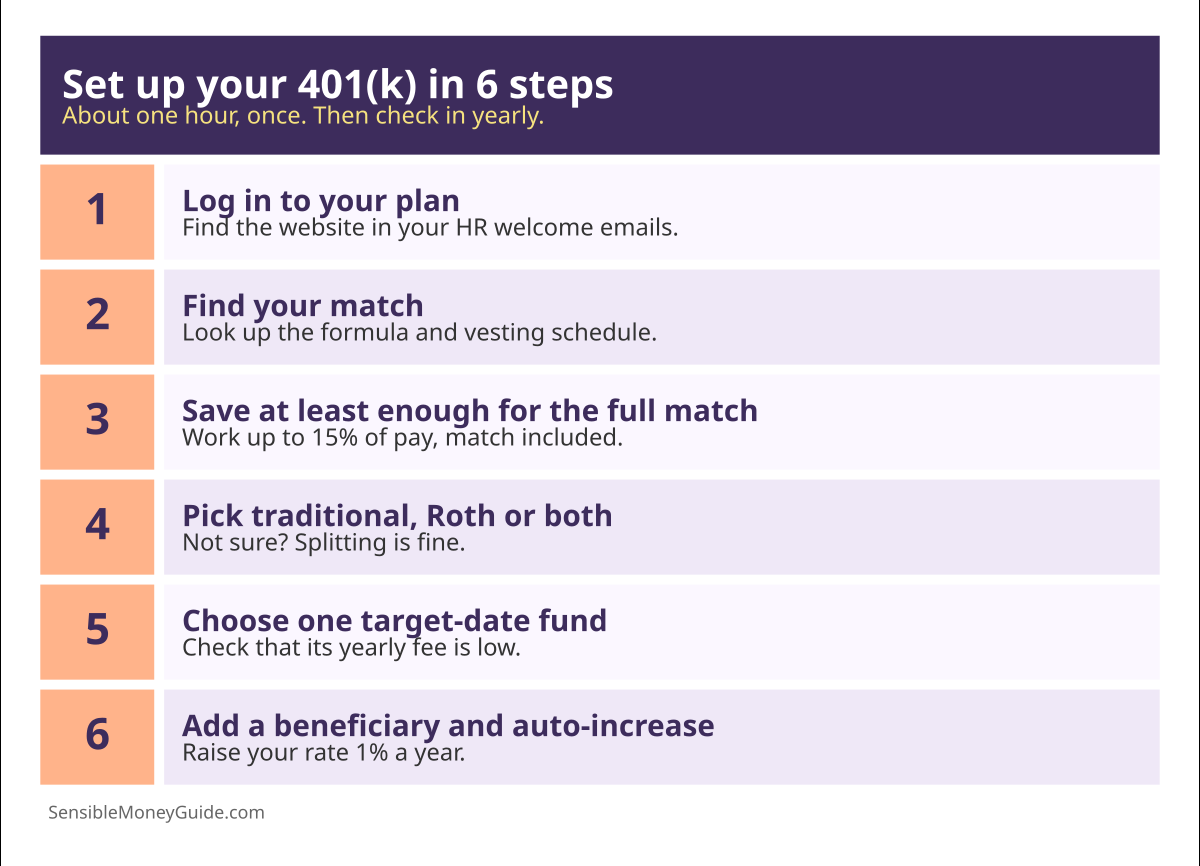
Here’s how to go from “I’ll figure it out later” to done, in about an hour.
- Find your plan login. Ask HR or check your onboarding emails for the plan’s website. Create your account.
- Learn your match. Find the match formula and vesting schedule in the Summary Plan Description.
- Set your savings rate. At a minimum, contribute enough to get the full match. Aim to work up to 15% total, counting the match.
- Pick traditional, Roth or both. Use the rule of thumb above. If you’re unsure, splitting is fine.
- Choose your investments. The simplest move is one target-date fund with a year close to when you’ll turn 65 or so. Check its expense ratio.
- Turn on automatic increases. Set your rate to rise 1% a year until you reach your goal.
- Name your beneficiaries. This is the person who gets your account if you die. It’s a two-minute form that matters a lot.
- Check in once a year. Review your rate, your fund and your fees. Bump your rate after raises.
Common 401(k) mistakes
These are the slip-ups that cost people the most. Many come from Kiplinger’s list of costly 401(k) mistakes, plus a few we see often.
- Not getting the full match. It’s part of your pay. Skipping it is like turning down a raise.
- Staying at the default rate forever. A 3% default is a starting point, not a plan.
- Never picking investments. If your money is sitting in cash, it’s barely growing.
- Cashing out when changing jobs. Taxes and penalties can take about a third, and you lose decades of growth.
- Losing track of old accounts. Keep a list. Roll old accounts over if it makes things simpler.
- Ignoring fees. A 1% difference can cut your final balance by more than a quarter.
- Forgetting about vesting. Know your vesting date before you give notice.
- Treating the 401(k) like a piggy bank. Loans and hardship withdrawals set you back. Build an emergency fund so you don’t need them.
- Panic selling in a downturn. Markets fall sometimes. Selling after a drop locks in the loss. If you’re decades from retirement, a dip means you’re buying shares on sale.
What people get wrong about 401(k)s
Myth: “I’m too young to worry about a 401(k).”
Fact: Your 20s are the best time to start. As our example showed, starting at 25 instead of 35 can nearly double your balance at 67.
Myth: “I’ll lose my 401(k) if I quit.”
Fact: Your own contributions and their growth are always yours. Only unvested employer money can be lost.
Myth: “I have to max it out or it’s not worth it.”
Fact: Even Ramsey Solutions, which pushes saving hard, says “You don’t have to max out your 401(k) to build a solid nest egg.” Getting the match and saving steadily matters most.
Myth: “My money is stuck until I’m 65.”
Fact: You can get it out sooner. Penalty-free withdrawals generally start at 59½. If you leave your job in or after the year you turn 55, you can also skip the penalty on that employer’s plan (not on IRAs or older plans). Loans and some exceptions exist too, though early access has costs.
Myth: “A Roth is always better” or “Traditional is always better.”
Fact: It depends on your tax rate now versus in retirement. Many people split their savings between both.
Myth: “Target-date funds are safe because they’re ‘set it and forget it.'”
Fact: They make investing simpler, but they hold stocks and bonds and can lose value, even near the target year.
The short version
- A 401(k) is a workplace retirement account that takes money from your paycheck, invests it and gives you a tax break.
- For 2026, you can put in up to $24,500, plus $8,000 more at age 50 or older, or $11,250 more at ages 60 to 63.
- Always contribute enough to get your full employer match. It’s part of your pay.
- Your own money is always yours. Employer money may follow a vesting schedule.
- Traditional means a tax break now. Roth means tax-free money later. Splitting is fine.
- A single low-cost target-date fund is a solid, simple choice for most people.
- Fees matter: a 1% difference can shrink your balance by more than a quarter over a career.
- When you change jobs, do a direct rollover or leave the money where it is. Try not to cash out.
Frequently asked questions
How much should I put in my 401(k)?
Start with at least enough to get your full employer match. Then work toward 15% of your pay, counting the match, which is what Fidelity suggests. If that’s too much right now, raise your rate 1% a year.
What is the 401(k) limit for 2026?
The limit for your own contributions is $24,500. If you’re 50 or older, you can add $8,000 more. If you turn 60, 61, 62 or 63 in 2026, your catch-up limit is $11,250 instead.
Is a Roth 401(k) better than a traditional 401(k)?
Neither is always better. A Roth tends to win if your tax rate is lower now than it will be in retirement, which is often true early in your career. A traditional 401(k) tends to win if your tax rate is high now. Splitting between the two is a reasonable choice if you’re unsure.
What happens to my 401(k) if I quit or get fired?
Your own contributions and their growth stay yours. You can leave the money in the old plan, roll it into a new employer’s plan or an IRA, or cash it out. Cashing out usually triggers taxes and, if you’re under 59½, a 10% penalty.
Can I withdraw from my 401(k) early?
Yes, but it usually costs you. Withdrawals before 59½ generally face a 10% penalty plus income tax, unless an IRS exception applies. Some plans also offer loans, hardship withdrawals or an emergency withdrawal of up to $1,000. If you don’t repay an emergency withdrawal, you generally have to wait three years to take another.
What is a good 401(k) balance by age?
Fidelity’s guideline is about 1x your salary saved by 30, 3x by 40, 6x by 50, 8x by 60 and 10x by 67. For context, Vanguard’s median account balance was $44,115 in 2025, while the average was $167,970, pulled up by large accounts. Don’t panic if you’re behind. Focus on raising your savings rate.
Should I invest in a 401(k) if I have debt?
Experts differ. Ramsey Solutions says to pause investing until you’ve paid off all consumer debt. Many other planners say to at least get the full match while you pay down high-interest debt, since the match is an instant return. Either way, high-interest credit card debt deserves a plan of its own.
Can I have a 401(k) and an IRA?
Yes. You can contribute to both in the same year. For 2026, the IRA limit is $7,500, plus $1,100 more if you’re 50 or older. Depending on your income, the tax break for traditional IRA contributions may be limited if you also have a workplace plan.
Do this today
Log in to your 401(k) website and write down three things: your current savings rate, your employer’s match formula and the fund your money is in. If your rate is below the full match, raise it today. It takes five minutes, and it’s a raise you give yourself.
No 401(k) at work? Ask HR whether one is offered and when you’re eligible. If there truly isn’t one, our guide to Roth and traditional IRAs shows you how to save on your own.
About this guide
Written and reviewed by Daniel Brienza, founder and editor of Sensible Money Guide (B.S. in Business Administration, University of South Florida). Every rule, limit and number in this guide was checked against the primary sources listed below. Daniel is not a licensed financial advisor; this guide is for general education.
Updated October 23, 2026. We clarified that RMDs start at age 73 or 75 depending on birth year, added the still-working exception, explained that 457(b) plans have a separate contribution limit, and added a comparison of early-withdrawal options and recent Fidelity data.
Sources
- Internal Revenue Service. 401(k) limit increases to $24,500 for 2026, IRA limit increases to $7,500. Nov. 13, 2025.
- Internal Revenue Service. COLA increases for dollar limitations on benefits and contributions. Accessed October 2026.
- Internal Revenue Service. Retirement topics: Catch-up contributions. Accessed October 2026.
- Internal Revenue Service. Retirement topics: Vesting. Accessed October 2026.
- Internal Revenue Service. Retirement topics: Loans. Accessed October 2026.
- Internal Revenue Service. Topic no. 558, Additional tax on early distributions from retirement plans other than IRAs. Accessed October 2026.
- Internal Revenue Service. Topic no. 413, Rollovers from retirement plans. Accessed October 2026.
- Internal Revenue Service. Retirement topics: Designated Roth account. Accessed October 2026.
- Internal Revenue Service. Retirement topics: Required minimum distributions (RMDs). Accessed October 2026.
- Internal Revenue Service. Retirement Savings Contributions Credit (Saver’s Credit). Accessed October 2026.
- Internal Revenue Service. Notice 2024-55: Certain exceptions to the 10 percent additional tax under Code section 72(t). 2024.
- U.S. Department of Labor, Employee Benefits Security Administration. A Look at 401(k) Plan Fees. September 2019.
- U.S. Bureau of Labor Statistics. Employee Benefits in the United States, March 2026. Sept. 25, 2026.
- Board of Governors of the Federal Reserve System. Economic Well-Being of U.S. Households in 2025: Savings and Investments. May 2026.
- U.S. Securities and Exchange Commission, Investor.gov. 401(k) Plans. Accessed October 2026.
- U.S. Securities and Exchange Commission, Investor.gov. Target Date Funds. Accessed October 2026.
- Vanguard. How America Saves 2026. June 2026.
- Fidelity Investments. Q2 2026 Retirement Analysis. 2026.
- Fidelity Investments. How much do I need to retire? Sept. 25, 2026.
- Charles Schwab. Changing Jobs: Should You Roll Over Your 401(k)? Aug. 29, 2025.
- NerdWallet. 401(k) Plan: What It Is and How It Works. Updated Feb. 12, 2026.
- Kiplinger. 8 Costly 401(k) Mistakes That Could Tank Your Retirement. Updated July 1, 2026.
- Ramsey Solutions. Should You Max Out Your 401(k)? Accessed October 2026.
- Charles Schwab, Hayden Adams. Required Minimum Distributions: What’s New in 2026. December 22, 2025.
- Internal Revenue Service. Retirement plan and IRA required minimum distributions FAQs. Accessed October 2026.
- Internal Revenue Service. How much salary can you defer if you’re eligible for more than one retirement plan? Accessed October 2026.
- Fidelity Investments. Q2 2026 Retirement Analysis. Accessed October 2026.
This article is for educational purposes only and isn’t financial advice. Consider talking with a qualified professional about your situation.


How to Build Credit From Scratch: Your First-Year Plan

How Does a 401(k) Work? Matching, Taxes and 2026 Limits

How Much Do You Need for a House Down Payment?

How to Lower Your Monthly Bills: Calls, Scripts and Savings

How Federal Income Taxes Work: Brackets, Deductions and Credits

How to Make a Budget That Actually Works, Step by Step

How Much Emergency Savings Do You Need? Find Your Number

How to Pay Off Credit Card Debt: Avalanche, Snowball and More

How Credit Scores Work: FICO Factors and Ways to Improve

You must be logged in to post a comment Login