


Credit Management
Credit Report Errors: How to Find, Dispute and Fix Them
Found credit report errors? See the key legal deadlines, a fill-in dispute letter, what to do if the bureau won’t fix it, and what one mistake can cost.

Credit report errors are common, and you can fix them for free. Get your reports from all three bureaus at AnnualCreditReport.com. Circle anything wrong. Then dispute it in writing with the bureau that shows it, and with the lender or collector that reported it. The bureau usually has 30 days to investigate. If it won’t fix a real mistake, you can escalate to the CFPB, your state attorney general or a lawyer. This guide shows each step, the key deadlines the law sets, and what one mistake can cost you.
In 60 seconds
- Your reports are free every week from Equifax, Experian and TransUnion at AnnualCreditReport.com, per the FTC.
- In a 2024 Consumer Reports study, 44% of people who checked found at least one mistake. The study wasn’t a random sample, but errors aren’t rare.
- Dispute in writing and attach proof. Keep copies of everything.
- Most disputes must be finished within 30 days. Some can run up to 45.
- Only wrong, incomplete or unverifiable items have to come off. Accurate negative items can generally stay for up to 7 years (10 for some bankruptcies).
- Disputing is free. A credit repair company that charges you before it has done the work is breaking the law.
| Your situation | Your first move |
|---|---|
| You haven’t looked at your reports in a while | Pull all three free reports today and use the review checklist |
| You found a wrong balance, late payment or duplicate account | Dispute with the bureau and the lender, with copies of your proof (pick your route) |
| You see accounts or inquiries you never opened | File a report at IdentityTheft.gov, then ask the bureaus for an identity theft block |
| You’re applying for a mortgage or car loan soon | Check now, because fixes take a month or more (see what errors cost) |
| The bureau said the item was “verified,” but it’s still wrong | Ask how it was verified, then climb the escalation ladder |
| An old debt seems to have a newer date | Check the 7-year clock and dispute the date |
What’s in this guide
- How common are credit report errors?
- What one mistake can cost you
- Get every report, including the ones you’ve never heard of
- A line-by-line review checklist
- Bureau, lender or both? Pick your route
- The dispute clock: the key deadlines in the law
- How to file a dispute that’s hard to ignore
- When the error is identity theft
- How long negative items can legally stay
- If the bureau says “verified”: your escalation ladder
- Your dispute tracker worksheet
- Credit repair myths vs. facts
- What to remember
- FAQ
How common are credit report errors?
More common than most people think. Your credit report is built from data that thousands of lenders, card issuers and collectors send to the bureaus every month. A typo, a mixed-up name or a payment posted late can slip in at any step.
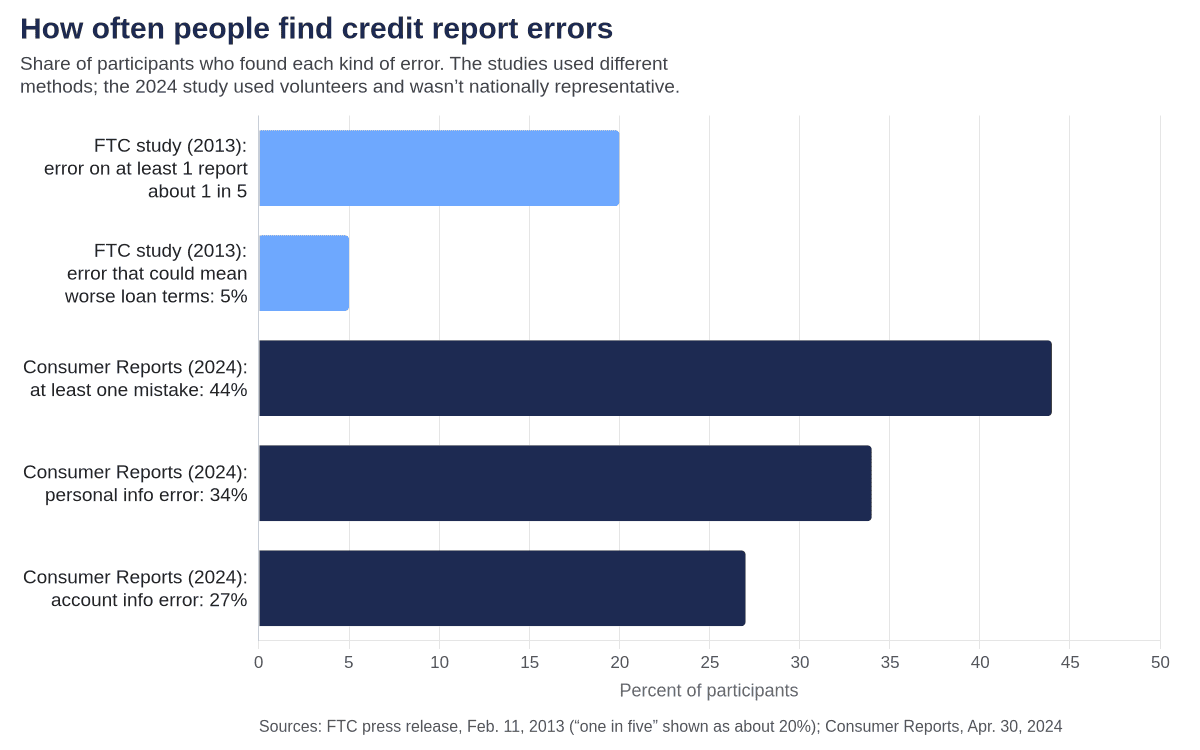
Two big studies give a sense of how often credit report errors show up. They used different methods, so don’t compare them head to head:
- The FTC’s study (released in 2013) had 1,001 people review 2,968 reports. About one in five had an error on at least one report. About 5% had errors that could have led to worse loan terms, according to the FTC’s summary.
- Consumer Reports and WorkMoney ran a “Credit Checkup” in February 2024 with more than 4,000 volunteers. 44% found at least one mistake. 34% found errors in personal information, and 27% found errors in account information, per Consumer Reports. The group notes the study wasn’t nationally representative.
“Millions of Americans have errors on their credit reports, which can do serious lasting damage to their financial prospects.”
Ryan Reynolds, then a financial fairness policy analyst at Consumer Reports, in a 2024 Consumer Reports release
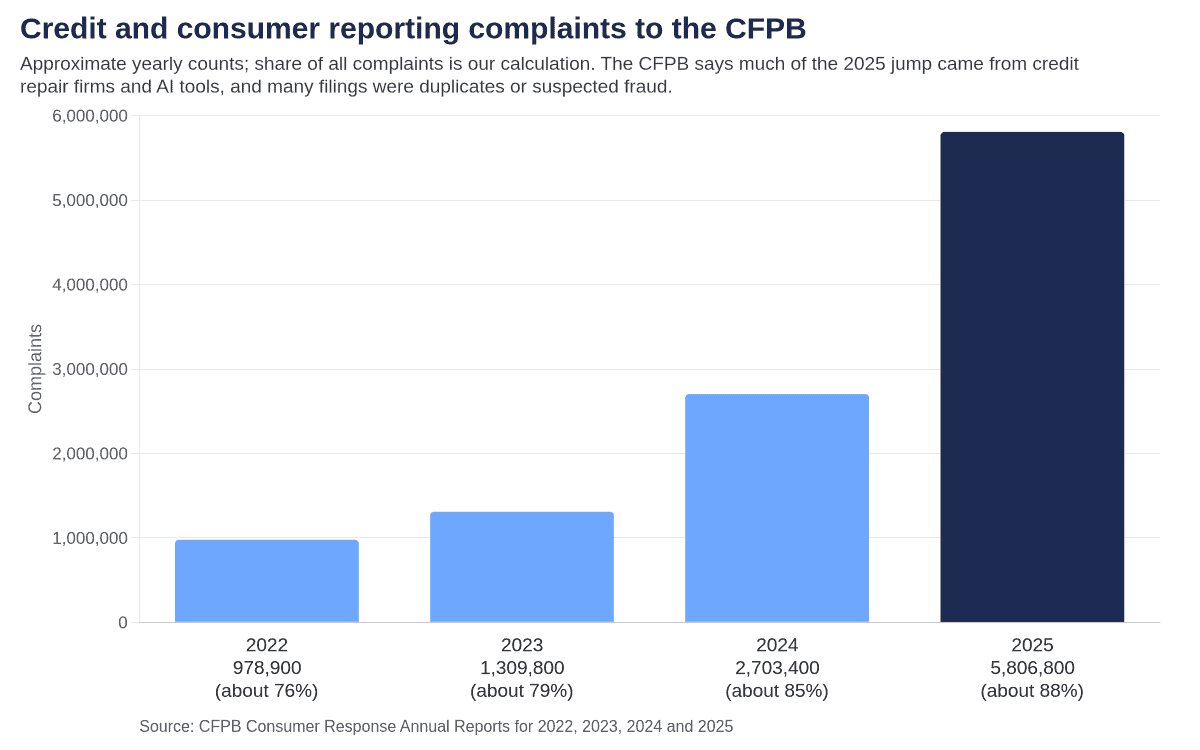
Complaints tell the same story. Credit and consumer reporting is now the top source of complaints to the Consumer Financial Protection Bureau (CFPB). The CFPB counted about 978,900 such complaints in 2022. In 2025 it counted about 5.8 million, roughly 88% of all the complaints it got, per its 2025 Consumer Response Annual Report.
Read that jump with care. The CFPB says much of the 2025 surge came from credit repair companies, “finfluencers” and AI tools filing for people. Companies sent back hundreds of thousands of complaints as duplicates or suspected fraud. So the count shows a crowded system, not exactly six times more mistakes.
What one mistake can cost you
An error matters most when it lowers your score right before you borrow. Here are three worked examples. All of them are hypothetical, and we ran the math in Python.
Example 1: A misplaced zero on a card balance
Say you have two credit cards. Card A has a $6,000 limit and Card B has a $4,000 limit. You owe $540 on Card A and $400 on Card B. But Card A’s issuer reports $5,400 by mistake.
| What’s reported | Card A use | Overall use |
|---|---|---|
| Correct ($540 + $400) | 9% | 9.4% |
| With the error ($5,400 + $400) | 90% | 58% |
Credit utilization, the share of your limits you’re using, is a big part of most scores. A jump from about 9% to 58% can pull a score down sharply. It stays down until the balance is fixed. Our guide to how credit scores work explains why utilization carries so much weight.
Example 2: An error right before a mortgage
Fannie Mae charges lenders an upfront fee called a loan-level price adjustment (LLPA). It rises as credit scores fall. Lenders typically pass it on to borrowers, either as a fee or built into the rate. Here’s what Fannie Mae’s LLPA matrix dated Sept. 9, 2026 sets by Classic FICO score. It’s for a purchase loan with 20% down and a term over 15 years:
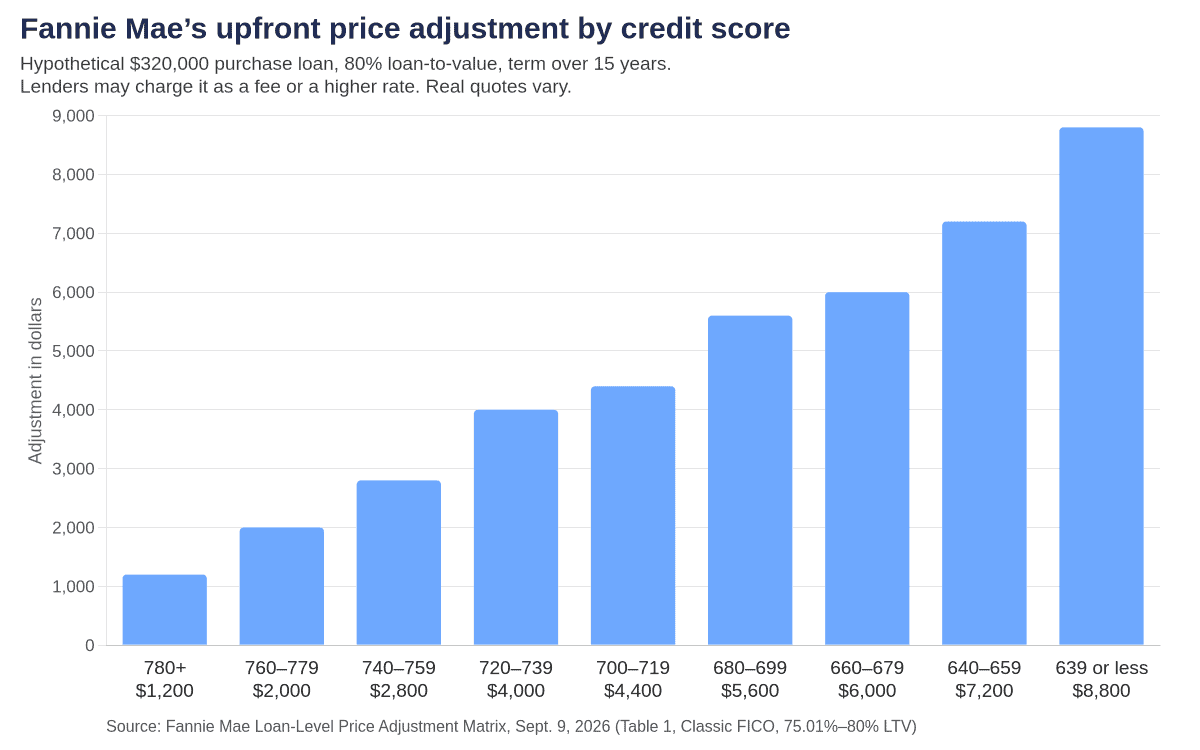
Now take a hypothetical $320,000 loan on a $400,000 home. With a correct score of 752, the LLPA is 0.875%, or $2,800. Suppose a wrong late payment drops the score to 688. The LLPA becomes 1.750%, or $5,600. That’s $2,800 more from one mistake. If the error pushed the score to 652, the extra cost would be $4,400.
These are only Fannie Mae’s base adjustments. Your real price depends on the lender, the loan type, other fees and the market, so real quotes will differ.
Example 3: The same error, paid through the rate
Some lenders build the cost into your rate instead of charging it up front. Freddie Mac’s survey put the average 30-year fixed rate at 7.32% for the week of October 22, 2026. That average comes from thousands of loan applications sent to Freddie Mac.
Assume, just for illustration, that an error raises your rate by a quarter point, to 7.57%. On $320,000 over 30 years, principal and interest rise from about $2,198 to about $2,253 a month. That’s about $55 more each month, or roughly $19,680 over the full 30 years if you never refinance. It’s a hypothetical gap, not a quote.
If you’re saving for a home, our down payment guide covers the rest of the costs. Check your reports at least a few months before you apply.
Get every report, including the ones you’ve never heard of
Start with the big three. The FTC says all three nationwide bureaus have permanently extended free weekly reports at AnnualCreditReport.com. That’s the only official site for them. You can also call 1-877-322-8228 or mail the request form to Annual Credit Report Request Service, P.O. Box 105281, Atlanta, GA 30348-5281. Reports ordered by phone or mail are processed and mailed within 15 days.
Equifax says that, under legal settlements, at least six free Equifax reports a year are available through December 31, 2026, as part of its free weekly reports. The weekly program itself continues after that.
Pull all three, not just one
Each bureau gets data from different lenders, so an error can sit on one report and not the others. Chase’s credit education page also suggests checking all three reports when you spot an account you don’t know.
Don’t forget specialty reports
Other companies keep files too. Many banks check ChexSystems or Early Warning Services before they open a checking account. Landlords use tenant screening reports. Employers use background checks. The CFPB keeps a list of these companies, with how to get each report. For example, Early Warning gives one free report every 12 months if you ask, and you have the legal right to dispute what’s in it. The same federal dispute rules apply to these companies.
A good habit: check the big three a few times a year. If a bank ever turns you down for an account, pull your ChexSystems and Early Warning files too.

A line-by-line review checklist
Print each report or open it on a big screen. Go section by section with a pen. Circle anything you can’t confirm from your own records.
Personal information
- Name spellings, including ones you’ve never used
- Current and past addresses
- Social Security number and birth date
- Employers (errors here don’t hurt your score, but an unknown one can hint at a mixed file)
Accounts
- Accounts you never opened (a possible sign of identity theft)
- Your own account listed twice, or one debt reported by both the original lender and a collector as if you owe both
- Late payments you made on time
- Wrong balances or credit limits
- A closed account shown as open, or one you closed shown as “closed by grantor”
- Debts discharged in bankruptcy still showing a balance
- You listed as the owner when you’re only an authorized user
Dates
- The date of first delinquency on old debts (a later date than the real one can keep a debt on your report too long)
- Negative items older than the time limits in the 7-year section
Inquiries and public records
- Hard inquiries from companies you never applied with
- Public records that aren’t yours, such as a bankruptcy
Glossary box: Bureau (or consumer reporting agency): a company that keeps your credit file, such as Equifax, Experian or TransUnion. Furnisher: the lender, card issuer, collector or other company that sends data about you to the bureaus. Reinvestigation: the law’s word for the bureau’s check after you dispute. Mixed file: someone else’s data merged into your report, often because of a similar name or Social Security number. Date of first delinquency: the date an account first went late and never caught up. It starts the 7-year clock.
Bureau, lender or both? Pick your route
You can dispute with the bureau, directly with the furnisher, or both. The CFPB suggests doing both when the error came from a lender. Each route has different strengths.
| Route | Best for | Key rule |
|---|---|---|
| Dispute with the bureau | Any wrong item on that bureau’s report, including personal details, inquiries and public records | The bureau must send your dispute to the furnisher within 5 business days and finish in 30 days in most cases |
| Direct dispute with the furnisher | Wrong balances, late payments or account status that the lender reported to every bureau | Send it to the address the furnisher lists for disputes. It has the same 30-day window. It doesn’t cover things like addresses or inquiries |
| Identity theft block | Accounts or debts from fraud | With an identity theft report, the bureau must block the item within 4 business days |
The furnisher route comes from Regulation V, 12 CFR 1022.43. It covers your liability for the debt, the account terms and your payment history. It generally doesn’t cover your personal details, employers, inquiries, public records or fraud alerts, or disputes sent by a credit repair company. Those go to the bureau. One fix at the furnisher can clean up all three reports at once, since it stops sending the bad data everywhere.
The CFPB offers free sample letters for both routes. Our own fill-in letter is in the filing section.
The dispute clock: the key deadlines in the law
The Fair Credit Reporting Act (FCRA) sets the timeline. Most guides mention 30 days and stop there. Here are the main deadlines for you and the bureau, from 15 U.S.C. 1681i unless noted. “Business days” skip weekends and holidays.
| What happens | Deadline | Where it’s from |
|---|---|---|
| Bureau tells the furnisher about your dispute | Within 5 business days of getting it | 1681i(a)(2) |
| Bureau finishes its investigation, or deletes the item | 30 days | 1681i(a)(1)(A) |
| Extension if you send more relevant info during those 30 days | Up to 15 more days | 1681i(a)(1)(B) |
| Dispute filed after your once-every-12-months free report required by federal law | 45 days (it’s unclear whether this covers the extra weekly reports) | 1681j(a)(3) |
| Bureau tells you a dispute is “frivolous or irrelevant” | Within 5 business days of deciding | 1681i(a)(3) |
| Bureau sends you the results | Within 5 business days of finishing | 1681i(a)(6) |
| You ask how the item was verified | Bureau must describe it within 15 days of your request | 1681i(a)(7) |
| A deleted item is put back | Written notice within 5 business days | 1681i(a)(5)(B) |
| Identity theft block | Within 4 business days | 1681c-2 |
One detail many guides miss: the 15-day extension doesn’t apply if the bureau finds the item wrong, incomplete or unverifiable within the first 30 days.
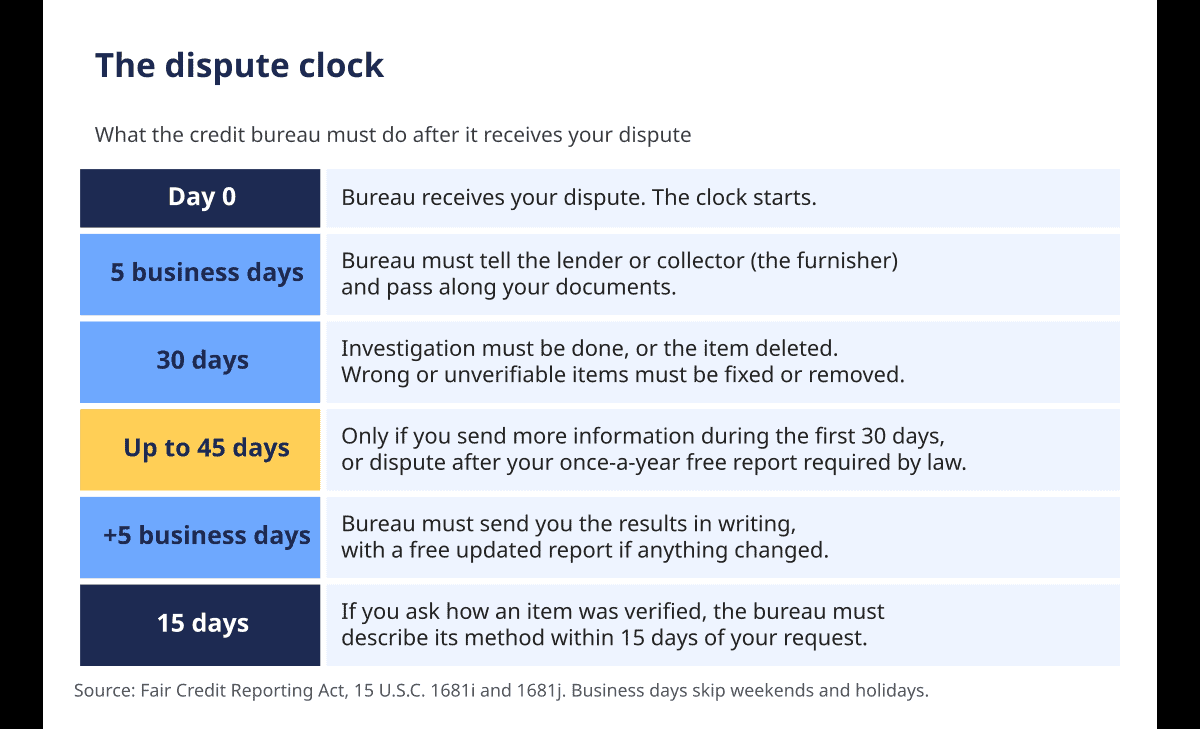
Worked example: putting dates on the clock
Here’s how the clock would run for a hypothetical dispute the bureau receives on Monday, November 2, 2026:
- About November 6: the bureau must have notified the furnisher. The law counts 5 business days beginning on the day it receives your dispute.
- About December 1: the end of the 30-day period.
- About December 16: the latest finish if you sent new information during the first 30 days (15 more days).
- December 8: the latest date for your results letter if the bureau finishes on December 1.
- If you ask how an item was verified on Monday, December 14, the answer is due by December 29.
The clock starts when the bureau receives your dispute. Online disputes usually arrive faster than mail. Certified mail gives you a dated receipt that proves when it arrived.
How to file a dispute that’s hard to ignore
You can dispute online, by mail or by phone. Online is usually fastest. Mail gives you the cleanest paper trail. Whichever you choose, the goal is the same: make it easy for the bureau to see the mistake and hard for it to wave it off.
The CFPB’s short video walks through the basics. It’s from 2019, so where it differs on how often reports are free, go with the weekly schedule above.
What to include
- Your full name, address and date of birth, plus a copy of an ID and a recent bill that shows your address
- The report number, if your report has one
- Each item you dispute, with the creditor name and the account number shown on the report
- What’s wrong and what the correct information is, in one or two plain sentences
- What you want done: delete it or correct it
- Copies (never originals) of your proof, such as bank statements, a paid-in-full letter or a court order
The CFPB recommends disputing in writing and sending copies of your documents. If you mail it, use certified mail with a return receipt, as American Express suggests, and keep records of every date. Clark Howard’s team also suggests writing down the name of everyone you speak with by phone.
Online forms often limit how much you can explain. If your case needs a full story, upload a letter as an attachment or switch to mail.
Fill-in dispute letter
[Your name] · [Address] · [Date of birth] · [Report number, if any]
[Bureau or company name and dispute address]
[Date]
I am disputing the following information on my credit report. I have enclosed copies of my ID, proof of address and supporting documents.
Item 1: [Creditor name], account ending [last 4 digits]. The report shows [what it says]. This is wrong because [reason]. The correct information is [what it should say]. Please [delete / correct] this item.
Enclosed: [list each document].
Under the Fair Credit Reporting Act, please investigate and send me the results in writing.
Sincerely, [Signature]
Keep it short and factual. One letter can list several items. Send a separate letter to each bureau that shows the error, and one to the furnisher.

What a “frivolous” notice means
A bureau can refuse to investigate if it decides a dispute is frivolous or irrelevant. That usually means you didn’t give enough information, or you sent the same dispute again with nothing new. The bureau must tell you within 5 business days and explain what information it needs. Furnishers follow a similar rule under Regulation V. The fix is simple: send the missing details or new proof, and the clock starts again.
Form letters copied from the internet are a common trigger. Write your own facts in your own words.
Will disputing hurt my score?
No. Filing a dispute doesn’t lower your score. American Express cites TransUnion on this: “there’s no impact to your credit score because you start a dispute.” Your score can change later if an item is fixed or removed.
When the error is identity theft
Accounts you never opened, or debts you never ran up, call for a faster track.
- Report it at IdentityTheft.gov. The FTC site walks you through the report and builds a recovery plan. The FTC’s Identity Theft Report is what you’ll send the bureaus when you ask for a block.
- Ask each bureau for a block. Send proof of identity, a copy of your identity theft report, the items that are fraud, and a statement that they aren’t yours. The bureau must block them within 4 business days and tell the furnisher, under FCRA section 605B.
- Freeze your credit. A freeze is free to place and lift. By phone or online, a bureau must place it within 1 business day and lift it within 1 hour, under 15 U.S.C. 1681c-1.
- Consider a fraud alert. An initial alert lasts one year, and an extended alert for identity theft victims lasts seven years, per the FTC. Placing one with one bureau is enough, since it must tell the other two.
Freezes and alerts don’t remove existing errors. They stop new accounts from being opened in your name while you clean up the old ones.
How long negative items can legally stay
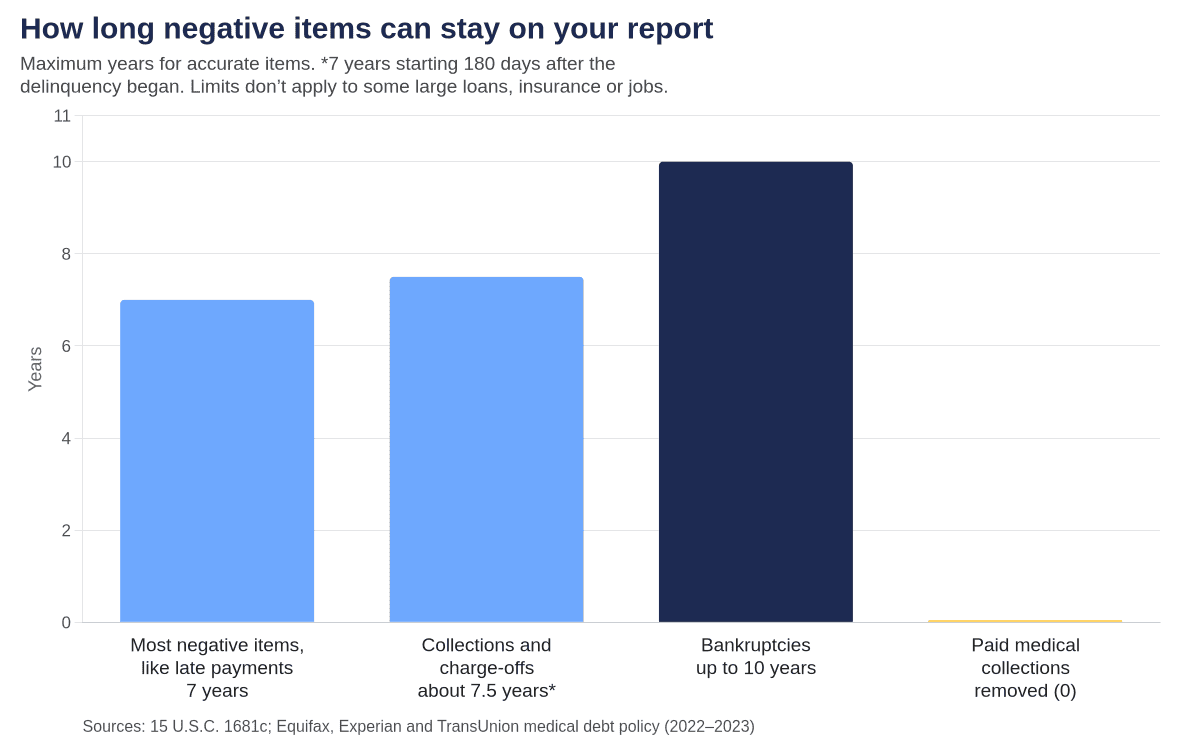
A dispute only works on items that are wrong. Accurate negative items stay until their time runs out, under 15 U.S.C. 1681c:
- Bankruptcies: up to 10 years from the date of the order for relief.
- Collections and charge-offs: 7 years, counted from 180 days after the delinquency began.
- Most other negative items, such as late payments: 7 years. Civil judgments can stay 7 years or until the statute of limitations runs out, whichever is longer.
- Criminal convictions: no time limit.
These limits don’t apply when the report is for a loan or life insurance policy of $150,000 or more, or a job paying $75,000 a year or more.
Worked example: the 7-year clock
Say a hypothetical card account first went late on March 15, 2020, and never caught up. Add 180 days and you get September 11, 2020. Add 7 years and the collection should drop off by about September 11, 2027. If a collector reports a later delinquency date, say 2022 because the debt was sold, that’s called re-aging. It’s a disputable error. Your old statements are the proof.
Medical debt rules today
The three bureaus changed their own policies in 2022 and 2023. Paid medical collections no longer appear. Unpaid medical collections wait a year before they show up. Medical collections that started under $500 were removed, per the bureaus’ joint announcement. A broader CFPB rule that would have banned most medical debt from reports was vacated by a federal court in July 2025, as Ballard Spahr reported. If you see a paid or small medical collection, dispute it.

If the bureau says “verified”: your escalation ladder
Sometimes a clear error comes back “verified as reported.” Often the bureau just asked the furnisher, and the furnisher said its data was right.
“If the furnisher says, ‘Yup, that’s right,’ the agency closes your dispute without doing its due diligence.”
Eric Croak, a CFP and founder of Croak Capital, to CNBC Select
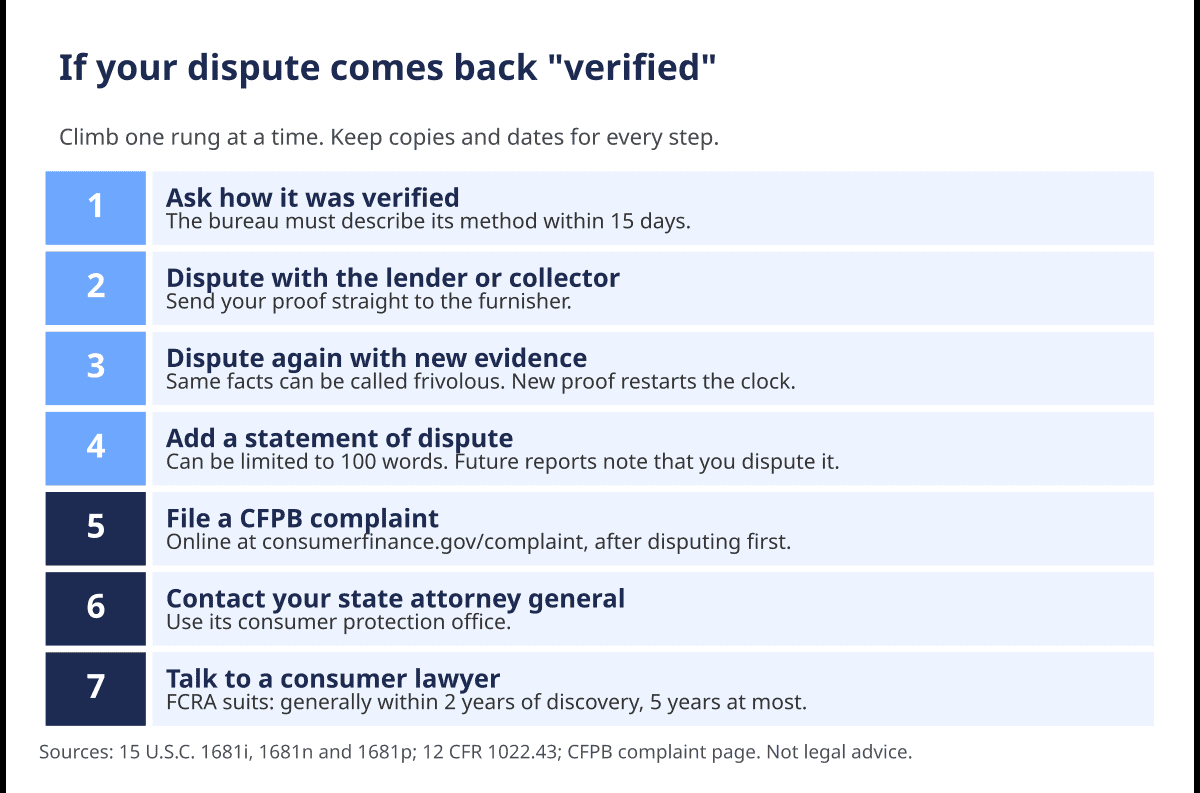
Don’t give up. Climb these rungs in order:
- Ask how it was verified. You have the right to a description of the method, including the furnisher’s contact details if available. The bureau must answer within 15 days of your request.
- Dispute directly with the furnisher. Send your proof to the lender or collector. A furnisher that agrees it was wrong must correct what it sends to every bureau.
- Dispute again with new evidence. A second dispute with the same facts can be called frivolous. A new document, like a letter from the lender, restarts the process.
- Add a statement of dispute. If the item stays, you can add a short statement to your file. The bureau can limit it to 100 words if it helps you write a clear summary. Future reports must note that you dispute the item.
- File a CFPB complaint. Use the CFPB complaint form. The CFPB says you must first dispute directly with the reporting company, so have your dispute dates ready.
- Contact your state attorney general. Many have consumer protection offices that take complaints.
- Talk to a consumer lawyer. You can sue under the FCRA. For willful violations, you can win actual damages or $100 to $1,000, plus punitive damages and attorney’s fees, under 15 U.S.C. 1681n. You generally must sue within 2 years of discovering the violation, and no later than 5 years after it happened (1681p). One catch: you generally can’t sue a lender over a direct dispute alone. A claim against a furnisher usually depends on having disputed through a bureau first, under 15 U.S.C. 1681s-2.
“Creditors seem to respond faster because you’ve now opened a federal complaint.”
Eric Croak, a CFP and founder of Croak Capital, to CNBC Select
Sample statement of dispute (under 100 words)
“I dispute the 60-day late payment reported by [Creditor] for June 2026. My bank statement shows the payment cleared on June 3, before the due date. The creditor has not corrected the error. Please consider this when reviewing my file.”
A statement won’t change your score, but a lender reading the report will see it.
After a win
Once an item is fixed, ask the bureau to send the correction to anyone who pulled your report recently. The FCRA covers the past 6 months for most uses and 2 years for employment, as the FTC explains. Then check again in a few months. If a deleted item comes back, the bureau must tell you in writing within 5 business days, and the furnisher must have certified that it’s accurate.
Your dispute tracker worksheet
Copy this table into a notebook or spreadsheet. One row per item per bureau. Fill in the deadline column using the dispute clock above.
| Item and bureau | Date sent and how | Date received (start of clock) | Deadline and result |
|---|---|---|---|
| [Creditor, account ending ____] at [bureau] | [__/__/__] online / certified mail #____ | [__/__/__] | 30 days: [__/__/__] · Result: ______ |
| Same item, sent to the furnisher | [__/__/__] | [__/__/__] | 30 days: [__/__/__] · Result: ______ |
| Method-of-verification request | [__/__/__] | [__/__/__] | 15 days: [__/__/__] · Answer: ______ |
| Follow-up check of all three reports | [__/__/__] | — | Item fixed everywhere? Y / N |

Keep your proof, letters and mail receipts in one folder. If you ever need to escalate, this log is the first thing a regulator or lawyer will ask for.
Credit repair myths vs. facts
| Myth | Fact |
|---|---|
| A credit repair company can erase anything negative. | The FTC says you can’t legally remove information that’s correct and up to date. Only scammers promise to remove all negative items. |
| You need to pay someone to dispute for you. | Disputes are free. The FTC says you can do the same things a credit repair company can do legally for little or nothing. |
| A paid credit repair company can charge you up front. | It’s illegal for a credit repair company to charge you before it helps you, per the FTC. |
| A special “609 letter” forces bureaus to delete debts. | Section 609 of the FCRA gives you the right to see your file. It doesn’t make bureaus delete accurate debts. A clear dispute with proof is all you need. |
| Disputing will hurt your score. | Filing a dispute has no effect. Only the outcome can change your score. |
| Paying off a collection removes it. | Accurate collections can stay for their full time, though paid medical collections are now removed. Paying may still matter to a lender reading your report. |
What to remember
- Check all three reports for free each week at AnnualCreditReport.com, and specialty reports if a bank turns you down.
- Dispute in writing with proof, with the bureau and the furnisher.
- The bureau has 30 days in most cases, up to 45 in some.
- Use the identity theft block for fraud. It has a 4-business-day deadline.
- Accurate negatives generally stay up to 7 years (10 for some bankruptcies). Wrong dates are disputable.
- If a dispute fails, ask how it was verified, then escalate step by step.
- Never pay anyone up front to “fix” your credit.
FAQ
How long does a credit report dispute take?
Usually 30 days from when the bureau gets it. It can stretch to 45 days if you send more information during the investigation, or if you dispute after getting your once-a-year free report required by federal law. The bureau then has 5 business days to send you the results.
Should I dispute with all three bureaus?
Dispute with each bureau whose report shows the error. Each one keeps its own file and won’t fix the others. Also dispute with the furnisher so it stops sending the wrong data.
Is it better to dispute online or by mail?
Online is faster and fine for simple errors. Mail with a return receipt gives you proof of what you sent and when. For complex cases or anything you might escalate, mail is safer. NerdWallet’s dispute guide lists each bureau’s online, phone and mail options.
Can I remove a late payment that was really late?
Not through a dispute. Accurate information can stay for 7 years. Some people ask the lender for a “goodwill” removal, but lenders don’t have to agree.
What happens if the furnisher doesn’t respond?
If the furnisher can’t verify the item in time, the bureau must delete or correct it. That’s one reason disputes with good proof often succeed.
Do I need a lawyer to dispute an error?
No. Most disputes are simple. A consumer lawyer helps when a clear error won’t get fixed and it’s costing you, such as a denied loan. The FCRA lets consumers who win recover attorney’s fees, so ask any lawyer how they charge for FCRA cases.
What if my report has someone else’s accounts?
That’s a mixed file. Dispute each wrong account, and send proof of your identity and your correct Social Security number and addresses. If the accounts look like fraud, use the identity theft steps instead.
Your move this week
Block 30 minutes. Pull all three reports at AnnualCreditReport.com and work through the checklist with a pen. If you find even one error, start a row in the tracker and send your first dispute before the week is out. If you’re still building your file, our guide to building credit from scratch covers the next steps.
About this guide
Published by Daniel Brienza, founder and editor of Sensible Money Guide (B.S. in Business Administration, University of South Florida). This guide was researched and drafted with the help of AI tools, fact-checked against the primary sources listed below, and reviewed and edited by Daniel before publishing. Daniel is not a licensed financial advisor; this guide is for general education.
Published October 30, 2026. Figures are current as of that date.
Sources
Government and official sources
- Federal Trade Commission, “Free Credit Reports” (accessed October 2026)
- Federal Trade Commission, “Disputing Errors on Your Credit Reports” (accessed October 2026)
- Federal Trade Commission, “What To Know About Credit Freezes and Fraud Alerts” (accessed October 2026)
- Federal Trade Commission, “In FTC Study, Five Percent of Consumers Had Errors on Their Credit Reports That Could Result in Less Favorable Terms for Loans” (February 11, 2013)
- Federal Trade Commission, “Only scammers say they’ll remove all negative information from your credit report” (August 5, 2024)
- Federal Trade Commission, IdentityTheft.gov (accessed October 2026)
- Consumer Financial Protection Bureau, “How do I dispute an error on my credit report?” (accessed October 2026)
- Consumer Financial Protection Bureau, “Sample letters to dispute information on a credit report” (accessed October 2026)
- Consumer Financial Protection Bureau, “Submit a complaint” (accessed October 2026)
- Consumer Financial Protection Bureau, Consumer Response Annual Report, 2025 (March 2026); also the 2024, 2023 and 2022 reports
- Consumer Financial Protection Bureau, “Early Warning Services, LLC” in its list of consumer reporting companies (accessed October 2026)
- Fair Credit Reporting Act, 15 U.S.C. 1681i, 1681j, 1681c, 1681c-1, 1681c-2, 1681n, 1681s-2 and 1681p, via Cornell Law School’s Legal Information Institute (accessed October 2026)
- Regulation V, 12 CFR 1022.43, “Direct disputes”, via Cornell Law School’s Legal Information Institute (accessed October 2026)
- Fannie Mae, Loan-Level Price Adjustment Matrix (September 9, 2026)
- Freddie Mac, Primary Mortgage Market Survey (week of October 22, 2026)
Banks, credit bureaus and research
- Chase, “What to do if you don’t recognize an account on your credit report” (accessed October 2026)
- American Express, “How to Dispute Your Credit Report” (updated September 15, 2025)
- Equifax, “Free Credit Reports” (accessed October 2026)
- TransUnion, “Equifax, Experian and TransUnion Remove Medical Collections Debt Under $500 From U.S. Credit Reports” (April 11, 2023)
- Consumer Reports, “Almost half of participants in Credit Checkup study find errors on credit reports” (April 30, 2024)
- Consumer Reports, “Credit report error complaints to CFPB have increased more than 2.5 times since 2021” (February 15, 2024)
News and personal finance media
- CNBC Select, “More People Are Finding Credit Report Errors. Here’s How to Fix Yours” (updated August 10, 2026)
- NerdWallet, “How to Dispute Credit Report Errors” (updated June 9, 2026)
- Clark Howard, “5 Steps To Dispute an Error on Your Credit Report” (accessed October 2026)
- Ballard Spahr Consumer Finance Monitor, “Federal judge vacates CFPB medical debt rule” (July 15, 2025)
This article is for educational purposes only and isn’t financial advice. Consider talking with a qualified professional about your situation.


Credit Report Errors: How to Find, Dispute and Fix Them

HSA Rules for 2026 and 2027: Limits, Taxes and Smart Uses

Asset Allocation by Age: How to Mix Stocks, Bonds and Cash

Debt Consolidation in 2026: Loans, Transfers and Pitfalls

How to Build Credit From Scratch: Your First-Year Plan

How to Pay Off Credit Card Debt: Avalanche, Snowball and More

How to Make a Budget That Actually Works, Step by Step

How Much Emergency Savings Do You Need? Find Your Number

How Credit Scores Work: FICO Factors and Ways to Improve

You must be logged in to post a comment Login