


Retirement Planning
When to Claim Social Security: Ages, Math and Trade-Offs
When to claim Social Security depends on income, health and your spouse. See the check at each age, break-even math, survivor rules and trust fund risks.

When to claim Social Security depends on three things: whether you need the money now, how long you and your spouse are likely to live, and whether someone will rely on your check after you die. If you can cover your bills without it and expect to live past your early 80s, waiting usually pays. If you can’t, or your health is poor, an earlier start can be the right call. You can start any month from 62 to 70, and your check stops growing at 70.
Which path fits you?
| Your situation | Path to consider | Why |
|---|---|---|
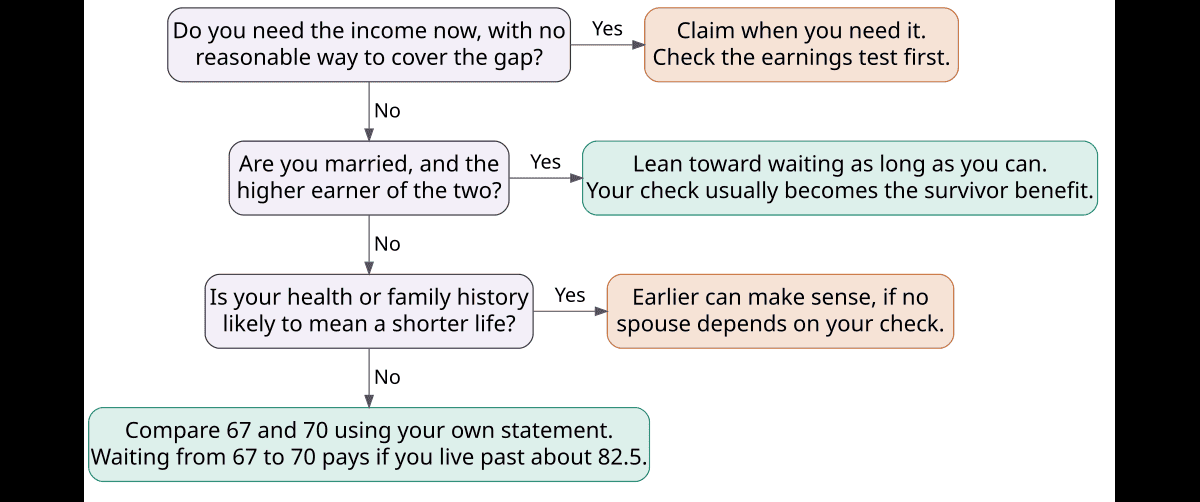
| You need the income now and can’t cover the gap another way | Claim when you need it | A bigger check later doesn’t help if bills go unpaid or debt piles up today |
| You’re the higher earner in a married couple | Wait as close to 70 as you can | Your check largely sets the survivor benefit your spouse may live on |
| You’re the lower earner in a married couple | An earlier start can work | The couple’s long-term income depends more on the higher earner’s check |
| You’re single, healthy and have savings to bridge the gap | Compare 67 with 70 | Waiting from 67 to 70 tends to pull ahead if you live past about 82½ |
| You’re single with a serious health problem | Earlier may be better | You may not reach the break-even age, and no spouse relies on your check |
| You’re under full retirement age and earning well above the limit | Often wait until you stop or reach that age | The earnings test can hold back much of your check for now |
The rest of this guide shows the math behind that table. It includes break-even ages with and without investing, a test of what a trust fund shortfall would do to those ages, and a side-by-side look at couples. Widowed? Go straight to the survivor section, since you may be able to take one benefit first and switch later.
What’s in this guide
- How your claiming age changes your check
- The break-even age, and the odds of reaching it
- Claim early and invest it? The return you would need
- Married, divorced or widowed
- If you are still working
- Taxes and Medicare
- Should the trust fund change your plan?
- Myths vs. facts
- What the experts say
- If you change your mind
- Your checklist before you file
- The short version
- Questions people ask
- One thing to do this week
- Sources

How your claiming age changes your check
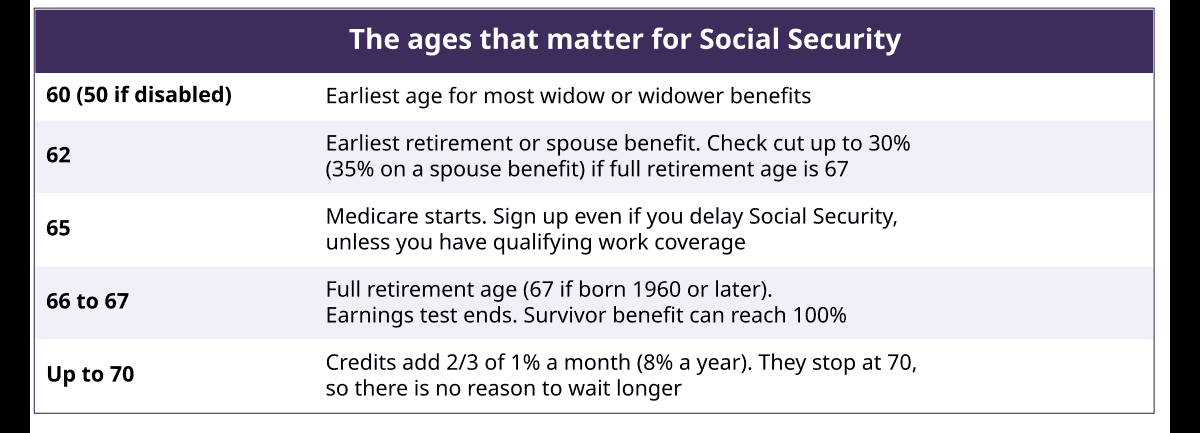
Your benefit starts from one number: the amount you’d get at full retirement age. Claim before that age and the check shrinks for good. Claim later and it grows. Social Security’s rules are exact: the check drops 5/9 of 1% a month for the first 36 months early, then 5/12 of 1% a month beyond that. It rises 2/3 of 1% a month, or 8% a year, once you pass full retirement age.
For anyone born in 1960 or later, full retirement age is 67. If you were born in 1959, it’s 66 and 10 months. If your birthday falls on January 1, use the year before. Those with an earlier full retirement age have slightly different percentages than the ones below.
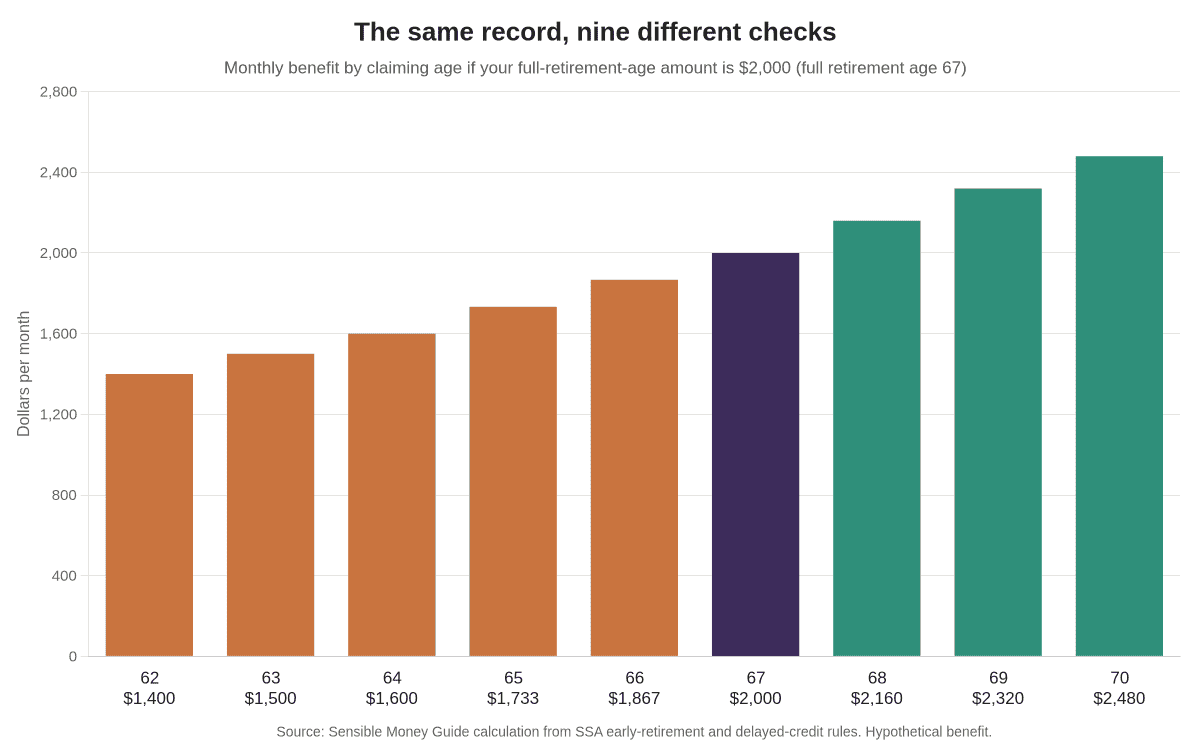
| Claim at | Percent of full amount | Check if full amount is $2,000 | Over a year |
|---|---|---|---|
| 62 | 70% | $1,400 | $16,800 |
| 63 | 75% | $1,500 | $18,000 |
| 64 | 80% | $1,600 | $19,200 |
| 65 | 86.7% | $1,733 | $20,800 |
| 66 | 93.3% | $1,867 | $22,400 |
| 67 | 100% | $2,000 | $24,000 |
| 68 | 108% | $2,160 | $25,920 |
| 69 | 116% | $2,320 | $27,840 |
| 70 | 124% | $2,480 | $29,760 |
The $2,000 is a round number for easy math. For scale, Social Security estimates the average retired worker will get $2,170 a month in January 2027, after a 3.6% cost-of-living raise. The most a worker retiring at full retirement age can get in 2027 is $4,188.
So the gap between the earliest and latest start is large. In this example, the age 70 check is about 77% bigger than the age 62 check ($2,480 vs. $1,400). And because cost-of-living raises are a percentage, that gap grows in dollars over time.
Words you’ll see
- Full retirement age (FRA): the age you get your full benefit, 66 to 67 depending on birth year.
- Primary insurance amount: the official name for that full benefit. It’s based on your highest 35 years of earnings.
- Delayed retirement credits: the 8% a year you earn by waiting past FRA, up to 70.
- Earnings test: the rule that holds back benefits if you claim early and keep working.
- Survivor benefit: the payment a widow or widower can get based on the spouse’s record.
- COLA: the cost-of-living adjustment, a yearly raise for people already eligible.
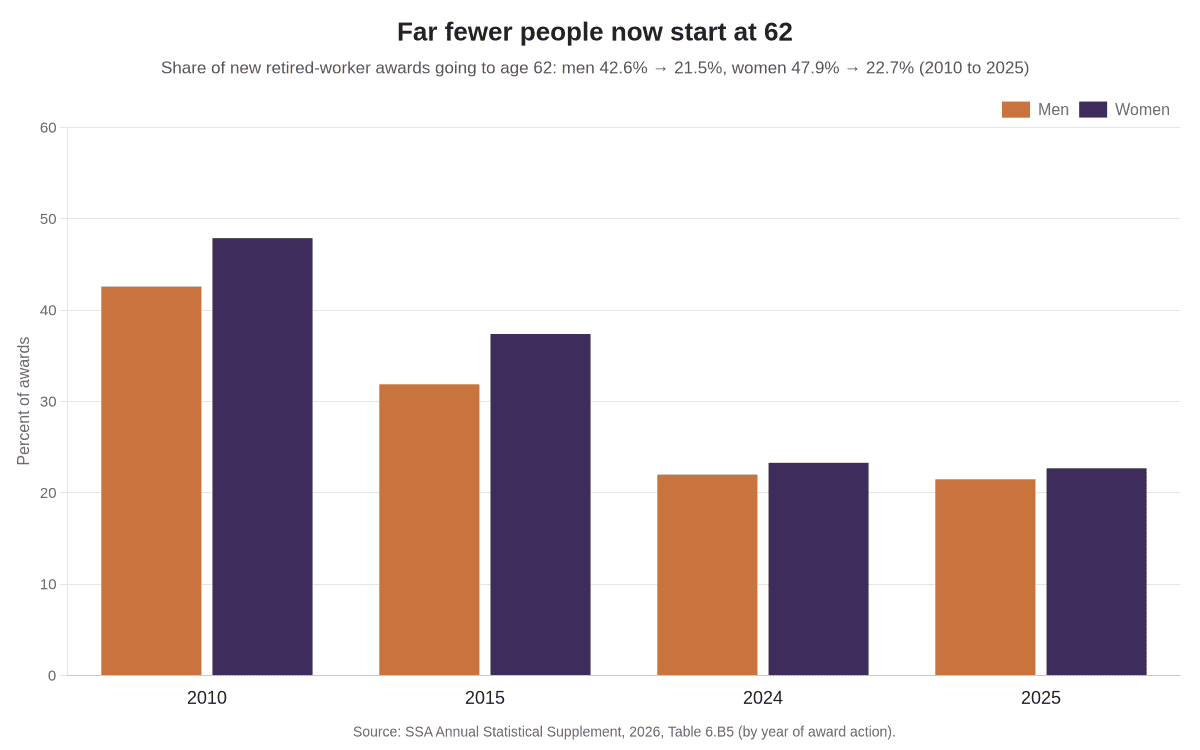
People are already moving later. In SSA data on new retired-worker awards, the share going to people aged 62 has fallen from 42.6% of men and 47.9% of women in 2010 to 21.5% and 22.7% in 2025. About 8% of 2025 awards were at 70 or later. That’s a trend, not advice, and what others do says little about your own situation.
The break-even age, and the odds of reaching it
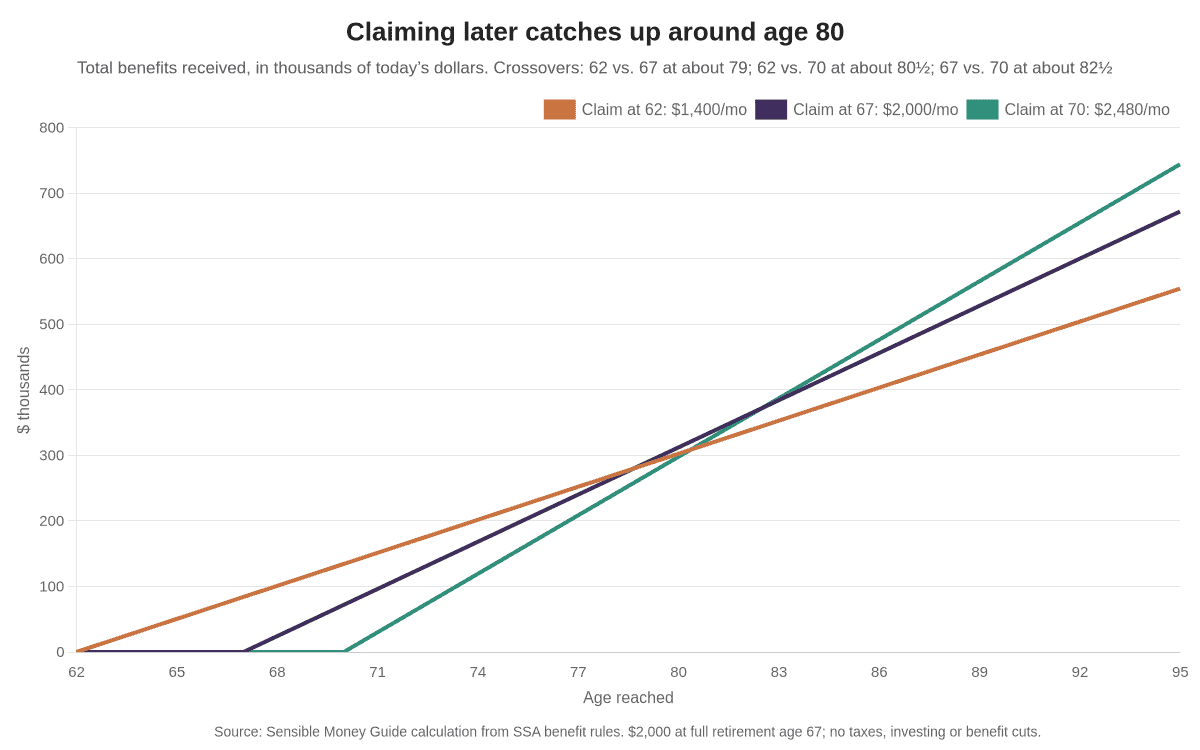
The break-even age is when the total from waiting catches up with the total from starting early. Before it, the early claimer has collected more. After it, the person who waited stays ahead for life.
We calculated these month by month from SSA’s own reduction and credit rules, using a full retirement age of 67. The size of your benefit doesn’t change the answer. Since a COLA raises every path by the same percentage, the crossover stays put when you count in today’s dollars.
| Choice | Break-even, no investing | If early checks earn 3% after inflation | If early checks earn 5% after inflation |
|---|---|---|---|
| 62 vs. 67 | About 79 | About 83 | About 88 |
| 62 vs. 70 | About 80½ | About 84½ | About 90 |
| 67 vs. 70 | About 82½ | About 86½ | About 92 |
You’ll see close numbers elsewhere. Schwab says break-even often falls in the late 70s or early 80s. Kiplinger, citing J.P. Morgan Asset Management, gives about 77 for waiting until full retirement age and 81 for waiting until 70. U.S. News reaches about 82½ for 67 vs. 70. The gaps may come from different assumptions.
Here are the running totals for one hypothetical person with a $2,000 full amount, in today’s dollars and before taxes:
| Lives to | Claimed at 62 | Claimed at 67 | Claimed at 70 |
|---|---|---|---|
| 75 | $218,400 | $192,000 | $148,800 |
| 80 | $302,400 | $312,000 | $297,600 |
| 85 | $386,400 | $432,000 | $446,400 |
| 90 | $470,400 | $552,000 | $595,200 |
| 95 | $554,400 | $672,000 | $744,000 |
How likely are you to get there?
A break-even age means little until you ask how likely you are to reach it. Using SSA’s 2023 period life table, we worked out the odds for someone already 62:
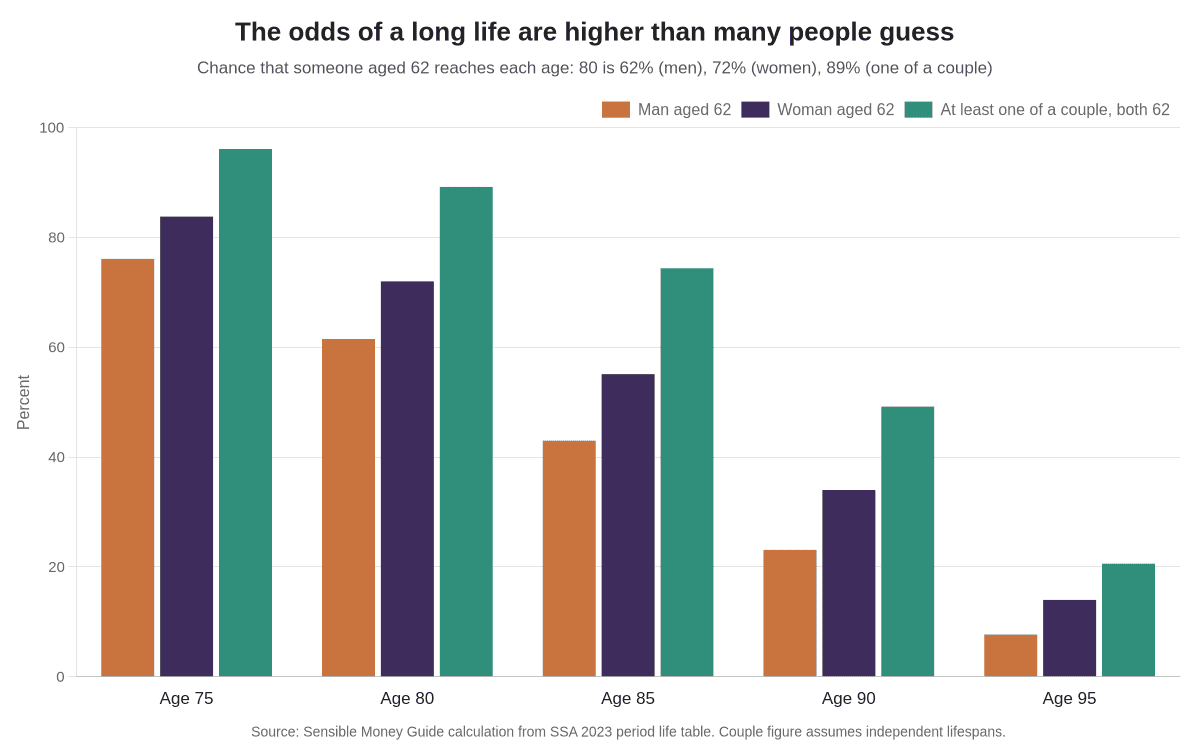
| Reaching age | Man now 62 | Woman now 62 | At least one of a couple, both 62 |
|---|---|---|---|
| 80 | 62% | 72% | 89% |
| 82 | 55% | 66% | 84% |
| 85 | 43% | 55% | 74% |
| 90 | 23% | 34% | 49% |
These are population averages. A period table reflects current death rates, so actual odds could be somewhat higher. The couple figure is for a man and a woman, both 62, and assumes their lifespans are independent. Your own odds may differ. Health matters, and it isn’t evenly spread: in David Blanchett’s analysis of the 2025 EBRI/Greenwald Retirement Confidence Survey, 44% of those who claimed at 62 reported good or excellent health at the time of the survey, compared with 75% of those who claimed at 70.
The couple column is the one many people miss. Even when each person has a modest chance of a long life, the odds that one of you lives to 85 are about three in four. Waiting works a bit like insurance against that outcome. It costs you if you die early, and it pays when money would otherwise be tightest.
“There is no one Social Security claiming age that is right for everyone.”
David Blanchett, head of retirement research at Prudential and a portfolio manager at PGIM, in ThinkAdvisor
Read this before you trust these numbers: Every example assumes a full retirement age of 67 and stays in today’s dollars, with no taxes, Medicare premiums or benefit cuts unless we say so. Some delayed credits aren’t applied until the January after you start, so real checks can lag a little. Treat break-even ages as approximate.
Claim early and invest it? The return you would need
Some people argue for taking the money at 62 and investing it. Ramsey Solutions takes this view, saying that in most cases it makes sense to take benefits sooner, since payments end when you die, and suggesting you invest the checks. T. Rowe Price’s authors reach the opposite view for many retirees. In their hypothetical example of a never-married retiree with $1 million saved, claiming at 70 instead of 62 left about $648,000 at age 90 rather than $363,000, assuming 5.3% yearly returns.
Our own test asks a simpler question: how much would you need to earn on the early checks, after inflation and taxes, to match the person who waited?
| If you live to | 62 vs. 67 | 62 vs. 70 | 67 vs. 70 |
|---|---|---|---|
| 80 | 1.2% | -0.4% | -3.3% |
| 85 | 4.0% | 3.3% | 2.1% |
| 90 | 5.4% | 5.1% | 4.4% |
| 95 | 6.2% | 6.0% | 5.7% |
A negative number means the earlier claimer is still ahead at that age, even with no investment gain. Read across the 90 row: to match waiting from 62 to 70, you’d need to earn about 5.1% a year above inflation and after taxes, every year.
That’s possible with stocks over long stretches, but it isn’t promised. The bigger check from waiting, by contrast, is set by current law and comes with a COLA, though it carries the same funding risk as every check. It also means you’d have to invest every check and not spend it. If you do plan to invest, our guide to how to mix stocks, bonds and cash by age can help you think through the risk.
The reverse: spend savings now to wait
You can also flip the idea and live on savings for a while so you can claim later. T. Rowe Price’s authors say the benefits can justify drawing down savings for several years before 70. Here’s the size of that trade in our example. Going from 67 to 70 means covering $72,000 of checks you skipped ($2,000 × 36 months). In return, you get $480 more a month, or $5,760 a year, for life. That’s a good deal if you live a long time and a poor one if you don’t.
The accounts you draw from matter too. Withdrawals from a traditional account are usually taxed, while qualified Roth withdrawals aren’t. Our guides to how a 401(k) works and Roth vs. traditional IRAs cover those rules.
Married, divorced or widowed: the decision changes
For a couple, the question isn’t really “When should I claim?” It’s “How much will the survivor have?” When one spouse dies, the household loses one check, and the survivor generally keeps about the larger one. It can be somewhat more if the higher earner claimed early, or less if the survivor claims before their own full retirement age. So the larger check is what matters most.
A side-by-side look at one couple
Here’s a hypothetical couple, the same age, with full retirement age amounts of $2,400 and $1,200. All amounts are in today’s dollars. The survivor column assumes the survivor has reached their own full retirement age for survivor benefits.
| Who claims when | Monthly, both alive | Monthly, survivor | Household total if the higher earner dies at 78 and the other at 92 |
|---|---|---|---|
| Both at 62 | $2,520 | $1,980 | $816,480 |
| Both at 67 | $3,600 | $2,400 | $878,400 |
| Higher earner at 70, lower at 62 | $3,816 | $2,976 | $946,944 |
| Higher earner at 70, lower at 67 | $4,176 | $2,976 | $944,064 |
Notice the survivor in the first row gets $1,980, not $1,680. If the worker claimed early, the survivor benefit is limited to the larger of the worker’s reduced benefit or 82.5% of the full amount, and 82.5% of $2,400 is $1,980.
Waiting has its price, though. If the higher earner died at 75 and the other spouse at 78, the household total would be $464,400 for “both at 62” and $416,736 for “higher at 70, lower at 62.” Early deaths favor early claiming. Long lives, especially for one spouse, favor waiting.
“The decision to claim Social Security is as much a personal decision as a financial one.”
Marguerita Cheng, a CFP with Blue Ocean Global Wealth in Potomac, Md., to Kiplinger

Spouse benefits
- A spouse can get up to half of the worker’s full retirement age amount. Since it’s based on that amount, the worker’s delay past full retirement age doesn’t raise it.
- Starting at 62 cuts it further. With a full retirement age of 67, the spouse’s benefit drops 35%, so a $500 benefit becomes $325.
- SSA pays the highest amount you qualify for and doesn’t add your own benefit and the spouse benefit together.
- You generally must be 62 and married for at least a year, unless you’re caring for a qualifying child. The benefit is paid on the record of someone entitled to Social Security.
- Unlike survivors, spouses born January 2, 1954 or later generally can’t take only a spouse benefit while their own benefit grows.
Divorced
Ex-spouses married for at least 10 years may qualify for benefits on a former spouse’s record. You must be at least 62 and not currently married, and if your ex hasn’t filed, the divorce must be at least two years old. And a survivor benefit can also be possible. Those payments don’t count toward the family maximum. Ask SSA to check your record if your own benefit is small.
Widowed
- Survivor benefits generally start at 60, or 50 to 59 with a disability. You generally must have been married for at least nine months, and remarrying before 60 (50 if disabled) generally disqualifies you. Exceptions exist if you’re caring for the child of the person who died.
- Payments start at 71.5% of the spouse’s benefit and can reach 100% at your full retirement age for survivor benefits, 66 to 67.
- You can’t collect both at once, but you can switch. You might start on survivor benefits, then move to your own at 70 when that check is highest. Kiplinger notes the reverse can work too: start on your own and switch to the survivor benefit later.
- Which order wins depends on the two amounts, so ask SSA to show both before you file.
One more thing: if you have a pension from work not covered by Social Security, the Windfall Elimination Provision and Government Pension Offset have ended. Older advice about reduced spouse or survivor benefits for those workers may no longer apply.
If you’re still working
Under full retirement age, the earnings test can hold back part of your check. For 2027, SSA withholds $1 for every $2 you earn above $25,560 ($24,480 in 2026). In the year you reach full retirement age, it’s $1 for every $3 above $67,920 ($65,160 in 2026), counting only earnings before the month you reach that age. Starting that month, earnings no longer reduce your check.
Only wages and net self-employment income count. Pensions, annuities, interest, investment earnings and capital gains don’t.
Worked example: claiming at 62 and earning $40,000
Say a hypothetical worker starts at $1,400 a month and earns $40,000 in 2027, a full year under full retirement age.
- Earnings over the limit: $40,000 − $25,560 = $14,440
- Amount to withhold: $14,440 ÷ 2 = $7,220
- SSA would generally hold back six full checks ($8,400) and pay the extra $1,180 the next year, so the net cost is $7,220
That money isn’t lost. SSA recalculates your benefit at full retirement age to credit the months withheld. With six full months withheld, this worker would be treated as starting at 62½, not 62, which raises the check from $1,400 to $1,450. So the money comes back slowly, over years.
There’s also a special monthly rule that can apply in your first year of retirement, when you may have earned a lot before leaving a job. For 2027, the monthly figure is $2,130 if you’re under full retirement age all year ($5,660 in the year you reach it). Ask SSA about it if you retire partway through a year.

If your earnings will stay well above the limit, claiming may not bring in much cash for now, and it still locks in a lower starting point. Working longer can also help in another way: a high-earning year can replace a lower one if it ranks in your top 35.
Taxes and Medicare: the costs that change the picture
Taxes on your benefits
To see whether benefits are taxed, the IRS has you add half your benefits to your other income, including tax-exempt interest. Up to 50% of benefits can be taxable if that total passes $25,000 for a single filer or $32,000 on a joint return. Up to 85% can be taxable above $34,000 or $44,000. These figures come from IRS Publication 915 for 2025 returns. Married people filing separately who lived together at any time in the year have a base amount of $0.
| Hypothetical household | Half of benefits + other income | Over the base amount? | Benefits subject to tax |
|---|---|---|---|
| Single: $24,000 benefits, $16,000 other income | $28,000 | Yes, by $3,000 | $1,500 |
| Joint: $36,000 benefits, $20,000 other income | $38,000 | Yes, by $6,000 | $3,000 |
| Joint: $36,000 benefits, $30,000 other income | $48,000 | Yes, and over $44,000 | $9,400 |
The last column shows how much is added to taxable income, not the tax itself. Separately, people 65 or older can take an extra deduction of up to $6,000 for tax years 2025 through 2028, or up to $12,000 for a couple when both qualify. Married couples must file jointly to claim it, and it phases out above $75,000 of modified adjusted gross income ($150,000 joint). That’s a deduction, not an exemption, so the benefit tax rules above still apply. Our guide on how federal income taxes work explains how deductions fit in.
Medicare at 65
Medicare has its own clock. Even if you delay Social Security, SSA advises signing up for Medicare at 65. Part B carries a late penalty of 10% for each full year you could have signed up but didn’t, unless you qualify for a Special Enrollment Period, which can apply if you have coverage through current work. Check first.
The standard Part B premium is $202.90 a month in 2026. Higher-income people pay more, starting above $109,000 ($218,000 joint). As of November 2, 2026, CMS hadn’t announced the 2027 figure. If you’re delaying Social Security, you pay premiums separately, while people already getting checks commonly have them taken out.
That flat premium weighs more on a small check. It takes about 14.5% of a $1,400 check but about 8.2% of a $2,480 one. After Part B, those two checks are $1,197 and $2,277 a month.
If you use a health savings account, plan ahead. Once you get Social Security at 65 or later, you generally get Part A too, and Medicare says to stop HSA contributions six months before you apply, because Part A can be backdated up to six months. If you start before 65, you’re generally enrolled automatically at 65. Our HSA rules guide has the details.
Should the trust fund change your plan?
This is the fear that pushes many people to claim early. In one adviser survey reported by Newsweek, 73.5% said client fears of cuts were motivating people to file early. So let’s look at what’s actually projected.
The 2026 Trustees report projects the retirement trust fund (OASI) will run out of reserves in the fourth quarter of 2032, when incoming money would cover 78% of scheduled benefits. If the retirement and disability funds were combined, that date moves to the third quarter of 2034, at 83%. The Congressional Research Service notes the combined figure falls to 65% by 2100, and the Trustees project the retirement fund’s payable share will decline to 62% by 2100. These are projections under current law, and Congress could change them.
We tested it: what a 22% cut does to break-even
Say every check were cut 22% starting in October 2032 and stayed there for life. That’s a simplified assumption for illustration, not a forecast. A person turning 62 in January 2027 who claimed early would collect full checks for nearly six years before the cut, so early claimers do get an edge. Here’s how big it is:
| Choice | No cut | 22% cut, turning 62 in Jan. 2027 | 22% cut, turning 62 in Jan. 2032 |
|---|---|---|---|
| 62 vs. 67 | About 79 | About 82 | About 79 |
| 62 vs. 70 | About 80½ | About 82½ | About 80½ |
| 67 vs. 70 | About 82½ | About 83½ | About 82½ |
The break-even age moves about one to three years for someone turning 62 now, and hardly at all for someone turning 62 just before the shortfall. Our test assumes the cut applies equally to every check; current law doesn’t spell out how a shortfall would be handled. On that assumption, the early claimer’s only edge is the uncut checks collected first. A common version of this math, like the U.S. News example, compares a cut check at 70 with an uncut check at 67. That can make waiting look worse than it would if both were cut.
Claiming early also doesn’t protect you. If a cut did come, the early claimer’s lower check would be cut too: in our example, $1,400 would become about $1,092, while $2,480 would become about $1,934.
“The real danger here is making a short-term decision that can have drastic long-term consequences.”
Drew Powers, founder of Illinois-based Powers Financial Group, to Newsweek
Myths vs. facts
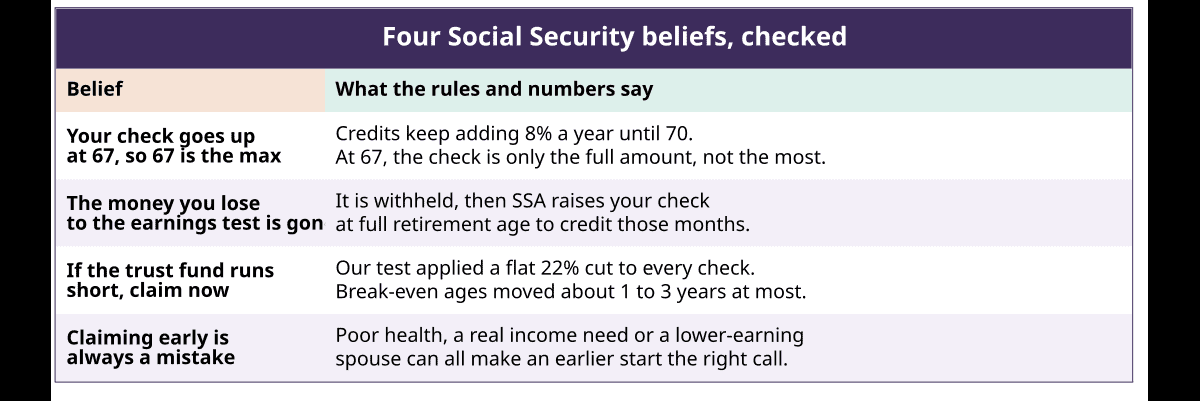
- Myth: 67 is the highest check. Fact: Credits keep adding until 70.
- Myth: Benefits withheld by the earnings test are gone. Fact: SSA raises your check at full retirement age to credit those months, though it takes time to get the value back.
- Myth: You should wait past 70 for more. Fact: Credits stop at 70, so there’s nothing to gain by waiting longer.
- Myth: Delaying Social Security means delaying Medicare. Fact: They’re separate decisions. Check your Part B timing at 65.
- Myth: Claiming early is always a mistake. Fact: Sometimes it’s the right call. See the table at the top of this guide.
What the experts say
Professionals don’t fully agree here, and it helps to see why. The authors below are looking at different groups of people.
“When you model the alternatives, delaying Social Security is a best practice that can benefit a majority of retirees.”
William Reichenstein, Ph.D., Thought Leadership Director, and Stuart Ritter, CFP®, Insights Director, at T. Rowe Price
Blanchett, quoted above, also says delayed claiming is typically the smart move, but his research adds a twist. He writes in ThinkAdvisor that once longevity is factored in, many who claim earlier could be making the “right” decision from an expected value view. In other words, some early claimers may simply know something about their own health.
Ramsey Solutions goes further and leans toward claiming early and investing, as noted above. That view depends on how the money gets invested and how long you live. Schwab puts the decision on your cash needs, life expectancy, marital status and job.
For a second explanation, this video from Stephen Spicer, a CFP, covers three factors in the decision. Rules and dollar figures in any video may be older than the ones in this guide.
If you change your mind
Claiming isn’t always final, but your options shrink quickly.
- Within 12 months: You can withdraw your application within 12 months of your first month of entitlement, and only once. You must repay all benefits paid on that application, and anyone else getting benefits on your record must agree in writing. Form SSA-521 is the form to use.
- At full retirement age to 70: You can ask SSA to suspend benefits. You earn credits for those months, and checks restart by 70. While suspended, you must pay Part B premiums directly, and missing them can cost you coverage. Anyone getting benefits on your record is suspended too, except a divorced spouse, and you can’t collect on someone else’s record during that time.
- Applying late: Benefits at or after full retirement age may be paid for up to six months back. A lump sum may be welcome, but those months then earn no credits, so your monthly check is lower than it would be. Back payments for months before full retirement age generally aren’t allowed if they would permanently reduce your benefit.
Your checklist before you file
- Sign in to my Social Security and check your earnings record for errors.
- Write down your estimates at 62, your full retirement age and 70. Use your statement instead of the $2,000 example here.
- Try SSA’s quick calculator if you want to test a different stop-work date.
- List your monthly bills. How much would you need from savings to wait one, three or five more years?
- Be honest about health and family history for both of you, not just the older spouse.
- If married, compare the survivor’s income under each plan, not just the income while you’re both alive.
- If you’ll still work, compare your wages with the earnings limit for the year.
- Set a Medicare date for 65 no matter when you claim, unless you have qualifying coverage through current work.
- Get a second opinion on the complex parts, such as a divorce or survivor switch, from SSA or a fee-only adviser.

The short version
- You can start any month from 62 to 70, and with a full retirement age of 67, the age 70 check is about 77% larger than the age 62 check.
- Break-even ages run about 79 to 82½ with no investing, and later if the early checks earn a real return.
- A man now 62 has about a 62% chance of reaching 80, and a woman about 72%. At least one of a couple has about 89%.
- In a couple, the higher earner’s claiming age usually matters most, since that check tends to become the survivor benefit.
- Under full retirement age, the earnings test can hold back benefits, but withheld months are credited back later.
- A projected shortfall shouldn’t scare you into claiming. In our test, a flat 22% cut moved break-even ages by about one to three years for someone turning 62 now.
- Needing the money or having poor health are real reasons to claim earlier. Waiting isn’t right for everyone.
Questions people ask
What is the best age to claim Social Security?
There isn’t one for everyone. Waiting tends to pay if you’re healthy, can cover your bills, and especially if you’re the higher earner in a couple. Earlier can be right if you need the income or expect a shorter life.
How much do I lose by claiming at 62?
If your full retirement age is 67, your check is 30% lower for life, before COLAs. A $2,000 full amount becomes $1,400. COLAs still apply to the lower amount.
Does my benefit keep growing after 70?
Not from delayed credits. They stop at 70, so waiting longer doesn’t raise your check. COLAs and a high-earning year can still affect it.
Can I work and collect Social Security at the same time?
Yes. Before full retirement age, earnings above the limit can hold back benefits ($25,560 for 2027). From the month you reach that age, your earnings don’t reduce your check.
Is Social Security taxed?
It can be at the federal level. Up to 85% of benefits can be taxable, depending on your other income, based on IRS Publication 915. Some states may also tax benefits, so check your state’s rules.
Can my spouse claim on my record if I haven’t filed?
Generally no. Spouse benefits are for the spouse of someone entitled to retirement or disability benefits. SSA can tell you how this applies to you, including rules for ex-spouses, who are treated differently.
Should I claim early because Social Security is running out of money?
We wouldn’t make that the main reason. Current projections show incoming money would still cover 78% to 83% of scheduled benefits at first, declining over time, not zero, and Congress could still act. A cut would also shrink an early claimer’s check.
Can I undo my decision to claim?
Yes, within limits. You can withdraw within 12 months of first being entitled, once, if you repay what you and anyone on your record received. After full retirement age you can suspend until 70 to earn credits.
One thing to do this week
Sign in to my Social Security and write down your three estimates: 62, full retirement age and 70. Then use the tables above with your own numbers. If you’re married, do it for both of you and compare the survivor’s income under each plan.
About this guide
Published by Daniel Brienza, founder and editor of Sensible Money Guide (B.S. in Business Administration, University of South Florida). This guide was researched and drafted with the help of AI tools, fact-checked against the primary sources listed below, and reviewed and edited by Daniel before publishing. Daniel is not a licensed financial advisor; this guide is for general education.
Written November 2, 2026. Facts and figures are based on data available on that date.
Sources
Government and official sources
- Social Security Administration, 2027 Cost-of-Living Adjustment (COLA) Fact Sheet, accessed November 2026.
- Social Security Administration, Benefits Planner: Retirement | Retirement Age and Benefit Reduction, accessed November 2026.
- Social Security Administration, Benefits Planner: Retirement | Delayed Retirement Credits, accessed November 2026.
- Social Security Administration, Early or Late Retirement, accessed November 2026.
- Social Security Administration, Benefits Planner: Retirement | Receiving Benefits While Working, accessed November 2026.
- Social Security Administration, How Work Affects Your Benefits (EN-05-10069), 2026.
- Social Security Administration, What you could get from Family benefits, accessed November 2026.
- Social Security Administration, Who can get Family benefits, accessed November 2026.
- Social Security Administration, What you could get from Survivor benefits, accessed November 2026.
- Social Security Administration, Who can get Survivor benefits, accessed November 2026.
- Social Security Administration, POMS RS 00615.320, Reduced WIB: Deceased NH Entitled to Reduced RIB or Reduced DIB Prior to Death (RIB LIM), accessed November 2026.
- Social Security Administration, Actuarial Life Table (2023 period life table), 2026 Trustees Report.
- Social Security Administration, Annual Statistical Supplement 2026, Table 6.B5, 2026.
- Social Security Administration, A Summary of the 2026 Annual Reports, 2026.
- Social Security Administration, Social Security Handbook § 1513, Retroactive Effect of Application, accessed November 2026.
- Social Security Administration, Social Security Fairness Act: Windfall Elimination Provision (WEP) and Government Pension Offset (GPO) update, accessed November 2026.
Other government sources
- Social Security Administration, Code of Federal Regulations § 404.640, Withdrawal of an application, accessed November 2026.
- Congressional Research Service, Social Security: Selected Findings of the 2026 Annual Report, June 25, 2026.
- Centers for Medicare & Medicaid Services, 2026 Medicare Parts A & B Premiums and Deductibles, November 14, 2025.
- Medicare.gov, Avoid late enrollment penalties, accessed November 2026.
- Medicare.gov, Working past 65, accessed November 2026.
- Social Security Administration, FAQ on suspending retirement benefits, accessed November 2026.
- Social Security Administration, Social Security blog, October 27, 2026, on benefits for divorced spouses.
- Social Security Administration, More Info: If You Are Eligible To Receive A Retirement Benefit And A Spouse’s Benefit, accessed November 2026.
- Internal Revenue Service, Publication 915, for 2025 returns.
- Internal Revenue Service, Is Social Security Taxable? video script, reviewed October 16, 2026.
- Internal Revenue Service, Working Families Tax Cuts: Tax deductions for working Americans and seniors, accessed November 2026.
Banks, investment firms and research
- T. Rowe Price, How prioritizing Social Security timing can provide a stronger retirement, March 2025.
- Charles Schwab, Guide on Taking Social Security: 62 vs. 67 vs. 70, June 12, 2026.
- Experian, When Should You Take Social Security?, June 15, 2026.
News and personal finance media
- Kiplinger, Eight Strategies for Deciding When to File for Social Security, updated January 9, 2026.
- ThinkAdvisor, How Health Influences Social Security Claiming, by David Blanchett, December 8, 2025.
- Newsweek, Social Security warning: Advisers sound alarm on potential benefit cuts, September 11, 2026.
- U.S. News via WTOP, How to Calculate Your Social Security Break-Even Age, July 13, 2026.
- Ramsey Solutions, How Does Social Security Work? 14 Common Questions, updated April 11, 2025.
- Journal of Accountancy, How to reverse course on collecting Social Security, March 21, 2023.
This article is for educational purposes only and isn’t financial advice. Consider talking with a qualified professional about your situation.


Beneficiary Designations: How to Name, Check and Update Them

Term Life Insurance: How Much You Need and What It Costs

How to Start Investing: Accounts, First Buys and Real Risks

Student Loan Repayment Plans: RAP vs. IBR vs. Standard

When to Claim Social Security: Ages, Math and Trade-Offs

Credit Report Errors: How to Find, Dispute and Fix Them
Student Loan Repayment Plans: RAP vs. IBR vs. Standard
Beneficiary Designations: How to Name, Check and Update Them
How to Start Investing: Accounts, First Buys and Real Risks
You must be logged in to post a comment Login